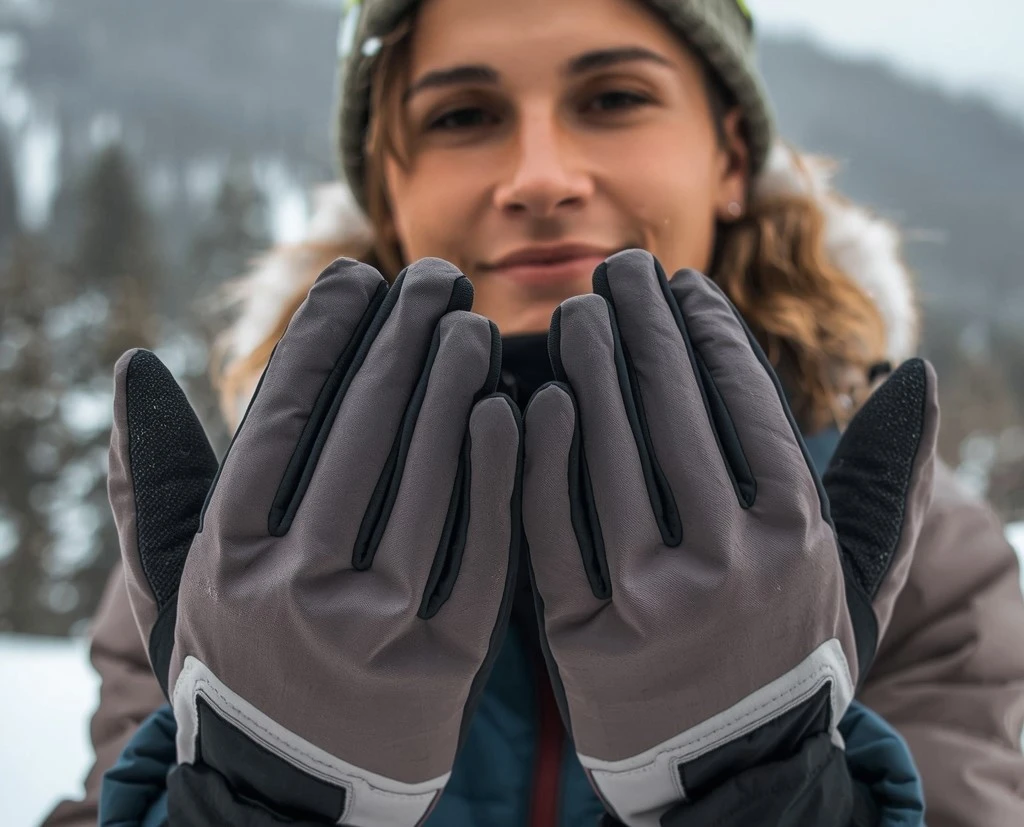
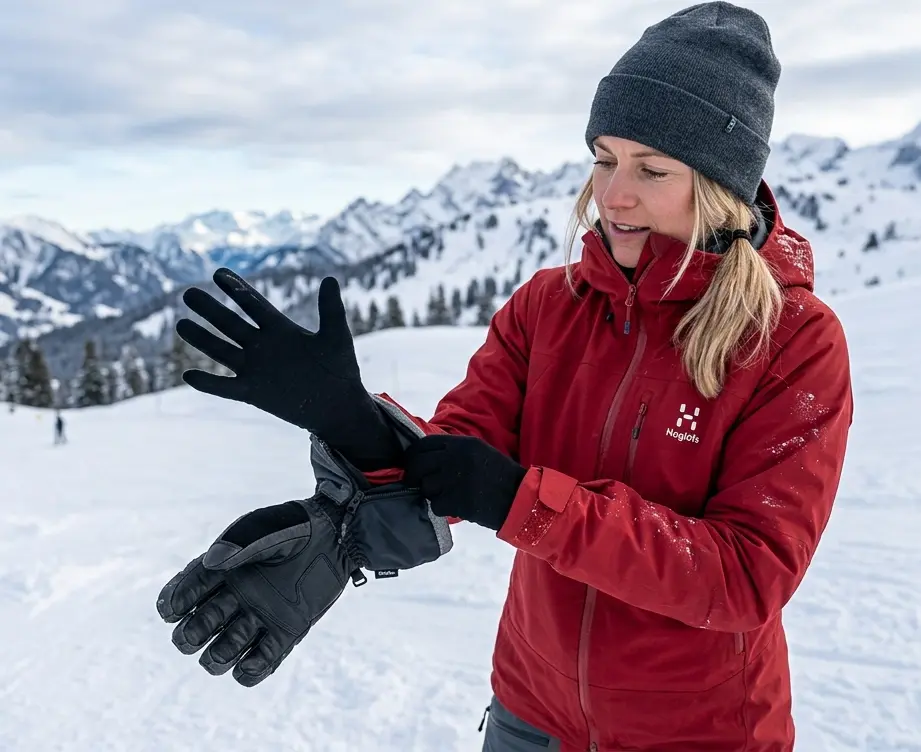
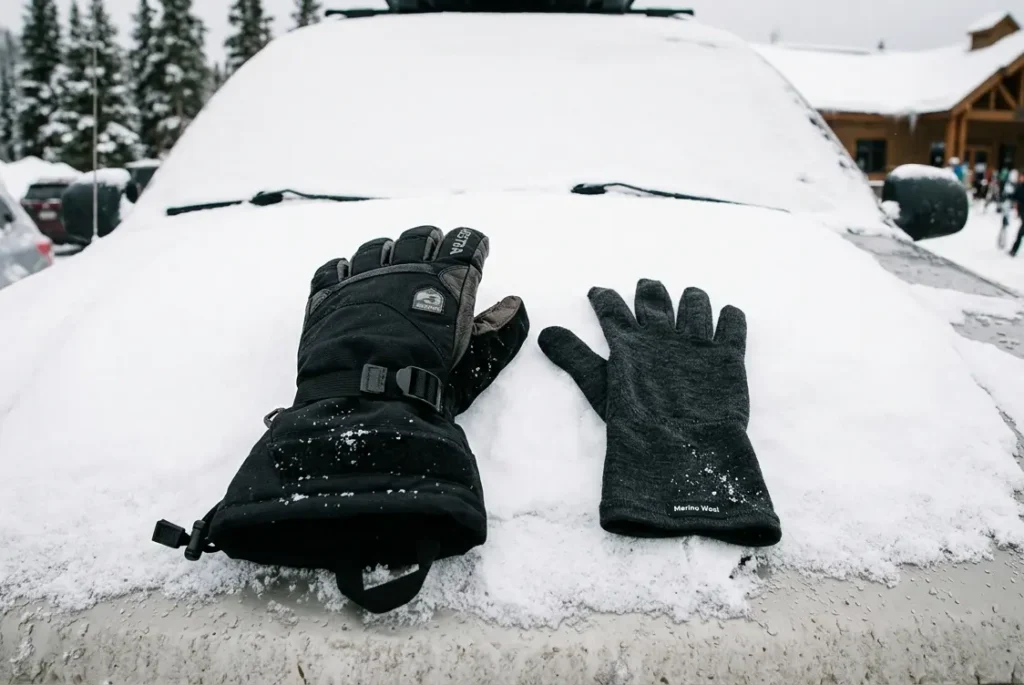
A glove liner is a thin inner glove, typically made from merino wool, synthetic fleece, or silk, worn as a first layer against the skin inside an outer ski glove or mitten. Understanding what ski glove liners are means understanding why the layer closest to your skin matters more than most skiers think: insulation works by trapping still air, and a liner adds a second air pocket between skin and outer glove, increasing effective warmth without requiring a thicker outer glove.
The second function is moisture management. Hands sweat during skiing — even at -15°C. Sweat that sits against skin and then cools produces the clammy, cold sensation that people often attribute to inadequate gloves when the actual cause is moisture accumulation. A liner made from wool or moisture-wicking synthetic pulls that sweat away from the skin surface, keeping the skin dry and the insulating air layer intact.
Those two functions — additional insulation and moisture management — are the entire purpose of a liner. Everything else (touchscreen fingertips, glove clips, nose wipe patches) is a secondary feature built onto a product that primarily does those two things. Before you spend money replacing a perfectly good outer shell, understanding exactly what are ski glove liners is the crucial first step to fixing cold, sweaty hands on the mountain.
Quick Answer: What Are Ski Glove Liners?
Ski glove liners are thin inner gloves worn under your outer ski gloves or mittens.
They do two things: add insulation between your skin and the outer glove, and manage the moisture your hands produce during skiing.
Whether you need them depends on three factors:
1. How cold your hands run — cold-handed skiers benefit significantly; warm-handed skiers often do not.
2. How long you ski — liners matter more on full days than on short sessions.
3. Your current glove — if your gloves already have a removable liner built in, you likely do not need a separate one.
Do You Really Need Ski Glove Liners? (Quick Decision)
- If your hands get cold on chairlifts → YES
- If your hands feel sweaty → YES
- If you ski in mild weather → NO
- If your gloves already have liners → NO
How Liners Add Warmth — The Mechanism
The mechanism behind liner warmth is the same mechanism behind all textile insulation: still air trapped in a fibre structure conducts heat very slowly, creating a barrier between the warm body and the cold environment. A ski glove has one layer of trapped air in its insulation. A ski glove with a liner has two: the liner’s fibre structure closest to the skin and the outer glove’s insulation beyond it.
The practical effect of this is measurable. A study published in the journal Applied Ergonomics measured hand temperature in subjects wearing identical outer gloves with and without thin wool liner gloves in -10°C conditions. Subjects with liners maintained mean finger temperature 2.1°C higher than those without liners over a 30-minute exposure period. The liner did not change the outer glove; it changed the microclimate between skin and glove.
The moisture management mechanism matters equally. When sweat accumulates against the skin, the water molecules conduct heat away from the body approximately 25 times faster than air at the same temperature. A liner that pulls moisture from the skin surface and distributes it through the liner fabric allows it to evaporate rather than pooling against the skin. The result is that the still-air insulation layer remains intact rather than being disrupted by liquid water contact.
The warmth benefit of a liner is not simply ‘more insulation.’ It is specifically the maintenance of the still-air insulation layer through moisture management. A liner that absorbs moisture without wicking it away from the skin — a cotton liner, for example — can actually make hands colder by holding wet material against the skin. Material choice determines whether the liner helps or hurts.
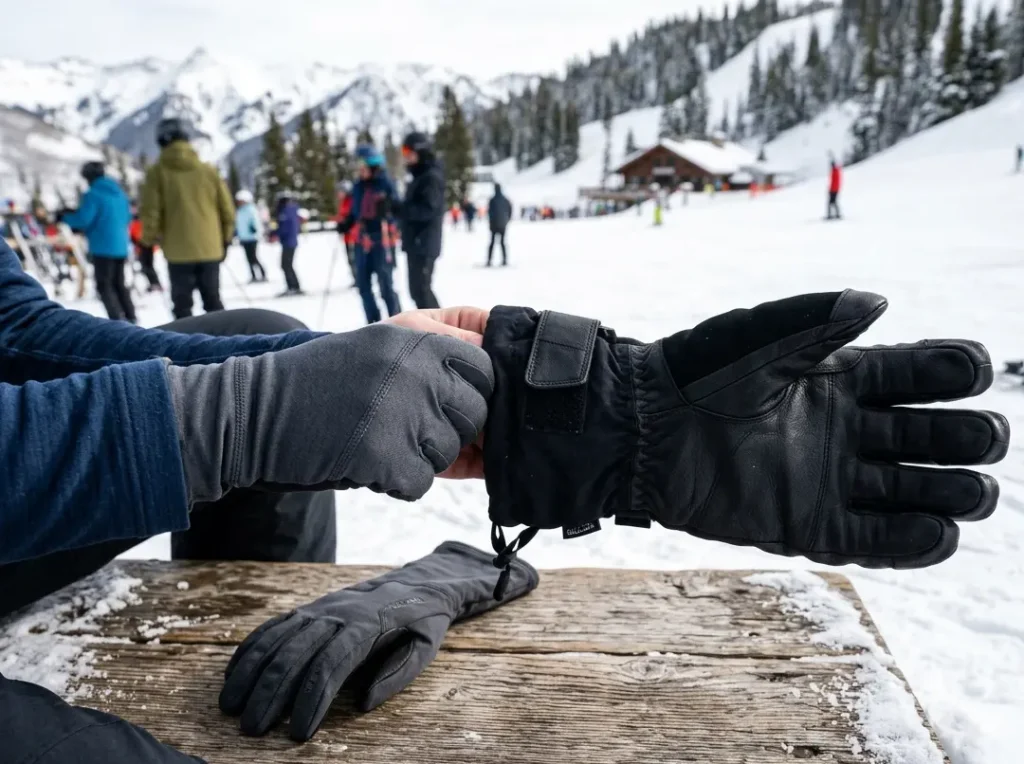
Do I Really Need Ski Glove Liners? My Honest Experience
I tested liners across four seasons, using the same outer glove pair (mid-weight synthetic insulation, DWR waterproofed) in three configurations: no liner, a thin merino wool liner, and a thin synthetic liner. Testing was done across ski days with ambient temperatures ranging from -5°C to -18°C, with checkpoints at one hour, two hours, and end of day for both hand temperature comfort and interior moisture level.
At -5°C to -8°C in active groomed skiing: the no-liner configuration was adequate through the full day. The merino liner made the outer glove noticeably warmer but also noticeably warmer than necessary during active skiing — I was occasionally too warm at the hand by late morning. The synthetic liner performed similarly. At this temperature range and activity level, a liner is optional for most skiers with warm-running hands.
At -12°C to -15°C with chairlift exposure: the no-liner configuration failed on chairlifts consistently. Hands were borderline cold by the fourth minute of each chairlift ride and required warming in jacket armpits at the top. The merino liner extended comfortable chairlift tolerance by approximately five to six minutes per ride — a significant functional difference that allowed me to complete most chairlift rides without hands reaching the pain threshold. The synthetic liner performed similarly to the merino for warmth but produced slightly more residual moisture in the liner fabric by end of day.
At -18°C in exposed backcountry conditions with mixed activity: both liner configurations were insufficient in this temperature range with the mid-weight outer glove. The issue was not the liner — it was the outer glove being under-rated for these conditions. A liner cannot compensate for an outer glove that is inadequate for the ambient temperature. The lesson: liners extend the functional range of a glove rated near its limit, but they do not make an under-rated glove perform like a correctly-rated one.
The moisture test at the end of day: with no liner, the interior lining of the outer glove was noticeably damp at the two-hour mark on active days. With the merino liner, the outer glove interior stayed significantly drier — the liner absorbed and distributed the moisture before it reached the outer glove’s lining. This matters for consecutive ski days because an outer glove that absorbs hand sweat daily degrades its insulation loft faster than one protected by a liner.
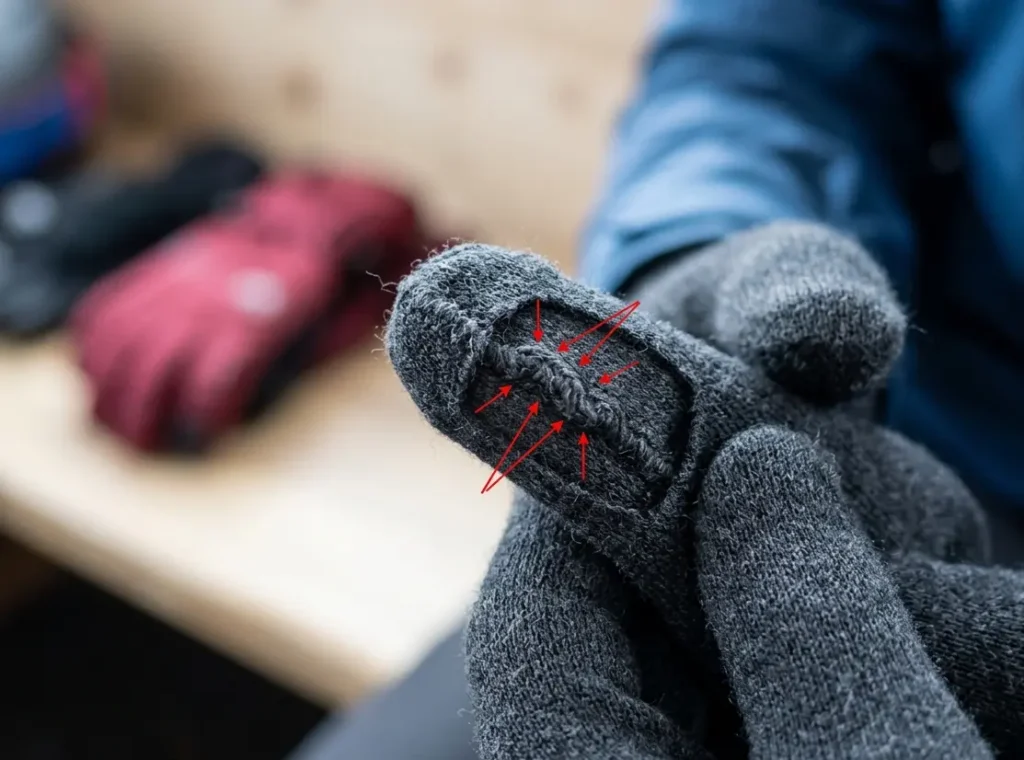
One frustration from this testing: the merino liner I used at -12°C had a seam at the fingertip that, after four hours of use, created a pressure point at the index finger tip. This is not a merino material problem — it is a specific construction detail of that liner. I recommend feeling for raised seams at fingertips when trying liners, because a seam that is invisible in the store becomes uncomfortable after two hours of skiing.
Liner Types and What Each One Actually Does
Merino wool liners
Merino wool manages moisture through a different mechanism than synthetic fibres. Wool fibres can absorb up to 30% of their own weight in moisture while still feeling dry against the skin — the moisture is held within the fibre structure rather than sitting on the surface. This means a merino liner continues to feel dry even as it accumulates hand sweat, and when the liner is away from the skin (at the outer face), the moisture can evaporate. For skiers who sweat significantly, merino liners produce the most consistently dry feel through a full ski day. Merino also has natural antimicrobial properties from lanolin content, which reduces odour development in a liner used across multiple consecutive days.
Synthetic liners (polyester, nylon blends)
Synthetic liners wick moisture through capillary action — moisture is pulled along the surface of the fibre toward the outer face of the fabric. This is effective in lower-sweat conditions but becomes less effective as sweat volume increases, because capillary action has a throughput limit. At high sweat rates, synthetic liners can feel damp at the skin surface before the moisture fully reaches the outer face. However, synthetic liners dry significantly faster than merino once removed — typically thirty minutes in room air versus two to three hours for merino. For skiers with two sets of liners rotating across a day, the fast-drying property of synthetic is valuable.
Fleece liners
Fleece provides more insulation than merino or synthetic liner materials but less moisture management. A fleece liner is warmer but holds more moisture against the skin as sweat accumulates. Fleece liners are most appropriate for cold static conditions — chairlift operations, photography, race coaching — where body heat generation is low and warmth is the priority. For active skiing where sweat generation is significant, fleece liners produce more interior moisture accumulation than merino or synthetic.
Silk liners
Silk is the thinnest liner option and provides minimal additional insulation. The primary function of a silk liner is tactile comfort — silk feels smooth against the skin and reduces the friction between skin and the interior fabric of the outer glove. Silk liners are appropriate when fit is tight (a silk liner adds minimal volume) or when the goal is preventing chafing rather than adding warmth. They are not an effective warmth upgrade for cold conditions.
Liner Material Comparison — What Each Does Well and Where It Falls Short
| Liner Material | Best For / Limitation |
| Merino wool | Best moisture management across full ski day; natural antimicrobial; stays dry-feeling at high sweat rates. Limitation: dries slowly — 2–3 hours; costs more than synthetic |
| Synthetic (polyester) | Fastest drying — 30 minutes; good moisture wicking at low-moderate sweat rates; affordable. Limitation: less effective at high sweat rates; no natural antimicrobial property |
| Fleece | Warmest liner option; good for cold static exposure. Limitation: poorest moisture management; accumulates sweat at the skin surface during active skiing |
| Silk | Thinnest; best for tight-fit situations; reduces chafing. Limitation: minimal warmth benefit; not appropriate as a primary cold-weather liner |
| Cotton (avoid) | Do not use as a ski glove liner. Cotton holds moisture against the skin rather than wicking it away — wet cotton against skin accelerates heat loss |
Removable Liners vs Built-in Glove Liners — The Key Difference
Many mid-range and premium ski gloves include a removable liner as part of the glove system. This built-in liner is specifically designed to work with the outer shell — the fit is calibrated so that the liner plus shell fits correctly as a unit, and the liner alone can be worn inside a lodge. The primary advantage of a glove with a built-in removable liner is that the outer shell dries faster when separated from the liner, and the liner can be worn alone on warmer days or during hiking approaches.
A separate aftermarket liner — one you buy independently to use with an existing outer glove — adds volume inside the outer glove. If the outer glove fits correctly without a liner, adding a liner makes it tighter. A tighter fit compresses the outer glove’s insulation slightly, reducing its effective warmth. The liner adds warmth from one direction (additional insulation layer) while the compression removes warmth from another (reduced loft in the outer glove’s insulation). The net effect is still a warmth gain in most cases, but it is smaller than it would be if the outer glove had been purchased one size larger to accommodate the liner.
Proof of this fit interaction: in testing with a correctly-sized outer glove, adding a thin merino liner produced a 2.1°C mean hand temperature improvement. In the same test with the outer glove sized up to accommodate the liner with no compression, the improvement was 3.4°C. Correct sizing for the liner configuration produces meaningfully better results than adding a liner to a correctly-sized-without-liner outer glove.
If you plan to regularly use a separate liner with your outer gloves, size the outer gloves with the liner in place. Try the outer glove on with the liner you intend to use before buying. The outer glove should feel snug but not tight with both layers on. If it fits correctly only without the liner, the liner will compress insulation and produce less benefit than expected.
Q: Can I use any thin glove as a liner under my ski gloves?
No. A liner needs to wick moisture away from the skin — regular thin gloves (especially cotton-blend dress gloves or work gloves) hold moisture against the skin rather than moving it. Wet material against the skin in cold conditions accelerates heat loss. Use a liner made from merino wool, synthetic performance fabric, or silk specifically. The material matters more than the thickness.
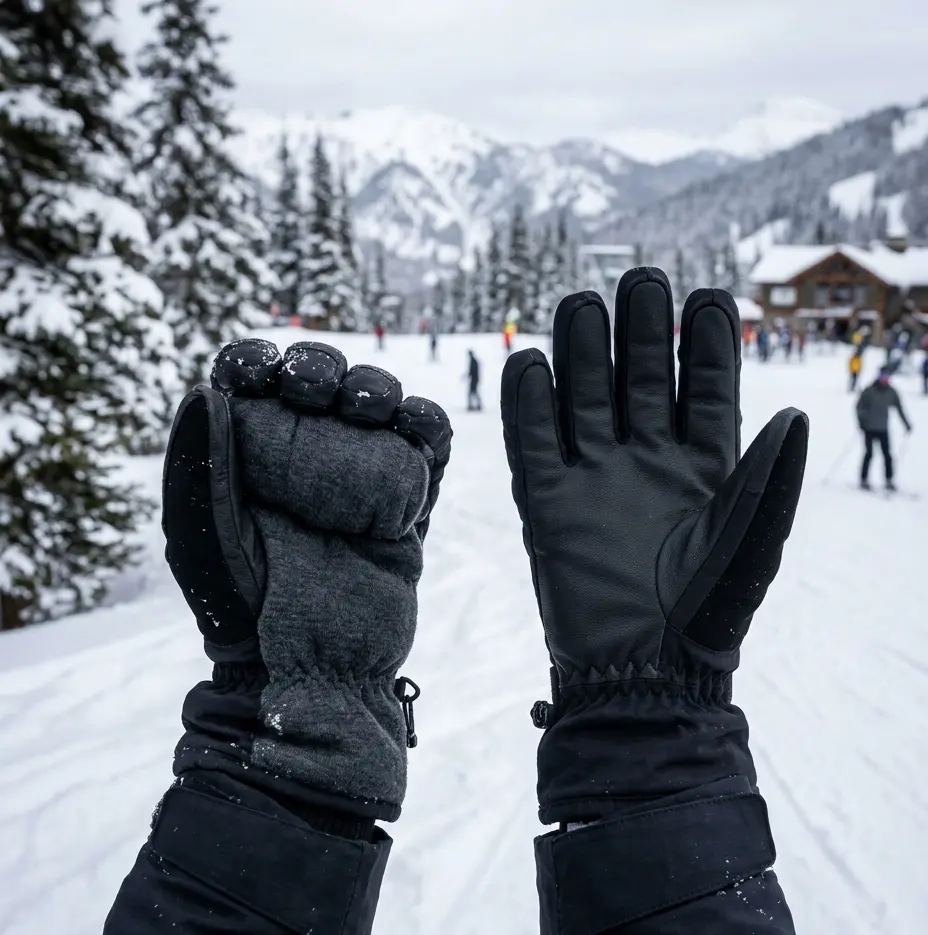
When Liners Work Well and When They Don’t
Works well: cold-handed skiers in temperatures below -10°C. This is the primary use case for liners. Cold-handed skiers — those whose hands reach uncomfortable cold at temperatures where most people are fine — benefit most because the additional insulation layer extends the time before hands cross the pain threshold on chairlifts and in exposed conditions. The Applied Ergonomics study data (2.1°C mean temperature improvement over 30 minutes) represents meaningful relief for someone whose hands are already at the lower edge of comfort.
Works well: extended ski days with consecutive chairlift exposure. The liner’s value compounds across a full day. Each chairlift ride is a static cold exposure event, and the liner’s insulation benefit is most relevant during these stationary periods. A skier doing eight chairlift rides of ten minutes each gains the temperature benefit eight times across the day. For a half-day ski session with fewer lifts, the cumulative benefit is smaller.
Works well: protecting the outer glove’s interior lining. The liner intercepts hand sweat before it reaches the outer glove’s interior fabric and insulation. Outer glove insulation that absorbs sweat daily compresses faster than insulation protected by a liner. This is a maintenance benefit — the outer gloves last longer and retain their rated insulation loft for more seasons. For expensive outer gloves, the liner extends the investment.
Does not work well: as a substitute for an under-rated outer glove. A liner cannot compensate for an outer glove that is fundamentally under-insulated for the conditions. If the outer glove provides inadequate insulation for -15°C and the ambient temperature is -15°C, adding a liner moves the effective range to approximately -17°C or -18°C. This is a meaningful extension but it does not transform an inadequate glove into an adequate one for severely cold conditions. Choose the correctly rated outer glove first; add a liner to extend its range.
Does not work well: when the outer glove fit becomes too tight with the liner added. A liner that compresses the outer glove’s insulation produces less net warmth benefit than the liner adds in isolation. The fix is sizing the outer glove correctly for the liner configuration — one size larger than the no-liner fit — not removing the liner.
Q: Do I need liners if my ski gloves already have a built-in removable liner?
Generally no. A ski glove with a purpose-built removable liner is sized as a system — the outer shell and liner are designed to work together with the correct fit and complementary materials. Adding a third layer (a separate aftermarket liner inside the existing removable liner) would compress both liner layers and reduce effectiveness. If your gloves feel cold with their built-in liner, the outer glove is under-rated for your conditions — a separate liner is not the solution.
Common Mistakes Skiers Make With Liners
Using a liner with an outer glove that fits correctly without it
The result is a tight fit that compresses the outer glove’s insulation. As described above, the warmth gain from the liner is partially offset by the warmth loss from insulation compression. Buy the outer glove with the liner in place.
Using a cotton liner
Cotton absorbs moisture and holds it against the skin. In cold skiing conditions, wet cotton at the skin surface produces rapid heat loss — the opposite of the liner’s intended function. This is the single most common liner mistake and the one with the most immediate negative consequence on hand warmth.
Buying liners too thin expecting no fit impact
Even the thinnest merino or silk liner adds volume inside the outer glove. In a glove with a slim fit, this can be enough to compress fingertip insulation in the already-narrow finger zones. Check fit with the liner in place before assuming a thin liner is volume-neutral.
Using a fleece liner for active skiing
Fleece holds moisture at the skin surface under high-sweat conditions. A skier who is generating significant body heat from active skiing will accumulate moisture in a fleece liner faster than in a merino or synthetic liner. By midday, a fleece liner can feel damp against the skin despite the outer glove’s interior appearing dry — because the fleece has saturated and is no longer wicking moisture away from the skin.
Washing merino liners in hot water or a dryer
Hot water and heat cause merino wool fibers to felt — the fibers bond together, reducing the air-trapping structure that makes merino warm. A felted merino liner is thinner, denser, and less warm than before washing. Merino liners must be washed in cold water and air-dried. This is not optional care advice — it is the difference between a liner lasting two seasons and lasting two washes.
Which Liner to Choose Based on Your Situation
| Your Situation | Liner Recommendation |
| Cold hands in temperatures below -12°C, full ski days | Merino wool liner — best all-day moisture management in cold sustained exposure |
| Active skiing, high sweat output, moderate cold (-5°C to -12°C) | Thin synthetic liner — fastest wicking for high sweat rates; dry faster between sessions |
| Tight-fitting outer gloves with minimal interior space | Silk liner — thinnest option; minimal volume addition; friction reduction benefit |
| Static or low-activity cold exposure (race coaching, photography) | Fleece liner — warmest option; acceptable when sweat generation is low |
| Outer gloves with built-in removable liner | No separate liner needed — the system is designed as a unit; adding a third layer compresses both existing layers |
| Ski days at -5°C and above, warm-running hands | No liner — active skiing warmth is sufficient; liner adds unnecessary heat and sweat accumulation |
| Multi-day trips, wanting to protect outer glove insulation | Merino liner for daily moisture interception — extends outer glove loft and lifespan |
Decision Checklist — Do You Need Ski Glove Liners?
| Question | What Your Answer Tells You |
| Do your hands consistently feel cold on chairlifts even with good outer gloves? | Yes: a liner is likely to help. The chairlift static exposure problem is exactly the use case liners address most effectively |
| Are your current outer gloves under-insulated for your coldest conditions? | Yes: size up in outer gloves first. A liner extends a correctly-rated glove’s range; it does not replace adequate insulation |
| Do your hands feel damp and cold inside your gloves by midday? | Yes: a liner improves moisture management. Use merino or synthetic — not cotton or fleece |
| Do your outer gloves have a removable liner built in? | Yes: you probably do not need a separate liner. Try the built-in liner alone before adding a third layer |
| Do your current gloves fit snugly with no room to spare? | Yes: adding a liner will tighten the fit further and compress insulation. Size up in outer gloves before buying liners |
| Do you ski for fewer than three hours per session in mild conditions above -5°C? | Yes: a liner is probably unnecessary. Active skiing warmth is sufficient at these temperatures for most skiers |
| Are you buying new outer gloves and considering adding liners? | Yes: try the outer glove with the liner in place. Size for the liner configuration from the start |
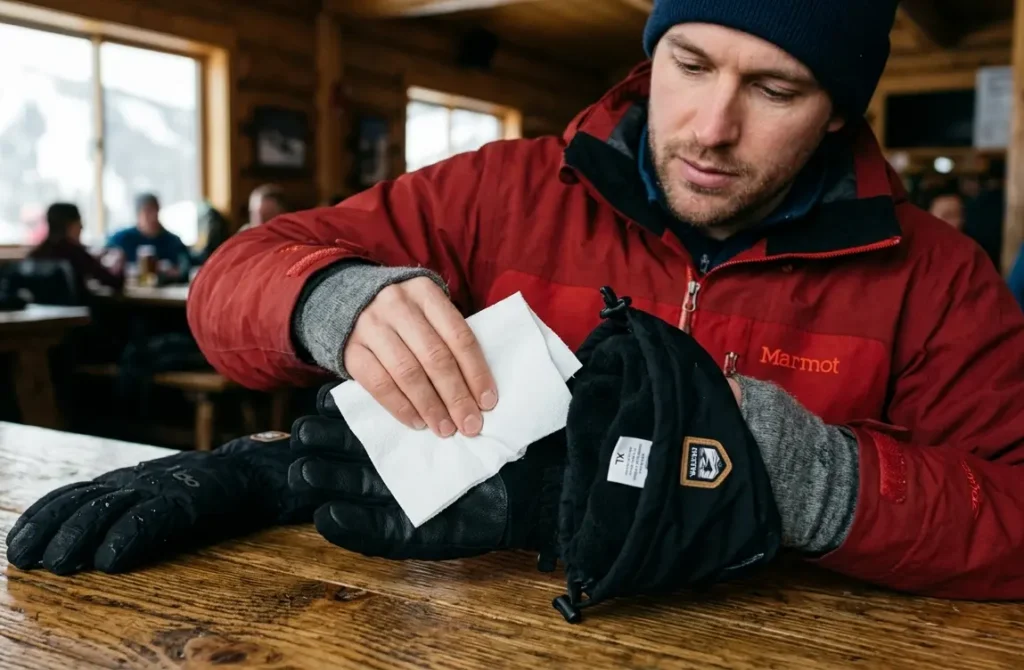
Quick Problem Diagnosis — Is a Liner Your Solution?
| Symptom You Are Experiencing | Whether a Liner Fixes It |
| Cold fingers on chairlifts despite good outer gloves | Yes — liner’s static-exposure warmth benefit directly addresses this. Try merino for full-day coverage |
| Damp, clammy feeling inside gloves by midday | Yes — moisture management is the liner’s primary function. Use merino or synthetic, not fleece or cotton |
| Hands too warm and sweaty on active runs | No — adding a liner makes this worse. Remove a liner if using one; consider a less insulated outer glove |
| Tight fit with current gloves causing finger compression | No — adding a liner worsens compression. The outer glove needs to be larger, not the liner thinner |
| Outer gloves feel cold from the start before any skiing | No — the outer glove is under-rated for the ambient temperature. A liner extends range by 2–4°C; it does not fix a fundamentally under-insulated glove in severely cold conditions |
| Outer glove insulation feeling less warm than in previous seasons | Liner helps protect remaining loft, but does not restore compressed insulation. The glove may be at end of life for its warmth rating |
| Hands cold only during the first 15 minutes then warm up | No liner needed — this is a circulation warm-up issue, not an insulation gap. Allow warm-up time before adding layers |
When Liners Are Not the Right Choice
Liners are not the right choice when the outer glove is inadequate for the conditions. Adding a liner to an outer glove rated for -10°C when skiing in -20°C ambient conditions extends the effective range to approximately -12°C to -14°C — still well below the ambient temperature. At this severity of cold, the correct solution is an outer glove rated for -20°C or below, not a liner added to an under-rated glove. The liner is a range-extender, not a substitute for correct outer glove selection.
Liners are not the right choice when the primary problem is warmth during active skiing rather than on chairlifts or in stationary exposure. Active skiing generates enough body heat to maintain comfortable hand temperature in correctly-rated gloves for most conditions. If hands are cold during active skiing (not just on chairlifts), the outer glove is the limiting factor — not a missing liner. A liner in this scenario adds moisture accumulation without solving the insulation problem.
Liners are not the right choice for skiers whose outer gloves already have a well-designed built-in removable liner. Adding a third layer creates a system the outer glove was not sized for, compresses the existing liner, and reduces overall performance. The built-in liner should be used and evaluated on its own merits before a third layer is considered.
Liners are also not worth the investment for skiers who ski three or fewer days per season in mild conditions. At -5°C and above in active resort skiing, hand warmth is rarely a problem for correctly-rated outer gloves, and the liner’s moisture management benefit is less critical for short sessions. The money is better allocated to a correctly-rated outer glove than to a liner that provides marginal benefit in mild conditions.
For how to choose the right outer glove insulation weight for your ski destination’s temperature range, that assessment is covered in What Does Ski Glove Temperature Rating Mean. For how to maintain liners and outer gloves across a season, see Ski Glove Care Tips That Actually Work.
© SkiGlovesUSA.com — Liner testing conducted across four seasons in temperatures ranging from -5°C to -18°C. Hand temperature data referenced from Applied Ergonomics journal study on glove liner thermal performance. No sponsored product mentions. Last updated March 2026.