Quick answer: Numb fingers on the mountain usually come from one of three places — the body pulling blood away from the hands to protect the core, a glove that’s compressing the wrist or knuckles enough to restrict blood flow on its own, or a vascular response like Raynaud’s that isn’t really about ambient temperature at all. Most of it is uncomfortable, not dangerous — but a smaller, specific set of signs means it’s time to stop and get inside.
If you’re dealing with this often enough that you’re considering new gear, the ski glove finder filters by warmth and fit so you’re not guessing.
Most skiers treat this as one problem with one fix: buy warmer gloves. That’s why it’s so often unsolved — a thicker glove helps the version of numbness caused by inadequate insulation, does nothing for the version caused by a too-tight wrist cuff, and can make sweat-related cooling worse if it’s bulky enough to trap moisture. The fix depends on which mechanism is actually happening, and they don’t all look the same.
- What's Actually Happening to Your Fingers
- When the Glove Itself Is the Problem
- Grip, Movement, and Why Stillness Makes It Worse
- Raynaud's: When It Isn't About Temperature at All
- Altitude Changes the Baseline
- Moisture Changes the Math, Even With Good Insulation
- The Question That Actually Matters: Normal or Warning Sign
- Common Mistakes and What They Actually Cost
- Matching Your Pattern to the Likely Cause
- Self-Check Tests You Can Run Today
- When Standard Advice Doesn't Apply
- Decision Checklist
- Frequently Asked Questions
What’s Actually Happening to Your Fingers
Cold triggers a specific, automatic response: the body narrows blood vessels in the hands and feet to reduce heat loss and keep warm blood circulating around vital organs first. Fingers, being both extremities and mostly bone, tendon, and skin with little insulating fat, are among the first places this shows up.
That response is protective, not a malfunction, and it means a correctly insulated glove can still fail to keep fingers warm if the blood delivering that warmth is being routed elsewhere. This is the mechanism behind the common pattern of hands feeling fine during an active run and going numb on the chairlift — movement generates heat that keeps the body comfortable enough not to restrict circulation, and stillness reverses that quickly.
Nerve function slows down alongside blood flow in cold tissue, which is part of why numbness and reduced dexterity tend to show up together rather than separately — it’s not just that fingers feel cold, it’s that fine motor tasks like working a zipper or a phone screen genuinely get harder at the same time. That combination is a useful signal in itself: if buttoning a jacket feels clumsy at the same time fingers feel numb, that’s consistent with an ordinary circulation response, not something unusual.
The body-temperature side of this — what raises core warmth enough to keep peripheral blood flow open, and the layering that supports it — is covered in real depth in a separate guide on keeping hands warm, so it’s not repeated at length here. What matters for this post is the diagnostic part: recognizing when this normal response is what’s happening, versus something else.
When the Glove Itself Is the Problem
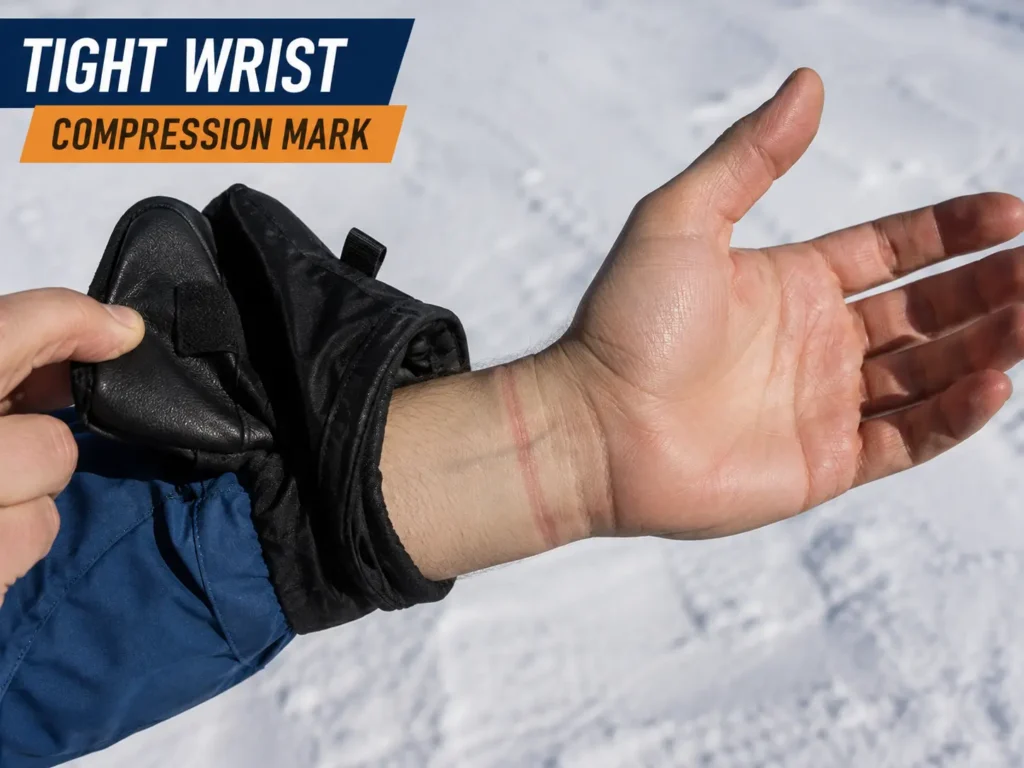
A glove that fits fine bare-handed can compress blood flow once a liner is added, once the hand swells slightly from grip activity, or once cold temperatures stiffen the shell material at the wrist closure. Any meaningful compression at the wrist or across the knuckles restricts the arteries supplying the fingers directly — no cold exposure required.
This pattern is identifiable by timing: numbness that shows up soon after putting gloves on, in mild temperatures, that doesn’t track with how cold or active the skier has been. Visible indentation marks on the wrist after removing gloves are a reliable sign this is fit, not temperature.
The fix here is mechanical, not thermal. Loosening the wrist closure by one notch, checking that a full fist closes without resistance at the knuckles, and sizing the outer shell with the liner already on if one is worn, address the actual restriction rather than adding warmth to hands that are already receiving reduced blood flow. If you’re shopping for gloves and want options with roomier palm cuts specifically, the best ski gloves breakdown covers fit differences across price points worth comparing before buying.
Grip, Movement, and Why Stillness Makes It Worse
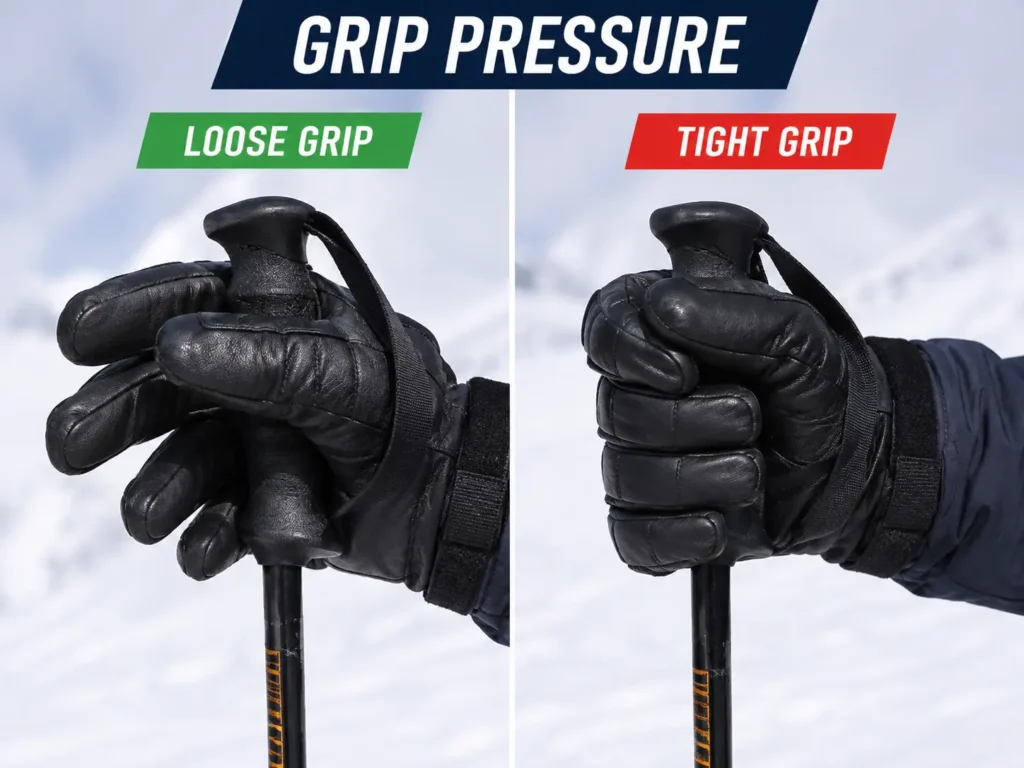
Holding poles with sustained tight grip creates continuous muscle tension in the hand and forearm, and sustained muscle tension compresses the small blood vessels running through the working muscle for as long as the grip holds. That’s a real, well-documented physiological effect, separate from ambient cold — it can restrict finger blood flow even with correctly sized, adequately insulated gloves.
Hand function in cold is genuinely temperature-sensitive at a level that’s been measured directly: a 2025 study on occupational cold exposure found measurable dexterity decline once finger skin temperature dropped to roughly 22.9°C, with recovery thresholds shifting higher after rewarming — meaning both grip function and finger sensation are tied to a specific, trackable temperature range, not just a vague sense of “cold.”
The practical version of this: a loose, three-finger contact grip rather than a full-hand tight one reduces how much the grip itself restricts blood flow, and deliberately opening and closing the hand fully every few minutes during a run acts as a pump that pushes blood back into the fingers between periods of restriction. Stillness on the chairlift removes that pumping action entirely, which is part of why numbness tends to show up there specifically.
Raynaud’s: When It Isn’t About Temperature at All
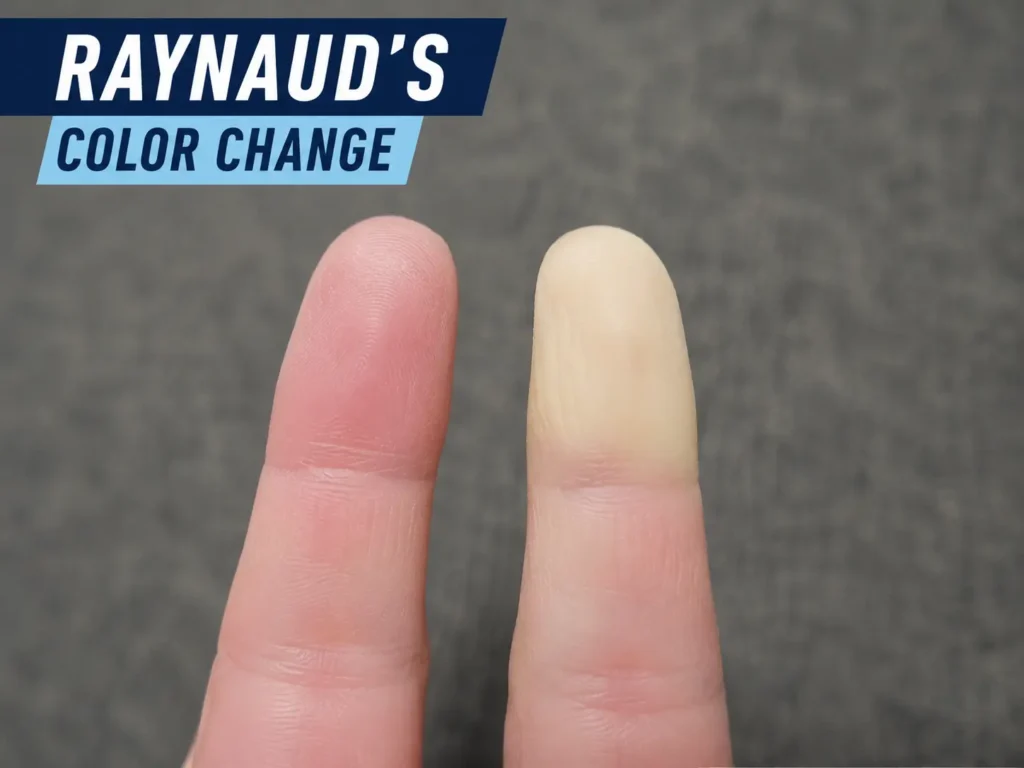
Some finger numbness during skiing isn’t a normal, proportional cold response — it’s a vascular condition called Raynaud’s phenomenon, where small arteries in the fingers spasm and temporarily cut off blood flow, sometimes triggered by relatively mild cold or even emotional stress rather than genuine cold exposure.
The National Institute of Arthritis and Musculoskeletal and Skin Diseases describes Raynaud’s phenomenon as episodes where fingers and toes become cold and numb and change color, most often triggered by cold temperatures or emotional stress, and notes the condition can be primary (on its own) or secondary to another underlying condition.
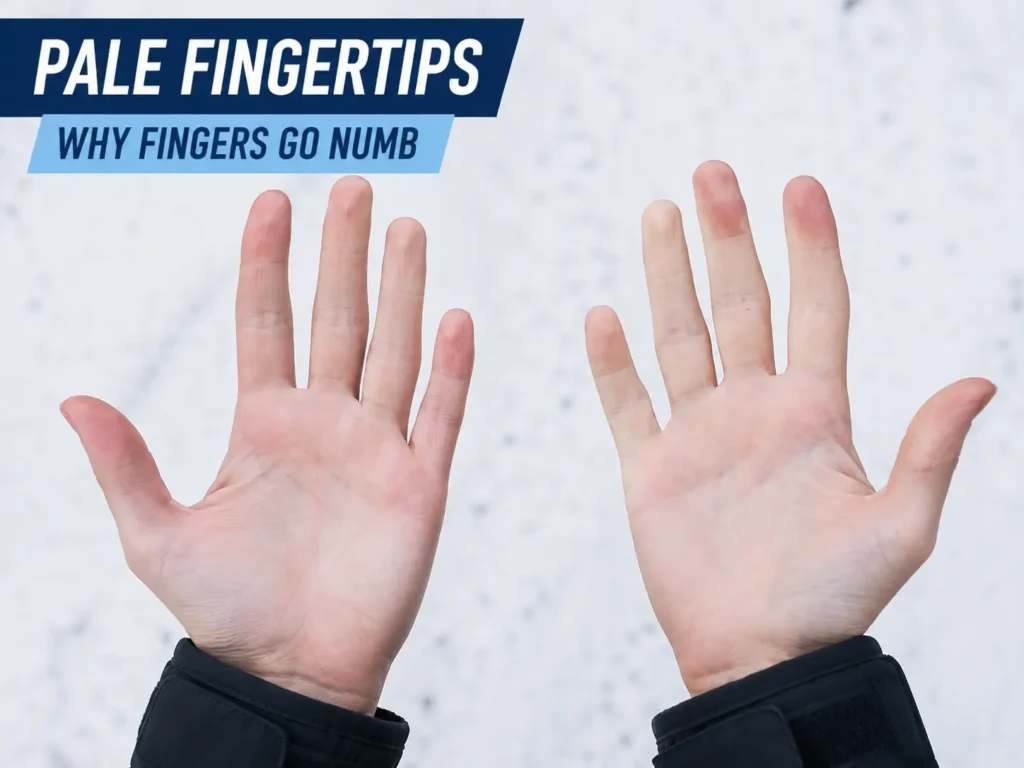
What separates this from ordinary cold numbness is the pattern: visible color change (fingers going white or bluish, not just red or pale from cold), numbness at temperatures that don’t bother other people, episodes that don’t line up cleanly with how cold or how still you’ve been, and sometimes an asymmetric pattern where some fingers are affected and others aren’t. If this pattern sounds familiar, it’s worth a conversation with a doctor rather than assuming it’s a gear problem — no glove upgrade fixes vasospasm that isn’t really about ambient temperature.
Altitude Changes the Baseline
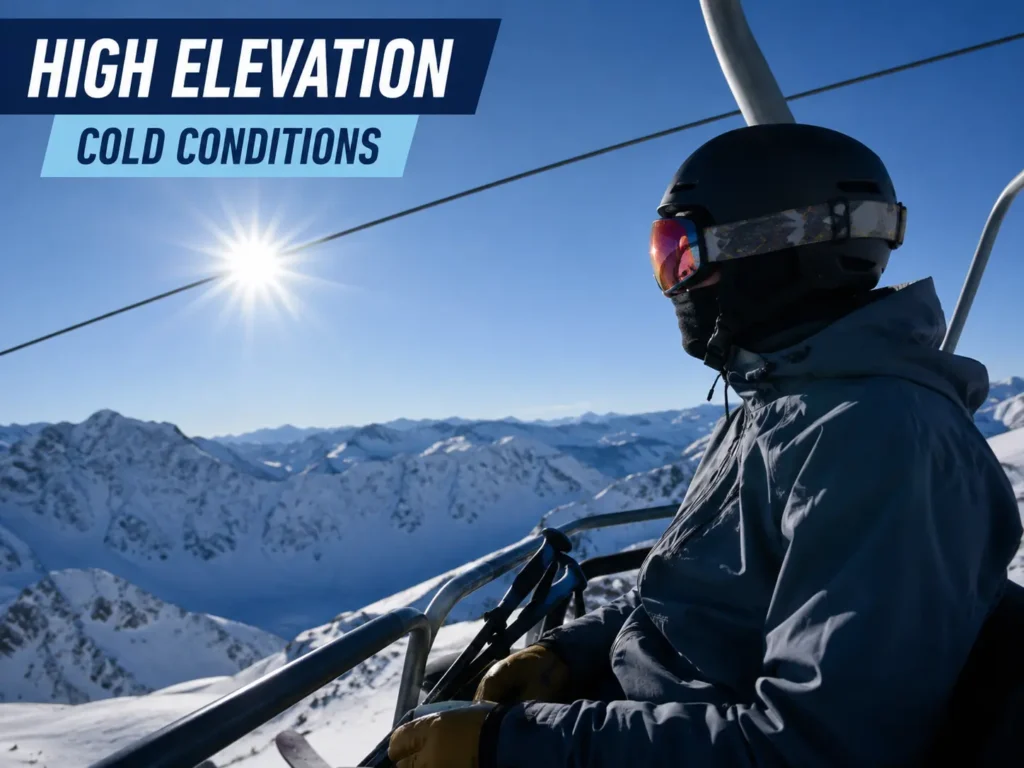
At higher-elevation resorts, reduced ambient oxygen pressure means the body is working somewhat harder to maintain normal circulation everywhere, and peripheral areas like fingers are typically deprioritized further during that adjustment period. Skiers arriving from low elevation often notice their hands go numb faster on day one or two at altitude than they do later in the same trip, using identical gear.
This isn’t usually something to solve with different gloves — it’s a temporary physiological adjustment. Staying well hydrated helps, since dehydration thickens blood and makes peripheral circulation less efficient, and it’s part of why altitude-related numbness tends to fade as the trip goes on rather than requiring an equipment fix. Alcohol and heavy caffeine intake both work against this in the first day or two at altitude, since both affect blood vessel tone in ways that compound the adjustment rather than easing it.
Moisture Changes the Math, Even With Good Insulation
A glove that’s genuinely warm dry can still leave fingers numb once sweat or melted snow gets inside it. Wet insulation conducts heat away from skin far faster than dry insulation traps it, so the same glove that felt adequate at the start of the day can become inadequate an hour in without the insulation rating itself changing at all.
This shows up as a pattern distinct from the others: fingers that were fine for the first run or two and get progressively colder afterward, especially on days with heavy exertion or wet snow. Swapping to a dry liner or pair mid-day addresses this directly in a way that no amount of standing still and warming up fully solves, since the problem is the wet layer itself rather than the ambient temperature.
The Question That Actually Matters: Normal or Warning Sign
This is the part most guides on this topic skip past, and it’s the part worth spending real attention on.
Ordinary cold-related numbness — tingling, reduced sensation, fingers that feel cold but respond to movement and warming — isn’t dangerous on its own. It becomes something to act on when the pattern shifts: fingers turning white or gray rather than just cold and red, numbness that doesn’t improve after ten minutes in a warm lodge, or skin that feels hard or waxy rather than simply cold.
The CDC’s guidance on recognizing frostbite describes watching for skin that has turned white or grayish and feels firm, waxy, or numb, and advises seeking immediate medical attention if those signs appear — which lines up with the practical test worth running on the mountain: press a fingertip firmly for a few seconds and release. Color returning within about two seconds is a normal response. Color that’s slow to return, or doesn’t return at all, means circulation to that finger is meaningfully compromised and it’s time to get inside, not push through one more run.
Common Mistakes and What They Actually Cost
Buying warmer gloves as the default fix helps only the insulation-shortfall version of this problem. If the actual cause is wrist compression or grip pressure, a thicker glove can make wrist compression worse and does nothing for circulation restricted inside the hand.
Ignoring numbness that starts at the beginning of the day treats a cold-start pattern as random bad luck instead of what it usually is — hands that were already vasoconstricted before skiing began, from cold exposure in a parking lot or on the walk to the lift.
Gripping poles tighter on difficult terrain without realizing it is instinctive and directly counterproductive — tighter grip means more restriction at exactly the moments skiers most want their hands to keep working well.
Treating every episode of numbness the same way misses the cases that matter. Color change, persistence after warming, or a hard/waxy feel are meaningfully different from ordinary cold-related tingling, and treating them identically means missing the point where continuing to ski is a bad idea.
Matching Your Pattern to the Likely Cause
| Pattern | Likely Cause | What Helps |
| Numb on chairlifts, fine during active skiing | Core temperature response at rest | Address body warmth — see linked warm-hands guide |
| Numb soon after gloves go on, even mild days | Glove fit compressing wrist or knuckles | Loosen wrist closure, check knuckle room with liner in |
| Fingertips numb, palms comfortable, worse on hard runs | Grip pressure restricting flow inside the hand | Looser three-finger grip, open-close hand every few minutes |
| Color change (white/blue), triggered by mild cold or stress | Raynaud’s phenomenon | Medical conversation; heated gloves can help independent of circulation |
| Worse for the first day or two at a new, higher-elevation resort | Altitude adjustment | Hydration and time — typically resolves within the trip |
| Fine at first, progressively numb through the day | Moisture compromising insulation | Swap to a dry liner or pair mid-day |
Self-Check Tests You Can Run Today
Timing check: numb at rest but fine while active points to core temperature, not gear.
Compression check: indentation marks on the wrist after glove removal point to fit, not cold.
Color check: white or blue coloring, not just red or pale, points toward Raynaud’s rather than ordinary cold response.
Press test: color returning within about two seconds after a firm press is normal; slower return is a warning sign worth acting on.
When Standard Advice Doesn’t Apply
People who already know they have Raynaud’s shouldn’t expect standard cold-weather fixes — better gloves, more layers, active movement — to prevent vasospastic episodes, since those episodes aren’t proportional to how cold or well-equipped someone is. Heated gloves, which generate warmth independent of the body’s own circulation, are a more relevant tool here than insulation alone.
Anyone newly arrived at high altitude should expect a day or two of faster numbness onset than usual, even with the exact gear that worked fine at lower elevation, and shouldn’t read that as a sign the gloves have failed.
Anyone on medications that affect circulation — some blood pressure medications and beta-blockers among them — may experience faster or more pronounced numbness than the general guidance here assumes, and should factor that into how seriously to take early warning signs specifically, rather than assuming average timelines apply.
Decision Checklist
| Your Situation | Action | Priority |
| Numb only during still periods (chairlifts) | Address core/body warmth — see linked guide | Fix habit |
| Wrist indentation marks after glove removal | Loosen wrist closure, recheck fit with liner | Act now |
| Fingertips numb with warm palms during hard runs | Loosen grip, add periodic hand flexes | Act now |
| Color changes to white or blue during episodes | Discuss with a doctor — not a gear issue | Get evaluated |
| Press test: color returns slowly or not at all | Stop skiing, warm hands, seek care if it persists | Urgent |
| Everything above checked, numbness is mild and resolves quickly | Normal cold response — no action needed | Good |
Numb fingers are common enough on the mountain that it’s easy to treat as background noise rather than a signal worth reading. Most of the time it is background noise — a normal, protective response that resolves with warmth and movement. The value in sorting out which pattern is yours isn’t just comfort; it’s knowing the difference between “get your hands moving” and “get inside now,” and for the deeper prevention strategies once you’ve identified a core-temperature pattern specifically, keeping hands warm picks up where this leaves off.
Frequently Asked Questions
Is numbness always a sign I need warmer gloves?
No — glove insulation only addresses one of several causes. If numbness is coming from wrist compression, grip pressure, or Raynaud’s, a warmer glove either won’t help or, in the compression case, can make things worse if the added bulk tightens the fit further.
Should I take my gloves off to check my fingers?
Briefly, yes, if you’re unsure whether numbness has crossed into something concerning. Checking for color change and running the press test takes a few seconds and gives real information; just don’t leave hands exposed to cold air any longer than needed to check.
Can numb fingers from skiing cause lasting damage?
Ordinary cold-related numbness that resolves with warming doesn’t cause lasting damage. Numbness that persists well after warming, or that comes with white/waxy skin, is a different situation and is the point where medical attention matters rather than waiting it out.
Does this affect kids differently than adults?
Children generally lose heat from extremities faster than adults and may not reliably report numbness until it’s more advanced, which is part of why regular check-ins on hand warmth matter more for kids than relying on them to say something’s wrong.