Quick answer: A thick glove is not automatically a warm one. What actually keeps your hands warm is tiny pockets of trapped air inside the insulation fibers. Air barely moves heat at all when it’s still. The moment those pockets get squeezed flat or filled with water, the glove stops working the way its rating implies, no matter how much material is still there.
If you want to check whether your current gloves are still doing their job, the ski glove finder can help you compare what you have against what your conditions actually need.
Most skiers assume a bulkier glove means a warmer glove. It’s an easy assumption to make, and it’s wrong often enough to matter. Two gloves can look and feel similarly thick and perform completely differently on the mountain.
The difference comes down to what’s happening at a much smaller scale than anyone can see by looking at a glove. This post breaks that mechanism down in plain terms, not as a buying guide and not as a troubleshooting checklist, but as the actual science underneath both of those things.
- Heat Moves Through Air Slower Than Almost Anything Else
- What's Actually Happening Inside the Fibers
- Why the Same Glove Feels Warm One Morning and Cold by Afternoon
- Compression Is the Quiet Way Insulation Fails
- What Gram Weight Actually Tells You
- Why Fingertips Get Cold Before the Rest of the Hand Does
- How Activity Level Changes What Insulation Needs to Do
- Common Mistakes People Make With Insulation
- Self-Check Tests You Can Actually Run
- Warning Signs Insulation Isn't Performing
- Decision Checklist
- When Passive Insulation Isn't Enough
- A Quick Way to Think About Any Insulation Claim
- Frequently Asked Questions
Heat Moves Through Air Slower Than Almost Anything Else
Every kind of insulation, in a ski glove or anywhere else, works on the same basic principle. The material itself doesn’t create warmth. Your body does. Insulation’s only job is to slow down how fast that warmth escapes into the cold air around it.
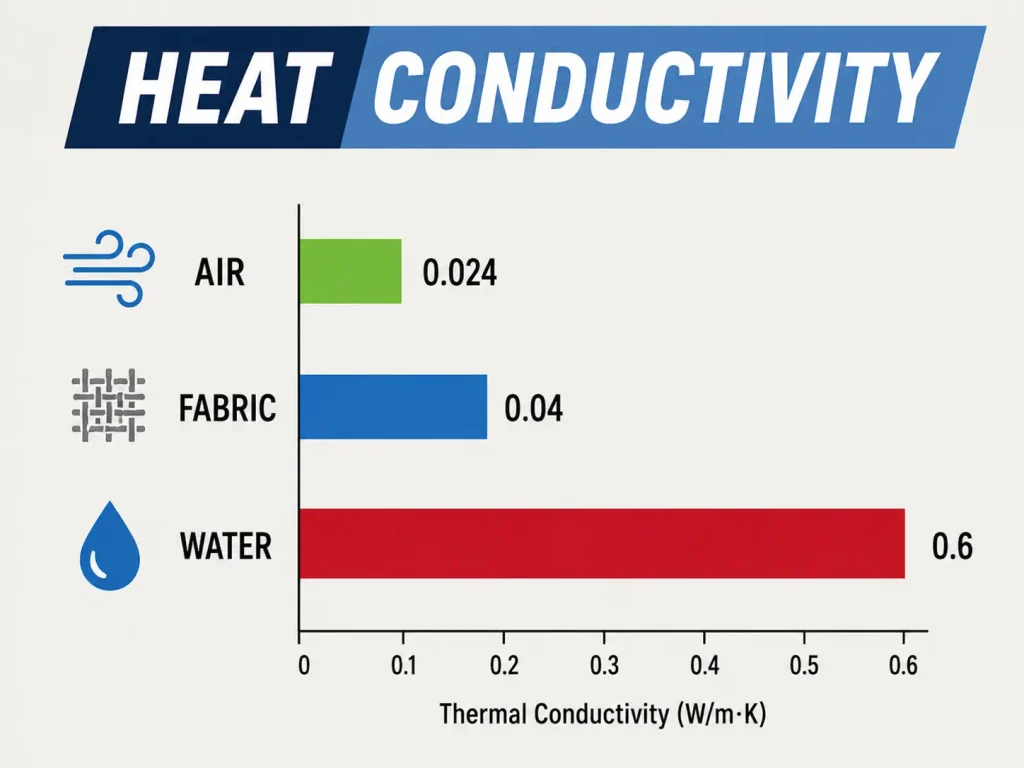
It does this by trapping still air. As conductivity data from real physics references confirms, air conducts heat far more slowly than water or solid fabric does. Water moves heat roughly 25 times faster than still air. That single number explains most of what happens to a glove’s warmth once things go wrong.
The word that matters here is “still.” Moving air carries heat away quickly, which is why wind chill exists. Insulation fibers work by trapping air and stopping it from moving. Once that trapped air escapes or gets replaced by something else, the fibers alone don’t insulate much better than any other thin fabric.
What’s Actually Happening Inside the Fibers
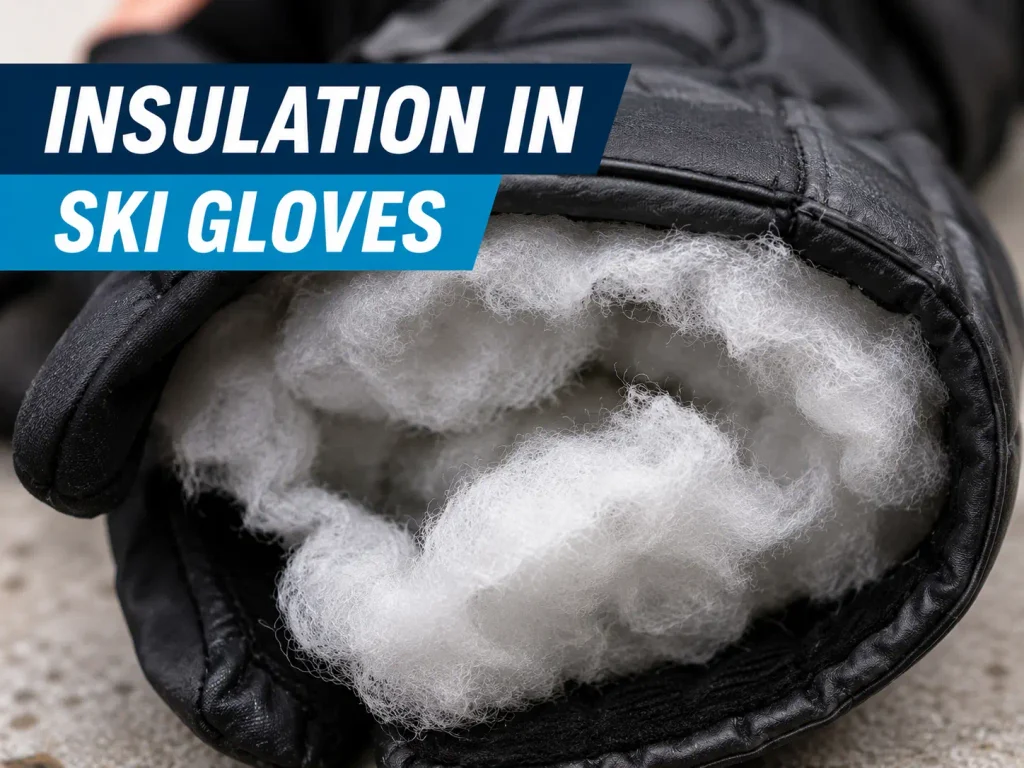
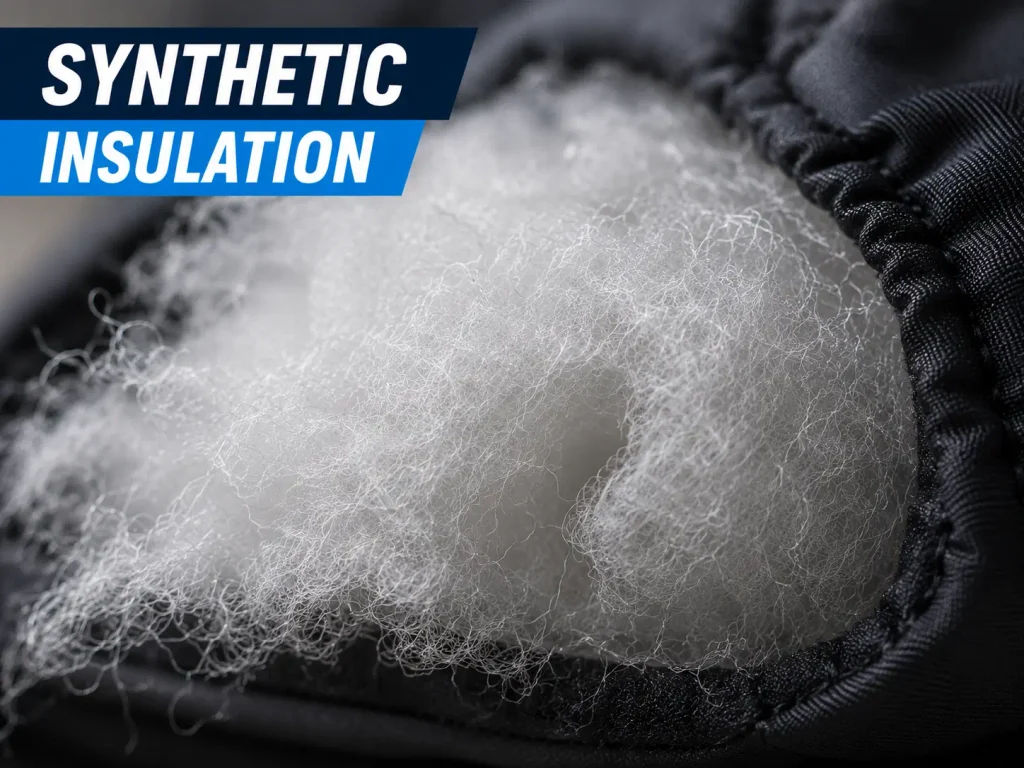
A ski glove’s insulation is made of fine synthetic fibers packed loosely together. The gaps between those fibers are what matter, not the fibers themselves. Each gap holds a tiny pocket of air, and thousands of these pockets stacked together create a real barrier to heat loss.
As 3M’s page on its own Thinsulate insulation explains, the effectiveness of this kind of material comes specifically from how well it traps still air in a small space, not from the raw amount of fiber present. Thinner fibers packed more densely can outperform thicker fibers packed loosely, because they create more small air pockets per square inch.
This is also why two gloves with the same insulation weight can feel and perform differently. Fiber type, fiber diameter, and how tightly they’re packed all change how much still air actually gets trapped, independent of how many total grams of material are inside.
Why the Same Glove Feels Warm One Morning and Cold by Afternoon
Once water gets into the insulation zone, it starts replacing the air in those pockets. Since water conducts heat around 25 times faster than air, even a small amount of moisture meaningfully drops how well the insulation performs.
This water can come from two directions. It can come from your own hands sweating, working its way into the fill from the inside. Or it can come from outside, through a shell that’s stopped repelling water the way it used to. Either direction produces the same result: the still air that was doing the actual insulating work gets displaced.
This is why a glove can feel completely fine for the first hour of a ski day and noticeably worse by the third or fourth. The moisture accumulates gradually, and the insulation’s performance drops right along with it, even though nothing about the glove’s construction has changed.
Compression Is the Quiet Way Insulation Fails
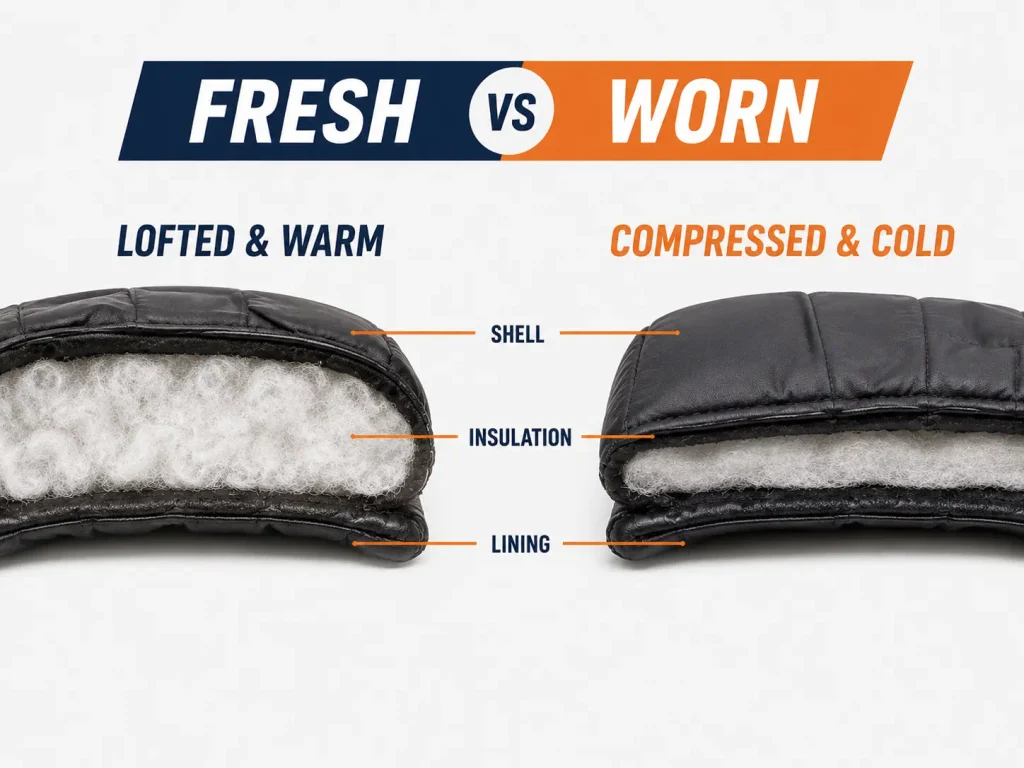
Water isn’t the only thing that destroys those air pockets. Physical pressure does the same thing, just through a different route. When insulation gets squeezed — by a tight fit, by gripping something hard, or by sitting compressed in storage for months — the fiber structure collapses and the air gets pushed out.
A compression study published in a peer-reviewed textile journal in 2025 measured this directly in insulated jacket construction: compression along stitch lines reduced loft enough to meaningfully cut thermal resistance at exactly those points. The same principle applies inside a glove, especially in narrow finger tubes where the fit is naturally tightest.
Unlike moisture, compression damage doesn’t need any water involved at all. A perfectly dry glove that’s been squeezed flat performs worse than its rating suggests, for the same underlying reason a wet one does: the air pockets that were doing the real work are gone.
What Gram Weight Actually Tells You
Ski glove insulation is usually labeled by weight, in grams per square meter — a single number like 100g, or sometimes split by zone, like 110g on the palm and 230g on the back of the hand. This number is a rough stand-in for how much fiber, and therefore how many potential air pockets, are packed into that fabric.
Here’s the part that matters: that number is measured under ideal lab conditions, uncompressed and dry. It says nothing about what happens once that same insulation is squeezed into a snug finger tube or exposed to hours of hand sweat. A higher gram number sets a ceiling on possible warmth. It doesn’t guarantee you’ll actually reach it.
Fiber type changes this ceiling too — down, synthetic fill, and blended materials all trap air differently and respond differently to moisture. The insulation guide breaks down which fill type actually fits which conditions, if you’re comparing options rather than just the mechanism.
This is genuinely useful to know before you shop by the number alone. For a full breakdown of how gram weight relates to the temperature rating printed on a glove’s tag, and why the same rating can perform very differently across brands, the rating guide covers that comparison directly.
Why Fingertips Get Cold Before the Rest of the Hand Does
Finger tubes are the narrowest part of any glove, which means insulation gets compressed there more than anywhere else, even in a correctly sized glove. Less trapped air survives in that tight space compared to the more open palm and back-of-hand zones.
This is a straightforward geometry problem, not a flaw in any specific glove. The same gram-weight insulation performs differently depending on how much room it actually has to stay lofted, and fingers simply don’t offer much room.
If your fingertips go cold well before your palm does, this compression difference is very often the reason, independent of anything else going on with moisture or fit elsewhere in the glove.
This is also why sizing up slightly, or choosing a glove designed with roomier finger tubes, sometimes solves cold fingertips better than switching to a heavier insulation weight altogether. The extra space lets the same fiber structure stay closer to its intended loft instead of being squeezed flat by design.
How Activity Level Changes What Insulation Needs to Do
Insulation’s whole job is slowing heat loss, and how much slowing is actually needed depends on how much heat your body is producing at that moment. Active skiing generates real metabolic heat. Sitting still on a chairlift generates much less.
This is why hands that feel fine while skiing often go cold within a few minutes of sitting down. The insulation hasn’t changed. The amount of heat your body is sending it to work with has dropped sharply, and the same insulation now has to work much harder against the same outside temperature.
A practical takeaway follows directly from this: the coldest exposure of your ski day is very often the chairlift, not the run itself, so it’s worth choosing insulation rated for standing-still cold rather than only the temperature you’ll be actively skiing in.
Common Mistakes People Make With Insulation
Buying by gram weight alone, without checking fit. A heavier insulation number in a too-tight glove can easily underperform a lighter one in a correctly sized glove, since fit compression cancels out much of that extra fiber.
Assuming a cold glove needs more insulation, when the real issue is moisture. Adding bulk doesn’t fix a glove that’s getting wet from the inside. A liner that manages sweat often solves the same problem more effectively than a heavier outer glove would.
Storing gloves compressed under other gear for months. Sustained pressure over an entire off-season can leave fibers slower to spring back, sometimes not fully. Storing gloves loosely, without weight on them, protects the loft that took a whole design process to build in. A breathable fabric bag on a shelf works better than the bottom of a packed gear bin.
Treating one afternoon of cold hands as proof the insulation failed. Cold hands late in the day can come from accumulated moisture, from dropped activity level, from a worn-out water-repellent coating, or some combination — not automatically from insufficient insulation.
Self-Check Tests You Can Actually Run
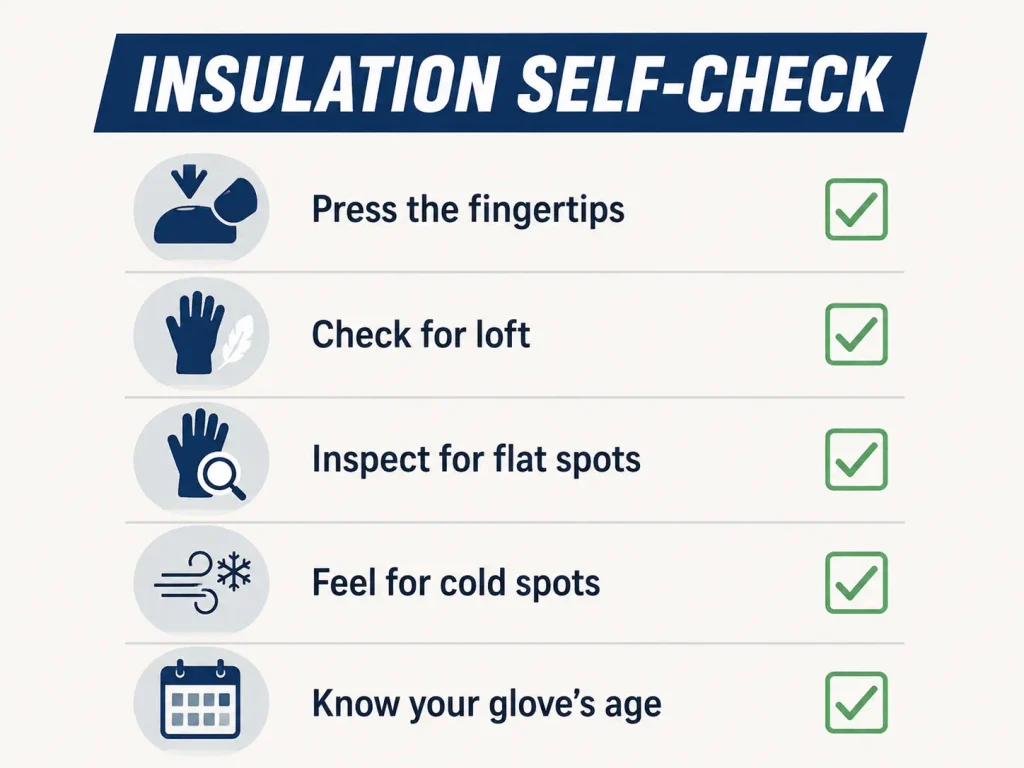
The loft test
Take the glove off, lay it flat, press the back-of-hand section down firmly, then release. Fibers with good structure spring back to full thickness within a couple seconds. Slow or incomplete rebound points to compression damage.
The moisture test
After a full ski day, press a dry paper towel firmly against the inside of the glove for a few seconds. Any dampness picked up confirms moisture reached the insulation, whether from sweat or from a leak.
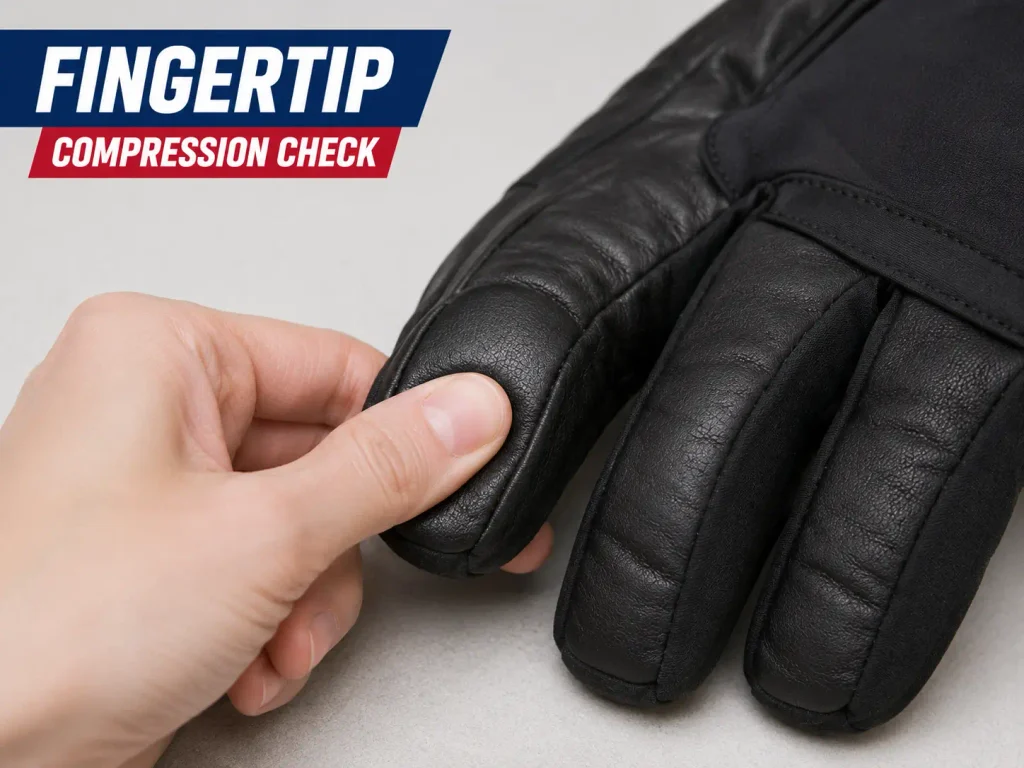
The fingertip check
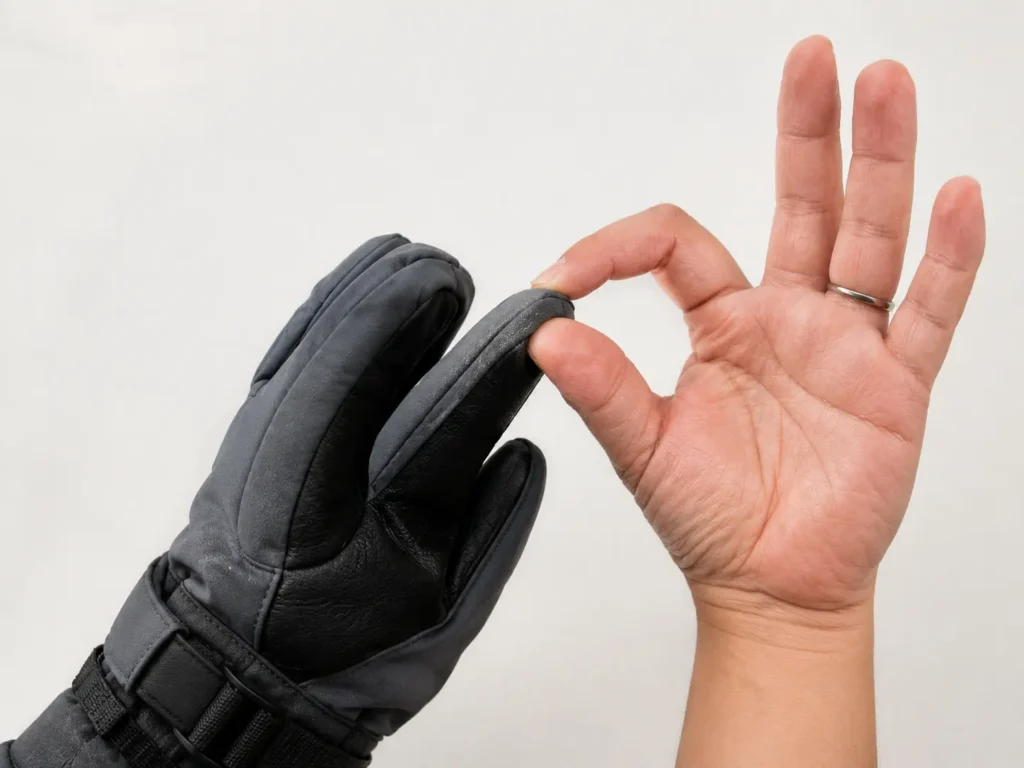
With the glove on, press each fingertip gently from the outside. You should feel some cushioned resistance before your fingers meet through the fabric. Almost no resistance means the finger tubes are compressed flat or under-insulated for the conditions.
Warning Signs Insulation Isn’t Performing
| Warning Sign | What It Usually Means |
| Warm at the start of the day, noticeably colder by afternoon | Moisture building up inside the insulation over time |
| Cold fingertips despite a warm palm | Finger-tube compression reducing effective insulation there specifically |
| Gloves felt fine last season, weaker at the start of this one | Possible storage-compression damage from off-season pressure |
| Glove feels damp inside with no obvious outside leak | Sweat reaching the insulation, often from a missing or poor liner |
| Warm while skiing, cold almost immediately at rest | Insulation is fine for active heat output but under-matched for standing-still exposure |
Decision Checklist
| Situation | What To Check |
| Buying based on a gram-weight number alone | Try the glove with your intended liner and check finger-tube room before buying |
| Cold hands that build up gradually through the day | Run the moisture test — likely a liner or waterproofing issue, not the insulation itself |
| Cold fingertips specifically, warm palm | Try a slightly larger size or thinner liner to reduce finger-tube compression |
| Gloves feel weaker at the start of a new season | Run the loft test after 48 hours of open, uncompressed storage |
| Warm skiing, cold at rest on lifts | Choose insulation rated for your coldest stationary exposure, not just active skiing |
When Passive Insulation Isn’t Enough
Trapped-air insulation has a real ceiling. Past a certain point — very low temperatures combined with wind and long stationary exposure — no amount of loft or gram weight fully compensates, especially in a glove that still needs to allow hand movement.
Heated gloves solve a different part of the problem. They add an actual energy source on top of the same trapped-air mechanism, which is why they help specifically in conditions where passive insulation alone has hit its physical limit rather than just needing more of it.
Circulatory conditions change the equation too. If reduced blood flow is the real limiting factor, insulation is slowing the loss of warmth from blood that isn’t reaching the hand in the first place. In that situation, more insulation has limited room to help, and a heated glove — which adds warmth independent of circulation — is a more direct fix.
Backcountry skiers moving under their own power face the opposite problem. Heavy insulation during an uphill climb traps more heat than the body needs to shed, leading to sweating and wet insulation before the descent even starts. Lighter insulation for the climb, with a warmer layer carried for the way down, matches the mechanism to the actual heat output better than one heavy glove worn the whole time.
Understanding the mechanism itself — not just the specs on a tag — is what makes all of these situational calls possible. Once you know that trapped still air is the entire game, decisions about fit, moisture management, and even when to reach for a heated glove start making a lot more sense.
A Quick Way to Think About Any Insulation Claim
Next time a glove listing highlights a big gram number or a dramatic-sounding temperature rating, it helps to run it through the same simple filter this whole mechanism comes down to: is the air trapped, is it dry, and is it under pressure.
A glove can score well on the label and still fail on any one of those three. A glove with a modest gram number can outperform a heavier one if it wins on all three instead. The number on the tag is a starting point, not the full answer, and now you know exactly what it’s leaving out.
Frequently Asked Questions
Does a thicker glove always mean warmer hands?
No. Thickness only matters if the fiber structure inside is intact and dry. A thick glove with compressed or wet insulation can perform worse than a thinner one with fully lofted, dry insulation.
Why does gram weight not guarantee warmth?
Gram weight is measured under ideal lab conditions — dry and uncompressed. Real-world fit, moisture, and compression all reduce how much of that rated performance you actually experience.
Is down or synthetic insulation better for trapping air?
Both work on the same trapped-air principle, but they behave differently once wet — synthetic fibers keep more of their structure when damp, while down collapses more completely. Fill type is covered in more depth in a dedicated comparison elsewhere on this site.
Can insulation recover after being compressed for a long time?
Often partially, after a day or two of sitting uncompressed. Very long-term compression, like months of off-season storage under weight, can leave some fibers permanently flattened.
Why are my fingertips always the coldest part of my hand?
Finger tubes are narrower than the rest of the glove, so insulation gets compressed more there than in the palm or back of the hand, even in a well-fitted glove. Less trapped air survives in that tighter space.
Does washing a glove damage its insulation?
It can, depending on how it’s washed. Harsh detergents and high heat can flatten synthetic fibers over time, while hand washing with mild soap and air drying tends to preserve loft much better across repeated seasons.