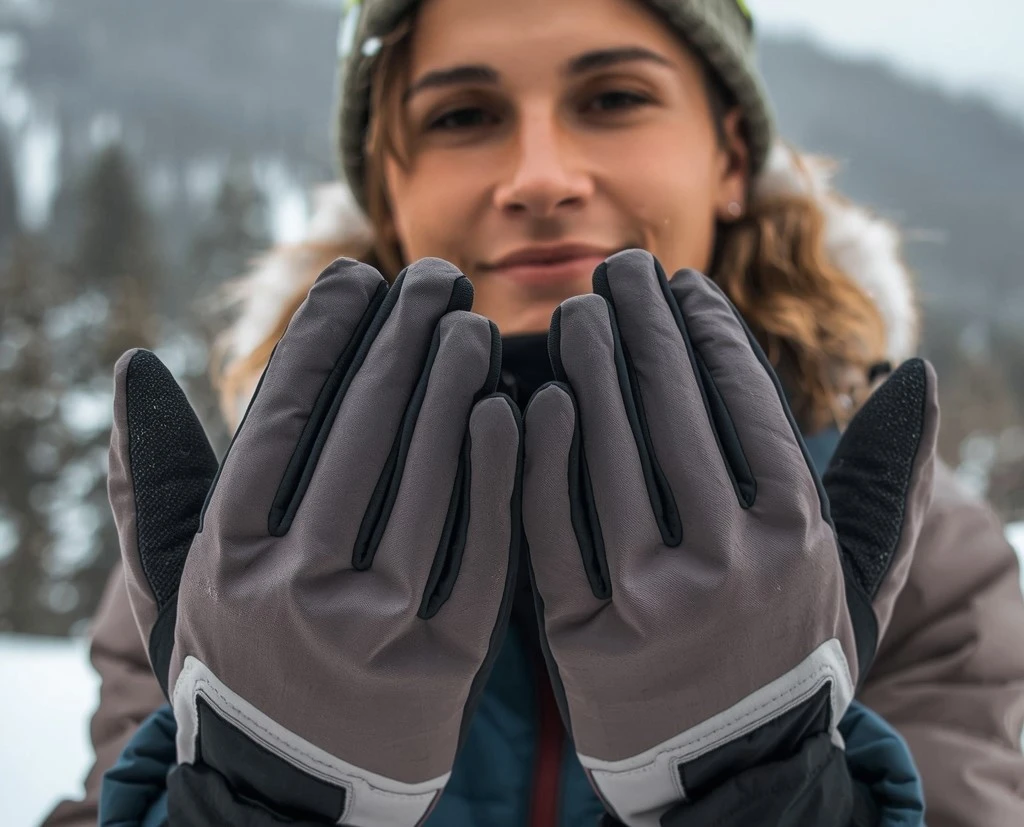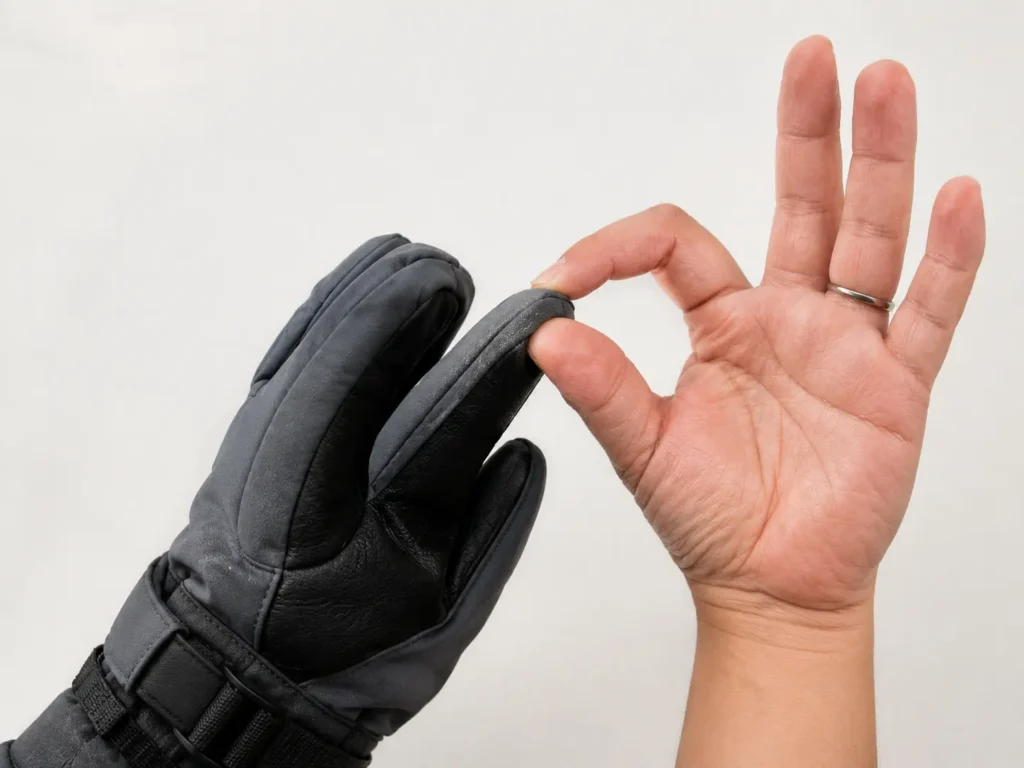
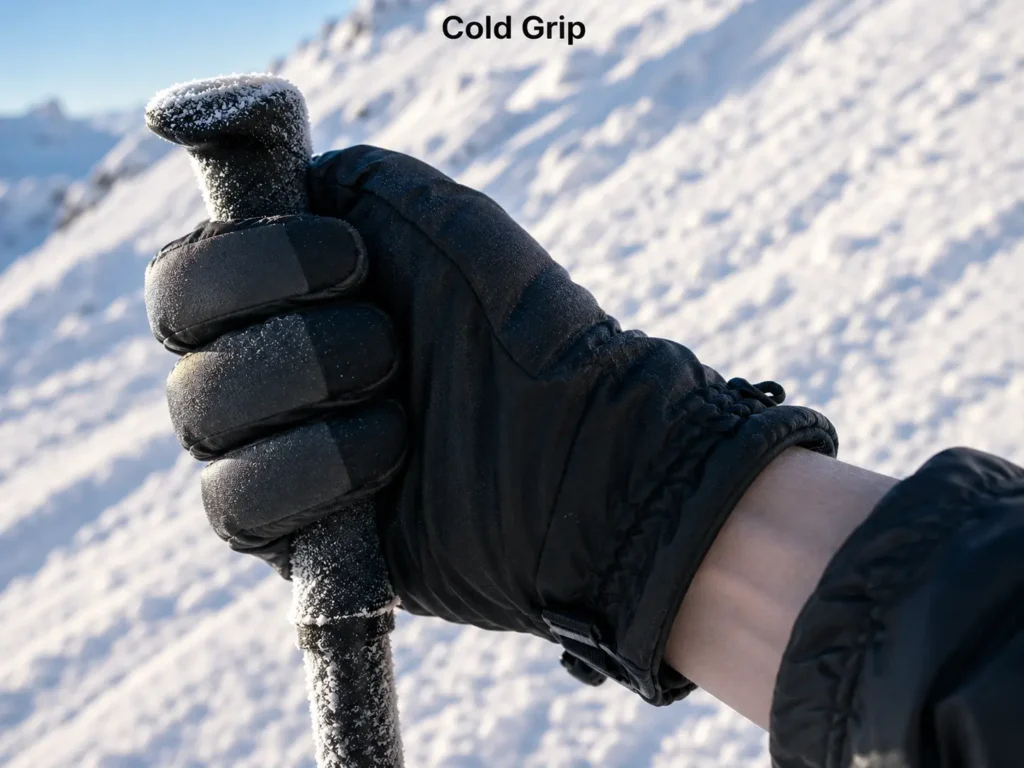
Quick answer: Cold temperatures physically stiffen the materials in your gloves — the shell fabric, the waterproof membrane, and the insulation all lose flexibility as they get colder, and moisture trapped inside makes it worse. Most of the time this is completely normal and reverses once the glove warms back up. The distinction that actually matters is whether the stiffness goes away with warmth, or stays no matter what.
If you’d rather get matched to a glove built to stay flexible in genuinely cold conditions, the Ski Glove Finder does that in under a minute.
- What's Actually Happening to the Materials
- Why Cheaper Gloves Stiffen Faster
- Normal Stiffness vs. a Real Problem
- When Persistent Stiffness Means Replace, Not Wait It Out
- What Actually Reduces Stiffness in the Cold
- Test Whether Your Gloves Are Responding Normally
- What to Look For When Buying With Cold-Flex in Mind
- Common Mistakes That Make This Worse
- Who Actually Needs to Prioritize This
- Wind and Altitude Change How Fast This Happens
- Frequently Asked Questions
- The Bottom Line
What’s Actually Happening to the Materials
Every material in a ski glove responds to cold the same general way: molecules move less, fibers pull tighter together, and the material resists bending more than it would at room temperature. None of this is a defect. It’s physics, and it happens to some degree in every glove on the mountain.
Shell Fabric Loses Elasticity
Woven fabrics and synthetic shells contain polymers that stay loose and flexible at moderate temperatures but contract as the cold sets in. A glove that felt soft in the lodge can genuinely feel like a different object on a cold chairlift ten minutes later, simply because the polymer structure has physically changed shape.
Membranes Stiffen Along With Everything Else
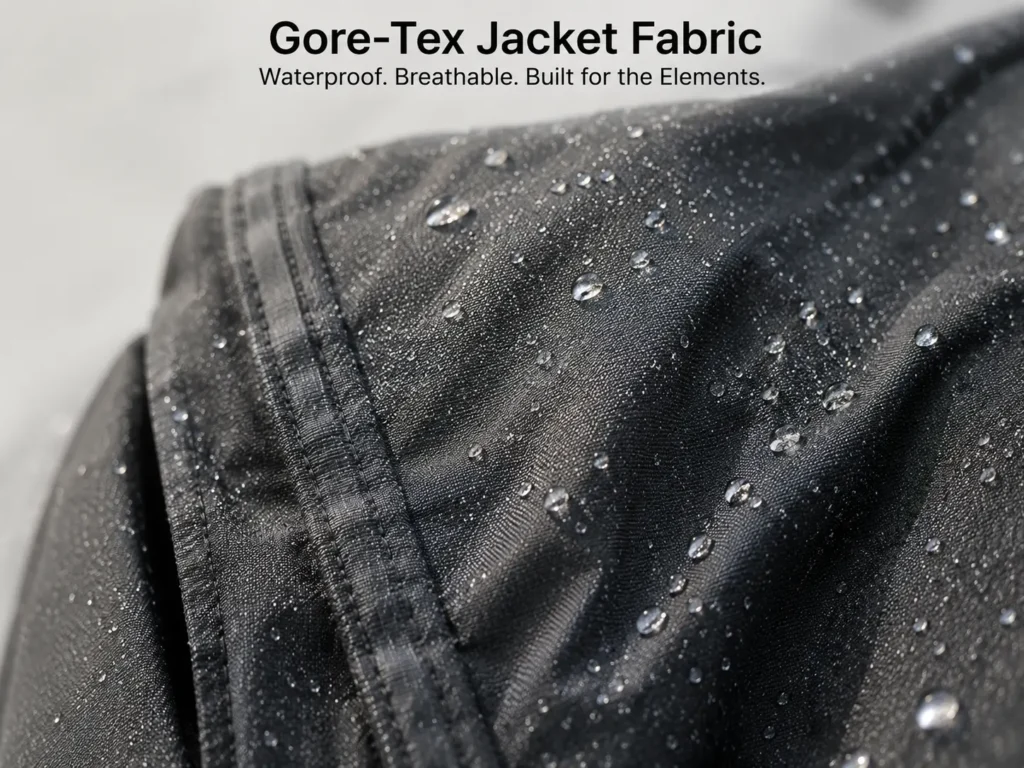
Waterproof-breathable membranes — Gore-Tex, eVent, and similar technologies — are built to block liquid water while letting vapor escape, and they do that job well regardless of temperature. What they can’t fully avoid is stiffening slightly in extreme cold, since the membrane material itself is subject to the same physical constraints as the fabric around it. Better membranes are engineered specifically to resist this more than cheaper ones, which is part of why premium gloves feel noticeably more supple at the same temperature.
Insulation Loses Loft
Insulation works by trapping still air, and that trapped air is what actually holds the warmth. Cold temperatures compress that structure slightly, which means less air, less loft, and a firmer feel overall. This is a related but distinct mechanism from the shell stiffening — it’s about warmth capacity dropping, not just flexibility, and it’s a big part of why gloves built specifically for genuinely extreme cold use construction choices that resist loft loss rather than just piling on more insulation.
Leather Behaves Differently Depending on Moisture
Dry, well-conditioned leather stays reasonably flexible even in real cold. The problem starts when leather absorbs moisture — sweat or melted snow — and then freezes. That combination turns supple leather rigid fast, which is why the same pair of gloves can feel fine in the morning and noticeably stiffer by afternoon, even at a stable temperature. A rubberized-material breakdown of how cold affects flexibility covers the same underlying mechanism from a different material angle, and it applies to more than just leather.
Why Cheaper Gloves Stiffen Faster
Not every glove handles cold the same way, and price tier is a genuinely reliable predictor here — not because of branding, but because of what actually goes into construction.
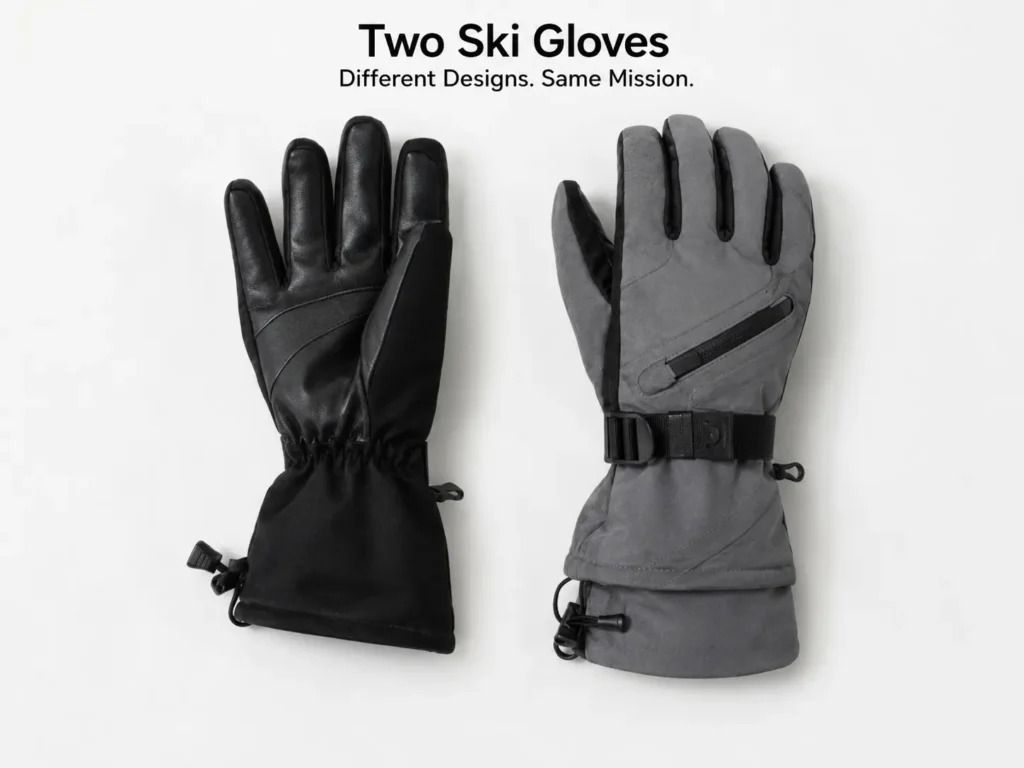
Budget insulation tends to use lower-loft synthetic fill that compresses more readily and doesn’t rebound as well once compressed. Budget membranes often rely on simpler polyurethane films that stiffen more noticeably than technologies specifically engineered for cold-flex performance. And many affordable gloves use PU synthetic leather instead of real leather — PU performs fine in mild weather but turns notably rigid in sub-zero conditions, losing both flex and grip texture in a way treated real leather generally doesn’t.
None of this means budget gloves are unusable in cold weather. It means the stiffness threshold arrives sooner and more sharply, which matters most for anyone skiing in genuinely extreme conditions rather than a typical resort day.
Normal Stiffness vs. a Real Problem
This is the distinction that actually determines what to do next, and it’s simpler than it sounds.
Normal, temperature-based stiffness improves once the glove warms up — inside your jacket, in the lodge, or just from sustained body heat during active skiing. If a glove softens noticeably after 10-15 minutes of movement or warmth exposure, the stiffness was a temperature response, not a defect. This happens to some degree in every glove, including high-end ones, in genuinely cold or windy conditions.
Problem stiffness stays rigid regardless of warmth. Palms that feel like cardboard even indoors, fingers that resist bending with real effort, a cuff that won’t loosen up, or a grip that feels consistently delayed rather than just cold-affected — these point to something beyond ordinary cold response. Usually that means the glove is worn out, has been soaked and dried repeatedly without proper conditioning, or simply wasn’t built for the conditions it’s being used in.
The quickest way to tell the difference: bring the glove somewhere warm and give it fifteen minutes. If it visibly loosens and regains normal flex, that’s temperature doing what temperature does. If nothing changes, the problem isn’t the cold anymore.
When Persistent Stiffness Means Replace, Not Wait It Out
A few specific signs mean the glove itself has degraded, separate from any temperature effect.
Cracking in the membrane or shell
Visible splits mean cold air is getting through regardless of insulation quality, and warming the glove won’t fix a physical crack.
Insulation that doesn’t rebound
Squeeze and flex the glove — insulation that’s clumped or bunched from years of use stays compressed and thin in spots even after warming, creating uneven cold zones that feel stiff in specific areas rather than uniformly.
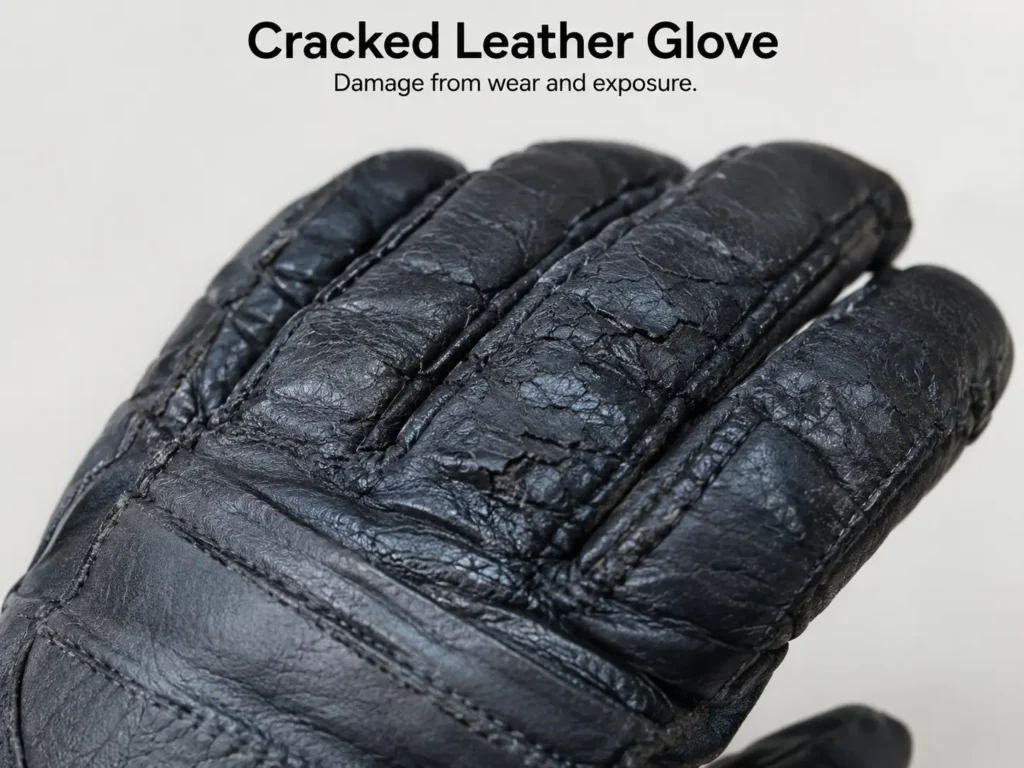
Leather that’s actually splitting, not just stiff. Conditioning helps prevent this, but once real cracks appear along fingers or seams, no amount of warming restores flexibility to that spot.
Stiffness that persists even indoors after genuine warming
This is the clearest signal — a glove that’s had ample time and warmth to loosen up and simply hasn’t is telling you the materials themselves have degraded past the point conditioning or care can fix.

What Actually Reduces Stiffness in the Cold
A few practical habits address this directly, without requiring new gear.
Keep gloves dry between runs
Moisture is the single biggest amplifier of cold-related stiffness, since trapped sweat or melted snow freezing inside the insulation compounds the natural cold-stiffening effect. Air-drying away from direct heat, and rotating between two pairs if you ski frequently, both help meaningfully.
Condition leather regularly
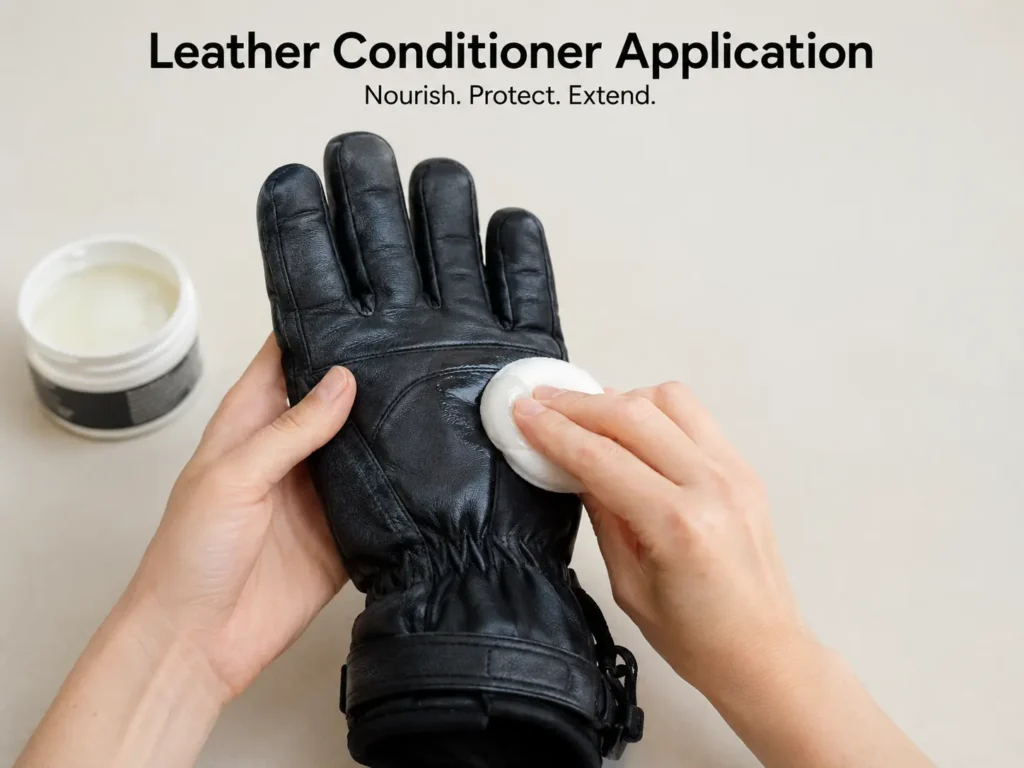
A light application of leather balm or wax before a cold-weather trip keeps the fibers supple and slows how fast moisture gets absorbed in the first place. REI’s guide to caring for water-repellent and leather gear covers the same underlying principle that applies directly to glove palms.
Warm gloves before putting them on
Tucking gloves inside a jacket or near body heat for five to ten minutes before the first run reduces the initial shock of going from room temperature to genuinely cold air, and it’s a habit that costs nothing.
Get the fit right
Gloves that are too tight compress insulation and speed up how quickly it loses loft. Gloves that are too loose let more cold air circulate against the material. A properly fitted glove — snug without compression — handles cold-induced stiffening better than either extreme.
Test Whether Your Gloves Are Responding Normally
Before assuming a glove needs replacing, this quick check separates temperature-driven stiffness from an actual problem.
Bring the glove somewhere warm and set a timer for fifteen minutes. Somewhere around body temperature — inside a jacket, a heated lodge, near your torso — works fine. Extreme direct heat isn’t necessary and can actually damage materials, so avoid radiators or heating vents for this test.
Flex the glove at the five-minute mark, then again at fifteen. Normal temperature-based stiffness shows a clear trend — noticeably looser at five minutes, close to fully flexible by fifteen. If there’s little to no change between the two checks, that’s a signal the stiffness isn’t purely about temperature.
Check specific zones separately. Press and flex the palm, then each finger tube, then the cuff. Uniform stiffness across the whole glove that improves with warmth points to normal material response. Stiffness concentrated in one specific zone — just the palm, just one finger — that doesn’t loosen with the rest of the glove often points to localized insulation bunching or a specific area of wear rather than a general cold response.
Note how quickly it happens again once you’re back outside. A glove that warms up fine indoors but re-stiffens within a minute or two of cold exposure is behaving normally — that’s just the material responding to temperature both ways. A glove that stays stiff even during active movement and building body heat is a different situation.
This test takes under twenty minutes and tells you definitively whether you’re dealing with ordinary physics or a glove that’s reached the end of its useful life.
What to Look For When Buying With Cold-Flex in Mind
For skiers who genuinely need reliable flexibility in sustained extreme cold — not just occasional cold snaps — a few product details matter more than general warmth ratings.
Named membrane technology matters more than a temperature rating alone. Gore-Tex, eVent, and similar branded membranes are specifically engineered and tested for cold-flex performance, which is different from simply being marketed as waterproof. A glove that lists a specific membrane technology is a better signal than one that just says “waterproof” without naming what’s actually doing that job.
Insulation type affects rebound, not just warmth. Higher-quality synthetic fills and treated down are engineered to resist compression and recover their loft after being compressed by cold or by gripping motion. Cheaper fills tend to compress and stay compressed until warmed, which is exactly the mechanism behind gloves that feel progressively stiffer through a cold day.
Real leather palms, if leather is your preference, generally outperform PU synthetic leather in genuine cold. PU is cheaper and looks similar, but it loses flexibility more sharply below freezing than treated real leather does. If cold-flex performance matters more to you than price, this is one of the more noticeable differences between budget and mid-range gloves.
Cuff construction affects how the glove handles temperature swings at the wrist. Softshell or stretch-fiber cuffs continue flexing in cold weather better than stiffer webbing-based designs, which matters most for anyone frequently removing and replacing gloves throughout a session — a common pattern for beginners, kids, and anyone handling gear or a phone regularly.
Common Mistakes That Make This Worse
Assuming stiffness always means a defect. Most cold-related stiffness is completely normal material behavior, not a sign anything’s wrong. Judging a glove’s quality by how stiff it feels in the first five minutes of extreme cold, before it’s had any chance to warm from body heat, isn’t a fair test of the glove.
Drying wet gloves on direct, high heat. This solves the immediate wetness problem but can permanently damage leather fibers and membrane materials, making the glove stiffer overall going forward, not just temporarily.
Skipping leather conditioning until gloves already feel dry and brittle. Conditioning works best as regular maintenance, not a rescue attempt after damage has already started. Waiting until a glove already feels stiff and cracked means some of that damage may not be reversible.
Buying based on room-temperature feel alone. A glove that feels perfectly soft and flexible in a warm store can behave completely differently at actual ski temperatures. This is exactly why membrane technology and insulation type matter more than how a glove feels in your hands indoors.
Ignoring localized stiffness as if it’s a general cold response. Stiffness concentrated in one specific area that doesn’t match the rest of the glove’s behavior is usually a wear or construction issue, not something warming the glove will fix.
Who Actually Needs to Prioritize This
Skiers in genuinely extreme or high-wind conditions, backcountry skiers exposed to sustained cold without frequent warm-up breaks, and kids — who generate less body heat and take more breaks, meaning more freeze-thaw cycles per session — feel this mechanism the most.
Skiers in milder resort conditions, or those who ski primarily in above-freezing temperatures, will notice this far less and don’t need to prioritize cold-flex membrane technology or leather conditioning schedules as heavily. If your typical ski day doesn’t include sustained sub-zero exposure, this mechanism is more of an occasional annoyance than a real gear consideration.
Wind and Altitude Change How Fast This Happens
Still, dry cold and windy, high-altitude cold produce noticeably different stiffening timelines, even at similar air temperatures.
Wind strips heat away from glove surfaces far faster than still air does, which means materials reach their stiffening threshold sooner on an exposed, windy chairlift than they would in the same air temperature with no wind. This is part of why gloves that feel fine walking to the lift can feel dramatically stiffer after a few minutes of exposed, high-speed lift exposure.
Altitude compounds this somewhat, since higher elevations typically pair colder air with more consistent wind exposure, and the combination accelerates the same underlying material response rather than introducing a new one. There’s no separate “altitude stiffening” mechanism — it’s the same cold-and-wind effect, just more consistently present at elevation.
Skiers dealing with long, exposed lift rides in windy conditions benefit more from prioritizing wind-resistant shell construction specifically, separate from insulation warmth alone, since wind exposure is often the actual driver behind stiffness that seems to arrive faster than the ambient temperature alone would suggest.
Frequently Asked Questions
Do all ski gloves stiffen in the cold?
Yes, to some degree — the underlying materials all respond to temperature the same basic way. Higher-quality membranes and insulation resist it more, but no material is fully immune.
Does leather freeze faster than synthetic materials?
Leather is more moisture-sensitive, so if it’s wet, it stiffens faster than dry synthetic materials once temperatures drop. Dry, well-conditioned leather performs reasonably well in cold on its own.
Are mittens less prone to this than gloves?
Generally yes — shared finger warmth in a mitten means insulation isn’t compressed individually per finger the way it is in a five-fingered glove, which tends to reduce the stiffening sensation somewhat.
What temperature range does this usually start at?
Most gloves begin losing noticeable flexibility below about -10°C (14°F), with the effect becoming much more pronounced below -20°C (-4°F). Trapped moisture accelerates this at any temperature.
Can trapped sweat make gloves stiffer even when it’s not that cold out?
Yes. Sweat that freezes inside insulation can produce the same rigid feeling even at temperatures that wouldn’t otherwise cause much stiffening on their own.
Does glove age affect how much this happens?
Yes — older gloves with compressed, worn insulation and drier, less-conditioned leather generally stiffen faster and more noticeably than newer gloves in the same conditions, even if they were originally comparable in quality.
Is there a way to prevent this entirely?
Not entirely — some degree of cold-related stiffening happens to nearly all materials at low enough temperatures. What’s genuinely preventable is the worst version of it: staying dry, conditioning leather regularly, and choosing cold-flex-rated membranes and insulation all reduce how severe the effect gets, even though they can’t eliminate the underlying physics.
The Bottom Line
Stiffness in extreme cold is mostly just materials behaving the way materials behave — and in the vast majority of cases, warmth reverses it completely. The distinction worth actually paying attention to is whether that reversal happens. A glove that loosens up after fifteen minutes near warmth is doing exactly what it’s supposed to. One that doesn’t is telling you something has worn out, and no amount of patience in the lodge is going to fix that.
The fifteen-minute warmth test above is worth running the next time a glove feels unusually rigid, rather than assuming either extreme — that it’s nothing to worry about, or that it’s automatically time to buy new gear. Fifteen minutes and a flex check settles the question definitively, and knowing which category a glove falls into changes what’s actually worth doing next: waiting it out, adding a conditioning routine, or genuinely replacing it before it becomes a safety issue on colder days.
If the tightness you’re noticing feels more like a fit problem than a temperature one — cold aside, the glove just feels too small or too snug — our breakdown of why ski gloves feel tight covers the sizing and fit-specific causes that this post doesn’t, since fit and temperature-driven stiffness are related but genuinely separate problems.