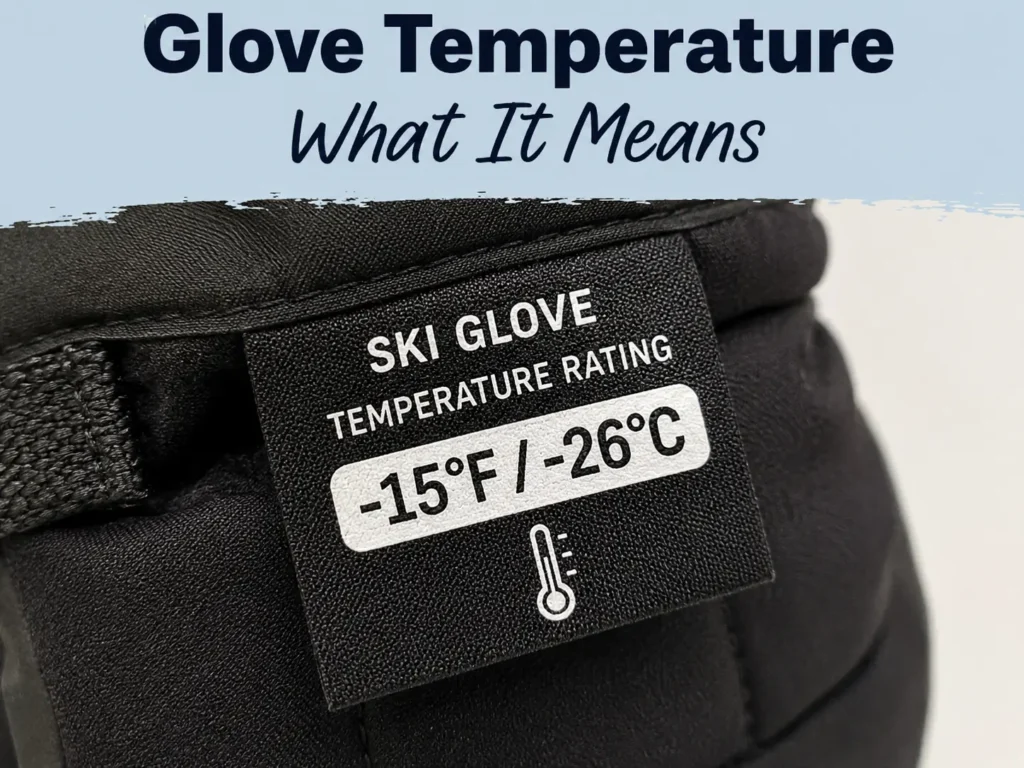
Quick answer: A glove’s printed number is the temperature at which the manufacturer’s own testing found that hands stayed comfortable during moderate activity — not a guaranteed limit, and not directly comparable between brands unless both carry the same EN 511 certification. The rating gets exceeded fastest by two things: standing still (chairlifts especially) and wet conditions. Add a margin for both, and the number becomes genuinely useful instead of misleading. If you want help matching a rating to your actual conditions, the ski glove finder walks through that directly.
A -20°C glove from one brand and a -20°C glove from another can feel completely different on the same chairlift, at the same temperature. That’s not a defect in either glove. It’s a gap in what the number is actually allowed to mean.
Most ski gloves in the US market never go through independent testing at all. The number on the tag is the manufacturer’s own internal claim, and understanding exactly what that claim does and doesn’t cover changes how useful it actually is.
- How the Number Actually Gets Set
- Why the Same Number Means Different Things Across Brands
- Standing Still Beats the Rating Faster Than Anything Else
- Wet Conditions Change the Math Entirely
- Comfort Rating vs. Extreme Rating Aren't the Same Number
- Your Own Circulation Shifts Where You Should Land
- Common Mistakes When Reading a Rating
- Warning Signs the Rating Isn't Telling You the Full Story
- Matching a Rating to Your Conditions
- Decision Checklist
- Frequently Asked Questions
How the Number Actually Gets Set
Where a real, independent standard exists, it’s called EN 511 — a European testing protocol that measures a glove’s resistance to convective cold, contact cold, and water penetration using a heated mannequin hand in a controlled chamber. As SATRA explains, gloves are scored on a numeric scale for each category, which makes two EN 511-certified gloves genuinely comparable to each other.
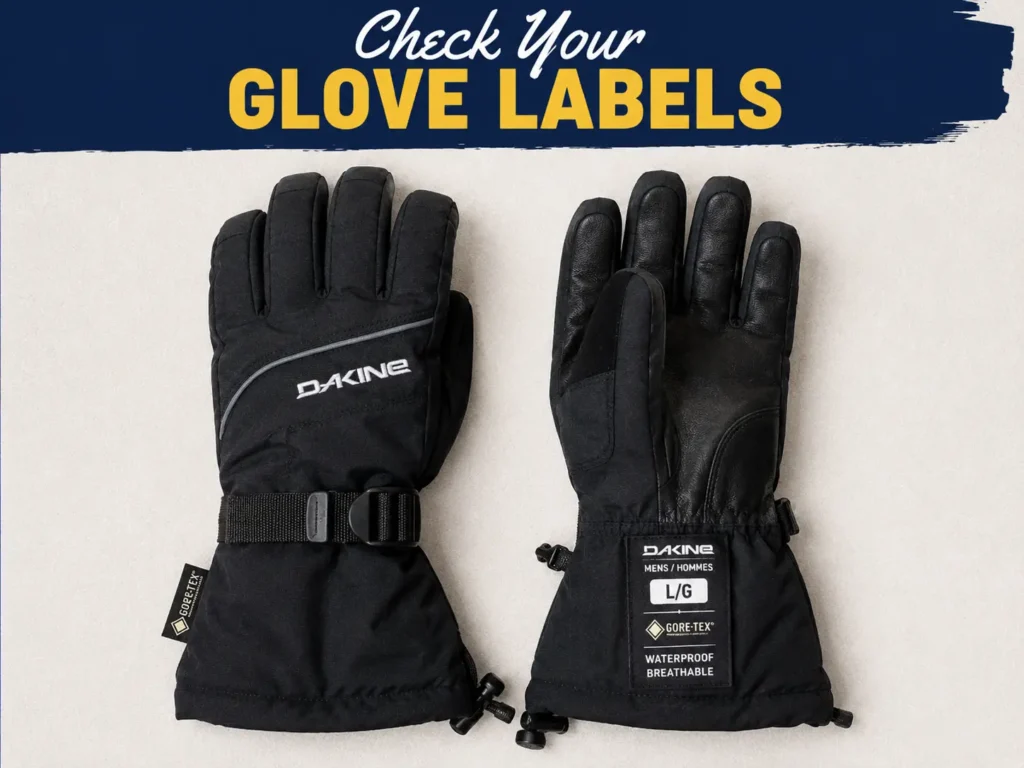
The catch is that EN 511 certification isn’t required to sell a glove in the US, and plenty of ski glove brands don’t pursue it. Without it, a brand sets its own rating using its own internal testing, with no outside body checking the method or the result.
A typical internal test puts people in a cold chamber wearing the glove and notes the temperature at which most subjects start feeling uncomfortable. That method has two real variables baked into it: how active the test subjects were, and how their individual circulation happened to run — neither of which is standardized the way EN 511’s mannequin-hand method is.
Why the Same Number Means Different Things Across Brands
Because there’s no requirement to use one shared testing method, a rating is only reliably comparable within a single brand’s own lineup. A -15°C glove from Brand A tested rigorously and a -15°C glove from Brand B tested loosely can carry the identical number while performing very differently on the same mountain.
This is exactly the problem EN 511 exists to solve, and it’s also exactly why an EN 511-certified rating is worth more than an uncertified one, even at the same printed number. When comparing gloves across brands, treat the temperature number as a rough starting filter, not a precise, guaranteed spec — then look at what’s actually generating the warmth (insulation type and weight) before deciding.
A useful habit here: if two gloves from different brands list the same rating, check whether either one names EN 511 certification specifically. If only one does, that’s the more trustworthy number of the two, regardless of which one sounds more impressive on the page.
Standing Still Beats the Rating Faster Than Anything Else
Most internal ratings get established during moderate physical activity, because that’s the scenario a brand’s test protocol usually simulates. Standing still changes the equation more than almost anything else a skier does on a normal day.
Active skiing generates real metabolic heat that supplements whatever the glove’s insulation is doing on its own. Standing still — waiting in a lift line, riding a chairlift — removes that supplemental heat source, leaving the glove to do the entire job alone.
Wind makes this worse specifically on exposed chairlifts. As the NWS chart on wind chill shows, moving air at a given temperature produces a meaningfully colder effective exposure than the same still-air temperature — which is exactly the condition a long, exposed chairlift ride creates.
The practical fix is straightforward: match your glove’s rating to your coldest expected chairlift exposure, not your coldest skiing temperature. A glove that feels perfectly rated while skiing can still leave hands cold every single time you sit down.
This also explains a pattern a lot of skiers notice without connecting it to the rating itself: hands that feel fine for the first few runs and progressively worse as the day goes on. It’s rarely the glove degrading over a single day — it’s usually more total chairlift time accumulating against a rating that was only ever tested for movement.

Wet Conditions Change the Math Entirely
A rating established in a dry testing chamber says nothing about what happens once a glove’s outer shell saturates. This matters because wet insulation doesn’t just perform a little worse — it can lose most of its effectiveness at once.
The physics behind this is straightforward. As a conductivity analysis of wet insulation explains, water conducts heat roughly 23 times faster than the still air insulation is designed to trap. Replace even a portion of that trapped air with water, and heat loss through the glove increases sharply.
Down insulation is affected the most, since its structure depends entirely on dry, lofted clusters that collapse once wet. Synthetic insulation holds its structure better when damp, which is why it tends to hold onto more of its rated performance in genuinely wet conditions. For the full comparison of how different insulation types actually perform, including where each one specifically falls short, the insulation guide covers that directly.
The practical takeaway: in spring slush or sustained wet snow, the type of waterproofing (a real membrane versus a coating that wears off) matters more to actual warmth than the temperature number printed on the tag.
Comfort Rating vs. Extreme Rating Aren’t the Same Number
Some brands list two separate figures — a comfort rating and an extreme (or limit) rating. These aren’t two versions of the same claim. The comfort rating is where hands stay genuinely comfortable during moderate activity. The extreme rating is closer to a safety floor — the point past which real risk starts, not a temperature anyone should expect to feel warm at.
Using the extreme number as a shopping benchmark is a common and avoidable mistake. A glove listing a -10°C comfort rating alongside a -20°C extreme rating will feel noticeably cold, not comfortable, at -20°C. The comfort number is the one that actually predicts how a normal ski day will feel.
Not every brand lists both numbers, and that itself is worth noticing. A single number with no distinction between comfort and extreme is more likely to be a comfort-style claim dressed up to sound more impressive than it is — genuine extreme ratings tend to come with the comfort number listed right alongside them, precisely because the gap between the two is real and worth disclosing.
Your Own Circulation Shifts Where You Should Land
Ratings are built around an assumed average circulation baseline, and real hands vary a lot from that average. Someone whose hands consistently run colder than their friends’ needs a meaningfully warmer rating than the number alone would suggest, just to reach the same comfort level.
This isn’t a flaw in the rating system — it’s simply outside what any single number can account for. If cold hands persist well beyond what a rating and reasonable margin should explain, the cause is sometimes circulatory rather than a gear mismatch at all. For a deeper look at when that’s the case, including how to tell the difference, the numb fingers guide covers that distinction directly.
Common Mistakes When Reading a Rating
Matching the rating to an average day instead of the coldest one. A mountain that’s usually -8°C but drops to -18°C on storm days needs a glove rated for the -18°C day, with margin, not the average.
Ignoring insulation type when comparing two similar numbers. Two gloves with the same rating can perform very differently once wet, depending on whether the fill is down or synthetic.
Treating the extreme rating as the comfort benchmark. These are two different claims. Shop by the comfort number if one is listed separately.
Assuming a higher rating is automatically the safer choice. Heavy insulation worn during active skiing at mild temperatures causes sweating, and sweat-soaked insulation loses warmth the same way externally wet insulation does.
Comparing ratings across brands with no EN 511 certification on either. Without a shared testing standard, the number alone doesn’t support a direct comparison — check insulation weight and type as well.
Warning Signs the Rating Isn’t Telling You the Full Story
| Warning Sign | What It Means |
| No insulation type or weight listed alongside the number | Rating may be a marketing claim with no verifiable basis behind it |
| Rating is far colder than similar gloves at the same price | A dramatic outlier rating is often inflated relative to genuinely comparable products |
| No mention of EN 511 or any testing method | Treat as an unverified internal claim specific to that brand only |
| DWR-only shell with a very cold rating | That number likely only holds in dry conditions — wet performance will fall well short |
Matching a Rating to Your Conditions
| Your Situation | What to Look For |
| Mild, above-freezing spring skiing | Lighter rating — heavy insulation causes sweating in these conditions |
| Typical resort skiing, moderate cold | Mid-range rating matched to your coldest expected day, not the average |
| Long, exposed chairlifts in real cold | Rating 5–8°C colder than the temperature you’re actually skiing in |
| Naturally cold-running hands | Add an extra margin on top of the chairlift adjustment above |
| Wet, spring, or sustained snowfall conditions | Prioritize real waterproofing construction over the number itself |
| Backcountry touring with sustained climbing | Lighter rating than ambient — aerobic effort adds real heat on its own |
Decision Checklist
| Check This Before Buying | What It Tells You |
| What’s the coldest day you realistically expect, including wind? | This, not the average day, sets your minimum rating requirement |
| Do you ride long, exposed chairlifts? | Add 5–8°C of margin beyond your skiing-only rating |
| Do your hands run cold compared to most people? | Add further margin on top of the chairlift adjustment |
| Will you ski in wet snow or spring slush? | Prioritize real waterproof membrane construction over the number |
| Does the listing name an EN 511 certification? | If yes, the rating is more trustworthy for cross-brand comparison |
| Does the listing specify insulation type and weight? | If not, the rating has no verifiable basis behind the number |
A temperature rating is genuinely useful once you know what it’s actually measuring and what it leaves out. It’s a manufacturer’s claim about moderate activity in dry, controlled conditions — not a guarantee that covers standing still, getting wet, or your own specific circulation. Build in margin for the first two, and account for the third yourself, and the number on the tag finally does the job it was supposed to do.
Frequently Asked Questions
Is a colder-rated glove always warmer than a warmer-rated one?
Not reliably across brands. Without EN 511 certification on both, two gloves rated at different temperatures may not actually differ in real performance — check insulation type and weight, not just the number.
Why do my hands feel fine skiing but cold on the chairlift?
The rating was likely set during active testing, which generates extra body heat the glove doesn’t have to produce on its own. Standing still removes that heat source, which is why chairlifts consistently feel colder than the rating suggests.
Does EN 511 certification cost more, and is it worth paying for?
It often does add cost, since certification requires independent testing. It’s worth prioritizing if you’re comparing gloves across different brands, since it’s the one case where the numbers are genuinely comparable to each other.
Should I always buy a warmer-rated glove than I think I need?
Not automatically. Over-rated insulation during active skiing in mild conditions causes sweating, and sweat-soaked insulation performs worse than a correctly matched rating would have.
Can a glove’s actual performance change over time even if the rating doesn’t?
Yes. Compressed or wet-damaged insulation performs below its original rating even though the printed number on the tag never changes. The rating describes a new glove under ideal conditions, not one that’s already seen wear.