Quick answer: Choosing waterproof ski gloves comes down to three things, checked in order — a named membrane (Gore-Tex, eVent, or a specific proprietary insert, not just the word “waterproof”), a shell material matched to your climate, and taped interior seams, since untaped seams leak regardless of how good the membrane is.
If you’re not sure which combination fits how and where you actually ski, the ski glove finder narrows it down by budget, climate, and hand temperature faster than reading listings one at a time.
Most skiers assume “waterproof” is a single fixed standard — a glove either meets it or it doesn’t. It isn’t. A glove can legally carry the word on its hang tag while relying entirely on a surface coating that wears off within a season, and another glove can carry the exact same word while genuinely surviving a full day of wet, sustained snow contact.
That gap is what this guide is actually about. Not whether waterproofing matters — it clearly does — but how to tell, before you pay for it, which side of that gap a specific glove actually sits on.
- The Word "Waterproof" Isn't Standardized
- Three Things Actually Worth Checking
- Waterproofing Reference
- The Choices That Actually Matter
- Waterproofing Isn't One Category
- When Waterproofing Isn't the Right Priority
- Why Two "Waterproof" Gloves Can Cost $40 Apart
- Common Mistakes When Choosing Waterproof Gloves
- Warning Signs a "Waterproof" Glove Will Fail Fast
- Matching Your Conditions to What to Look For
- Self-Check: Verifying Waterproofing Before You Buy
- When Standard Advice Doesn't Apply
- Decision Checklist
- Frequently Asked Questions
The Word “Waterproof” Isn’t Standardized
Nothing legally requires a manufacturer to publish a specific waterproof rating before printing “waterproof” on a hang tag. There’s no audit, no enforcement body, and no minimum bar a glove has to clear before the word goes on the packaging.
That’s not a fringe problem specific to one brand — it’s structural to how the word gets used across the entire glove market. A DWR-only glove with no internal membrane and a fully sealed, Gore-Tex-lined glove can both say “waterproof” on the same shelf, at wildly different price points, describing wildly different real-world performance.
That’s the starting point for choosing correctly: the word on the label tells you almost nothing on its own. What actually matters is whether a specific, named membrane and a specific, checkable seam construction back it up.
Three Things Actually Worth Checking
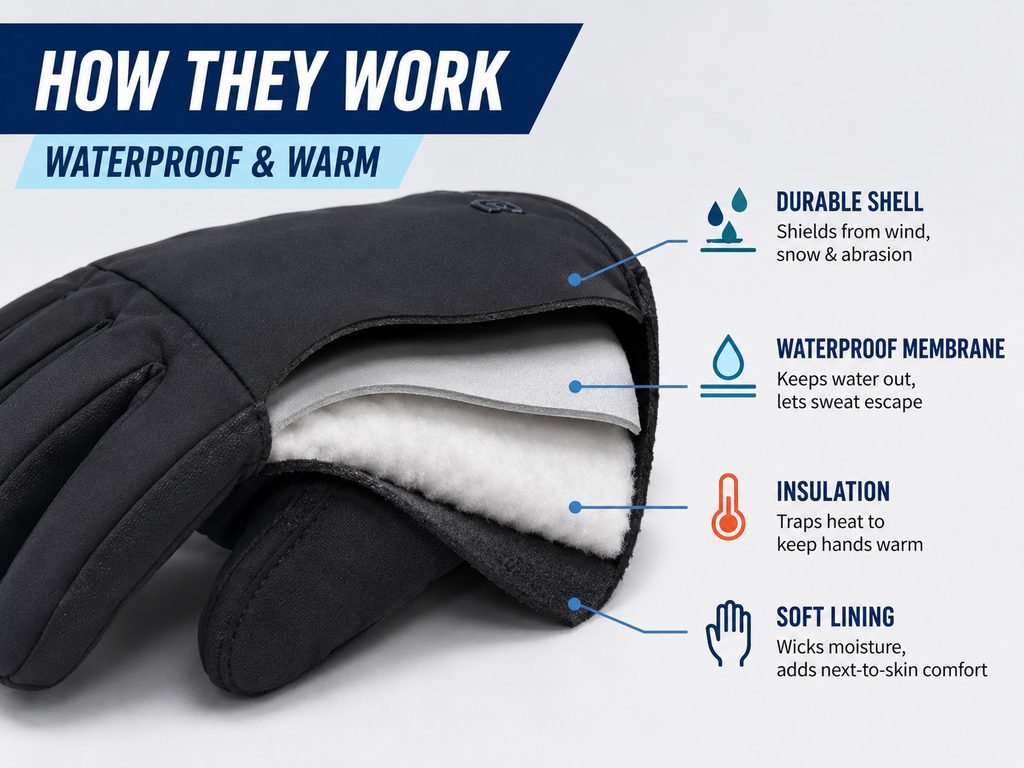
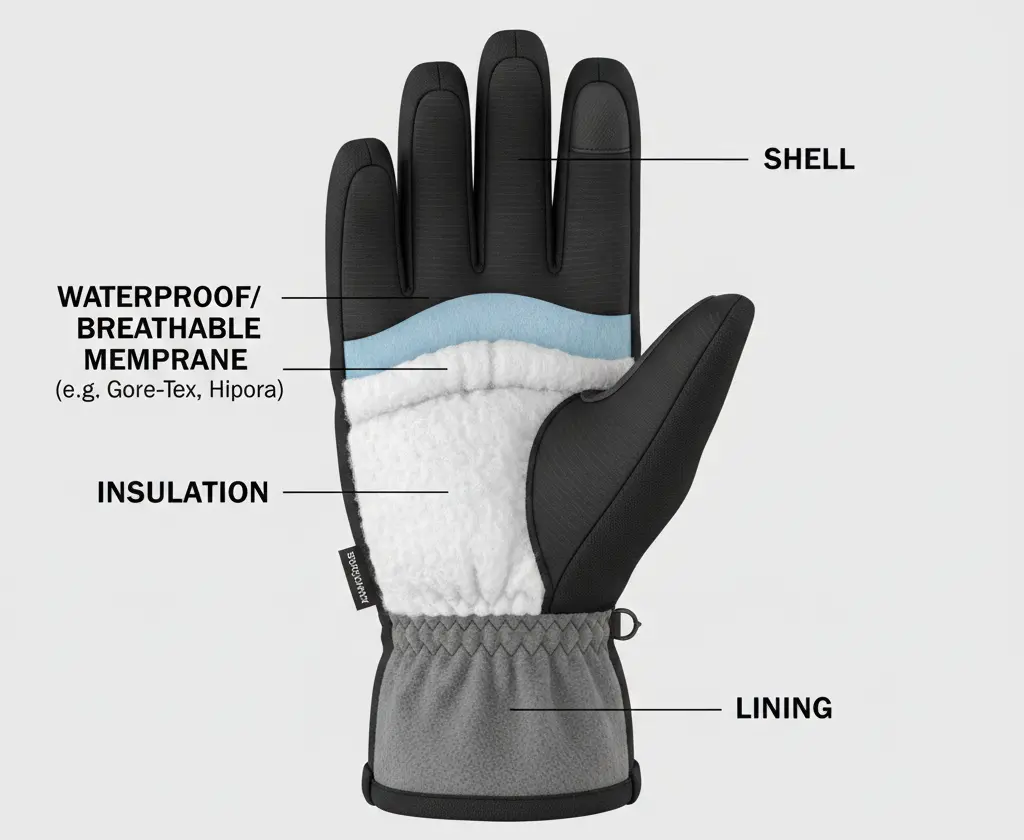
A named membrane, not just the word “waterproof.” Gore-Tex, eVent, or a specific proprietary insert (DryRide, Hipora, a brand’s in-house name) means there’s an actual layer doing the blocking. If a listing never names one, there may not be one at all — just a DWR coating on the outer fabric.
A hydrostatic head rating, if the listing includes one. This number, measured in millimeters, reflects how much water pressure the fabric can withstand in a lab setting before water penetrates through — the hydrostatic head testing process explains the mechanics in more detail than most product pages bother to. Not every glove publishes this number, but when one does, it’s a genuinely checkable data point rather than a marketing word.
Taped interior seams. A membrane can be flawless and a glove can still leak, because every seam is a row of needle holes. Quality construction tapes over those holes on the inside; cheaper construction skips it or only tapes the seams most likely to show up in a product photo.
Waterproofing Reference
| Feature | What It Verifies | What It Doesn’t Cover |
| Named membrane (Gore-Tex, eVent, proprietary) | An actual internal barrier exists, not just a surface coating | Doesn’t confirm seam quality or shell durability on its own |
| Hydrostatic head rating (mm) | Lab-measured water pressure resistance of the fabric | Measures new fabric under controlled conditions, not a broken-in glove after a season |
| Taped seams | Needle holes at stitch lines are sealed | Doesn’t help if the membrane itself is thin or absent |
| DWR coating | Outer shell resists surface wetting when new | Wears off with use and isn’t the same thing as the membrane |
| “Waterproof” on the tag alone | Nothing independently verifiable | No standard requires disclosure of what’s actually inside |
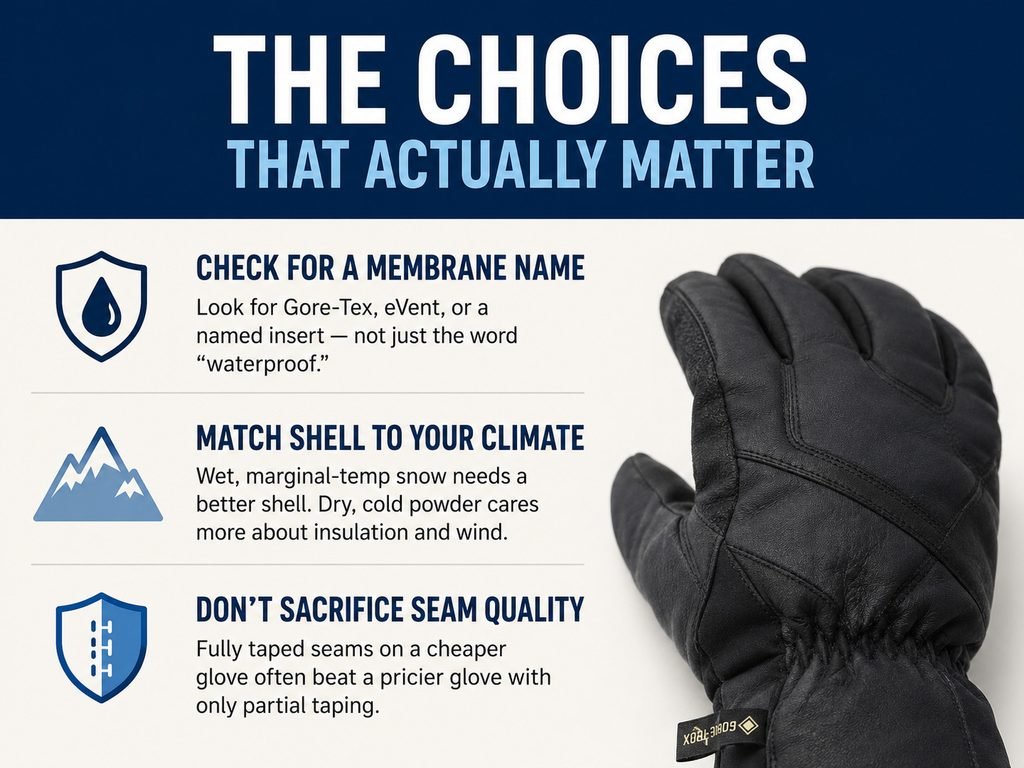
The Choices That Actually Matter
Check for a membrane name, not the word itself. Scroll past “waterproof” in any listing and look specifically for Gore-Tex, eVent, or a named proprietary insert. If none appear, treat the claim as unverified — not necessarily false, but unconfirmed from the listing alone.
Match shell material to your actual climate, not the highest price tag on the shelf. Wet, marginal-temperature snow punishes a bad shell fast; dry, cold powder is far more forgiving of shell choice and cares more about insulation and wind resistance.
Don’t sacrifice seam quality to save on price. A cheaper glove with fully taped seams will often outperform a pricier one that only taped the seams visible in a product photo — this is genuinely one of the bigger hidden differences between a $50 glove and a $130 one.
If you’re weighing that decision against an actual budget, comparing options by price tier is a faster way to see which membrane-and-shell combinations show up at which price point than reading individual spec sheets.
Waterproofing Isn’t One Category
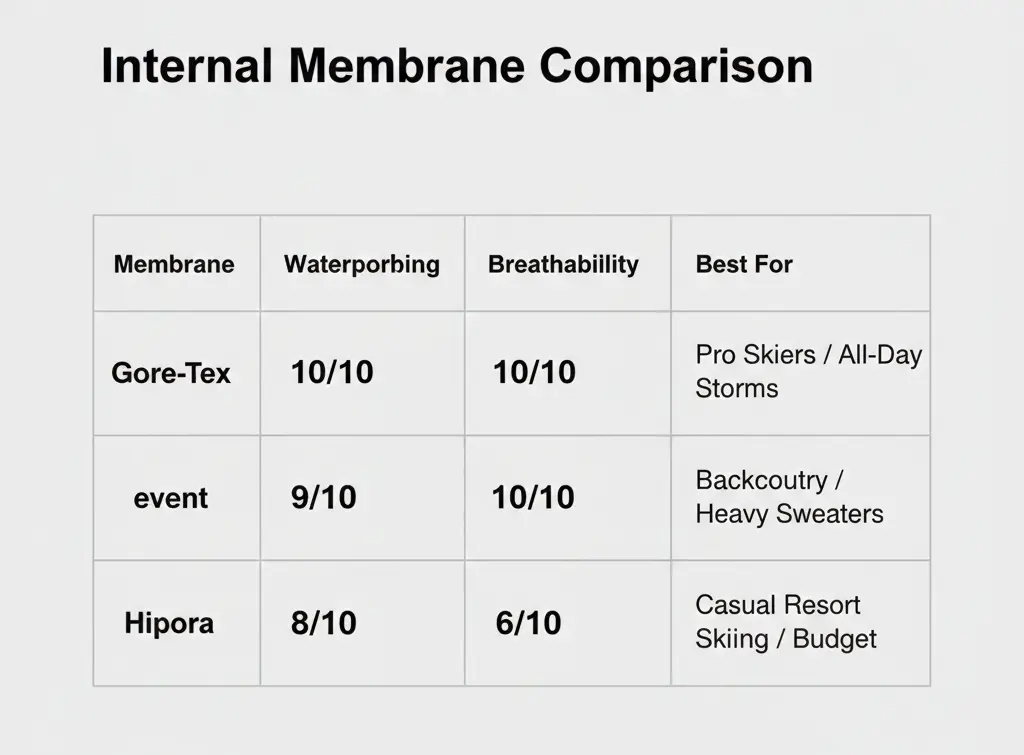
Gore-Tex is the benchmark most other membranes get compared against. As Gore-Tex’s own technology page describes it, the membrane blocks liquid water while still letting water vapor escape — which is why it holds up across a full day of mixed conditions rather than just resisting a quick splash. The trade-off is cost: you’re paying a real premium for the license and the consistency behind it.
eVent uses a similar porous-membrane approach, popular with high-output skiers who hike or skin for their turns, since it tends to breathe a little more aggressively under a heavy sweat load. It’s less common in mainstream ski gloves than Gore-Tex, so options narrow if you go looking for it specifically.
Proprietary membranes (brand-specific names like Hipora or an in-house insert) are genuinely fine for most resort skiers. They cost less than licensed Gore-Tex, and the real performance gap mostly shows up on the wettest, longest days rather than a typical resort afternoon.
DWR-only gloves have no internal membrane at all — just a chemical coating on the outer fabric. As explained in the background on how DWR treatments work, that coating is applied at the factory and wears down with use, dirt, and friction over time. This is where most buying mistakes happen, because a DWR-only glove can feel perfectly dry in the store and fail within an hour of real snow contact once the coating wears thin.
Shell material adds a second layer to this. Synthetic shells don’t absorb water the way leather does and dry faster between days, which makes them the safer default for wet, coastal conditions. Leather shells grip a pole better and age well if maintained, but untreated leather absorbs water like a sponge and needs periodic waxing to stay water-resistant — upkeep synthetic shells don’t require.
When Waterproofing Isn’t the Right Priority
Skiers in dry, cold-powder climates (interior Rockies and similar) face less external moisture threat than wind and sustained cold. A full waterproof membrane still helps, but it’s no longer the single deciding factor — insulation weight and wind resistance carry more of the load in those conditions.
Backcountry and touring skiers often work against themselves by over-prioritizing waterproofing. Sustained aerobic effort produces heavy sweat, and a heavily sealed, low-breathability glove traps that moisture instead of the snow it was designed to block. A thinner, breathable glove for the ascent with a warm waterproof pair packed for the descent is the more practical setup.
Very casual or occasional skiers should weigh the premium honestly. A well-built proprietary-membrane glove performs close enough to Gore-Tex for someone skiing a handful of days a season that the price difference rarely earns its keep at that usage level.
Why Two “Waterproof” Gloves Can Cost $40 Apart
Price differences in this category aren’t random, even when two gloves look nearly identical on a shelf. Most of the gap traces back to three things: whether the membrane is licensed (Gore-Tex) or in-house, how much of the interior seam length actually got taped, and how precisely the insulation is mapped around the fingers rather than just bulked up on the back of the hand.
A $50 glove and a $130 glove can both say “waterproof.” What usually differs is that the $130 glove tapes every seam, including the low-stress ones, uses a licensed membrane the brand pays a fee for, and maps insulation more carefully. None of that shows up in a product photo — it only shows up after a full season of real use, which is exactly why relying on the word alone tells you so little about which end of that price range you’re actually paying for.
Insulation and breathability interact with waterproofing in a way that’s easy to miss when comparing specs on paper. Two gloves can share the same membrane and still perform differently in the same conditions, simply because one traps more of your own sweat than the other. That’s not a flaw in the membrane — it’s a mismatch between insulation weight and how much moisture your hands actually produce during the activity you’re doing.
Common Mistakes When Choosing Waterproof Gloves
Trusting the word “waterproof” without checking for a membrane name. The word carries no enforcement behind it. The membrane name is what actually converts a marketing claim into something checkable.
Assuming a fully waterproof glove can’t leave hands wet. It can — from the inside. Heavily insulated, low-breathability gloves trap the sweat your hands produce constantly, and that moisture has nowhere to go except into the liner.
Buying based on shell material alone. A leather glove with no membrane and a synthetic glove with a real membrane aren’t interchangeable just because both are labeled waterproof. The membrane is the variable that matters most, not the shell.
Sizing down for a snugger feel. A too-tight glove stretches seams, widening the exact needle holes the tape is supposed to seal, while also compressing insulation and restricting the circulation that keeps hands warm in the first place.
Ignoring cuff style entirely. Even a perfect membrane and shell won’t help if snow falls directly in through the wrist opening. Gauntlet cuffs seal against a jacket sleeve; under-cuff styles rely on the jacket’s own closure instead.
Warning Signs a “Waterproof” Glove Will Fail Fast
| Warning Sign | What It Means |
| Listing never names an actual membrane, just the word “waterproof” | Claim is unverified — possibly DWR-only with nothing behind it |
| No mention of taped seams anywhere in the description | Seams may be stitched but not sealed, a common cost-cutting step |
| Reviews mention wet hands specifically on wet or slushy days, not extreme cold | Points to a shell or seam problem more often than a true membrane failure |
| Product photos show visible stitching with no interior tape detail shown | Sometimes checkable before you buy from close-up photos alone |
Matching Your Conditions to What to Look For
| Your Conditions | What Actually Addresses It | What to Check For |
| Wet, coastal, near-freezing snow | A real internal membrane, not DWR alone | Named membrane (Gore-Tex, eVent, or specific proprietary insert) |
| Dry, cold, sub-zero powder | Insulation and wind resistance more than the membrane | Insulation weight and shell wind resistance first |
| Spring or high-output skiing | Breathability over maximum sealing | Lighter membrane construction, moisture-wicking liner |
| Backcountry touring | Breathable ascent glove, warm sealed glove for descent | Two-glove system rather than one all-purpose pair |
| Frequent wet chairlift/snow contact | Sealed seams specifically | Confirmed taped interior seams, not just a membrane claim |
Self-Check: Verifying Waterproofing Before You Buy
Scroll the listing for a membrane name. Gore-Tex, eVent, or a specific proprietary insert present means the claim is checkable. Absent means it isn’t, regardless of how confidently “waterproof” appears elsewhere on the page.
Check whether a hydrostatic head number is listed. If it is, treat it as a genuine data point — higher generally means more resistance to sustained pressure — but remember it describes new fabric under lab conditions, not a broken-in glove.
Fold the cuff inside out if you’re shopping in person. Run a finger along the interior seams. Smooth tape strips mean sealed construction. Bare thread means a direct path for water regardless of what the membrane can do.
When Standard Advice Doesn’t Apply
Skiers in consistently dry, sub-zero conditions can reasonably deprioritize the membrane in favor of insulation weight and a well-maintained leather shell, since external moisture is a smaller threat than the cold itself in that specific climate.
Anyone doing high-output backcountry travel should treat breathability as equal to or more important than waterproofing, since trapped sweat from a heavily sealed glove causes more discomfort on an ascent than moderate snow exposure typically does.
Buyers replacing a glove that failed early should check seam construction before assuming the membrane was the problem — a leak that shows up specifically at the fingertips or thumb seam, rather than across the whole palm, usually points to a seam failure rather than a membrane one.
Decision Checklist
| Your Situation | Action | Priority |
| Listing says “waterproof” with no membrane named | Treat the claim as unverified | Confirm before trusting |
| No mention of seam sealing in the description | Assume seams may be untaped | Check in person if possible |
| You ski wet, near-freezing conditions regularly | Prioritize a named membrane above all else | Membrane first |
| You ski dry, sub-zero powder most of the season | Weigh insulation and wind resistance equally | Balance, not membrane-first |
| Backcountry or high-output touring | Prioritize breathability for the ascent | Two-glove system if possible |
| Casual skier, low seasonal use | Weigh the Gore-Tex premium against actual use frequency | Proprietary membrane often sufficient |
The honest version of choosing waterproof ski gloves has very little to do with trusting a hang tag and almost everything to do with checking three specific things: whether a real membrane is named, whether the shell fits your actual conditions, and whether the seams got sealed instead of just stitched.
Once those three check out, the rest of the decision — cuff style, insulation weight, price — gets a lot easier, because you’re no longer trying to compensate for a glove that was never going to keep water out in the first place. For the full breakdown of what specific mm and IP numbers mean once you’re comparing listed ratings side by side, the waterproof rating guide covers that in more depth than fits here.
Frequently Asked Questions
Is a higher hydrostatic head rating always better?
Not necessarily. A higher number means more resistance to sustained water pressure, but most resort skiing doesn’t require the highest ratings on the market — those matter more for extreme, sustained wet exposure than an average day on groomed runs.
Can a leather glove ever be genuinely waterproof?
Yes, if it has a named membrane like Gore-Tex behind the leather shell. The leather itself isn’t waterproof on its own — it needs periodic waxing — but a membrane underneath does the actual water-blocking regardless of what the shell is made from.
Do I need Gore-Tex specifically, or is a proprietary membrane good enough?
For most resort skiers, a well-built proprietary membrane performs close enough to Gore-Tex that the difference won’t be noticeable in typical conditions. Gore-Tex earns its premium mainly in sustained, extreme wet-weather use.
Why do my “waterproof” gloves feel wet even though water isn’t getting in from outside?
That’s almost always sweat, not a leak. Heavily insulated, low-breathability gloves trap the moisture your hands produce, and it has nowhere to go except into the liner.
Is checking for a membrane name worth the extra time when shopping?
Yes, and it takes under a minute in practice. A single scroll through a listing looking for Gore-Tex, eVent, or a named proprietary insert is the entire process — far less effort than most shoppers already spend comparing price or insulation weight, and it’s the one check that actually confirms whether “waterproof” means anything.