As an Amazon Associate, I earn from qualifying purchases.
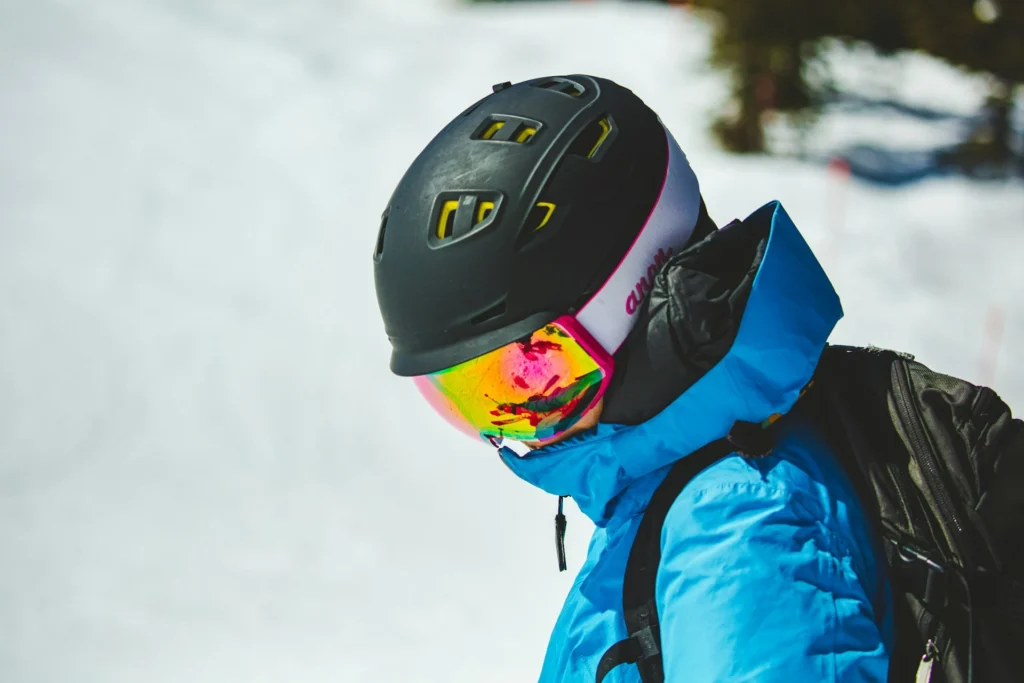
Quick Answer: A good ski helmet fits snugly, carries a safety certification and has vents you can live with. You do not need to spend $300 to get that. OutdoorMaster Kelvin II adds MIPS for $59.99. Odoland bundles a helmet and anti-fog goggles for $62.99. Smith Rodeo brings a trusted brand, MIPS and a dial fit for $105, and Giro Ledge adds a self-adjusting fit and goggle-friendly vents from $93.71 to $124.95, with the price set by color. Pick the one that fits your head and your budget, and try it with your goggles.
Helmets and gloves go together on cold days. The Ski Glove Finder helps you pick gloves for your budget and weather in about a minute.
| Helmet | MIPS | Certification listed | Vents | Listed price |
| OutdoorMaster Kelvin II MIPS | Yes | ASTM | 14 | $59.99 |
| Odoland Helmet and Goggles Set | Not listed | ASTM | 14 | $62.99 |
| Smith Rodeo MIPS | Yes | ASTM F2040, CE EN 1077 | 10 fixed | $105 |
| Giro Ledge MIPS | Yes | Not listed on the page | Stack Vent and Super Cool Vents | $124.95 (some colors $93.71) |
Prices and details come from each product page when this was written. Check them again before you buy, since sellers change prices often.
- What a Ski Helmet Does
- MIPS in Plain Words
- What the Safety Stickers Mean
- OutdoorMaster Kelvin II MIPS: The Lowest Price With MIPS
- Odoland Helmet and Goggles Set: Two Pieces in One Box
- Smith Rodeo MIPS: A Trusted Brand at an Entry Price
- Giro Ledge MIPS: Self-Adjusting Fit and Goggle Vents
- How to Size a Ski Helmet
- Helmet, Goggles and Hat: Making Them Work Together
- Spending Plan: What a Good Helmet Costs
- Why Helmets Are Worth Wearing
- What Doctors Recommend
- Helmets Help, But Control Keeps You Safe
- Caring for Your Helmet
- Mistakes When Buying a Ski Helmet
- Questions Skiers Ask
- Which One to Buy
What a Ski Helmet Does
A helmet gives your head a hard shell and a layer of foam between your skull and whatever you hit. The shell spreads out a blow, and the foam crushes to soak up energy. That is why a helmet only works once, and why you replace it after a hard crash.
It will not make you safe to take bigger risks. A helmet lowers the chance and the severity of a head injury, but it cannot stop every injury. Skiing in control, looking uphill before you start and keeping a safe distance are still your best protection.
It also helps you stay warm. Foam and ear pads keep wind off your head, and vents let heat out on warm days. A helmet with good airflow keeps you comfortable from the first lift to the last run.
MIPS in Plain Words
MIPS stands for Multi-directional Impact Protection System. It is a thin liner inside the helmet that lets the shell slide a little around your head in an angled hit. Most falls on snow are not straight-on hits, so that small slide is meant to cut the twisting force on the brain.
Three of these helmets list MIPS: the Kelvin II, the Smith Rodeo and the Giro Ledge. The Odoland page lists a shockproof shell and ASTM certification but does not mention MIPS. If you want MIPS, check the product name and the page before you buy.
| Part of the helmet | What it does | Where to look on the page |
| Outer shell (ABS or PC) | Spreads the force of an impact | Construction or materials |
| EPS foam core | Crushes to absorb energy | In-mold construction |
| MIPS liner | Lets the shell slide in angled hits | Product name or features |
| Fit dial or system | Adjusts size to your head | Adjustable fit |
| Vents | Let heat and sweat out | Number and style of vents |
| Ear pads and lining | Keep ears warm; often removable | Detachable lining or pads |
What the Safety Stickers Mean
Look inside the helmet or at the product page for a standard. In the United States, ASTM F2040 covers helmets for recreational snow sports. CE EN 1077 is a European standard for ski helmets. Smith lists both for the Rodeo, and the Kelvin II and Odoland pages list ASTM certification.
A certification means the helmet passed a set of impact tests. It does not mean it will stop every injury, and it does not replace a good fit. Buy from a brand that states its standards clearly, and avoid helmets with no mention of safety testing.
The Giro page you pasted lists MIPS and a hard shell construction but does not name a standard. Check the helmet’s label or Giro’s site when you buy. Most major brands certify their snow helmets.
OutdoorMaster Kelvin II MIPS: The Lowest Price With MIPS
OutdoorMaster Kelvin II MIPS Ski Helmet
– MIPS system with a reinforced ABS shell and shock-absorbing EPS core
– ASTM certified with 14 air vents for ventilation
– Adjustable dial fit with detachable lining, earmuffs, and chin band
~$59.99
★★★★★ (4.6/5 — 325 Amazon reviews)
Check Price on Amazon →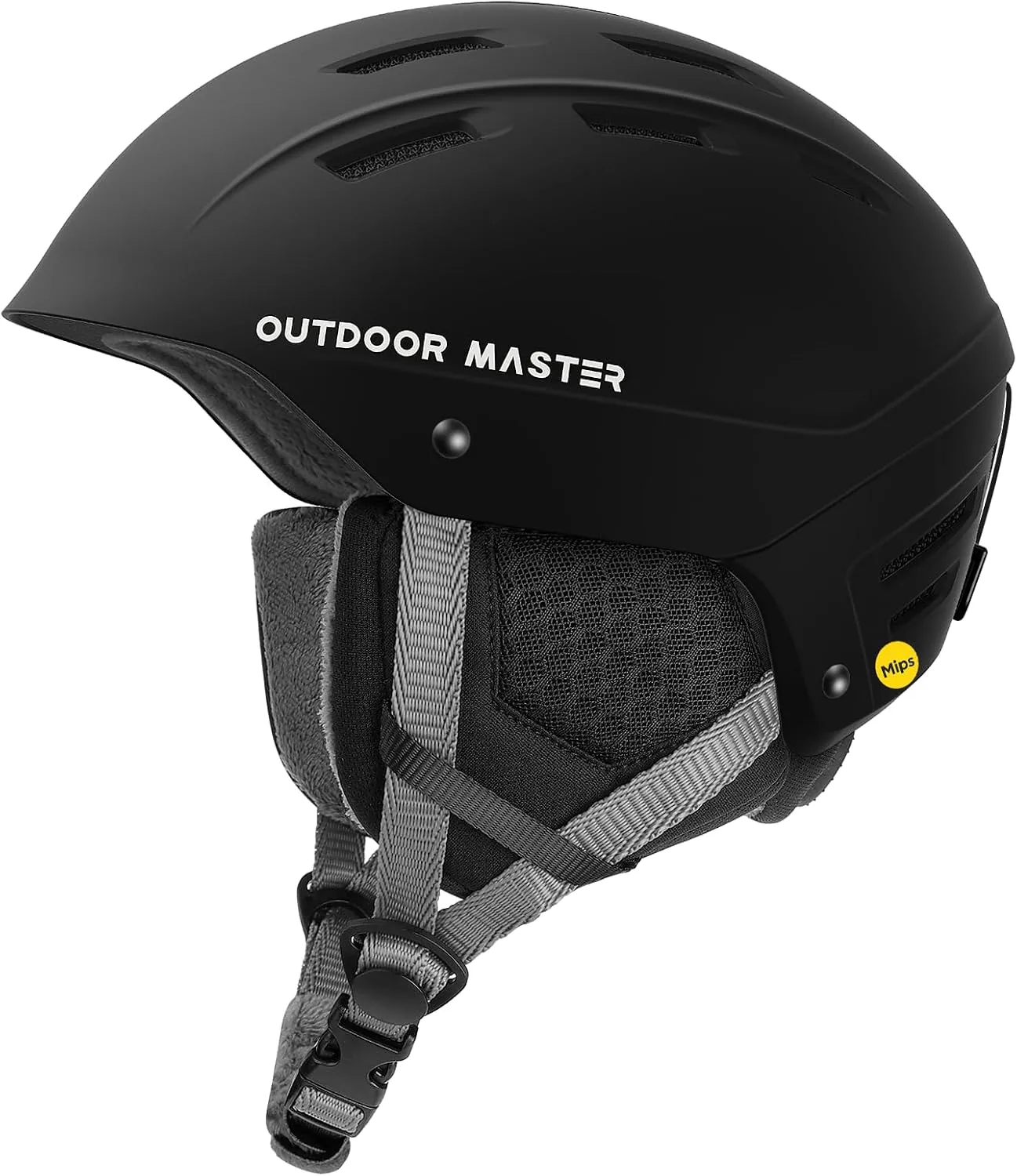
The Kelvin II costs $59.99 in Matte Black and $65.99 in Matte Gray, with nine other options. The page lists a MIPS system, a reinforced ABS shell, a shock-absorbing EPS core with in-mold construction and ASTM certification. It has 14 vents, which the page says help shield you from freezing winds while keeping air moving.
Fit is easy to adjust. A dial adjusts the size, and a detachable lining, earmuffs and soft chin band add warmth and comfort. The page says it is lightweight, which helps reduce pressure on long days. Sizes are Small (18.89 to 21.25 inches), Medium (21.25 to 22.83 inches) and Large (22.83 to 24.41 inches).
The sizing is the key detail. Wrap a tape measure around your head just above your ears, level all the way around, and pick the size that matches. If you fall between two sizes, try the helmet on with a thin hat or buff, since that changes the fit. The page says it fits adults, with an adjustable strap.
At about $60, it is the lowest price here, and a good way to add MIPS on a tight budget. The page says it pairs with OutdoorMaster ski goggles for a seamless fit, which helps if you plan to buy both. Choose it if you want MIPS, many vents and a simple dial fit without spending much.
Odoland Helmet and Goggles Set: Two Pieces in One Box
Odoland Ski Helmet & Goggles Set
– ASTM certified helmet with a PC outer shell and EPS inner shell
– Anti-fog goggles with Flow-Tech venting included in the set
– Detachable lining, removable earmuff, and a bonus carry bag
~$62.99
★★★★★ (4.6/5 — 3,392 Amazon reviews)
Check Price on Amazon →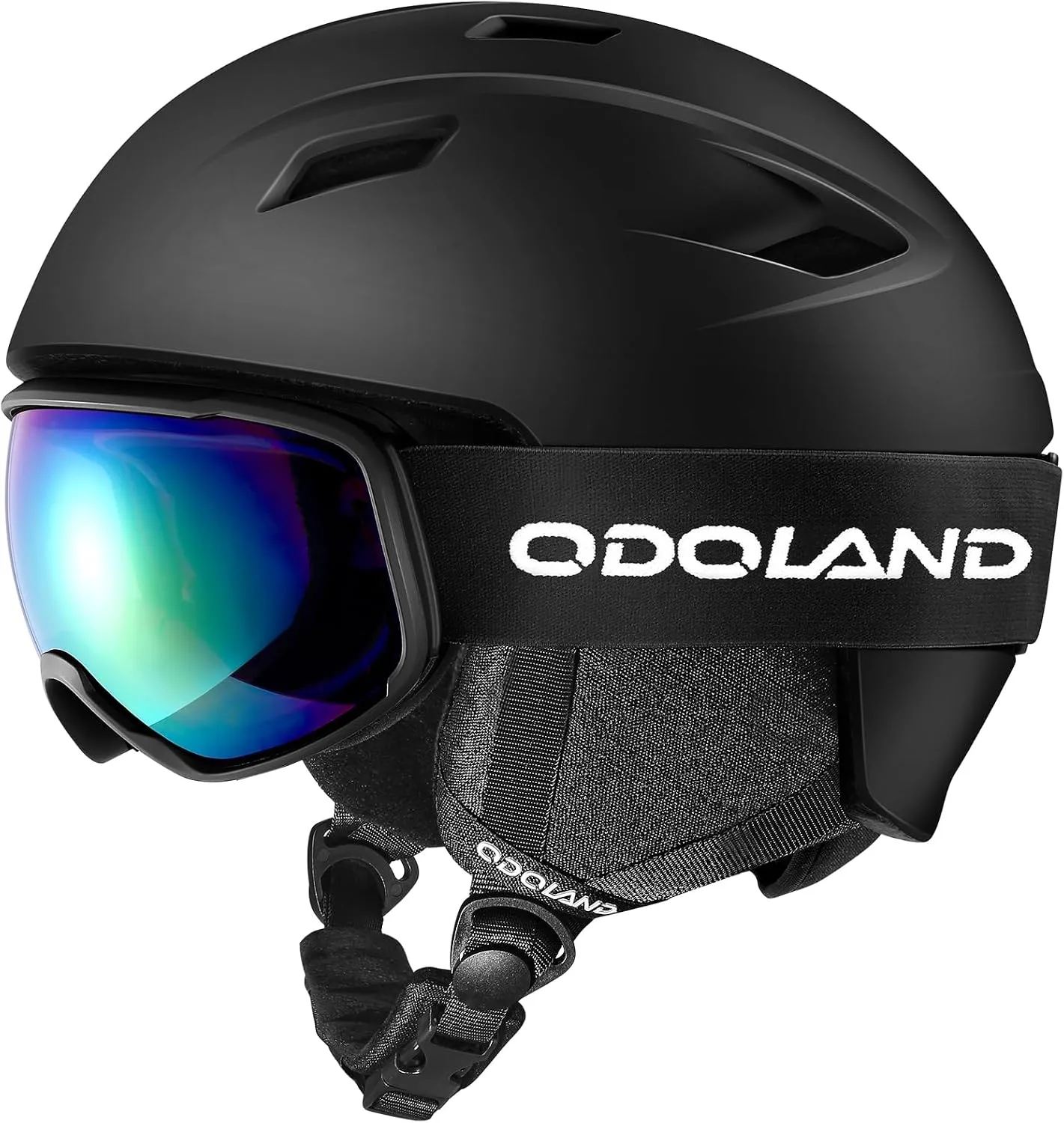
Odoland sells a helmet and detachable goggles together for $62.99, down from $69.99, in a wide range of colors. The page lists ASTM certification, a PC outer shell and an EPS inner shell for shockproof, windproof protection. It has 14 vents, a detachable lining, a removable earmuff and a soft chin band. A carry bag is included.
The goggles are the bonus. The page says they use Flow-Tech venting to reduce fogging and keep air moving inside the lens. A set means the helmet and goggles are made to work together, with a strap system that holds the goggles in place. That saves you a separate purchase and a fit check.
Sizes run from Small (52 to 55 cm) through Medium (55 to 59 cm) to Large (59 to 63 cm). Measure your head in centimeters and match it to the chart. The page lists an easy-adjust band for a snug fit and says the design is lightweight.
This listing does not mention MIPS, so if that feature matters to you, look at the Kelvin II, Rodeo or Ledge. For a skier who wants a complete head kit for about $63, it is hard to beat. Choose it if you want a helmet and goggles in one purchase.
Smith Rodeo MIPS: A Trusted Brand at an Entry Price
SMITH Rodeo MIPS Snow Helmet
– MIPS safety system with ASTM F2040 and CE EN 1077 certification
– 10 fixed vents plus AirEvac to keep lenses clear and fog-free
– Micro-adjustable dial fit with removable ear pads
~$105
★★★★★ (4.6/5 — 50 Amazon reviews)
Check Price on Amazon →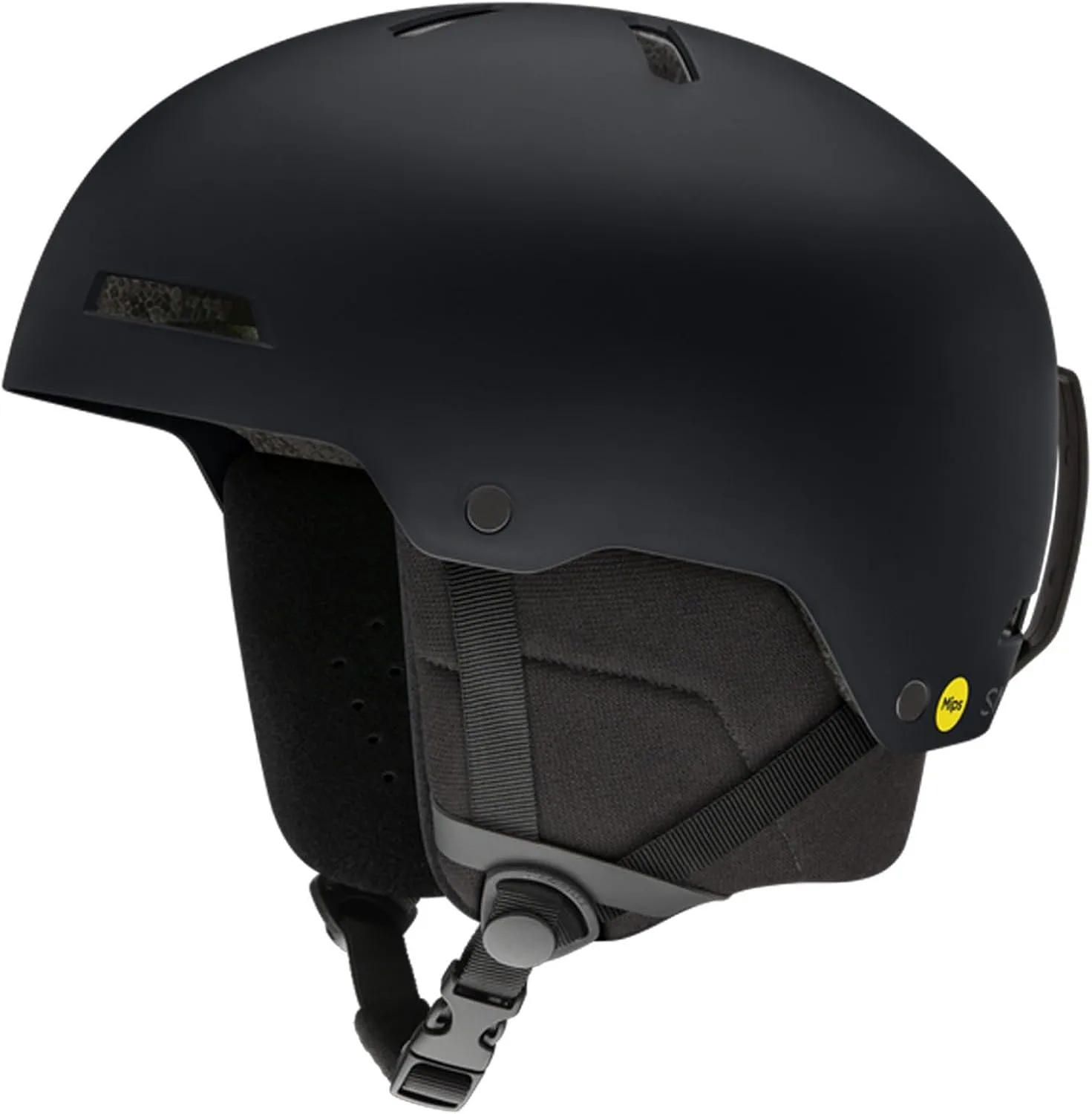
Smith lists the Rodeo at $105 in Matte Black, Matte Chalk and Matte White, in sizes Medium, Large and X-Large. The page lists an ABS shell, the MIPS system and certifications to ASTM F2040 and CE EN 1077. Smith says its design is clean and simple, with solid safety and comfort tech.
It has 10 fixed vents for steady airflow and a system called AirEvac that works with Smith eyewear to help keep lenses clear. A micro-adjustable dial lets you fine-tune the fit, and removable ear pads help you adjust the warmth. Fixed vents mean you cannot close them, so it works best across a wide range of weather.
The brand matters here. Smith has made snow gear since 1965, and its helmets are known for good build quality. The Rodeo is the maker’s entry model, so it keeps the core features and skips the extras that raise the price. Better Trail describes it as getting you Smith’s respected build quality, a MIPS liner and a fit dial for just over $100.
Choose it if you want a name-brand helmet with MIPS and certifications listed for both U.S. and European standards. If you already own Smith goggles, the AirEvac system pairs well with them. At $105, it sits in the middle of this group.
Giro Ledge MIPS: Self-Adjusting Fit and Goggle Vents
Giro Ledge MIPS Adult Snow Helmet
– MIPS protection with a hard shell attached to an EPS foam liner
– Auto Loc 2 self-adjusting fit system with on-the-fly vertical tuning
– Stack Vent aligns with goggles to help keep them clear and fog-free
~$124.95
★★★★★ (4.7/5 — 1,173 Amazon reviews)
Check Price on Amazon →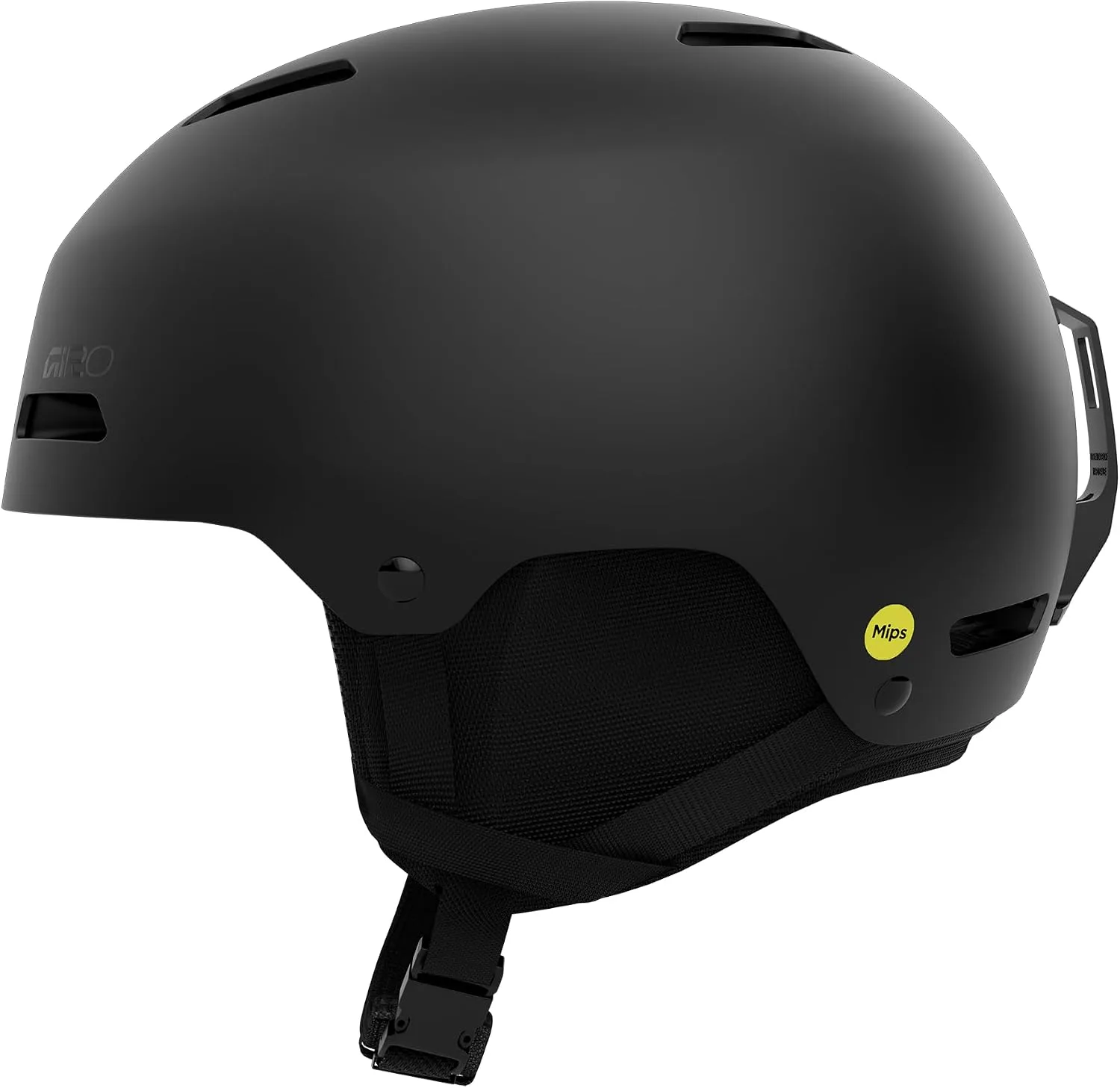
Giro’s Ledge costs $124.95 in Matte Black, with several colors at $93.71 and others from $104.95 to $134.95. The page lists MIPS, a hard shell with an EPS foam liner, and sizes from Small to X-Large. It also lists compatibility with aftermarket audio systems, removable ear pads and a removable goggle retainer.
The fit system is the star. The page describes Auto Loc 2, a self-adjusting system with an elastic band at the back and three circumference settings. On-the-fly Vertical Tuning lets you fine-tune the fit and goggle position without taking the helmet off. That means you can adjust at the top of a run with gloves on.
Vents help with fog. A Stack Vent at the front lines up with your goggles to help keep them clear, and Super Cool Vents on top let hot air escape. Giro says the helmet pairs seamlessly with its EXV goggles, and it suggests Axis, Ella and Blok goggles.
The color you pick changes the price, so shop by color if you want the lowest cost. Choose it if you want an easy-to-fit helmet from a major brand with MIPS and good goggle compatibility. Pair it with cold weather goggles next, since the helmet and goggles must seal together at the brow.
How to Size a Ski Helmet
Measure first. Wrap a soft tape measure around your head, about an inch above your eyebrows and just above your ears, and keep it level. Write the number in inches and centimeters, since brands use different units. Compare it with each size chart, which is why the Kelvin II lists inches and the Odoland lists centimeters.
Then check the fit. The helmet should sit level on your head, with the front edge about one finger width above your eyebrows. It should feel snug all around, with no pressure spots. Shake your head from side to side, and the helmet should move with your head and not slide.
The chin strap should be snug, with room for one or two fingers under it. A loose strap lets the helmet shift in a fall. Try the helmet with the goggles you plan to wear, and with a thin hat or buff if you ski in cold weather.
| Check | What good looks like | If it is wrong |
| Front edge | About one finger above the eyebrows | Too low blocks vision; too high leaves your forehead open |
| Side-to-side shake | Helmet moves with your head | Size down or tighten the dial |
| Pressure points | None after a few minutes | Try the next size up |
| Chin strap | Snug, one or two fingers of room | Adjust the strap |
| Goggle gap | No gap at the brow | Try goggles that match the helmet |
Helmet, Goggles and Hat: Making Them Work Together
Your helmet sits next to your goggles all day, so they must fit as a pair. Look for a front edge that lines up with the top of your goggles. A gap lets cold air hit your forehead and leaves a cold stripe on the skin. Brands such as Smith and Giro design their helmets and goggles to work together for this reason.
The strap matters too. The goggle strap should sit on the outside of the helmet, and the helmet’s retainer, if it has one, keeps the strap from sliding. Giro lists a removable goggle retainer, and the Kelvin II page says its design fits OutdoorMaster goggles.
In a deep cold, a thin hat or buff under the helmet helps, but too much material can make the fit loose. Choose a thin liner and test the fit. If you wear glasses, bring them and check that the helmet and goggles still seat well.
Spending Plan: What a Good Helmet Costs
A helmet is not the place to chase the lowest price, but you do not need the highest either. The four helmets here run from $59.99 to $124.95. Each lists a hard shell and a way to adjust the fit. Choose the features you will use, and put the rest toward gloves and goggles.
| Budget | Helmet | What you get |
| About $60 | OutdoorMaster Kelvin II | MIPS, 14 vents, dial fit |
| About $63 | Odoland Set | Helmet plus goggles, 14 vents |
| About $105 | Smith Rodeo | MIPS, name brand, two standards listed |
| About $94 to $125 | Giro Ledge | MIPS, self-adjusting fit, goggle vent |
If you are building a whole outfit, our ski jackets picks show how to stay warm and dry on a small budget. A helmet, goggles, jacket and gloves are the core of a good beginner outfit.
Why Helmets Are Worth Wearing
A Johns Hopkins–led review looked at 16 studies and found that helmets decrease the risk and severity of head injuries in skiers and snowboarders. The researchers also found that helmets did not seem to increase risk-taking or neck injuries, which debunks a common worry. The Johns Hopkins Hub explains helmet findings in plain language.
The same team reports that up to 20 percent of ski and snowboard injuries are head injuries, and that many happen when a rider hits a tree or the ground. Often the injured people were not wearing helmets. That is a strong reason to pick any certified helmet and wear it every run.
No helmet is a guarantee, and it does not replace skill. But the numbers favor wearing one, and a snug, well-fitted helmet is comfortable enough that you will forget it is on.
What Doctors Recommend
The Eastern Association for the Surgery of Trauma reviewed the evidence and recommends that all recreational skiers and snowboarders wear safety helmets, to reduce the number and severity of head injuries. Its guideline is available on the EAST guideline page, along with the studies behind it.
The guideline also notes that helmets do not seem to raise the risk of neck injuries or reckless behavior. In short, the medical view is clear: a helmet is a sound, low-cost way to protect your head. The cost of a basic helmet is small next to the cost of a head injury.
Helmets Help, But Control Keeps You Safe
The National Ski Areas Association shares a simple rule: a helmet helps, but you still need to ski in control. Its Responsibility Code asks skiers to stay in control, look uphill before starting and stop only where others can see you. You can read it on the NSAA safety page before your next trip.
Think of the helmet as backup, not as a license for speed. A rider who skis within their ability, keeps distance from others and respects closed trails will be safer with or without a helmet, and safer still with one.
Caring for Your Helmet
Treat your helmet like safety gear. Store it in a cool, dry place, away from heat and direct sun. Avoid leaving it in a hot car, since heat can damage foam and glue. Wipe it with a damp cloth and mild soap, and avoid harsh chemicals that may weaken the shell.
Wash removable ear pads and linings by hand. Let everything air dry before you put it back. If the helmet takes a hard hit, replace it, even if it looks fine, since the foam may be crushed inside. Many makers suggest replacing a helmet every few years, so check the label.
| Part | Care | How often |
| Shell | Wipe with damp cloth and mild soap | After muddy or wet days |
| Ear pads and lining | Hand wash if removable, air dry | Every few trips |
| Chin strap | Wipe and check for wear | Each season |
| Foam and fit system | Check for cracks or compression | After any hard impact |
Mistakes When Buying a Ski Helmet
The first is buying by looks. Color and style matter less than fit. A helmet that sits wrong cannot protect you well.
The second is skipping the measurement. Sizes differ between brands, and a tape measure takes a minute. Do it before you order.
The third is ignoring the goggles. A helmet and goggles must fit together. Try them as a pair, or buy a set.
The fourth is wearing a used helmet after a crash. The foam may be damaged. Replace it.
The fifth is choosing a helmet with no standard listed. Look for ASTM or CE marks. They show it passed tests.
Questions Skiers Ask
Do I need a helmet to ski?
No law requires one for adults in most places, but doctors recommend them. A helmet lowers the risk and severity of head injuries, and many resorts require them for kids and lessons.
Is MIPS worth it?
MIPS adds a small cost for a liner meant to reduce twisting forces in angled impacts. For about $60, the Kelvin II shows you can get it on a budget.
How tight should a ski helmet be?
Snug all around, with no pressure points. It should not move when you shake your head, and the strap should leave room for a finger or two.
Can I wear a hat under my helmet?
A thin hat or buff is fine. A thick hat can leave the helmet loose. Try the full setup before you buy.
How long does a ski helmet last?
Replace it after any hard impact. Otherwise, check the label for the maker’s advice, which is often every few years.
Are helmet and goggle sets a good idea?
They can be. A set means the pieces fit together, and it often saves money. Check the size and the features, such as MIPS, before you buy.
Which One to Buy
Want MIPS at the lowest price? Choose the OutdoorMaster Kelvin II. Want a helmet and goggles in one box? Choose the Odoland set. Want a name brand with MIPS and two standards listed? Choose the Smith Rodeo. Want a self-adjusting fit and goggle vents? Choose the Giro Ledge.
A quick look at cost: Kelvin II is $59.99, Odoland is $62.99, Smith Rodeo is $105 and Giro Ledge runs from $93.71 to $124.95. Over 30 ski days, even the priciest costs about four dollars a day. Measure your head, try the helmet with your goggles and replace it after any hard hit.
Affiliate disclosure: Some links on this page may be affiliate links. If you buy through them, skiglovesusa.com may earn a small commission at no extra cost to you. Prices, features and care instructions come from the manufacturers’ product pages and can change.