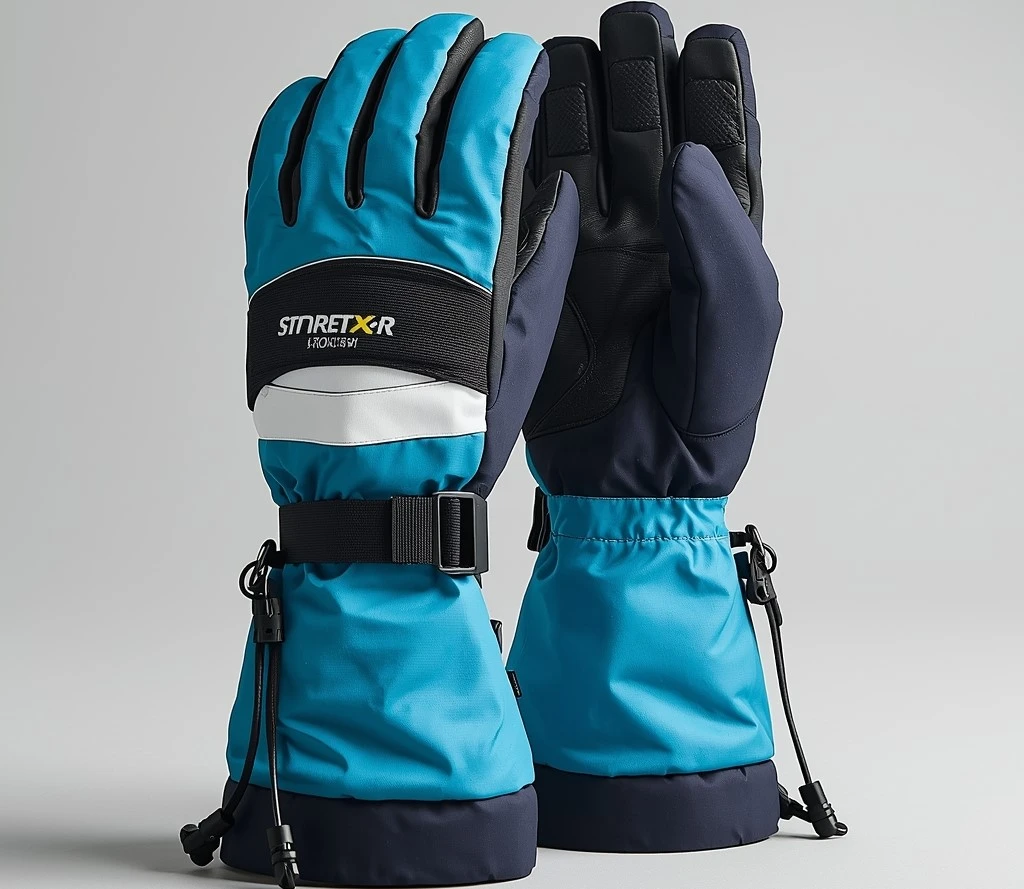
Quick answer: A wrist strap and a leash solve two completely different problems, even though they sit in roughly the same spot on a glove. The strap seals the gap between your glove cuff and jacket sleeve while you’re skiing, blocking wind and snow from reaching your wrist. The leash keeps the glove tethered to your wrist for the moments it’s off — swapping goggles, checking a phone, adjusting a boot buckle. Use only one and you’re covered for half the problem. Ski glove finder can help if strap or leash design is one factor among several you’re weighing on a new pair.
- The Wrist Strap: Sealing Out Wind and Snow
- Why a Tightened Strap Sometimes Still Lets Cold In
- The Leash: Keeping the Glove With You When It's Off
- Why the Chairlift Makes the Leash Non-Negotiable
- Neither Component Replaces the Other
- Cuff Style Changes What the Strap Actually Has to Seal
- Keeping the Strap Actually Working
- Why Wind Makes an Open Wrist Gap Worse Than It Sounds
- Common Mistakes With Straps and Leashes
- When Wrist Straps and Leashes Aren't the Real Fix
- Condition-Based Priority Guide
- Warning Signs Something's Not Working
- A Quick Pre-Season Checklist
- FAQ
The Wrist Strap: Sealing Out Wind and Snow
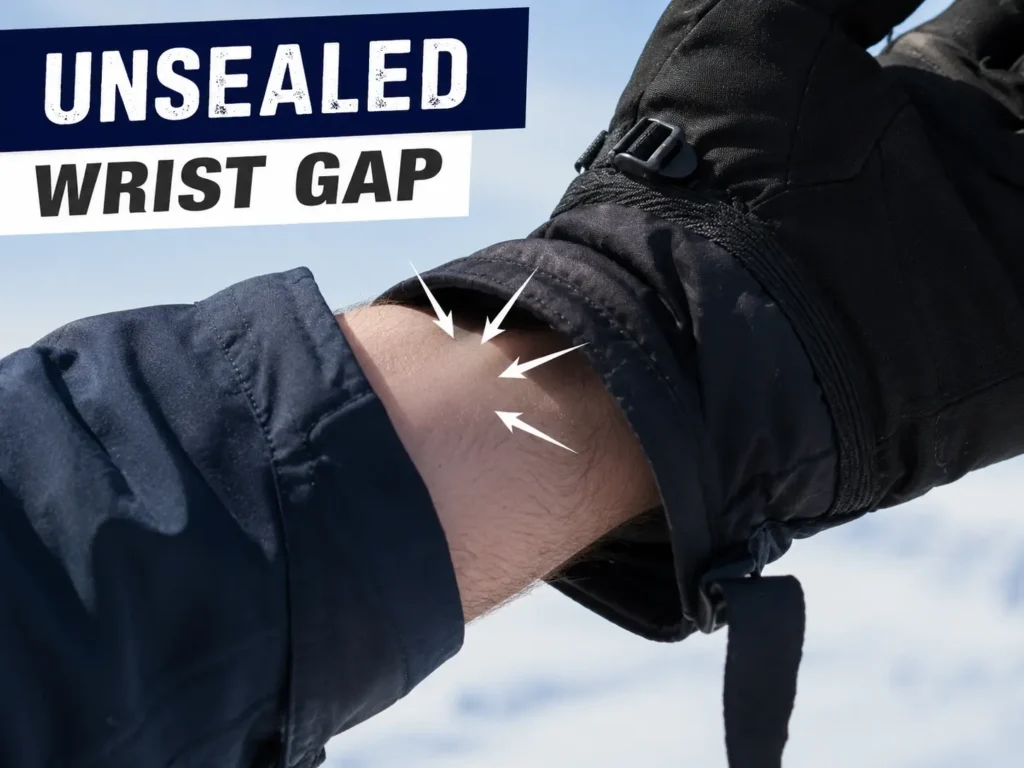
The strap’s job is mechanical and specific: close the opening where the glove cuff meets the jacket sleeve. Left open, that gap lets wind blow directly against wrist skin and lets snow work its way in during a fall or deep-powder contact. Neither problem is about insulation quality — a well-insulated glove with an open wrist gap still lets cold air reach skin the insulation was never meant to guard against.
The wrist specifically matters more than most people assume, and there’s a real physiological reason why. The hands and wrists carry a dense concentration of arteriovenous anastomoses — direct connections between small arteries and veins that play an outsized role in regulating body heat by shunting blood close to the skin surface. Cold air reaching that zone cools blood flowing through it before it ever reaches the fingers, which is why a gap at the wrist can leave fingers cold even inside an otherwise warm, well-fitted glove.
This is also why the same insulated glove can feel dramatically colder on a windy chairlift than it did during an active run moments earlier. Nothing about the glove changed — active skiing generates warmth and reduces how much time wind has to act on any given gap, while sitting still on an exposed lift gives wind sustained, uninterrupted access to whatever gap exists. The strap matters most in exactly the situation where a skier has the least ability to do anything else about it.
Why a Tightened Strap Sometimes Still Lets Cold In
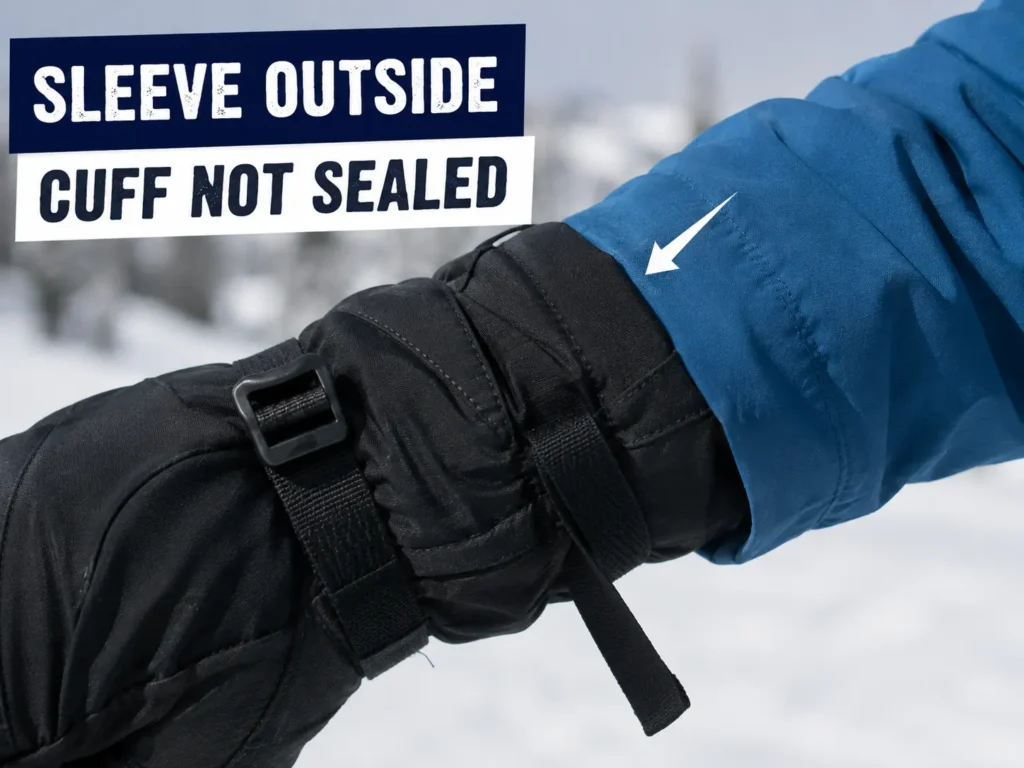
The most common strap mistake isn’t leaving it loose — it’s tightening it over the wrong surface. The seal only forms when the jacket sleeve is tucked inside the glove cuff before the strap closes. Tightening the strap around bare cuff fabric, with the jacket sleeve sitting outside it, closes the strap but leaves the actual sleeve-to-glove gap open underneath.
The correct sequence: put the jacket on, extend the sleeve fully, tuck the last couple of centimeters of sleeve inside the glove cuff, then tighten the strap so it closes over both layers together. A useful check — raise both arms overhead and flex the wrists. If the cuff and sleeve separate and expose skin, the strap needs to be tighter or the sleeve needs to be tucked in further.
It’s worth doing this check with the actual jacket you’ll be wearing, not a thinner layer. Sleeve thickness varies enough between a light shell and a heavily insulated parka that a strap adjusted around one can leave a real gap around the other, even though nothing about the glove itself changed.
The Leash: Keeping the Glove With You When It’s Off
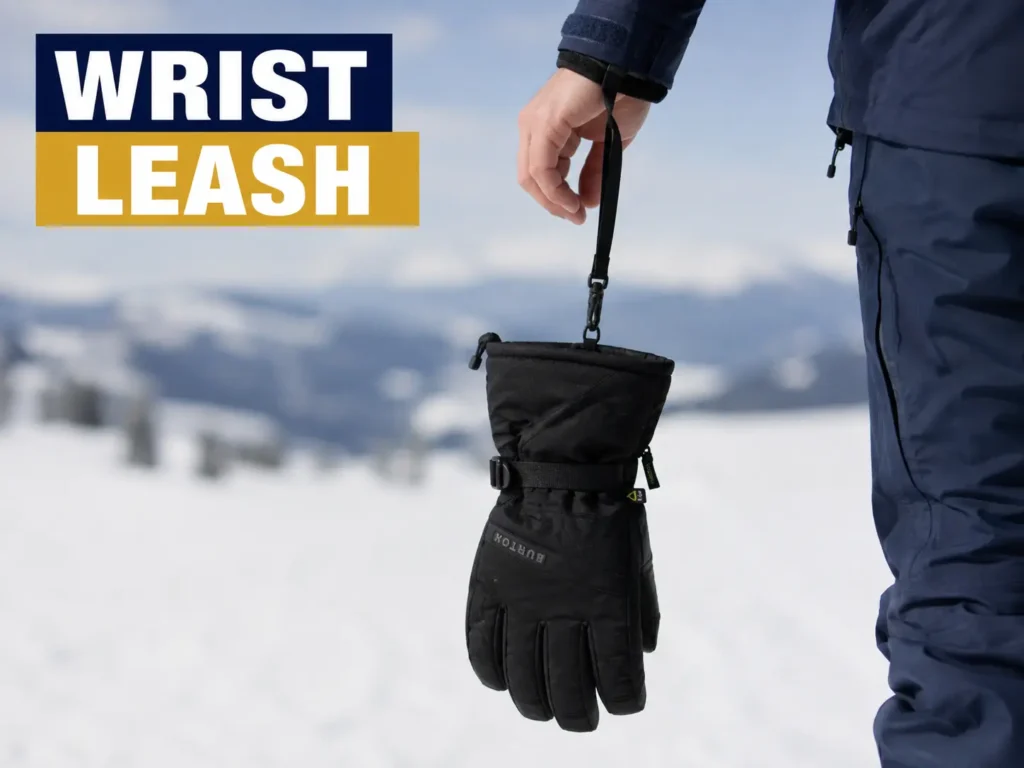
The leash does a completely different job, and it only matters during the moments a glove comes off — which happen more often across a ski day than most people track. Chairlift snack breaks, goggle adjustments, sunscreen, phone use, boot buckles after a fall — each one is a small window where a glove set down somewhere can be knocked off, blown away, or simply left behind.
The leash goes on the bare wrist before the glove, not over the glove afterward — a loop worn on the outside can’t hold a glove that’s already come off. Positioned correctly, it works passively: no action required during removal, the glove just stays tethered to the wrist wherever it goes.
Counting removal events across an actual ski day makes the case for a leash clearer than any single dramatic scenario does. Snack breaks, goggle wipes, phone photos, boot adjustments, sunscreen reapplication — a skier can easily remove gloves six to ten times across a full day without consciously tracking it. A leash doesn’t need to prevent one catastrophic loss to earn its place; it just needs to be right more often than luck would be across that many small moments.
Why the Chairlift Makes the Leash Non-Negotiable
A glove dropped from a moving chairlift falls a real distance into snow that’s often too deep and too far from the lift line to recover without ski patrol, and patrol isn’t always able to prioritize a retrieval. But the chairlift isn’t actually the most frequent removal event — it’s just the most dramatic one. The real value of a leash comes from covering every smaller removal throughout the day, not just the one everyone pictures.
Kids and beginners are worth calling out specifically here, since they tend to remove gloves more often than experienced adult skiers — adjusting boots repeatedly, fumbling with bindings, needing more frequent breaks. Higher removal frequency multiplies the odds that any single removal goes wrong, which is exactly why a leash matters more, not less, for the skiers most likely to skip it.
Neither Component Replaces the Other
A glove with a great strap and no leash seals perfectly while worn but offers zero protection the moment it comes off. A glove with a leash and no strap stays with you but leaves a cold gap at the wrist all day. Both problems are real, and they happen at different times, which is exactly why both features exist on the same glove rather than one being an upgrade over the other.
It helps to think of them as covering two separate timelines within the same ski day rather than two versions of the same feature. The strap’s entire job happens during the roughly six hours a glove is actually on a hand. The leash’s entire job happens during the cumulative minutes across that same day when it isn’t. Neither timeline overlaps with the other, which is precisely why neither can substitute for it.
Cuff Style Changes What the Strap Actually Has to Seal
A strap’s job looks different depending on cuff length. A gauntlet cuff goes over the jacket sleeve, so the strap is sealing a layer that’s already largely covered. A short cuff sits under the sleeve, which puts more of the sealing burden directly on the strap itself, since there’s less overlapping fabric to begin with. The fuller comparison of how cuff length changes this dynamic, along with wind and snow protection more broadly, is covered in the cuff style guide on this site.
Neither cuff style makes the strap optional — it just changes how much work the strap is doing relative to the cuff itself. A gauntlet with a loose or poorly tightened strap can still leak wind around the edges of that overlap, and a short cuff with an excellent strap can still perform well despite less overlapping fabric, since the strap is doing more of the sealing work directly rather than relying on the cuff’s length to help.
Keeping the Strap Actually Working
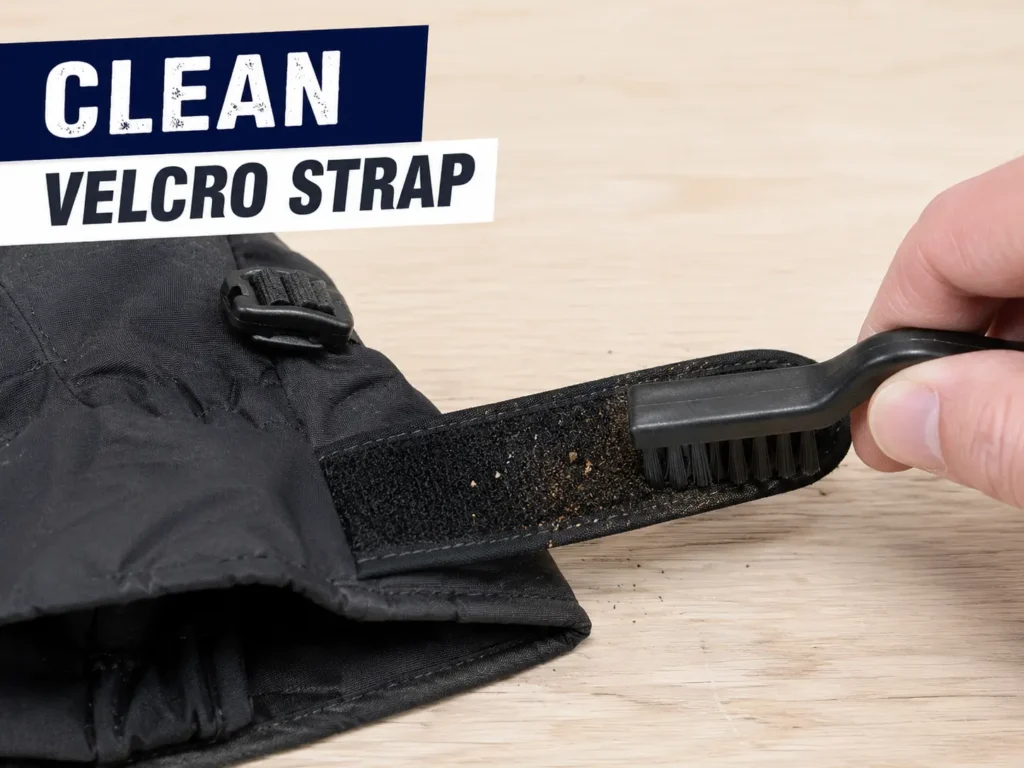
Velcro wrist closures are the most common strap mechanism, and they degrade in a specific, fixable way. The hooks collect lint, snow crystals, and glove fiber over a season, and once enough debris packs into them, the official Velcro brand guidance confirms exactly what’s happening: trapped debris blocks the hooks from reaching the loop material, which reduces bond strength even though the closure looks intact. A stiff brush runs through the hook side before each trip restores most of the lost grip. If the hooks themselves are visibly flattened rather than just dirty, cleaning won’t fix it — that’s genuine wear, not buildup, and the closure needs replacing.
Non-Velcro strap systems — drawcords, elastic bands with a cinch — fail differently. Elastic loses tension gradually through repeated stretch cycles over a season, the same fatigue any elastic material experiences with use, which is a slower, less obvious failure than a clogged Velcro strip going quiet all at once. A drawcord’s failure point is usually the cord lock mechanism rather than the cord itself — check that it still holds tension under a firm tug, not just that the cord feels intact.
Why Wind Makes an Open Wrist Gap Worse Than It Sounds
Still air near skin insulates reasonably well on its own — it’s moving air that strips heat away fast. The underlying mechanism is straightforward convective heat transfer: moving air continuously replaces the thin, warmed layer of air right against skin with new, cold air, and that constant replacement is what makes wind feel so much colder than the actual air temperature alone would suggest. A wrist strap blocks exactly this mechanism at exactly the zone where it matters most for hand temperature.
This also explains a pattern many skiers notice without understanding why: standing still in wind feels colder than skiing through the same wind at speed. It seems backwards, since skiing adds the wind of your own motion on top of ambient wind. The difference is that active skiing generates continuous body heat production, which offsets a good portion of that added convective loss, where standing still on a lift generates almost none — the wind exposure is similar, but the body’s ability to keep up with it is not.
Common Mistakes With Straps and Leashes
Tightening the strap once in the morning and never checking it again is a common one. Straps loosen through a session’s worth of arm movement and flexing, and a strap that was snug at 9am is often noticeably looser by the first lift ride.
Wearing the leash loop over the glove exterior instead of under it defeats the entire mechanism — a loop that isn’t in contact with the wrist itself can’t hold anything once the glove comes off.
Attributing cold fingers to insufficient glove insulation, when the actual cause is an unsealed wrist strap, is the costliest mistake — it leads to buying a warmer, more expensive glove that has exactly the same open gap and produces exactly the same cold-finger result.
A less obvious mistake: assuming a leash that came pre-attached is automatically still functional. Leash attachment points take real load every time a glove hangs from one, and repeated loading over a season can loosen stitching or hardware without any visible sign until the moment it actually fails. A quick tug test at the start of each season — pulling firmly on the leash where it meets the glove body — catches this before it matters.
When Wrist Straps and Leashes Aren’t the Real Fix
If fingers are cold on a calm, low-wind day, the wrist gap isn’t the likely cause, since there’s no wind driving convective cooling through it in the first place — that points toward insulation weight or circulation instead. And if a glove is genuinely the wrong size, shifting or restricting circulation under grip load, strap adjustment can’t compensate for a fundamentally incorrect fit.
There’s a useful diagnostic order worth following when hands are cold and the cause isn’t obvious. Check the strap and sleeve position first, since it’s the fastest thing to verify and rule out. If that’s confirmed sealed and cold hands persist, move to insulation weight next. Only after both of those check out is circulation or a genuine fit problem the more likely remaining explanation — working through them in that order avoids replacing an expensive glove to fix what was actually a thirty-second strap adjustment.
Condition-Based Priority Guide
| Condition | Priority | Why |
| Cold, windy, exposed terrain | Wrist strap | Wind reaching the wrist cools blood flow to fingers within minutes |
| Powder and deep snow | Wrist strap | Falls and wrist-deep contact push snow past an unsealed cuff |
| Chairlift rides with glove removal | Leash | A dropped glove from height is frequently unrecoverable |
| Lodge breaks, equipment adjustments | Leash | These are the most frequent removal events on a ski day |
| Backcountry or off-piste | Both equally | Frequent gear changes plus resumed skiing need both functions |
| Beginner skiers | Both | Highest removal frequency plus least experience managing either component |
Warning Signs Something’s Not Working
| Warning Sign | Likely Cause |
| Cold fingers arriving suddenly mid-run in wind | Wrist gap open — strap not tightened or sleeve not tucked in |
| Snow at the wrist after falls | Cuff not sealed — same fix as above |
| Glove shifting during aggressive movement | Strap too loose, or glove is the wrong size |
| Leash uncomfortable or digging in | Routed over the glove instead of under it, against skin |
| Strap tightened but wrist still cold | Sleeve not actually tucked inside the strap perimeter |
| Velcro not holding through a run | Hooks clogged with debris, or worn flat and needing replacement |
A Quick Pre-Season Checklist
- Tuck the jacket sleeve inside the cuff before tightening the strap, every time, not just on day one
- Re-check strap tension at every chairlift boarding — straps loosen through normal movement
- Put the leash loop on the bare wrist before the glove, never after
- Inspect the leash attachment point at the season’s start for fraying or loose stitching
- Clean Velcro hooks with a stiff brush before each trip, and replace if hooks are visibly flattened
- If cold fingers persist with a properly sealed strap, look at insulation or fit instead
FAQ
Do all ski gloves come with both a strap and a leash?
Most do, but not universally — some budget or minimalist gloves skip the leash specifically. If a glove lacks one, an aftermarket leash is a simple, low-cost addition rather than a reason to avoid an otherwise good glove.
Can a leash replace a wrist strap’s function?
No — a leash does nothing while the glove is being worn, since it only activates once the glove comes off. They cover two separate windows of a ski day and neither substitutes for the other.
Is it normal for a wrist strap to feel tight?
Snug is correct; genuinely tight enough to feel constant pressure or affect circulation is not. The goal is no gap opening under arm movement, not maximum tightness.
Why does my strap feel fine in the shop but loose on the mountain?
Cold temperatures can slightly stiffen elastic and Velcro components compared to how they feel at room temperature indoors, and thicker gloves worn with thicker jacket layers on-mountain change the fit compared to trying gloves on with a t-shirt sleeve in a store. Adjusting the strap on your first real ski day, not just at purchase, accounts for both differences.