As an Amazon Associate, I earn from qualifying purchases.
Quick Answer: For cold days, look for goggles with a double lens, an anti-fog inner coating, working vents, soft multi-layer foam and a strap that sits well over a helmet. findway and OutdoorMaster give you that package for about $30 and also fit over glasses. Odoland adds two magnetic lenses, one for sun and one for low light, at about $45. Smith 4D MAG is the premium pair at $355, with a wider field of view and a quick lens swap. Pick by budget and by how often you face bitter cold.
Cold hands go with cold eyes. The Ski Glove Finder helps you match gloves to your budget and weather in about a minute.
| Goggle | Lens | Anti-fog | Fits over glasses | Listed price |
| findway OTG | Double lens, frameless spherical | Inner lens coating plus vents | Yes | $28.49 |
| OutdoorMaster OTG | Dual-layer lens, VLT 10% to 11.5% | Anti-fog inner lens | Yes | $29.99 |
| Odoland Magnetic | Two magnetic lenses, frameless | Ventilation channels | Yes | $44.99 |
| Smith 4D MAG | ChromaPop, MAG lens swap | Helmet-matched venting | Not stated | $355 |
Prices and details come from each product page when this was written. Check them again before you buy, since sellers change prices often.
- Why Goggles Fog When It Gets Cold
- What Cold Weather Asks of a Goggle
- Lens Tint and VLT in Plain Words
- findway OTG Ski Goggles: Double Lens at a Low Price
- OutdoorMaster OTG Goggles: Simple, Light and Helmet-Ready
- Odoland Magnetic Goggles: Two Lenses in One Box
- Smith 4D MAG: The Premium Pair
- Wearing Goggles With a Helmet and Gaiter
- Eye Protection Is More Than Fog Control
- What Standards Say About Ski Goggles
- Quick Habits That Keep Lenses Clear
- What to Do When Goggles Fog Anyway
- Match the Goggle to Your Cold Day
- Mistakes That Make Goggles Fog
- Questions Skiers Ask
- Which One to Buy
Why Goggles Fog When It Gets Cold
Fog is simple physics. Your face is warm and damp. Your lens is cold. When warm, moist air hits a cold surface, it turns to tiny drops of water, and your view goes soft. The colder the day, the bigger the gap, and the easier it happens.
Breath is the biggest source. Every time you breathe out, damp air slips up past your nose and into the goggle. Sweat from your forehead adds to it. Snow that melts on the foam adds a little more. A goggle has to move that damp air out faster than it builds up.
Three things help. A double lens keeps a pocket of air between your face and the cold outer lens. An anti-fog coating on the inside spreads moisture into a thin film so it does not bead. And vents let the damp air leave. A goggle that combines all three gives the best chance of a clear view.
What Cold Weather Asks of a Goggle
Bitter cold adds a few demands beyond fog. Wind pushes cold air through gaps, so the foam must seal against your face. Soft foam stays comfortable on cold skin, and several layers hold in a bit more warmth. A strap that fits your helmet closes the gap at your temples and keeps the goggle from sliding.
| Feature | Why it helps in the cold | Where it shows up here |
| Double lens | Air gap slows fogging and cold transfer | findway, OutdoorMaster |
| Anti-fog inner coating | Spreads moisture into a thin film | findway, OutdoorMaster |
| Vents or channels | Let damp air out | findway, Odoland, Smith |
| Multi-layer foam | Soft seal that keeps drafts out | findway, Odoland, Smith |
| Long, non-slip strap | Stays put over a helmet | All four |
| Quick lens swap | Switch for storms or bright sun | Odoland, Smith |
Hands matter too. A goggle strap, a zipper and a lift ticket all need working fingers, which is why our guide to gloves for freezing temperatures pairs well with a good goggle. Keep both warm, and you stay out longer.
Lens Tint and VLT in Plain Words
VLT stands for visible light transmission. It is the share of light that passes through the lens. A low number means a dark lens for bright sun. A high number means a clear or yellow lens for clouds, snow and dusk. GearJunkie’s testers say the best lenses for sunny days sit between 5% and 20% VLT.
| Conditions | VLT to look for | Lens look |
| Bright sun, bluebird day | About 5% to 20% | Dark or mirror |
| Mixed light, some cloud | About 20% to 40% | Rose, copper or gold |
| Flat light, snowfall, dusk | About 40% and up | Yellow, clear or light rose |
Cold days can be bright or dark, so a goggle with a second lens covers more. Odoland ships with a yellow lens listed at VLT 80% for overcast and night. findway lists many lens options from about 7% to 46%, and OutdoorMaster lists dark lenses around 10% to 11.5%. Smith includes an extra low-light lens with the 4D MAG.
findway OTG Ski Goggles: Double Lens at a Low Price
findway Ski Goggles OTG
– Double lens with anti-fog, anti-scratch, and full-face mirror coating
– Ventilation system moves air across the lens to reduce fogging
– Oversized OTG design with a silicone-backed non-slip strap
~$28.49
★★★★★ (4.6/5 — 4,761 Amazon reviews)
Check Price on Amazon →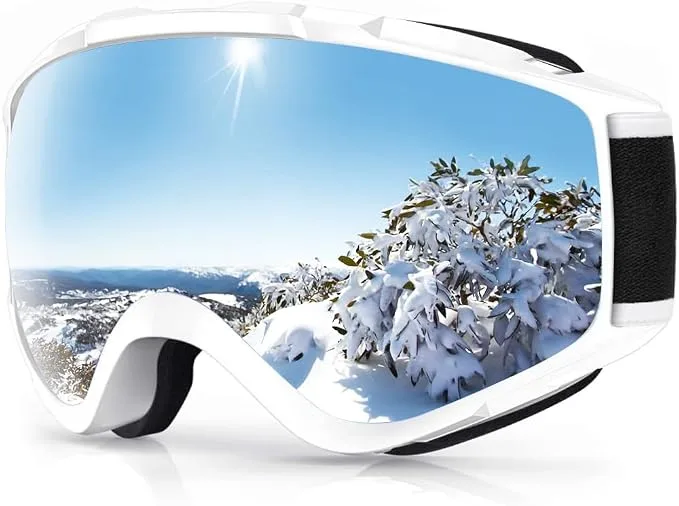
findway lists these at $28.49, down from $29.99. The page describes a double lens with an anti-fog inner lens, a ventilation system that moves air over the inside of the lens, and a frameless spherical lens for a wide view. The frame is TPU with triple-layer foam, and the strap is silicone-backed and non-slip. There are many colors and lens tints, from about 7% to 46% VLT.
The OTG shape means it fits over glasses, which helps if you wear them. It also adds room, so there is space for your face to breathe and for foam to seal without pressing on your frames. The page says it works with helmets and comes with a one-year guarantee.
For care, the page says to keep the goggles in their pouch and let them air-dry after use. It says to avoid wiping the inner lens often and not to clean the outer lens with fingers or a rough cloth. That advice matters in the cold, since a scratched anti-fog layer cannot be repaired.
The page lists it for adults and teens aged 12 and up. If you want cold-day goggles with a double lens, vents and a helmet-friendly strap at a small price, this is a strong place to start. Pick a tint that matches the light where you ski most.
OutdoorMaster OTG Goggles: Simple, Light and Helmet-Ready
OutdoorMaster OTG Ski Goggles
– Over-the-glasses design fits adults and youth
– Dual-layer lens with anti-fog coating and 100% UV400 protection
– Soft TPU frame with extra-long strap for helmet compatibility
~$29.99
★★★★★ (4.6/5 — 10,714 Amazon reviews)
Check Price on Amazon →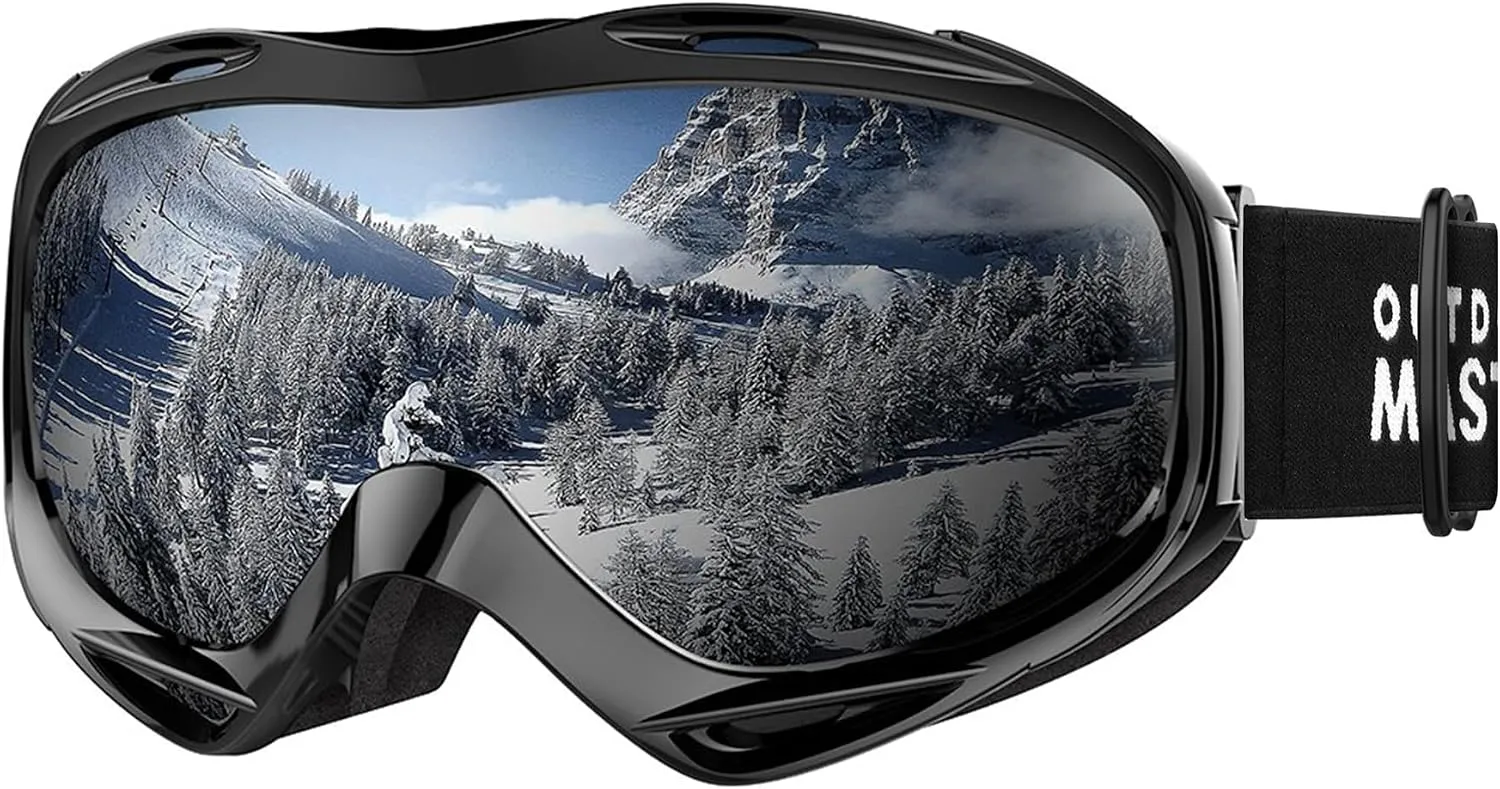
OutdoorMaster costs $29.99 for the standard colors, and one lens option costs $47.38. The page lists dual-layer lens technology with an anti-fog inner lens, 100% UV400 protection and a soft TPU frame. The lens options include VLT 11% and VLT 10%, in black and white frames, and one at 11.5%. It comes with a carrying pouch.
The strap is extra long and elastic, and the page says it works with all helmets. That is a big plus in cold weather, since the strap needs to sit snug over a helmet and not slip with gloves on. The goggles suit adults and youth, and the OTG design leaves room for glasses.
The UV400 label is the seller’s claim, so look for it on the goggle itself as well. UV400 means the lens blocks light up to 400 nanometers, which covers UVA and UVB. We explain why that matters in the eye safety section below.
At about $30, it is one of the easiest ways to get a double lens and an anti-fog layer. Choose it if you want a no-fuss goggle for cold days, with a dark lens for sunny mornings and a pouch to protect it in your bag.
Odoland Magnetic Goggles: Two Lenses in One Box
Odoland Magnetic Ski Goggles OTG
– Two interchangeable lenses swap in seconds with a magnetic frameless design
– Wide unobstructed lens with ventilation channels to prevent fogging
– OTG fit with multi-layer foam lining and an extra-long adjustable strap
~$44.99
★★★★☆ (4.5/5 — 751 Amazon reviews)
Check Price on Amazon →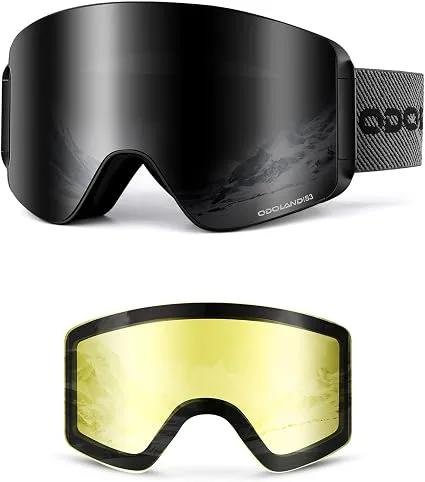
Odoland lists these at $44.99 with 10% off, down from $49.99, in many colors. The big idea is the magnetic lens swap. The page says two lenses come in the box: a cylindrical lens for sunny slopes and a yellow lens, listed at VLT 80%, for overcast and night. You switch in seconds, with no tools.
The frameless design gives a large, open view. The page lists ventilation channels that move air to prevent fogging during hard runs, and multi-layer foam lining for warmth and cushioning. At 0.66 pounds, it is light, which helps on long days. An extra-long adjustable strap fits over headwear, and the OTG shape fits over glasses.
Two lenses matter more in the cold than people expect. A winter day can start in bright sun and end in a snowstorm. Instead of carrying a second goggle, you swap the lens at the chairlift. The page says to hand wash with mild soap and lukewarm water and store the goggles in a cool, dry place, away from direct sun.
Choose it if you ski in changing weather and want two lenses for under $50. If you are watching your gear budget, our best ski gloves pick cover options at many prices, so you can plan goggles and gloves together.
Smith 4D MAG: The Premium Pair
SMITH 4D MAG Snow Goggles
– BirdsEye Vision widens the field of view by 25%
– ChromaPop lens technology enhances contrast and natural color
– MAG magnetic lens change system with an extra low-light lens included
~$355
★★★★☆ (4.2/5 — 39 Amazon reviews)
Check Price on Amazon →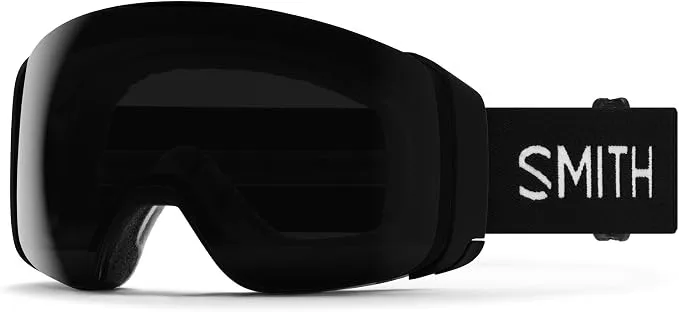
Smith’s 4D MAG costs $355 and is made in the USA. The page highlights BirdsEye Vision, which adds 25% to the field of view, and ChromaPop lenses made to boost contrast and natural color. It comes in two colors, Black with Everyday Green Mirror and Black with Sun Blue Mirror, and in sizes Medium and X-Large.
The MAG system uses magnets for a quick lens change. The goggles include an extra lens for low light. Smith says it is built for tight integration with its helmets, for comfort, venting and fog-free performance, and the QuickFit strap makes it easy to adjust. The silicone-backed strap stays put.
Better Trail’s testers rate the 4D MAG’s clarity and contrast highly and describe its triple-layer foam as soft on skin, and REI’s testers named it Editor’s Choice. Treat those as good signs, not guarantees, since fit changes from face to face. Try it on with your helmet before you commit.
The care steps are simple. Store it in the microfiber bag with the lens sleeve, use the gogglesoc lens protector when it is not in use, and clean gently with a soft, damp cloth. At $355, it suits skiers who spend many days a year on the hill and want the best clarity they can buy.
Wearing Goggles With a Helmet and Gaiter
Your goggles have to work with the rest of your gear. Put your helmet on first, then the goggle, and check that there is no gap between the top of the goggle and the helmet brim. A gap lets cold air hit your forehead and can cause a cold stripe on the skin. Adjust the strap so the goggle sits snug but not tight.
A neck gaiter pulled over your nose can push breath up into the goggle. If your lens fogs, drop the gaiter below your nose on easy runs, or leave a small gap so breath leaves downward. Some skiers choose a thin, breathable fabric to help moisture escape.
Keep the goggles on your face while you ski and off your forehead while you stop. When you push goggles up, warm, damp air from your skin gets trapped inside and can freeze the lens. Pull them down only when you are ready to ski.
Fit changes by face. A goggle that sits well on one skier can leave a gap on another, so try each pair with your helmet and your gaiter. Check the nose area first, since that is where cold air and breath slip in. Smith lists its 4D MAG in Medium and X-Large, while the other three list one size, so check the shape of the frame against your face.
Eye Protection Is More Than Fog Control
Bright snow bounces sunlight back at your eyes. The American Academy of Ophthalmology explains that snow blindness is a painful form of photokeratitis caused by UV rays reflected from snow and ice. It says sunglasses or goggles that block at least 99% of UV rays, and shield you from dry, freezing wind, help prevent it. Read its snow blindness guide before a bright cold trip.
Like a sunburn, the damage may not show until hours later. That is one reason UV protection matters on cloudy days too. Check that your goggle lists UV400 or 100% UV protection, and replace lenses that are badly scratched.
The cold wind makes your eyes water and dry out as well. A goggle that seals well keeps wind off your eyes, which lowers watering and keeps your view clearer. This is why a good seal matters as much as the lens in freezing weather.
What Standards Say About Ski Goggles
For years, ASTM F659 was the standard for ski and snowboard goggles in the United States. The ANSI blog explains that it set rules for optics, lens strength, UV stability and fog resistance. You can read its summary of the ski goggle standard for more detail.
One catalog lists the latest version as withdrawn in 2024, so newer goggles may follow other standards or the maker’s own tests. The takeaway is simple: look for clear labeling about UV protection and impact resistance, and buy from a maker that explains how its lenses are tested.
Quick Habits That Keep Lenses Clear
Global Rescue advises wearing 100% UV-blocking goggles or sunglasses even on cloudy days, and its prevention tips are a quick read. Beyond UV, a few habits protect your lens and your view.
Never wipe the inside of the lens with a glove or a rough cloth. It scratches the anti-fog coating. Shake off snow, then let the goggle air dry in a warm, dry place. Store it in the pouch, and keep it away from heaters, which can warp foam and damage coatings.
Carry a spare lens or a second goggle on very wet days. Replace foam that has gone flat or torn, since a poor seal lets in cold air and breath. And never breathe on the lens to defog it, because it only adds moisture.
What to Do When Goggles Fog Anyway
Even good goggles fog sometimes. When it happens, do not wipe the inside. Stop somewhere safe, lift the goggle away from your face for a minute and let the air move through it. Shake off loose snow, and let the lens clear on its own.
Then check the cause. Is your gaiter pushing breath up? Are the vents blocked by your helmet or hat? Is the foam packed with snow? Fixing the source works better than any quick wipe. If the lens is wet inside, ride the chairlift with the goggles on your lap and let the wind dry it.
A spare dry goggle or lens saves a cold afternoon. If you often ski in heavy snow, keep a second lens in an inner pocket, where it stays warm. Swapping to a dry lens takes a minute and clears the problem at once.
Match the Goggle to Your Cold Day
| Cold day | What it feels like | Goggle to reach for |
| Bluebird and frozen, below 15°F | Bright sun, hard glare | OutdoorMaster or findway with a dark lens |
| Storm with wind and snow | Low light, wet air | Odoland with the yellow lens, or Smith 4D MAG |
| Changing weather, sun then cloud | Light shifts through the day | Odoland or Smith, with a quick lens swap |
| You wear glasses | Frames press and fog | Any OTG pick: findway, OutdoorMaster or Odoland |
| Skiing many days a year | Gear gets hard use | Smith 4D MAG |
Mistakes That Make Goggles Fog
The first is pushing goggles up on your forehead. Warm, wet skin heats the inside of the lens, and then the lens freezes when you pull it down. Wear them on your face or keep them in your hand.
The second is covering vents. A thick gaiter, a hat brim or a helmet that blocks the top vents can stop air from moving. Check that the vents stay open.
The third is wiping the inner lens. It removes the anti-fog layer. Let snow melt and dry on its own.
The fourth is buying the wrong lens for your light. A dark lens in a storm makes everything hard to see. A clear one on a bright day can leave you squinting. Pick a lens that fits your usual weather, or pick a goggle with two lenses.
The fifth is skipping the helmet fit. A strap that is too short or a goggle that sits wrong can leave a gap that lets cold air in. Try the full setup before you buy.
Questions Skiers Ask
Why do my goggles fog in the cold?
Warm, damp air from your face hits a cold lens and turns to water. A double lens, an anti-fog coating and good vents slow the problem, and keeping goggles on your face stops warm air from getting trapped.
Are cheap goggles enough for cold weather?
They can be. findway and OutdoorMaster list double lenses, anti-fog coatings and helmet-friendly straps near $30. Premium goggles add clarity, a wider field of view and quick lens swaps, but the core features are present at a low price.
What does OTG mean?
Over the glasses. These goggles are roomy enough to fit over regular glasses, so you can see clearly without contacts.
What lens should I pick for storms?
A lens with a higher VLT, such as yellow or light rose, helps in low light and snow. Odoland’s yellow lens, listed at 80% VLT, is made for overcast and night.
Can I use a gaiter with goggles?
Yes. Make sure the gaiter does not push breath up into the lens. Drop it below your nose on easy runs, and leave the vents open.
How often should I replace goggles?
Replace them when the lens is badly scratched, the foam is torn or flat, or the strap has stretched out. With careful use, a good goggle can last several seasons.
Which One to Buy
Want a double lens and anti-fog at the lowest price? Choose findway. Want a simple, helmet-ready pair with a pouch? Choose OutdoorMaster. Want two lenses for changing weather? Choose Odoland. Want premium clarity and a wide field of view? Choose Smith 4D MAG.
A quick look at cost: findway is $28.49, OutdoorMaster is $29.99, Odoland is $44.99 and Smith is $355. Over 40 ski days, even Smith costs about $8.90 a day. Try your goggles on with your helmet, check that the vents stay open and keep it dry between runs.
Affiliate disclosure: Some links on this page may be affiliate links. If you buy through them, skiglovesusa.com may earn a small commission at no extra cost to you. Prices, features and care instructions come from the manufacturers’ product pages and can change.