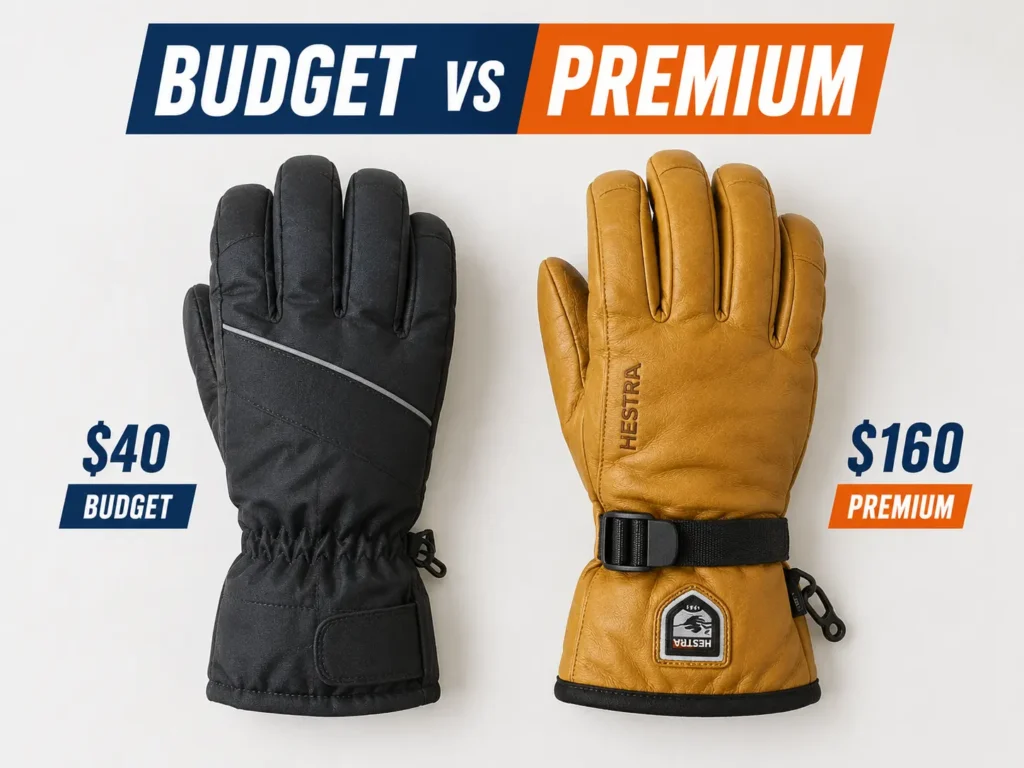
Quick answer: A $40 glove and a $150 glove can both keep your hands warm on a given day — warmth isn’t where the price gap actually shows up. It shows up in how the glove is built: the seam construction, the material grade, and how many seasons it survives before something fails. Whether that’s worth paying for depends almost entirely on how often you ski, not on chasing the warmest spec sheet.
If you’re trying to figure out where your own gloves should land on that spectrum, the ski glove finder filters by both budget and use frequency, which is a faster starting point than comparing warmth ratings alone.
Most comparisons of cheap versus expensive gear focus on the wrong variable. They ask which one feels warmer on day one. The more useful question is which one is still performing the same way on day fifty, and that’s a construction question, not a warmth question.
- What the Price Difference Actually Buys
- The Seam Is Where Budget Gloves Actually Fail
- Price Driver Reference
- The Cost-Per-Wear Math
- Where the Premium Actually Comes From
- When the Premium Isn't Worth It
- When It Clearly Is
- Common Mistakes When Deciding
- Warning Signs a Budget Glove Won't Last the Season
- Matching Spend to Situation
- Self-Check Tests You Can Run Today
- When Standard Advice Doesn't Apply
- Decision Checklist
- Frequently Asked Questions
What the Price Difference Actually Buys
Three things separate a $40 glove from a $150 glove, and warmth isn’t reliably one of them. Plenty of budget gloves are genuinely warm when new — the insulation inside a cheap glove and an expensive one can be functionally similar in a store.
The real gap is in material grade — whether the palm is genuine leather or PU-coated synthetic, and which grade of leather if it is. It’s in construction precision — how the seams are stitched, where they’re placed, and how carefully the pattern pieces are cut. And it’s in longevity math — how many days of real use each option delivers before something in it fails.
None of those three show up in a product photo or a warmth rating. That’s exactly why they’re the things budget manufacturers skip first — cutting corners there doesn’t hurt the spec sheet, it only hurts the glove after several weeks of actual use.
The Seam Is Where Budget Gloves Actually Fail
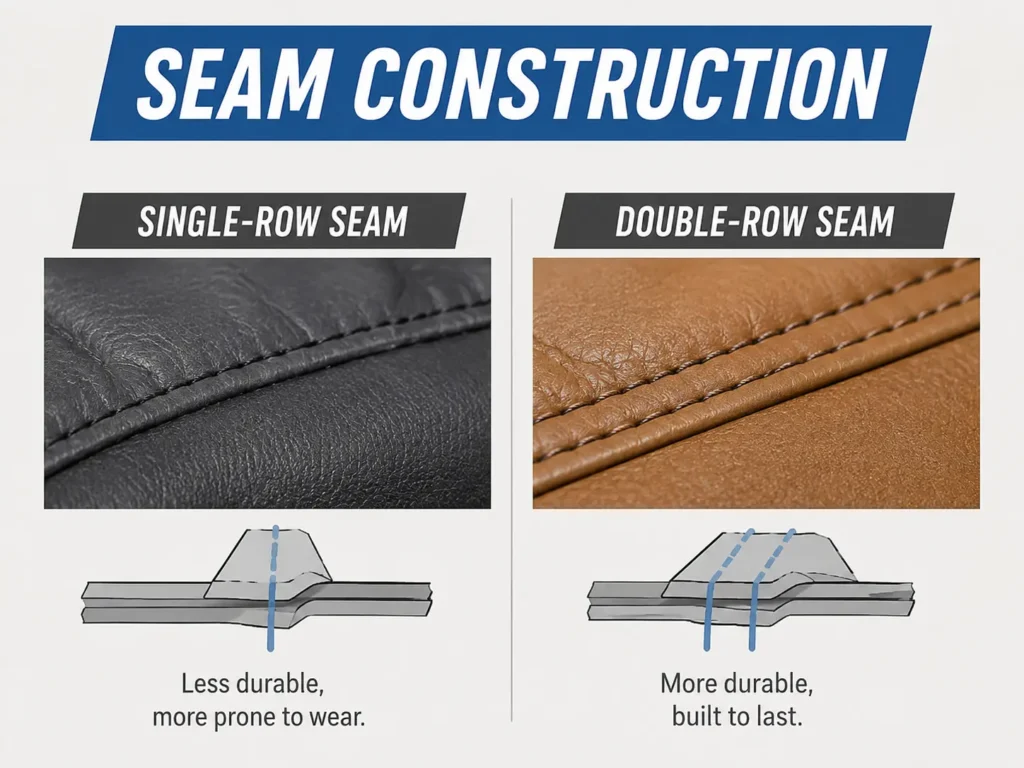
The highest-stress point on any ski glove is the thumb base seam. Every pole plant loads it with the combined force of grip tension and lateral thumb movement, over and over, for an entire ski day.
Seam durability isn’t a vague quality claim — it’s been studied directly in textile engineering research. Stitch density and seam construction have a measurable, well-documented effect on how much force a seam can withstand before it fails, and a second row of stitching along a stress point meaningfully increases that failure threshold compared to a single row.
Budget gloves use single-row stitching at the thumb base because it’s faster and cheaper to produce, and because a seam looks identical in a product photo whether it’s single-row or double-row. Premium gloves use double-row or reinforced stitching specifically at this point, along with seam placement that moves stitching off the palmar contact surface entirely — both of which cost more in manufacturing time but neither of which shows up anywhere a shopper would normally look before buying.
Price Driver Reference
| Driver | What You’re Paying For | Where the Gap Shows Up |
| Material grade | Genuine leather vs. PU-coated synthetic, and leather grade if applicable | Flexibility retention and lifespan under repeated cold exposure |
| Construction precision | Stitch density, seam placement, pattern-cutting accuracy | Seam failure timeline under real stress, not warmth |
| Longevity | How many seasons before something fails structurally | Total cost across the glove’s actual usable life, not sticker price |
The Cost-Per-Wear Math
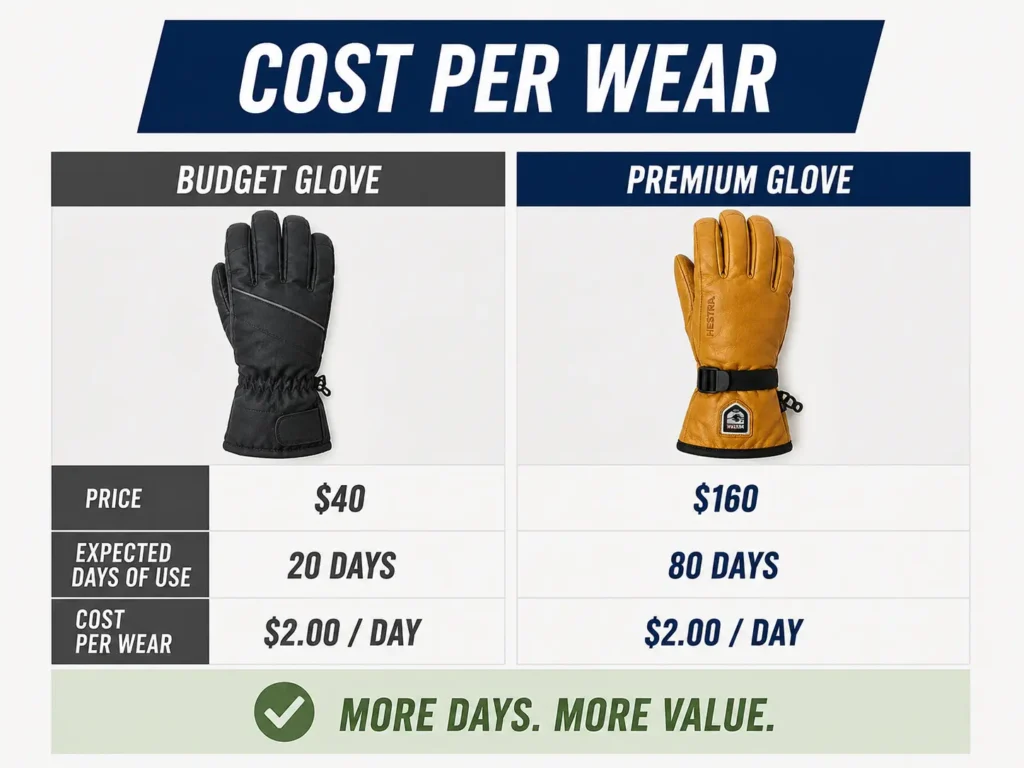
There’s a real economic framework for this kind of comparison, and it isn’t specific to gloves. Cost-per-wear divides a purchase price by the number of times an item actually gets used, and research from the University of Bath and Cambridge Judge Business School found that framing a purchase this way shifts people toward higher-quality options even when the upfront price is higher — because the math, not just the sticker price, tells the real story.
Applied to gloves, the logic is straightforward. A $40 glove that reliably fails — seam separation, palm stiffening, insulation compression — by day 15 to 20 of real use costs roughly $2 to $2.65 per ski day if you ski that much in a season and then replace it. A $150 glove built to survive 60 or more days of use across several seasons costs closer to $2.50 per day at that same usage level, and considerably less per day if it lasts multiple seasons.
The number that actually matters in this comparison isn’t the purchase price. It’s your own days-per-season, because that’s the variable that decides which side of that math you land on.
Where the Premium Actually Comes From
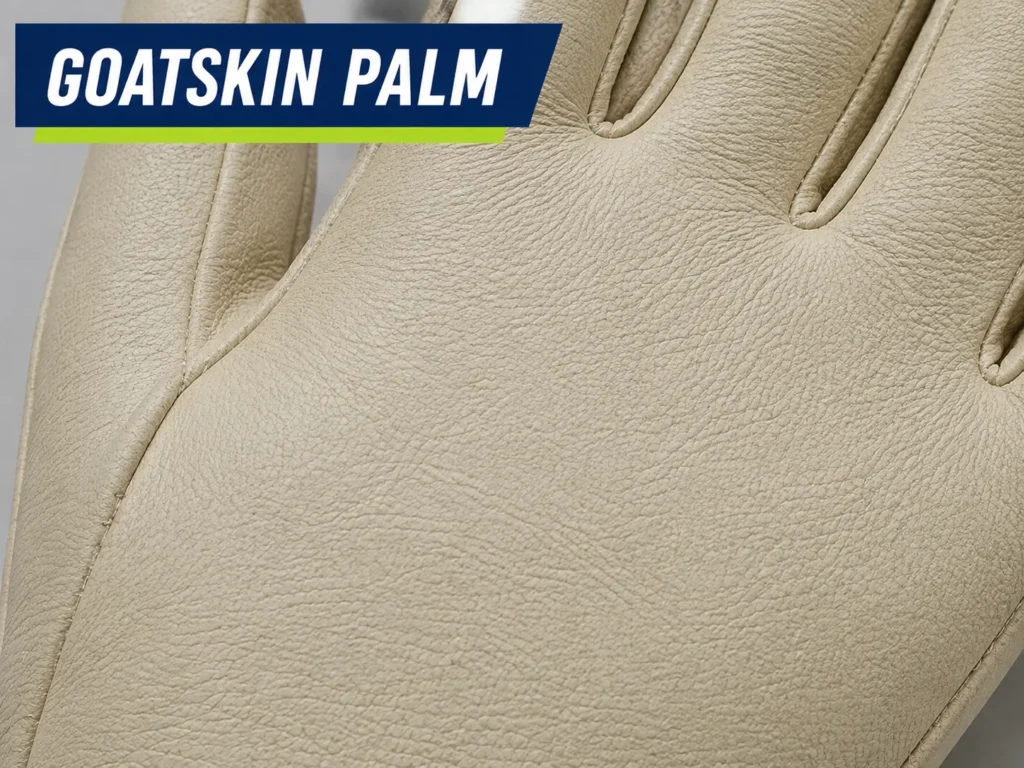
A genuine leather palm, properly conditioned, holds up to cold flexing and repeated grip pressure in a way PU-coated synthetic doesn’t — the material science behind that difference is covered in depth in the palm-material breakdown on this site, and it’s worth understanding before assuming “leather” alone means quality, since leather grade varies as much as the leather-versus-synthetic choice itself.
Insulation mapping — lighter fill in the finger tubes, heavier fill across the back of the hand — is a design decision that costs more in manufacturing complexity but delivers real dexterity and warmth benefits without adding bulk. And breathable membrane construction, when it’s a genuinely named technology rather than a generic “waterproof” claim, keeps interior moisture from accumulating over a full day, which matters more the longer and more actively you’re skiing.
If you’re weighing these features against your budget directly, comparing options across price tiers is a faster way to see which specific features show up at which price point than reading spec sheets one at a time.
When the Premium Isn’t Worth It
Casual skiers doing five or fewer days a season get very little practical benefit from premium construction. At that usage level, even a budget glove’s seams and materials rarely see enough cumulative stress to fail within a season, and the cost-per-wear math simply doesn’t favor the expensive option.
Kids who will outgrow gloves within a season or two aren’t a good fit for premium investment regardless of usage frequency — the glove will be replaced for sizing reasons before construction quality becomes the limiting factor.
Mild, dry-climate skiers — spring skiing at moderate resorts, for example — put less cumulative stress on materials than cold, wet, high-frequency use does, which narrows the practical gap between budget and premium construction.
When It Clearly Is
Skiers doing 15 or more days a season are the group where the cost-per-wear math consistently favors premium construction, since that usage level is exactly where budget seams and materials tend to fail within a single season.
Anyone who has already replaced a budget glove once or twice due to seam failure or material breakdown has effectively already paid the cost-per-wear penalty of buying cheap repeatedly — at that point, one premium purchase is often cheaper than continuing to replace budget gloves annually.
Skiers in consistently wet or cold conditions put more stress on both seams and material flexibility than dry, mild-condition skiers do, which shortens a budget glove’s practical lifespan and shifts the math further toward premium construction.
Common Mistakes When Deciding
Assuming the most expensive option is automatically the best fit. Price correlates loosely with construction quality, not perfectly — some expensive gloves prioritize branding or unrelated features over the seam and material details that actually matter here.
Buying premium construction for a usage level that doesn’t need it. A five-day-a-season skier paying for 60-day durability is paying for a lifespan they’ll likely never actually use.
Ignoring that premium leather requires more care, not less. A genuine leather palm holds up better than PU over time, but only with periodic conditioning — skipping that maintenance narrows the durability gap the premium price was supposed to buy.
Comparing sticker price instead of cost-per-wear. A cheaper glove replaced twice in a season can easily cost more, in total, than one premium glove that lasts the same period.
Treating warmth rating as a proxy for overall quality. As covered above, warmth and construction durability are largely independent variables — a warm glove isn’t necessarily a durable one.

Warning Signs a Budget Glove Won’t Last the Season
| Warning Sign | What It Predicts |
| Single visible row of stitching at the thumb base | Higher risk of seam separation under repeated pole-plant stress |
| Palm material stretches uniformly like plastic when pinched | PU-coated synthetic, more prone to cold-stiffening and cracking than genuine leather |
| No named insulation or membrane technology listed | Generic materials more likely to compress or trap moisture over a season |
| Seams run directly under finger and palm contact zones | Interior pressure points that worsen with wear, not just a comfort issue |
| Price significantly below the category average for stated features | Corners are being cut somewhere not visible in the listing |
Matching Spend to Situation
| Your Situation | Recommended Tier | Why |
| 5 or fewer ski days a season, mild conditions | Budget to mid-range | Cost-per-wear rarely favors premium at this usage level |
| 15+ ski days a season | Premium | Seam and material stress accumulate fast enough to justify the investment |
| Already replaced a budget glove due to failure | Premium | Repeated budget purchases often cost more than one premium purchase |
| Growing child | Mid-range | Sizing turnover outweighs construction lifespan as the limiting factor |
| Wet or consistently cold climate | Premium | Higher material stress shortens budget glove lifespan specifically |
Self-Check Tests You Can Run Today
Seam check: count the stitch rows at the thumb base — one row is a durability risk, two is reinforced.
Pinch test: plastic-like uniform stretch is PU; grain texture with resistance is genuine leather.
Usage math: divide your last glove’s price by how many days it actually lasted before something failed — that’s your real cost-per-wear baseline for comparison.
Care honesty check: if you know you won’t condition a leather palm periodically, the durability advantage of premium leather narrows considerably.
When Standard Advice Doesn’t Apply
Gifted or rental-adjacent use — gloves worn occasionally by multiple people, or bought for a single trip — breaks the cost-per-wear logic entirely, since the “wear count” that makes premium construction pay off never accumulates for any one user.
Backcountry and touring skiers face a different cost calculation than resort skiers, since breathability during sustained aerobic output can matter more than seam durability alone — a softshell glove with excellent breathability but simpler construction can be the better investment for that specific use case rather than a fully reinforced resort glove.
Anyone whose current gloves are already showing structural failure is better served checking what’s actually happening to the material before deciding what to buy next — why gloves crack covers the specific failure mechanisms in budget and premium materials alike, which is useful context before spending more on a replacement.
Decision Checklist
| Your Situation | Action | Priority |
| 5 or fewer days a season | Stick with budget or mid-range | Skip the premium spend |
| 15+ days a season | Prioritize double-row seams and named materials | Invest in premium |
| Already replaced a glove due to failure this season | Recalculate cost-per-wear including the replacement cost | Reconsider tier now |
| Own leather gloves but never condition them | Start a conditioning routine or accept a shorter lifespan | Address before next purchase |
| Buying for a child or one-off trip | Budget to mid-range | Premium lifespan won’t be used |
The honest answer to whether expensive ski gloves are worth it is that price alone was never the right question. Days per season, conditions, and whether you’re willing to do basic maintenance are what actually determine whether the premium construction pays for itself — and once you know your own numbers, the decision usually becomes obvious rather than requiring another spec sheet comparison.
Frequently Asked Questions
Is there a specific number of ski days where premium gloves start paying off?
Roughly 15 days a season is where the cost-per-wear math typically starts favoring premium construction, though climate and conditions shift that number — wetter, colder conditions push it lower, since materials degrade faster under that stress.
Do mid-range gloves offer a reasonable middle ground?
Yes, and for most moderate skiers they’re the better fit. Mid-range gloves often include named insulation and reasonable seam construction without the full cost of genuine leather and premium membrane technology, covering a meaningful part of the durability gap at a fraction of the price difference.
Does buying premium mean I can skip glove maintenance entirely?
No — genuine leather specifically requires periodic conditioning to maintain its durability advantage over synthetic materials. Skipping that maintenance narrows the gap the premium price was supposed to buy.
Is a higher price ever just branding rather than construction quality?
Yes, and it’s worth checking directly rather than assuming. Stitch rows at stress points and material composition (genuine leather versus PU, named insulation versus generic) are checkable details that tell you more than price tier alone.