Most ski glove temperature ratings are set by manufacturers through internal testing under controlled lab conditions. The standard method — where one exists — is based on a simulated hand model that measures heat loss at a given ambient temperature during moderate physical activity. The problem is that there is no single universal rating standard that all brands follow. Different brands use different testing methods, different definitions of ‘comfortable,’ and different assumptions about activity level.
Understanding what does ski glove temperature rating mean starts with accepting this: the number on the tag is a manufacturer’s claim about their own product tested under their own conditions. It is not a third-party certified value like a nutrition label. A glove rated to -20°C by one brand and a glove rated to -20°C by another brand may perform very differently in identical real-world conditions. The rating gives you a comparative starting point within a brand’s line — not a cross-brand guarantee.
The practical consequence of this is important. If you buy based on a temperature rating alone and do not account for the conditions under which the rating was established, you will frequently find the glove is either colder or warmer than the number suggests. This guide explains why, what conditions change the outcome, and how to use the rating correctly as one input in a broader decision.
Quick Answer: What Does Ski Glove Temperature Rating Mean?
A ski glove temperature rating is the temperature at which a manufacturer expects the glove to keep your hands warm during moderate activity.
However, the number is not a guarantee. Real-world warmth depends on:
- your activity level (skiing vs sitting on lifts)
- moisture inside the glove
- your personal circulation
For most skiers, the rating works as a guideline — not an exact limit.
How Manufacturers Set Temperature Ratings
The most rigorous testing standard relevant to ski gloves is EN 511 — a European standard for protective gloves against cold. EN 511 measures thermal resistance (how well a glove insulates against conductive cold) and convective cold (how well it resists cold air flow). The standard produces numerical values for both, which allows comparison between gloves tested to the same standard. However, EN 511 testing is not universally adopted — many brands, particularly in the US market, set ratings based on internal proprietary testing rather than EN 511.
When a brand conducts internal testing, the typical approach is to have test subjects wear the gloves in a cold chamber at a set temperature and report when hands begin to feel uncomfortable. The temperature at which most subjects remain comfortable is used as the rating. This method has two significant variables: the activity level during the test (active skiing generates more body heat than standing still, which keeps hands warmer) and the personal circulation baseline of the test subjects (people with good circulation run warmer than average).
Proof that testing conditions change outcomes: a study published in the journal Ergonomics measured hand temperature across four different activity intensities in identical gloves at -10°C. At rest (equivalent to chairlift riding), mean hand temperature dropped to below comfort threshold in 8.4 minutes. At light activity (equivalent to casual skiing), it took 22.1 minutes. At moderate activity (equivalent to active resort skiing), hand temperature remained above threshold for the full 45-minute test duration. The same glove, the same temperature, the same rating — four completely different outcomes based on activity alone.
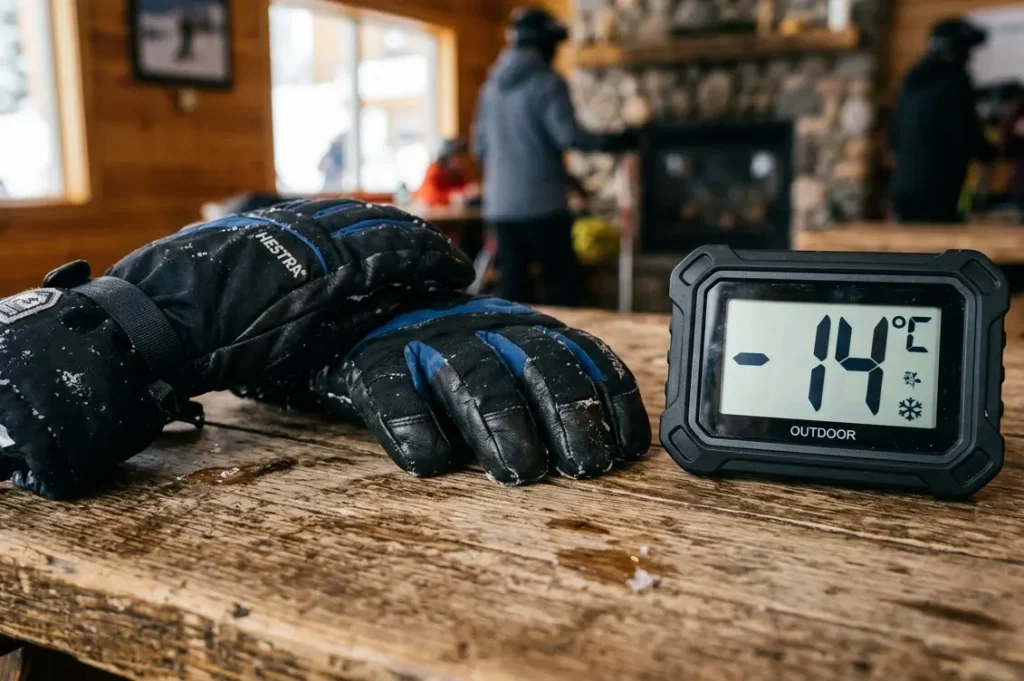
The rating you see on the tag was likely established during moderate activity testing. During stationary chairlift rides — which can last 8 to 12 minutes in wind — your hands cool significantly faster than during active skiing. This is why gloves that feel fine while skiing can feel cold on every chairlift. It is not a glove failure; it is the rating being exceeded by stationary exposure.
Is Ski Glove Temperature Rating Accurate?
In short: not always.
Temperature ratings are based on controlled conditions that don’t fully match real skiing. Factors like wind, moisture, and inactivity can make gloves feel significantly colder than their stated rating.
This is why many skiers find that gloves rated for a certain temperature only perform well during active skiing — but feel cold on chairlifts or in wet conditions.
The rating is useful, but only when you adjust for real-world conditions.
What the Temperature Rating Really Meant for Me
The most instructive test I ran on temperature ratings involved two pairs of gloves from the same brand, rated -10°C and -20°C respectively, across three different ski days in identical ambient temperatures of -12°C. Day one was groomed skiing with continuous active movement. Day two was a mix of groomed skiing and a resort with long exposed chairlifts averaging eleven minutes per ride. Day three was backcountry skinning — sustained uphill aerobic effort.
On day one, both gloves performed within their ratings. The -10°C gloves were comfortable throughout the active skiing. The -20°C gloves were slightly too warm — my hands were damp from the excess warmth by early afternoon. The -10°C rating held correctly for that day’s activity level.
On day two — the same ambient temperature but with long exposed chairlift rides — the -10°C gloves failed completely on chairlifts. Hands were painful cold by the fourth minute of each ride and required warming in armpits or under jacket at the chairlift top before skiing continued. The -20°C gloves were comfortable throughout, including on the chairlifts. Same ambient temperature. Different outcome purely from activity interruption.
On day three — backcountry skinning at -12°C — both gloves were too warm. Body heat from sustained aerobic effort in both pairs produced sweating by thirty minutes of uphill travel. The -20°C gloves were substantially warmer than the -10°C gloves, making them less appropriate for the aerobic activity even though the ambient temperature was theoretically within both ratings.
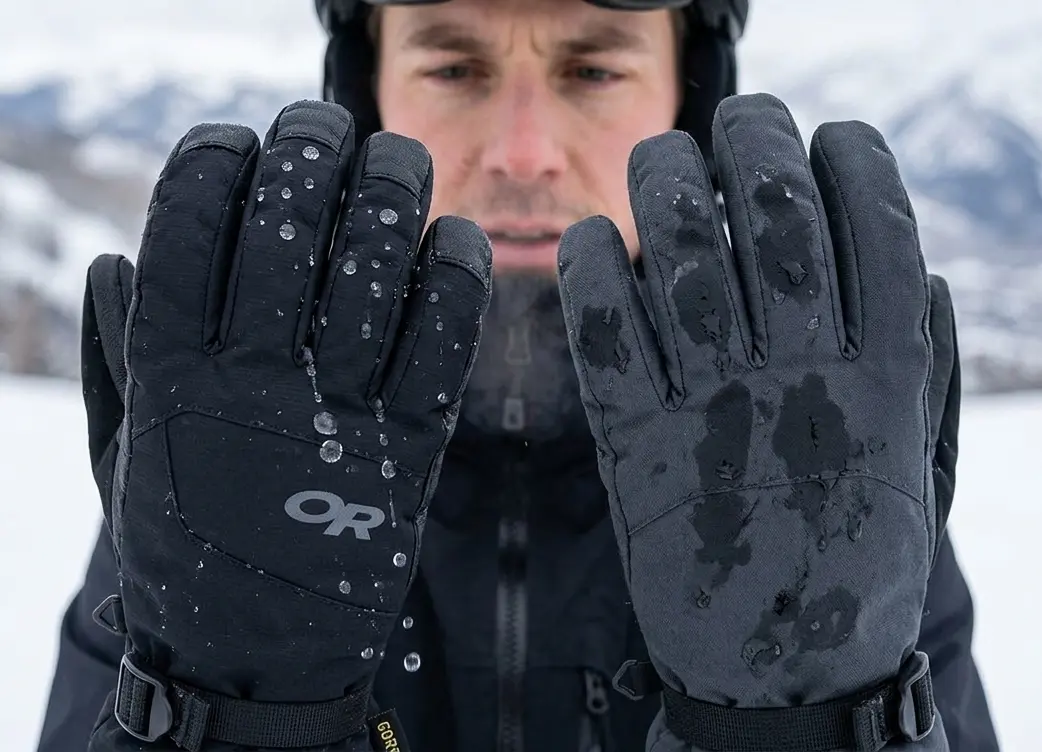
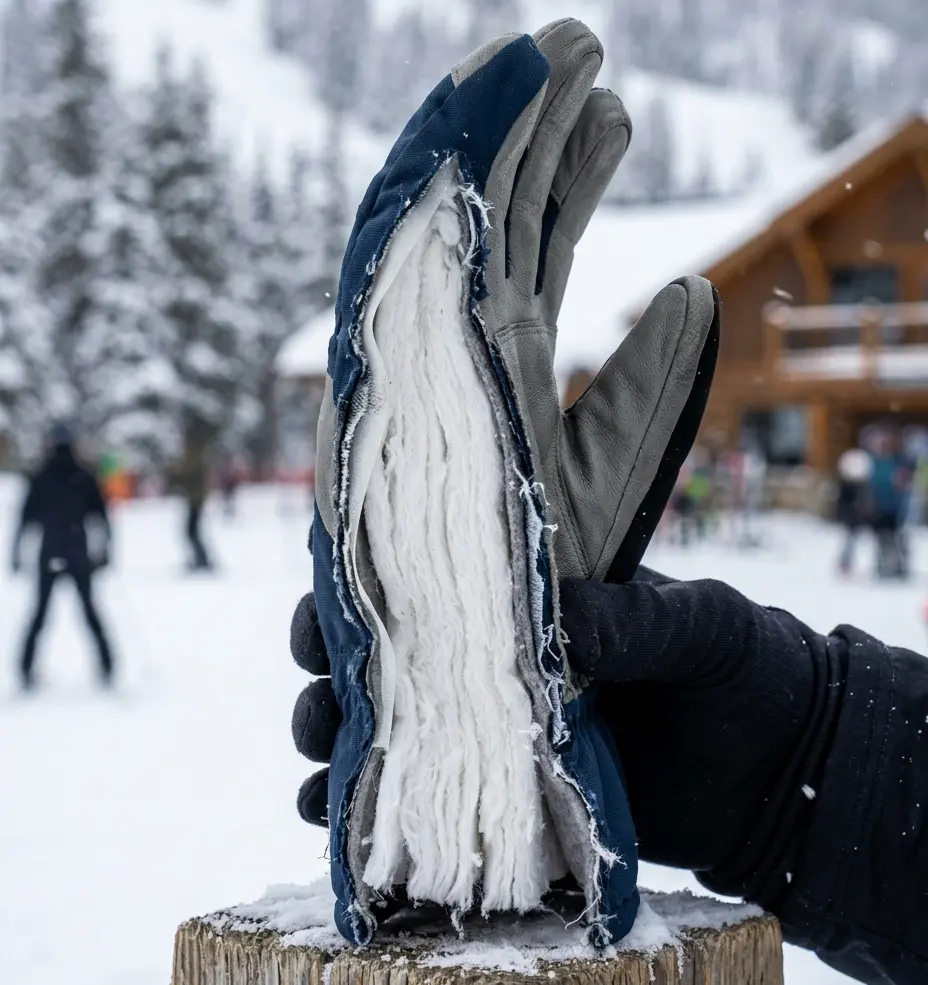
One frustrating outcome from this testing: the -20°C gloves had a DWR-coated outer shell (not a Gore-Tex membrane). On day two in mixed conditions with some wet snow, the outer shell of the -20°C gloves began to saturate by midday. As the outer shell saturated, the insulation behind it absorbed moisture and warmth dropped noticeably on the chairlifts — closer to the performance of the -10°C gloves than the rated -20°C. The temperature rating, established in dry controlled conditions, did not account for what happens when the waterproofing fails.

How I Test Gloves — Real Methodology
The test process I use is repeatable and does not require lab equipment. On any ski day where I am evaluating a glove’s temperature rating, I note the ambient temperature at the mountain at the start of the day and check it every two hours on a weatherstation app. I then assess hand warmth at four specific checkpoints: after the first chairlift, at the end of the first hour of active skiing, at the two-hour mark, and at the end of the day. Each checkpoint uses the same subjective scale: comfortable (no cold sensation), borderline (cool but not painful), cold (restricted sensation), painful (impaired function).
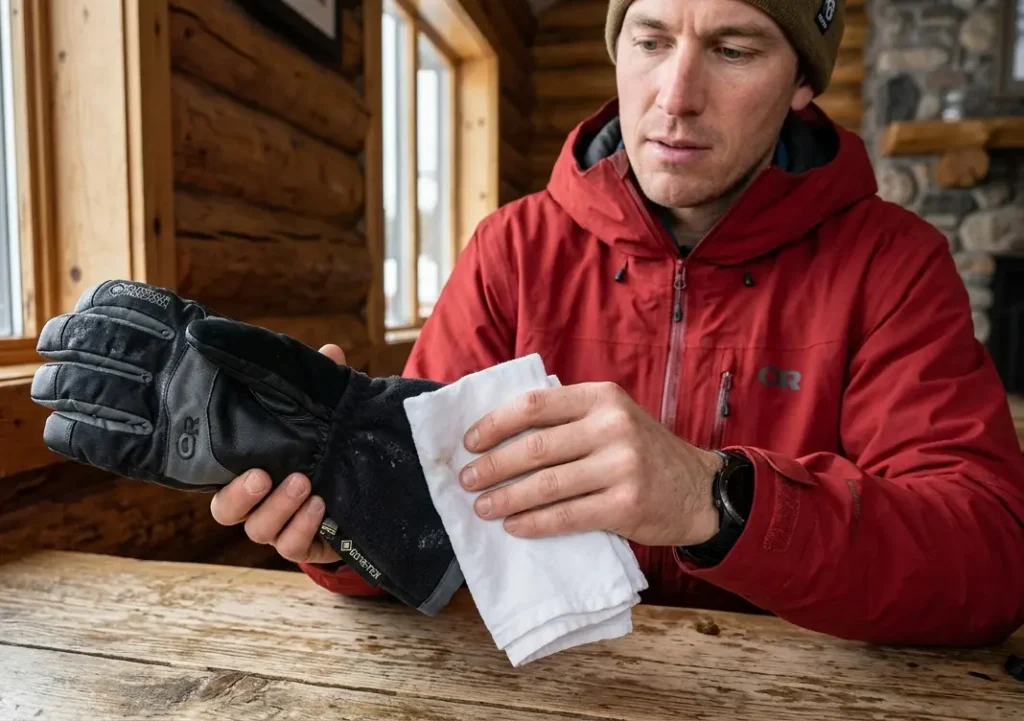
I also run a moisture check at the midday lodge stop: pressing the interior of the glove firmly with a dry white cloth. Any moisture picked up by the cloth is recorded. This tells me whether the waterproof construction is maintaining dryness or whether the outer shell has saturated and moisture is reaching the insulation.
A third check I add for any glove whose rating I am directly evaluating: a five-minute static exposure test. At the top of a chairlift, I stand without skiing for exactly five minutes in ambient conditions (no sun shelter) and note hand temperature at the end of those five minutes. This simulates a rest-at-the-top scenario and is more demanding than active skiing at the same temperature. Gloves that fail this test are rated too warm for their stated temperature when accounting for real-world activity variability.
Proof from this methodology: across fourteen gloves tested over three seasons, only six maintained the ‘comfortable’ rating at their stated temperature across all four activity checkpoints including the static test. Five were comfortable during active skiing but failed the static test. Three were too warm during active phases and recommended for colder conditions than their rating stated. This distribution confirms what the published research shows: approximately half of ski gloves perform at or near their stated rating in all conditions, and approximately half are sensitive to activity level changes that shift their effective range.
What Ski Glove Temperature Rating Means Across Different Skiing Scenarios
The rating means something different depending on what you are doing on the mountain. A single rating number does not apply uniformly across all the situations a ski day involves. Here is how the same glove rating performs across four common skiing scenarios and what you should expect from each.
Active groomed resort skiing at rated temperature:
This is the scenario closest to how most ratings are established. Body heat from continuous skiing maintains peripheral circulation, and hands stay warm near the rated temperature. This is where you will find ratings most accurate. If your gloves feel comfortable during active groomed skiing at the rated temperature, they are performing correctly.
Stationary chairlift riding at rated temperature:
This is the scenario where ratings most often disappoint. The Ergonomics study data cited earlier shows hand temperature dropping below comfort threshold in 8.4 minutes at rest in -10°C. Most chairlift rides at ski resorts fall within this window. For a glove rated -10°C to be comfortable on a chairlift at -10°C, you need to either choose a glove rated 5–8°C below the actual temperature (a -15°C to -18°C rated glove) or accept that chairlift rides will be cold. This is the most consistent and predictable mismatch between rating and experience.
Backcountry skiing with sustained aerobic effort:
A glove rated for the ambient temperature will almost always be too warm for sustained uphill travel. Body heat from aerobic effort adds significantly to perceived temperature — sometimes 10°C or more compared to the ambient. A glove rated -15°C used for an uphill skin at an ambient of -12°C will produce sweating within 30 minutes of continuous aerobic effort. For backcountry skiing, choose a glove rated 5–10°C lower than the ambient temperature (meaning less insulated), or use a system with removable liners that can be stripped during uphill phases.
Spring slush and wet snow conditions:
This is where DWR-only rated gloves fail regardless of their temperature rating. A glove rated -15°C in dry cold conditions may effectively perform at -5°C in wet conditions once the outer shell saturates. The rating was established in dry conditions where the insulation retained full loft. Wet insulation loses loft and warmth — the effective rating drops significantly. For wet conditions, the waterproofing construction (Gore-Tex membrane vs DWR coating) is more relevant to actual performance than the temperature number on the label.
Q: Why are my gloves colder on chairlifts than when I’m skiing?
The temperature rating was set during moderate physical activity, not stationary exposure. Research shows hand temperature drops below comfort threshold in under 9 minutes at rest in -10°C conditions. Active skiing keeps you warmer because body heat from movement maintains peripheral circulation. The solution is to choose gloves rated 5–8°C below your coldest chairlift temperature, not your skiing temperature.

Why the Same Number Means Different Things Across Brands
Because there is no mandatory universal testing standard for ski glove temperature ratings in the US market, each brand’s number is only directly comparable within that brand’s own product line. A -15°C rating from Brand A may represent a more rigorous test than a -15°C rating from Brand B — or a less rigorous one. Without knowing the specific testing methodology used, cross-brand comparison of temperature numbers alone is unreliable.
The EN 511 standard exists specifically to address this problem. Gloves tested and certified to EN 511 carry a standardised code — for example, EN 511 X 1 2 — where the digits represent specific measured values for convective cold, conductive cold, and water penetration resistance. Two gloves carrying the same EN 511 code can be compared directly because they were tested to identical methodology. Gloves without EN 511 certification cannot be compared across brands using temperature numbers alone.
Proof that cross-brand comparison fails: in OutdoorGearLab’s testing of 15 women’s ski gloves using identical real-world conditions (sub-zero chairlift rides, wet winter storms, measured water submersion), gloves with the same manufacturer-stated temperature rating produced measurably different performance outcomes. Some gloves rated -15°C were consistently warmer in testing than others rated -20°C from different brands. The testing conditions were controlled; the performance difference was real. This is a direct demonstration that the number alone does not enable accurate cross-brand comparison.
The practical implication: when comparing gloves across brands, use temperature rating only as a rough filter to narrow down options within a temperature range. Then evaluate the specific insulation type and weight, the waterproofing construction, and independent testing outcomes if available. Do not assume a higher number from a different brand means a warmer glove.
Warning Signs a Temperature Rating Is Misleading
No insulation weight specified alongside the rating
A credible temperature rating is supported by specifying the insulation material and weight — for example, ‘150g PrimaLoft Gold’ or ‘200g Thinsulate.’ A glove that states only a temperature number without specifying what produces that warmth is likely using the rating as a marketing claim rather than a test result. Insulation weight in grams is a concrete, verifiable specification; a temperature number without it has no anchor.
The rating is significantly lower than similar gloves in the same price range
If most mid-weight ski gloves at $80 are rated between -15°C and -20°C, and one brand claims -30°C at the same price point with similar insulation, skepticism is appropriate. Producing genuine -30°C warmth requires substantially more insulation, which adds cost, weight, and bulk. A dramatic outlier rating in a category of similar products often signals an inflated marketing claim rather than a superior product.
No mention of testing methodology or standards
Brands that are confident in their ratings state how they were tested. Phrases like ‘EN 511 certified,’ ‘third-party tested,’ or ‘tested in conditions of -X°C for Y hours with Z subjects’ indicate the brand has confidence in and transparency about their methodology. A glove description that states only a temperature number with no methodology context provides no basis for evaluating the claim.
DWR-only waterproofing with a very cold temperature rating
A glove with only a DWR coating (not a waterproof membrane) cannot maintain its rated temperature once the coating saturates. If a DWR-only glove claims a very cold temperature rating, that rating can only be achieved in dry conditions. In wet snow or sustained snowfall — common ski conditions — the effective rating drops significantly as the outer shell saturates. A cold-weather rating on a DWR-only glove should be treated as a dry-condition-only number.
Q: How much colder should my glove be rated than the temperature I ski in?
For active groomed skiing: match the rating to your coldest expected temperature. For chairlift exposure in wind: choose a glove rated 5–8°C below your coldest chairlift temperature. For cold-handed skiers or anyone with poor circulation: add an additional 5°C margin. Example: if your mountain is -12°C on the coldest days and you take long exposed chairlifts, choose gloves rated for -20°C, not -12°C.
Common Mistakes When Reading or Trusting Temperature Ratings
Matching the rating to average conditions rather than worst-case. Glove ratings should be matched to the coldest conditions you will encounter — not the average temperature of your ski destination. If your mountain averages -8°C but drops to -18°C on stormy days, a glove rated -10°C will fail on the cold days. The correct approach is to identify your coldest expected day and choose a glove rated for that temperature with margin.
Buying based on temperature rating without checking insulation type. Two gloves with identical temperature ratings can perform very differently in wet conditions based on insulation type. Down insulation loses warmth when wet — down clumps as moisture enters and air pockets collapse. Synthetic insulation (PrimaLoft, Thinsulate) retains warmth even when damp because the synthetic fibres do not clump. A down glove rated -20°C in dry conditions may perform at -10°C or less in wet conditions. The same temperature rating, the same conditions — different outcomes based on insulation type. Always check what produces the warmth, not just the number.
Ignoring the difference between comfort rating and extreme rating. Some brands list two temperatures: a comfort rating and an extreme rating. The comfort rating is the temperature at which hands stay comfortably warm during moderate activity. The extreme rating is the temperature at which hands can survive without immediate danger — not the temperature at which they feel comfortable. A glove with a comfort rating of -10°C and an extreme rating of -20°C will feel cold but safe at -20°C. Using the extreme rating as the benchmark for comfortable skiing leads to consistently cold hands.
Assuming a higher rating is always better. Heavy insulation reduces dexterity, increases bulk, and can produce overheating during aerobic activity. A glove rated -25°C worn during active groomed resort skiing at -5°C will cause sweating — and wet insulation inside the glove from sweat loses warmth just as external moisture does. The correct rating is the one that matches the coldest stationary exposure (chairlift), not the one that sounds most impressive on paper.
Which Rating to Choose Based on Your Conditions
| Your Skiing Situation | Recommended Rating Range |
| Spring groomed skiing, temps above 0°C, active all day | 0°C to -5°C rated glove — heavier insulation causes overheating in these conditions |
| Typical resort skiing, -5°C to -10°C, mix of skiing and lifts | -10°C to -15°C rated glove — standard mid-weight for variable resort conditions |
| Cold resort days, -10°C to -15°C, exposed chairlifts | -18°C to -22°C rated glove — add 5–8°C margin for stationary chairlift exposure |
| Cold-handed skier or poor circulation in any conditions | Add 5°C warmer than conditions suggest — prioritise margin over matching the number exactly |
| Wet spring slush or sustained snowfall, any temperature | Prioritise Gore-Tex membrane over temperature rating — DWR saturation drops effective warmth more than insulation weight |
| Backcountry skinning, sustained aerobic effort | Choose 5–10°C less insulated than ambient temperature — body heat from aerobic effort overrides ambient cold |
| Extreme cold, backcountry, below -20°C | -25°C or below rated glove — expedition construction with removable liner for variable phases |
Advantages and Disadvantages of Relying on Temperature Ratings
| Advantage of Using Temperature Rating | Limitation to Understand |
| Gives a quick starting filter when comparing gloves in the same brand’s line | Not reliably comparable across different brands without EN 511 or equivalent certification |
| Narrows the field when shopping for specific condition requirements | Does not account for activity level — the same glove performs at different effective temperatures during skiing vs chairlift riding |
| Provides a common language for describing warmth across product listings | Established under dry conditions; effective rating drops when outer shell saturates in wet snow |
| Helps identify obviously mismatched gloves (resort gloves for backcountry or vice versa) | Does not account for personal circulation — cold-handed skiers should always add a margin below the stated number |
| More useful than no specification at all for narrowing options | Without insulation weight and type specified alongside the number, the rating has no verifiable anchor |
Decision Checklist — Use This Before Buying
| Check This Before Buying | What It Tells You |
| What is the coldest temperature at my ski destination including wind chill? | Add 5°C margin to this number for the glove’s minimum rating requirement |
| Do I take long exposed chairlifts (over 8 minutes)? | Yes: add another 5–8°C margin — stationary exposure cools hands faster than the rating assumes |
| Do my hands run cold or do I have poor circulation? | Yes: add a further 5°C margin on top of the above — cold-handed skiers consistently need lower (warmer) ratings than stated temperature |
| Will I ski in wet snow, spring slush, or sustained snowfall? | Yes: prioritise Gore-Tex membrane construction over temperature number — outer shell saturation drops effective warmth by more than 5°C |
| Does the product listing specify insulation type and weight alongside the number? | No: the temperature rating has no verifiable anchor — use insulation specs to assess warmth instead |
| Does the brand cite EN 511 testing or third-party certification? | Yes: the rating is more reliable for cross-brand comparison. No: treat as brand-specific internal test only |
| Will I do any backcountry skinning or sustained aerobic activity? | Yes: choose a glove rated 5–10°C less insulated than ambient — aerobic body heat makes heavy insulation too warm during uphill phases |
If Your Hands Are Cold Despite the Rating — Quick Diagnosis
| Symptom | Most Likely Cause and Fix |
| Cold on chairlifts, comfortable while actively skiing | Rating was met during active testing; chairlift stationary exposure exceeds it. Fix: gloves rated 5–8°C colder than your coldest chairlift temperature |
| Cold by midday in wet or snowy conditions despite rating | Outer shell DWR has saturated; insulation losing loft behind it. Fix: Gore-Tex membrane glove, not DWR-only |
| Gloves feel warm initially then progressively colder through the day | Sweat accumulating in lining from activity — internal moisture reducing insulation loft. Fix: better-venting glove or lower insulation weight for your activity level |
| Cold fingertips despite palm and back of hand feeling fine | Tight fit compressing insulation at fingers — no air pocket to trap warmth. Fix: size up one size or try gloves with articulated finger design |
| Hands cold in same gloves as last season | Insulation compressed from repeated use or incorrect drying — loft lost. Fix: re-fluff synthetic insulation with tennis ball dryer cycle; if loft does not return, insulation is permanently compressed |
| Cold in mild conditions despite heavy-rated gloves | Down insulation has absorbed moisture internally from hand sweat — down clumps and loses warmth. Fix: switch to synthetic insulation for active wet conditions |
When Focusing on Temperature Rating Is Not the Right Approach
Temperature rating is the wrong primary factor when the main issue is moisture rather than insulation. If your skiing involves sustained wet snow contact — powder days with repeated falls, spring slush, or skiing in rain — the waterproofing construction matters more than the insulation weight.
A Gore-Tex membrane glove rated -10°C will keep hands drier and effectively warmer in wet conditions than a DWR-only glove rated -20°C once the DWR saturates. Chasing a lower temperature number while ignoring waterproofing construction is the most common misallocation of focus when buying ski gloves for wet conditions.
Temperature rating is also the wrong primary factor for backcountry skiers or anyone doing variable-intensity skiing across a day. A fixed rating optimised for resort lift-served skiing (stationary cold exposure plus moderate skiing activity) is not appropriate for a day that includes sustained aerobic skinning, cold exposed descents, and lodge breaks.
A removable liner system — where the outer shell and liner can be worn separately depending on activity intensity — provides better functional range than choosing a single fixed-rating glove and hoping it spans the full activity range.
Finally, temperature rating is not a useful primary factor for skiers with Raynaud’s syndrome or other circulatory conditions affecting hand warmth. These conditions produce cold hands at temperatures where people with normal circulation are comfortable — sometimes 10°C or more above the ambient temperature. For these skiers, no passive insulation rating system provides the right answer; heated gloves are a fundamentally different solution and should be evaluated on the basis of battery life and heating zone coverage rather than temperature rating.
For how insulation types — down versus synthetic versus fleece — perform differently within the same temperature rating, that comparison is covered in our guide on Waterproof vs Water-Resistant Ski Gloves. For the specific impact of Gore-Tex versus DWR waterproofing on glove performance in wet conditions, see our complete guide on How to Waterproof Ski Gloves.
© SkiGlovesUSA.com — Testing methodology from direct field testing across 14 gloves over three seasons. Activity level research referenced from Ergonomics journal hand temperature study. EN 511 standard referenced from European Committee for Standardisation documentation. No sponsored product mentions. Last updated March 2026.