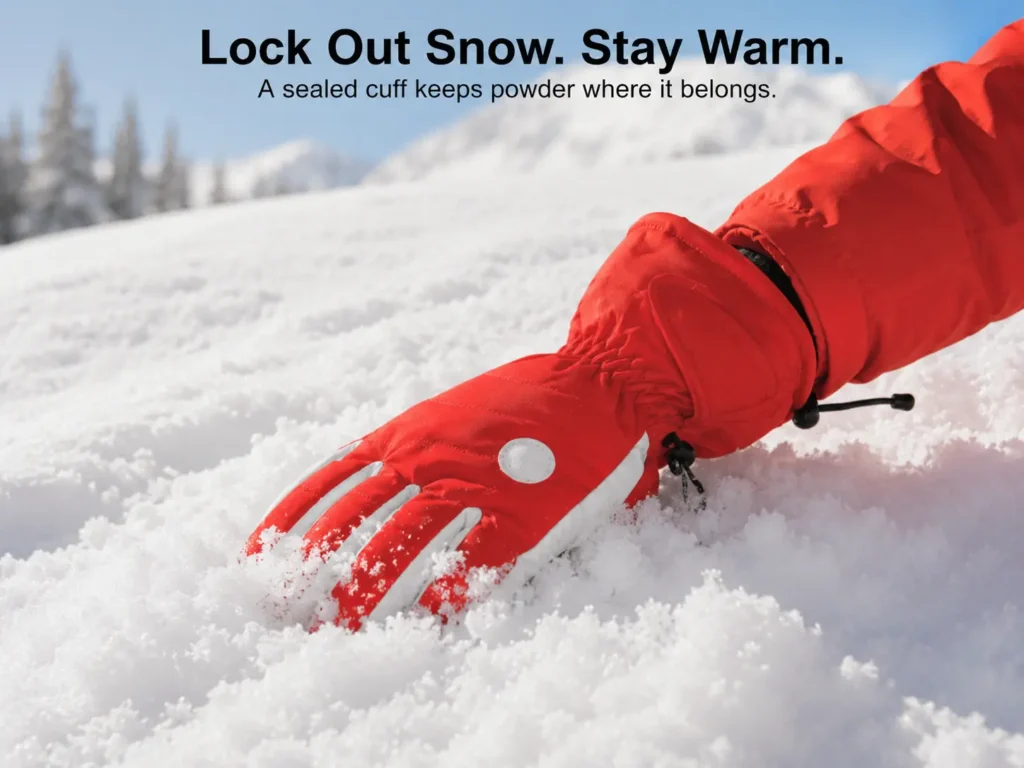
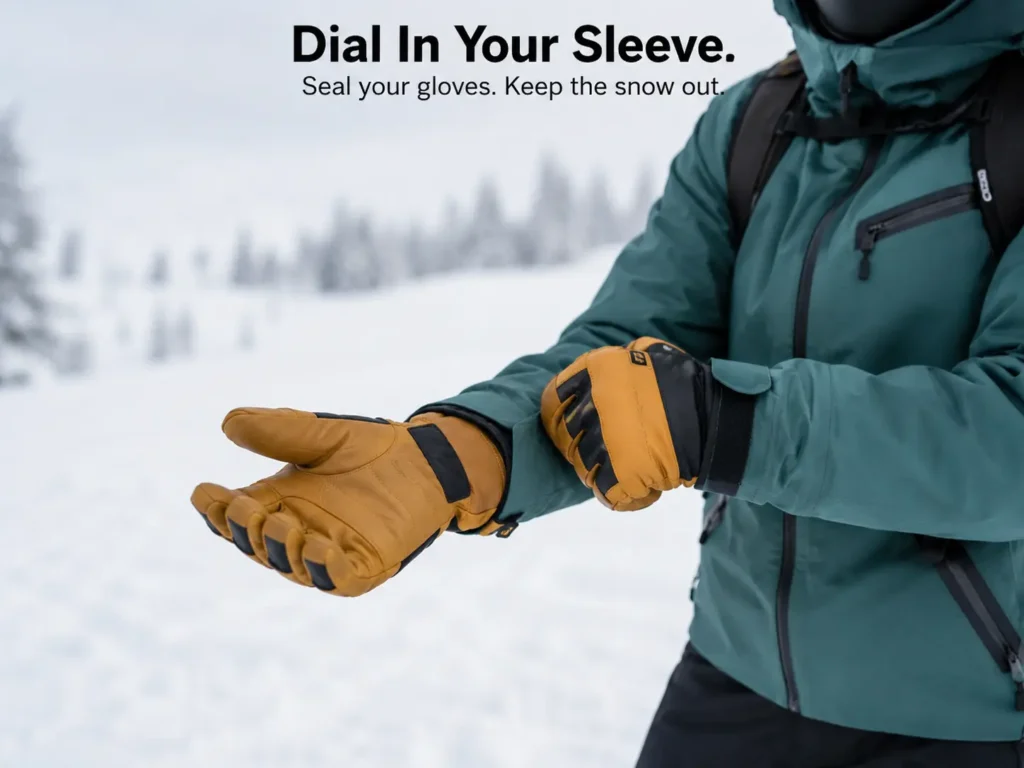
Quick answer: In most cases, it’s not the gloves failing — it’s the gap between glove and jacket sleeve. Wearing the glove cuff over the jacket sleeve instead of under it, and actually cinching the wrist, closes that gap and stops the vast majority of snow entry without buying anything new.
If you’d rather get matched to a glove built with real cuff sealing in mind, the Ski Glove Finder does that in under a minute.
- Where the Gap Actually Comes From
- The Fixes That Actually Work
- What This Looks Like for Kids Specifically
- Construction Features Worth Prioritizing
- Does This Actually Matter for Your Kind of Skiing?
- Quick Self-Check for Your Current Setup
- Common Setup Mistakes, Not Gear Failures
- Testing Seal Quality Before You Buy
- When It's Actually the Gloves, Not the Setup
- Frequently Asked Questions
- The Setup Fix First, New Gear Second
Where the Gap Actually Comes From
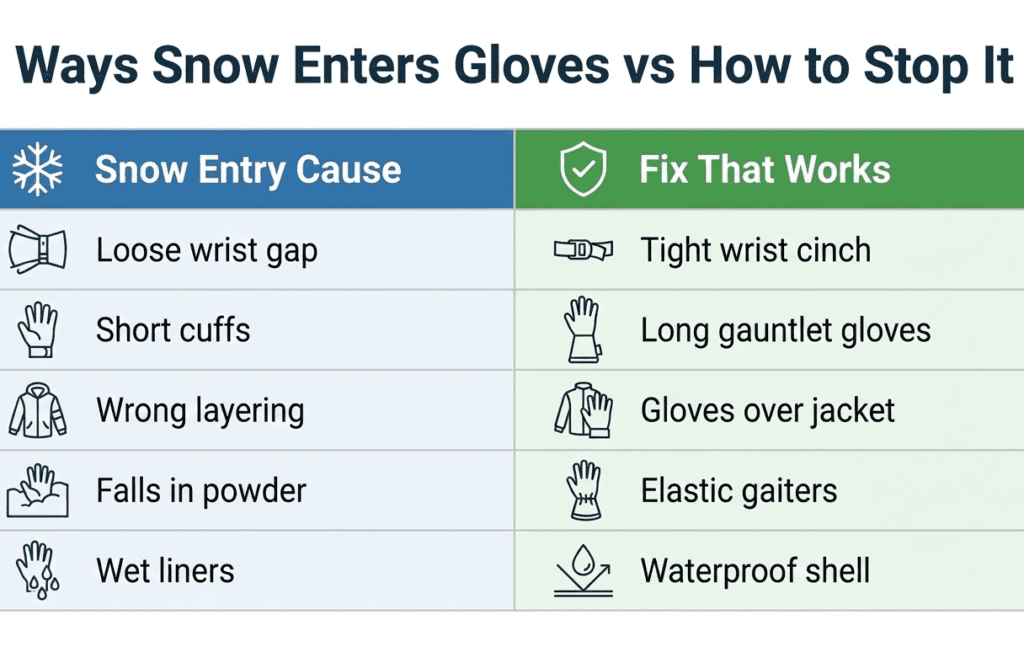
Snow finds openings, and on most skiers, the biggest opening isn’t in the glove itself — it’s the small space where the jacket sleeve and glove cuff meet. Once that gap exists, powder and fall-related snow contact will find it consistently, especially in deep or wet snow.
A loose wrist opening
Worn-out elastic or a low-profile cuff design lets snow slide straight down into the glove, especially once the glove is a season or two old and the elastic has relaxed.
Short cuffs paired with the wrong layering
Short cuffs that sit under the jacket sleeve look clean and low-bulk, but they leave more exposed skin at the wrist unless the layering underneath is close to perfect every single run.
Wearing the glove under the jacket when it wasn’t built for that
This is the single most common setup mistake. It creates a small funnel exactly where snow tends to collect during falls or powder turns.
Hand plants in deep snow
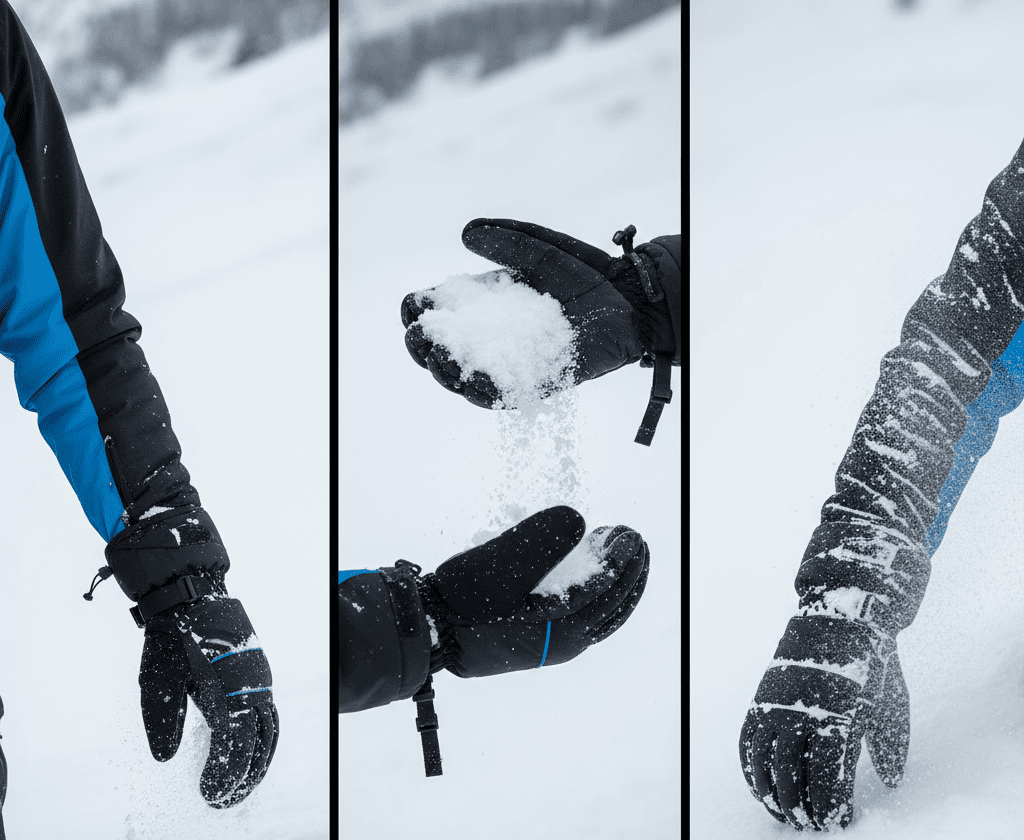
Falling, pushing back up, or digging around in powder puts hands directly into snow, and an unsealed wrist packs full fast under that kind of direct contact.
No cinch or drawcord at all
Gloves without any wrist seal — no drawcord, no velcro strap, no elastic gaiter — let snow in from above any time the arm moves or bends.
Once snow gets past that opening, the insulation nearby gets damp, the liner absorbs moisture, and cold hands follow quickly. The entry point matters more than most people realize, since a genuinely warm glove with an open wrist still ends up cold once enough snow has packed in.
The Fixes That Actually Work
These are the same adjustments ski instructors and mountain staff rely on, mostly because they cost nothing and solve the majority of cases without new gear.
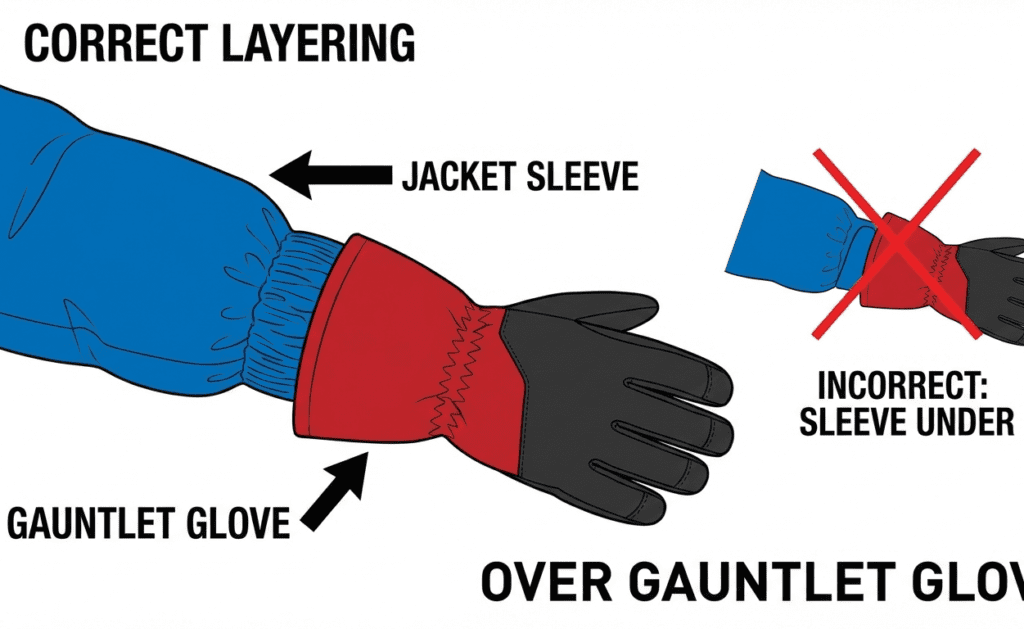
Wear the glove cuff over the jacket sleeve. This single change fixes most snow-entry problems on its own. When the glove sits over the sleeve rather than under it, snow sheds off the outside instead of funneling straight down into the wrist opening — particularly effective in deep snow or after a fall.
Choose a gauntlet-style glove with a long cuff for powder days. Long cuffs are built specifically to cover the jacket sleeve fully, which makes the seal far less dependent on getting the layering exactly right every time. Short cuffs can still work fine on groomers, but they demand more precision in wet or deep conditions. For a full breakdown of when a longer cuff is worth the extra bulk versus a short cuff, our comparison of gauntlet and short-cuff styles covers the tradeoffs in more depth than fits here.
Actually use both the drawcord and the wrist strap, not just one. The drawcord blocks snow from above, and the wrist strap keeps the cuff from gapping open during normal arm movement. Skipping one of the two leaves a real, if smaller, opening.
Add a powder cuff gaiter if your current gloves lack one. These are inexpensive add-on cuffs that slide over the glove and cinch around the jacket sleeve. Backcountry riders use them often because they seal out fine, blowing snow without changing how the glove itself fits.
Use glove leashes to avoid bare-hand snow contact. Leashes mainly prevent lost gloves, but they carry a secondary benefit — they stop you from setting bare hands directly into snow while fumbling to retrieve a dropped glove during a break or lift ride.
Consider mittens specifically for heavy powder days. Mittens generally have fewer seams and a simpler, often longer cuff, which tends to seal more reliably in deep snow or during frequent falls, at some cost to finger dexterity.
Skip tucking gloves inside the jacket sleeve. This is the layering error most new skiers make by instinct — it feels tidier, but unless the glove is specifically designed for under-sleeve wear, it creates a small chute that channels snow directly into the cuff.
Moisture that gets past a seal reduces insulation performance and speeds up heat loss through the hands, which is well documented in general cold-stress guidance — the same principle that applies broadly to cold-weather safety applies directly here: keeping moisture out matters as much as the insulation itself.
What This Looks Like for Kids Specifically
Kids run into this more often, and usually for different reasons than adults. They fall more, dig in powder intentionally, crawl around at the base of the lift, and rarely think to check or retighten a wrist seal mid-run.
Longer gauntlets help more for kids than for adults. Since kids move around more and rarely keep sleeves in a fixed position, a longer cuff that sits over the jacket stays sealed through falls and general roughhousing in a way a short cuff usually doesn’t.
Internal elastic gaiters work even when kids forget everything else. A built-in elastic cuff inside the glove blocks snow before it reaches the insulation, and it functions passively — no cinching required, which matters since kids often skip that step entirely.
One-pull cinches make a real difference for parents. Being able to tighten a cuff with one motion, with cold hands, at the base of a lift, means the seal actually gets adjusted rather than skipped because it’s inconvenient.
Leashes matter more for kids, not less. Kids drop gloves constantly — during snack breaks, glove changes, parking lot chaos — and a leash prevents both lost gloves and the bare-hand-in-snow moment that happens while chasing one down.
Once a kid’s insulation gets wet, heat loss accelerates quickly, and a ski day often ends earlier than planned as a direct result. A slightly longer cuff and an internal gaiter solve most of this without needing to buy warmer, bulkier, or more expensive gloves. For families shopping specifically with this in mind, our roundup of the best ski gloves for kids filters specifically for cuff length and seal quality, not just warmth ratings.
Construction Features Worth Prioritizing
A few specific design details separate gloves that reliably seal out snow from ones that only do it under ideal conditions.
Internal powder skirts
These sit as a barrier around the wrist inside the glove itself, blocking snow before it can reach the insulation layer, and they function as backup even when the outer cuff isn’t perfectly sealed.
Double cinch systems
Being able to tighten the wrist and the outer cuff independently creates a tighter overall seal and handles arm movement better than a single adjustment point.
Genuine gauntlet length, not just a longer-looking cuff
Actual gauntlet length is built to fully cover a jacket sleeve during movement, not just when standing still — worth checking against your specific jacket rather than assuming “long cuff” on a label means enough coverage.
A waterproof-breathable membrane
This keeps moisture from soaking through the shell itself while still letting sweat vapor escape, which matters once any snow does get past the cuff seal — a good membrane limits how much that moisture actually reaches your skin.
Structured wrist padding
Gloves that hold their shape at the wrist resist collapsing into gaps when gripping a pole or working a binding buckle, which cheaper, unstructured cuffs tend to do under exactly that kind of pressure. REI’s guide to choosing winter gloves and mittens covers cuff and seal construction as part of overall glove fit, which is worth a look if you’re shopping with this specific problem in mind.
Does This Actually Matter for Your Kind of Skiing?
Not every skier needs to prioritize this the same amount, and being honest about that saves money on features you might not need.
Powder skiers and anyone who falls often — beginners, kids, terrain park riders working on new tricks — get the most value from long gauntlets, internal gaiters, and double-cinch systems. Frequent hand-to-snow contact is exactly the scenario these features are built for.
Groomer-focused skiers who rarely leave packed runs deal with far less snow-entry risk in the first place. A shorter cuff with basic wrist elastic is usually enough, and spending extra on backcountry-grade sealing features offers less practical benefit for this kind of day.
Backcountry and touring skiers face a different pattern — fewer falls overall, but sustained snow contact while skinning, digging out gear, or handling equipment in deep snow. Powder gaiters and a genuinely long gauntlet matter more here than cinch speed, since adjustments happen less frequently but need to hold for longer stretches.
Spring and wet-snow skiers deal with heavier, wetter snow that packs into gaps more aggressively than dry powder does. A tight, double-cinched seal matters more in these conditions than it would on a cold, dry powder day, since wet snow both enters more easily and causes faster heat loss once it does.
Quick Self-Check for Your Current Setup
Before assuming new gloves are the answer, this takes about a minute and tells you where your actual weak point is.
Check the layering order first
Look at how your glove currently sits relative to your jacket sleeve. If the cuff tucks under the sleeve and the glove wasn’t specifically designed for that order, switching to over-the-sleeve wear alone may solve most of the problem before anything else changes.
Test the cinch under tension
With the glove on, reach overhead and swing your arm as if reaching for a pole basket or adjusting a helmet. If the wrist visibly gaps open during that movement, the cinch either isn’t tight enough or has lost its holding strength.
Look for daylight at the wrist
With arms at rest, check whether there’s a visible gap between glove and sleeve. Any visible opening is a place snow will find on a real run, even if it looks minor standing still.
Feel for elastic that’s lost its snap
Older internal gaiters and cuff elastic lose tension over time. If the material feels loose or doesn’t spring back after stretching, that’s a sign the passive seal isn’t doing its job anymore, independent of technique.
Running through these four checks usually points clearly at whether the fix is a layering habit, a cinch adjustment, or genuinely worn-out gear — three very different problems that all show up as “snow keeps getting in.”
Common Setup Mistakes, Not Gear Failures
Most snow-entry problems trace back to small, fixable habits rather than a genuinely bad glove.
Wearing the glove under the jacket sleeve when it isn’t built for that layering order, which creates the funnel effect covered above.
Leaving the wrist cinch loose or skipping it entirely, which opens the seal every time the arm swings or reaches.
Choosing a short cuff for a powder-heavy trip. Short cuffs are fine on groomed runs but struggle specifically in soft, deep snow where they simply don’t reach far enough over the sleeve.
Letting jacket fabric bunch at the wrist, which creates small gaps that snow finds quickly, particularly after repeated arm movement through a run.
Removing gloves frequently for breaks, phones, or snack stops, which exposes the dry lining to snow and meltwater more times than necessary across a full day.
Not resetting the seal after a fall. A hard fall often shifts the cuff open slightly, and skiing the next few runs without re-cinching lets snow back in even on gloves that were properly sealed to start.
Buying based on how a glove looks in a store, not how it seals under movement. A cuff that looks snug while standing still can gap open significantly once an arm is actually reaching, gripping, or swinging through a normal skiing motion — worth testing arm movement before assuming a snug-looking fit will hold on the mountain.
Assuming all gauntlet-labeled gloves provide the same coverage. Cuff length varies meaningfully between brands even within the “gauntlet” category, and a genuinely long gauntlet from one brand can be noticeably shorter than another brand’s version of the same label.
Testing Seal Quality Before You Buy
If you’re shopping specifically to solve a snow-entry problem, a few in-store checks tell you more than a product description ever will.
Try the glove on with the actual jacket you’ll be wearing. Cuff-to-sleeve fit varies enough between jacket and glove combinations that testing them together, rather than judging the glove alone, catches mismatches a spec sheet won’t show.
Reach overhead and swing your arm through a full range of motion. This mimics pole plants and general skiing movement far better than standing still does, and it’s the single fastest way to spot a cuff that looks secure but isn’t.
Check whether the cinch can be operated one-handed. If you can’t tighten or loosen the wrist cinch using just the hand wearing the glove, that’s a real practical problem on the mountain, where using your other hand to adjust a cinch usually isn’t convenient mid-run.
Look inside for an actual gaiter, not just a lining. Some gloves market “internal cuff protection” that’s really just standard lining fabric rather than a dedicated elastic barrier. Pulling the cuff open and checking for a distinct inner elastic layer confirms whether that feature is real or just marketing language.
When It’s Actually the Gloves, Not the Setup
Sometimes the problem really is worn-out gear rather than technique, and a few specific signs point that direction.
Cuffs that no longer hold their shape
Softened, worn elastic lets snow slip through even with otherwise perfect layering, and this happens gradually enough that it’s easy to miss until it’s fairly advanced.
Velcro or cinch failure
Once a wrist strap loses grip or a drawcord toggle stops holding tension, the seal simply can’t be tightened properly no matter how careful the layering is.
Torn internal gaiters
These thin elastic barriers wear out over time, and once torn, they stop functioning as the backup seal they’re meant to provide.
Persistent wetness even on dry, groomed days
If snow is getting in even without deep powder or frequent falls, the structural seal has likely broken down enough that reproofing technique won’t fix it — replacement becomes the more practical option.
Frequently Asked Questions
Should gloves go over or under the jacket sleeve?
For most skiers, over the sleeve is the better default. It creates a physical shedding surface so snow slides off the outside instead of funneling down into the wrist opening.
Why does my kid’s gloves fill with snow so much faster than mine?
Kids fall more often, spend more time playing in powder, and rarely remember to tighten a wrist strap mid-run. A longer gauntlet cuff with a one-pull cinch closes most of that gap without relying on them to manage it themselves.
Are mittens genuinely better for heavy powder days?
Often yes, mainly because mittens tend to have fewer seams and a longer cuff, which seals more consistently during frequent falls or sustained powder contact.
Can a wrist leash actually make snow exposure worse?
Only if gloves are allowed to dangle directly in snow. Used properly, a leash mainly prevents the bare-hand-in-snow moment that happens while chasing a dropped glove.
Is snow getting in always a sign the gloves are worn out?
Not always — a loose layering habit causes most cases. But if cinches no longer hold, seals are visibly torn, or wetness persists even in easy, dry conditions, that’s a genuine gear-failure signal rather than a technique fix.
Does jacket length matter as much as glove cuff length?
Somewhat — a jacket sleeve that’s already short or rides up when arms are raised reduces how much coverage even a good glove cuff can provide. Checking the two together, rather than the glove in isolation, gives a more accurate picture of your actual seal.
Do internal gaiters wear out faster than the outer cuff?
Generally yes, since the elastic in internal gaiters sees constant flex with every hand movement, while the outer cuff fabric mostly just needs to hold its shape. Checking gaiter elasticity specifically, separate from how the outer cuff looks, catches this kind of wear earlier.
Can layering technique alone fix a badly designed glove?
Up to a point. Good layering technique compensates for a short cuff or basic wrist elastic reasonably well in dry, groomer conditions, but it can’t fully substitute for genuine gauntlet length and a double-cinch system once conditions get wet, deep, or fall-heavy.
The Setup Fix First, New Gear Second
Sealing the wrist properly — cuff over the sleeve, both cinches actually used — resolves the large majority of snow-entry complaints without spending anything. Reaching for new gear before checking layering and seal condition first usually means solving a problem that a $0 adjustment would have fixed just as well.
Running through the self-check above takes about a minute and tells you definitively which category the problem falls into: a layering habit worth changing today, a cinch that needs tightening or replacing, or gear that’s genuinely reached the end of its useful life. Knowing which one you’re actually dealing with saves both money and the frustration of buying a new pair that solves a problem the old pair never actually had.
If cold hands are showing up even with a properly sealed wrist, the moisture may be coming from somewhere other than snow entry entirely — sweat buildup is a completely different mechanism with its own separate fixes, worth ruling out before assuming the seal itself has failed. And if what you’re noticing looks more like general material breakdown over a season of use — cracking, fading, seams pulling apart — rather than a single wet-wrist problem, that points toward broader wear and tear rather than the entry-point issue this guide covers.