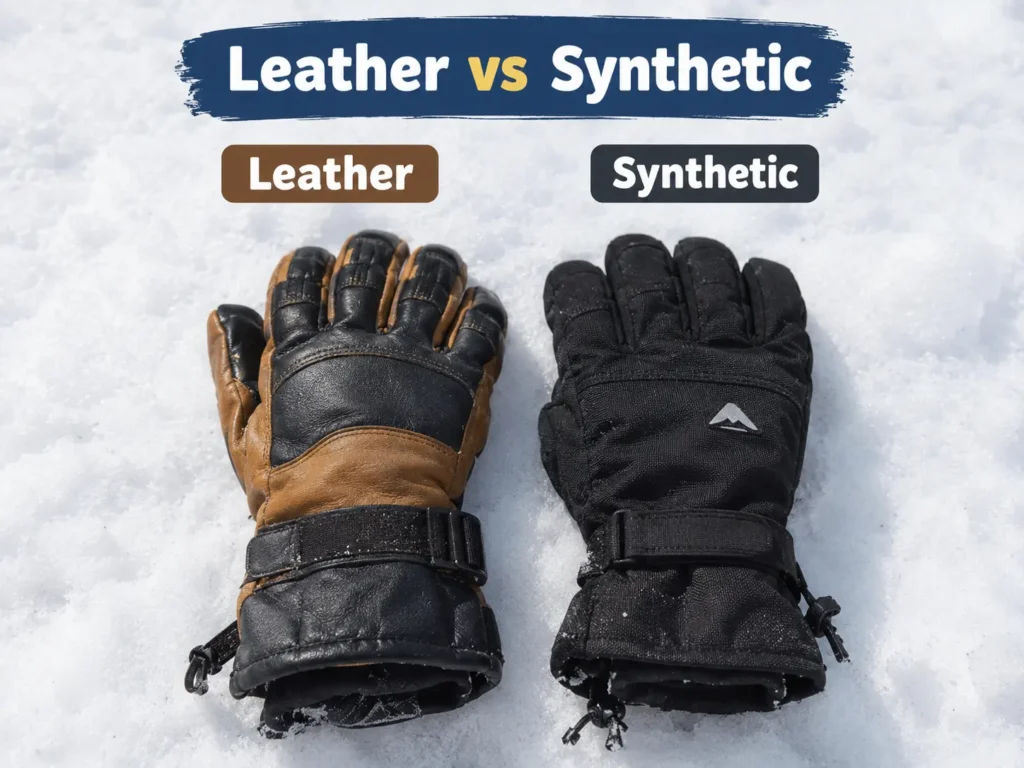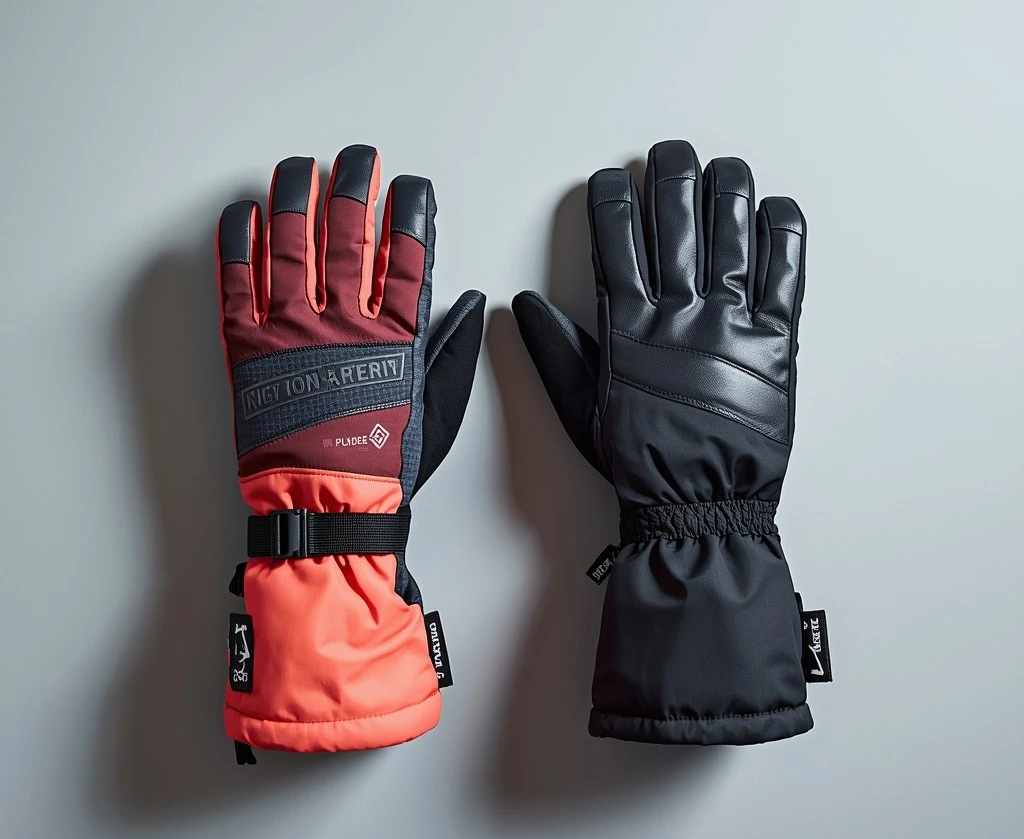
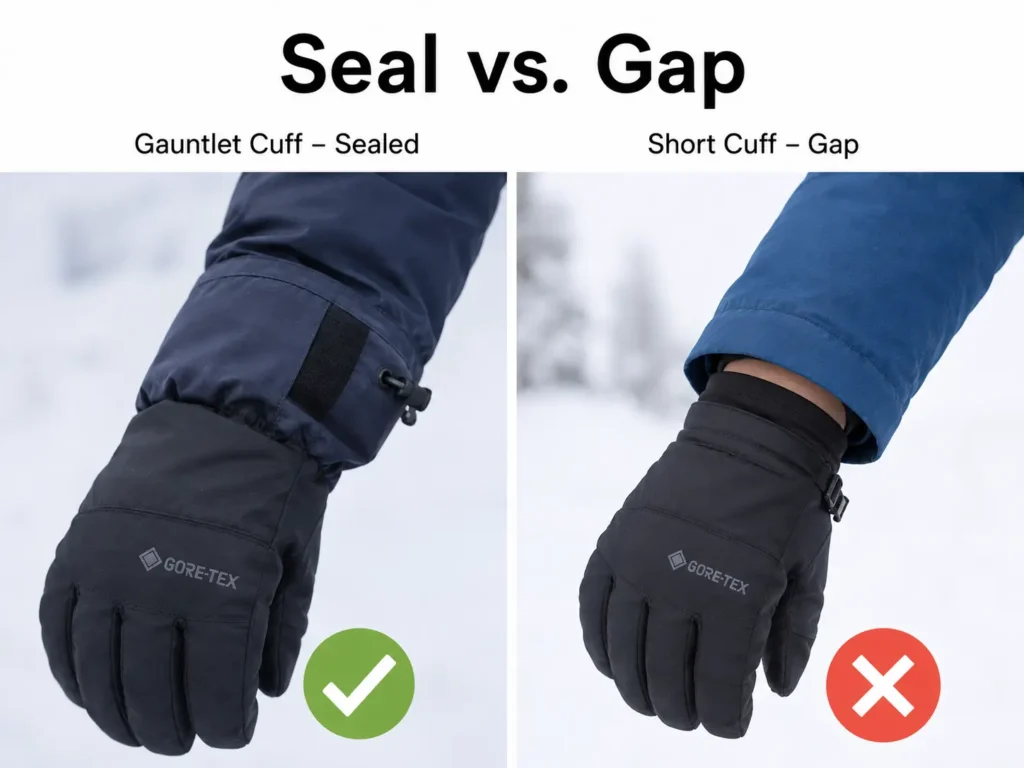
Quick answer: The real difference between these two glove styles comes down to one gap. A gauntlet cuff pulls over your jacket sleeve and closes that gap with a drawcord. A short cuff tucks under the sleeve and relies entirely on the jacket to close it. Gauntlets win when you fall often, ski powder, or face wind-driven snow. Short cuffs win when you remove gloves frequently, care about wrist mobility, or mostly stick to groomed runs in mild conditions.
If you’re not sure which category your skiing actually falls into, the Ski Glove Finder walks through your typical conditions and points you to a style that matches.
Neither style is objectively better — they’re built to solve different problems, and most of the confusion around this choice comes from skiers picking based on looks rather than understanding what each design is actually for.
- The One Mechanical Difference That Explains Everything Else
- Why the Gap Matters More Than Most Skiers Realize
- Where Gauntlets Genuinely Win
- Where Gauntlets Genuinely Lose
- Where Short Cuffs Genuinely Win
- Where Short Cuffs Genuinely Lose
- Insulation and Materials: A Separate Question From Cuff Style
- Cost, Durability, and Layering — The Practical Extras
- How to Actually Decide
- Common Mistakes Worth Avoiding
- Frequently Asked Questions
- The Takeaway
The One Mechanical Difference That Explains Everything Else
Every other difference between these two styles — warmth, dryness, mobility, how fast you can pull them off — traces back to a single structural choice: where the cuff sits relative to your jacket sleeve.
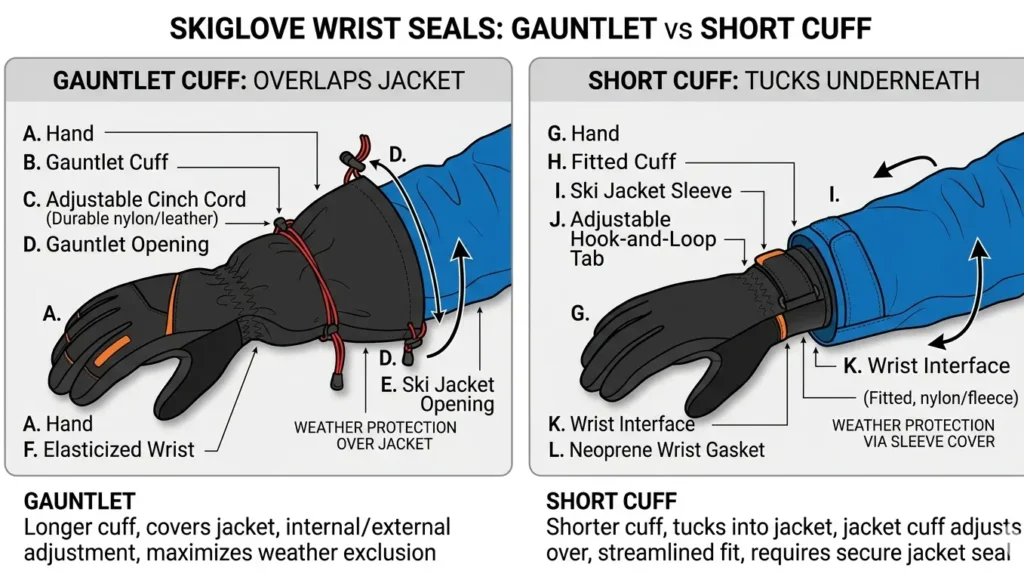
A gauntlet cuff extends past the wrist and sits over the jacket sleeve, then cinches down with a drawcord. That overlap physically closes the gap where snow and wind would otherwise reach the wrist. It’s not a feature added on top of the glove — it’s the entire point of the design.
A short cuff sits under the jacket sleeve and stops at or just past the wrist. It doesn’t try to seal anything itself. Instead, it depends on the jacket sleeve doing that job — closing snugly enough around the glove that no gap is left exposed.
That single distinction is why the two styles perform so differently depending on conditions. A gauntlet’s seal works regardless of what jacket you’re wearing. A short cuff’s seal only works if your jacket happens to be built for it.
Why the Gap Matters More Than Most Skiers Realize
A wrist gap doesn’t feel like a problem until the specific moment it becomes one — a fall in deep snow, a gust of wind on an exposed ridge, an afternoon of accumulated moisture that started as one overlooked opening.
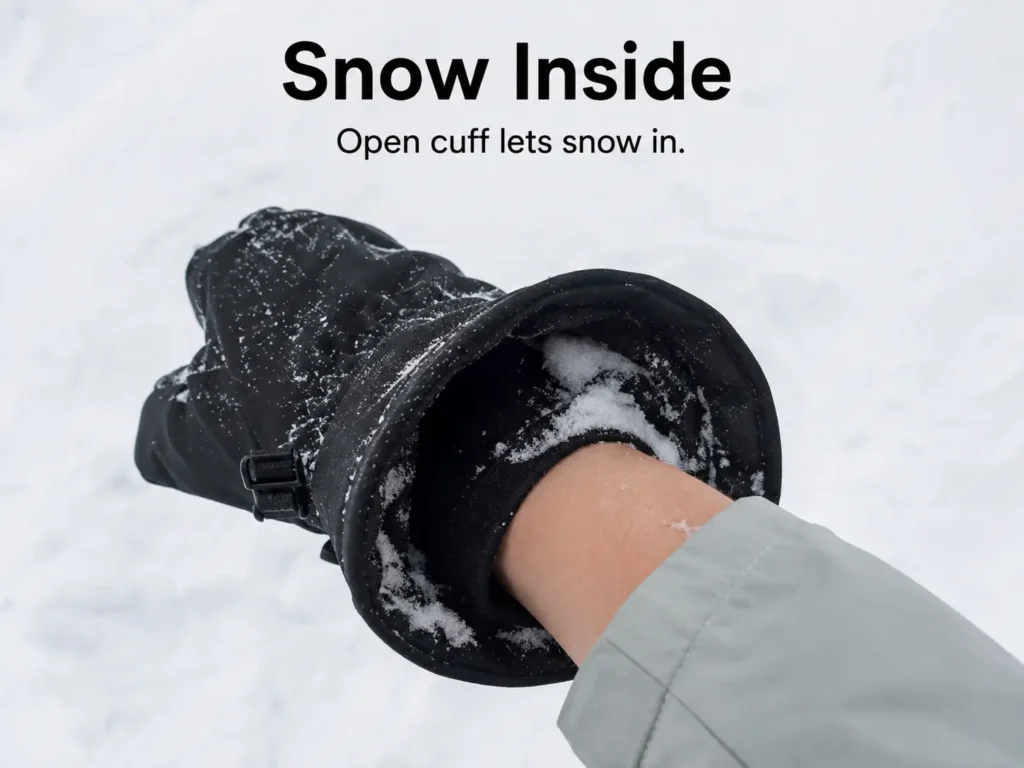
Snow entering through this gap is a mechanical event, not a fluke. When a skier falls forward in powder, the jacket sleeve tends to ride up the arm while the glove cuff stays roughly in place, and whatever gap exists between them opens to its full width right as the arm plunges into snow. Anything that gets in during that moment melts against body heat and runs down toward the fingers — independent of how waterproof the glove itself is.
Wind adds a second version of the same problem. On an exposed chairlift or open ridge, moving air finds the same gap and channels cold directly onto the wrist — one of the areas where blood vessels sit close to the skin surface, which means heat loss there affects hand temperature faster than exposure to other parts of the hand would. Windproof membrane technology used in technical outerwear exists specifically to block this kind of wind chill while still allowing the glove to breathe — but that membrane can’t help if the wind is entering through an open gap rather than through the fabric itself.
This is also why checking actual wind chill on the National Weather Service’s wind chill chart matters more for this decision than checking air temperature alone — a jacket-glove gap that’s a non-issue on a calm day can become the deciding factor once wind is added to the same temperature.
Where Gauntlets Genuinely Win
The gauntlet’s advantage is structural and doesn’t depend on luck, technique, or which jacket you happen to own that day. Because the seal comes from the glove itself rather than from a jacket-glove pairing, a gauntlet performs consistently across different outer layers, different fall patterns, and different wind conditions.
This matters most in three scenarios: deep powder where falls routinely bury the arm, tree skiing and off-piste terrain where branches and variable snow expose gaps unpredictably, and storm days where wind-driven snow finds openings that would be irrelevant in calm weather. In all three, the short cuff’s performance depends entirely on a jacket sleeve holding up under conditions it usually wasn’t specifically built to handle.
Beginners benefit from this consistency too, for a less obvious reason: fall frequency is simply higher while learning, and unpredictable falls are exactly the situation where a gauntlet’s protection doesn’t depend on the skier doing anything right — it just works by design.
Not all gauntlets behave the same, though. A stiff, traditionally constructed cuff — often leather-reinforced — restricts wrist movement noticeably. A softer, pre-curved cuff with stretch panels barely does. Skiers who tried one gauntlet years ago and disliked the bulk may be surprised by how different a modern, flexible cuff feels. The category isn’t uniform, and dismissing gauntlets entirely based on one older or stiffer pair skips over a real amount of variation.
Where Gauntlets Genuinely Lose
The over-sleeve design that makes gauntlets protective also makes them slower to put on, take off, and readjust. That’s a minor annoyance for a skier who removes gloves twice a day. It’s a real friction point for backcountry skiers doing repeated skin transitions, where gloves come off and go back on several times in cold conditions that make fiddling with a drawcord genuinely unpleasant.
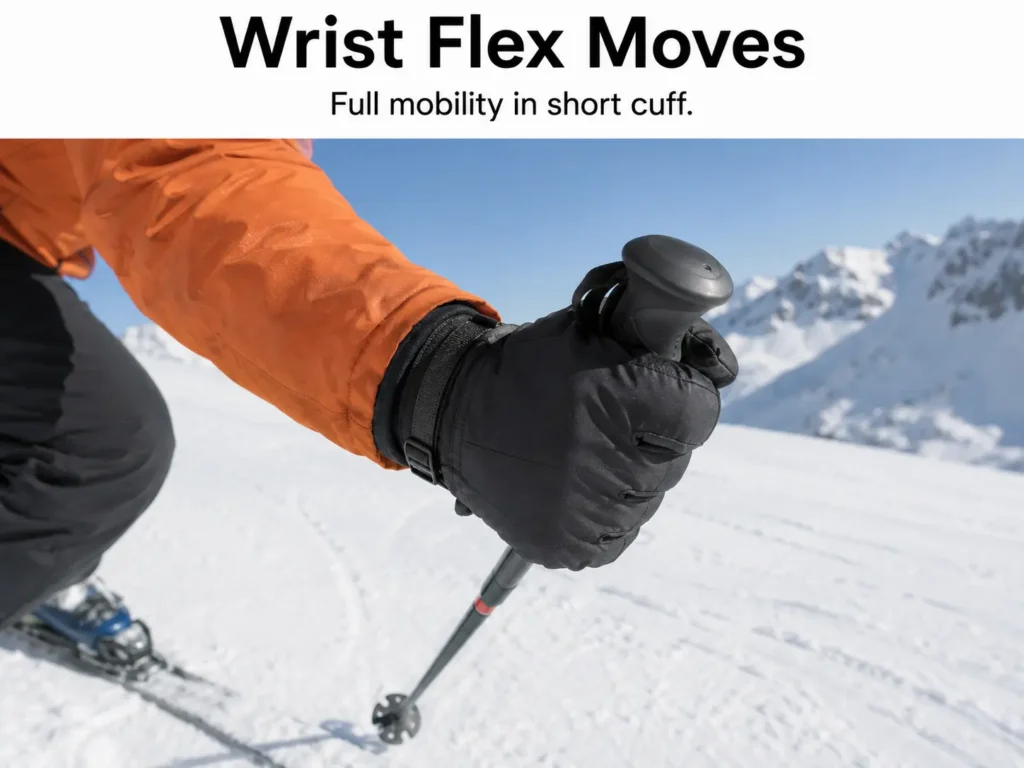
Wrist mobility is the second trade-off. Pole planting involves a real wrist motion — the wrist cocks forward on the downhill side of a turn, repeated hundreds of times across a ski day — and any added bulk above the wrist has some effect on that movement. It’s rarely dramatic with a flexible modern cuff, but skiers doing precise technical work, racing, or park riding tend to notice it more than recreational resort skiers do.
Jacket compatibility can also work against a gauntlet rather than for it. If a jacket sleeve is unusually wide or thick, a gauntlet cuff can bunch rather than seat cleanly, which creates pressure points and, in some cases, a worse gap than the one it was meant to close. It’s worth trying a gauntlet over the actual jacket you ski in before assuming it will fit as intended.
Where Short Cuffs Genuinely Win
A short cuff’s biggest advantage is that there’s simply less glove above the wrist — nothing to overlap, reposition, or tighten. That translates directly into two things: faster on-and-off, and unrestricted wrist movement, since the hand and wrist move exactly as they would without a cuff in the way at all.
That mobility advantage shows up most clearly in pole feel. Skiers who’ve developed a feel for pole timing through years on snow often notice small changes in tactile feedback, and a bulkier cuff above the wrist can mute that feedback slightly. It’s a subtle effect, but it’s real enough that some experienced and competitive skiers actively prefer the short cuff for this reason alone.
Short cuffs also happen to perform better in warm, wet conditions — not because they were designed for it, but as a side effect of the same gap that causes problems in cold weather. In spring skiing or temperatures near freezing, hand sweat becomes more of a comfort issue than cold air does, and a short cuff’s open wrist zone allows some of that moisture to ventilate out rather than staying trapped the way a sealed gauntlet cuff would hold it in.
Where Short Cuffs Genuinely Lose
The short cuff’s entire performance depends on a variable it doesn’t control: the jacket sleeve. A tight, purpose-built technical sleeve can close snugly enough around a glove cuff to make the short cuff perform almost as well as a gauntlet in moderate conditions. A wide, loosely finished sleeve — common on many mid-range and budget ski jackets — leaves a gap that no glove quality can compensate for, because the glove was never the part of the system responsible for sealing it.
This is the most overlooked factor in the whole comparison. A skier who assumes their short cuff gloves have failed may actually be dealing with a jacket sleeve that never provided the seal the glove design depends on. Before writing off short cuffs entirely, it’s worth checking whether the actual problem sits one layer up.
Fall frequency and snow depth compound this weakness directly. A short cuff skier who falls occasionally on packed groomed snow rarely exposes much of the gap — the falls are shallow and the snow doesn’t flow into small openings. The same skier falling in waist-deep powder is a different situation entirely: snow moves under pressure into every available gap on nearly every fall.
Insulation and Materials: A Separate Question From Cuff Style
It’s worth separating cuff type from warmth, because the two get conflated more often than they should. Both gauntlet and short-cuff gloves can be built with identical insulation, identical shell materials, and identical waterproof membranes — the cuff style itself doesn’t determine how warm a glove is. What it determines is whether moisture gets into that insulation in the first place, which affects performance indirectly but significantly. A well-insulated short cuff glove that lets snow in during a fall will underperform a lighter-insulated gauntlet that stays dry, simply because wet insulation loses effectiveness fast. Anyone comparing warmth ratings between two gloves should factor in cuff type as a real-world variable, not just the stated temperature rating on the tag.
Regardless of cuff style, the outer shell’s water resistance depends on maintaining the fabric’s durable water repellent (DWR) coating, which wears down with use and needs periodic reapplication — a gauntlet with a worn DWR coating can still soak through the shell even with a perfectly sealed wrist, so cuff type and shell maintenance are separate problems that both need attention.
Cost, Durability, and Layering — The Practical Extras
Price differences between the two styles are usually small and driven more by brand and materials than by cuff type itself — a gauntlet isn’t inherently more expensive than a short cuff at the same insulation and shell quality. Durability follows a similar pattern: the drawcord and cinch hardware on a gauntlet is one more component that can eventually wear out or fray, but it’s a minor maintenance point rather than a real durability gap between the two styles.
Layering is where the styles diverge more meaningfully. A short cuff leaves room to add a wrist layer underneath — a liner glove, a base layer cuff, even a watch or fitness tracker — without much fuss, since nothing above the wrist is trying to seal against anything else. A gauntlet’s cuff is more particular about what fits underneath it; bulky layering under a gauntlet can interfere with how cleanly the cuff seats over the jacket sleeve, which is worth checking before layering heavily under one.
If you’re shopping for a first pair and want to see how these trade-offs play out across specific gloves at different price points, our buying guide covering the best ski gloves across budgets breaks down cuff style alongside insulation and waterproofing for a range of options, rather than treating cuff type as an afterthought the way many spec sheets do.
How to Actually Decide
Three questions settle this for most skiers, and they’re worth working through honestly rather than guessing.
What does your jacket sleeve actually do?
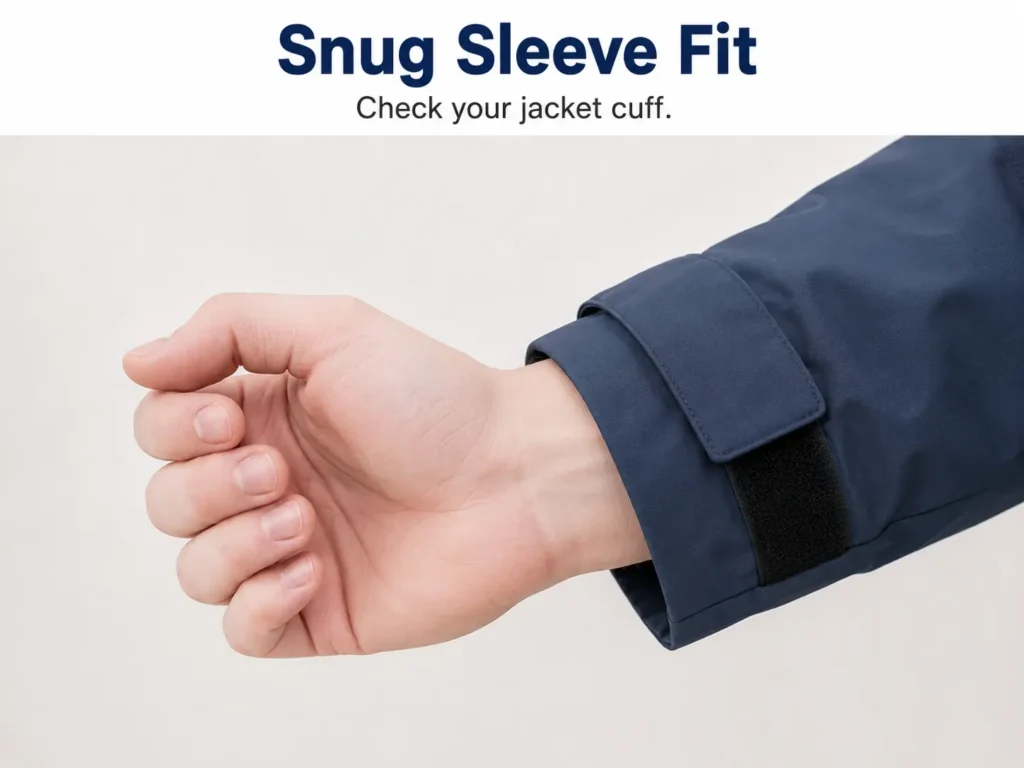
Put the jacket on and try closing the sleeve around your bare wrist. If it closes snugly with no visible gap, a short cuff is viable in a wider range of conditions. If there’s a gap, or the sleeve is wide and loosely finished, that jacket can’t provide what a short cuff depends on — and the choice shifts toward gauntlet regardless of anything else.
How often do you actually fall, honestly?
Most skiers underestimate this. If your skiing is limited to groomed terrain you know well, falls are genuinely rare and a short cuff holds up fine. If you ski new terrain, powder, or off-piste even occasionally, treat fall frequency as high enough to matter — one fall in deep snow is enough to soak a short cuff’s interior for the rest of the day.
How often do your gloves come off during a normal day?
Think through lodge stops, boot adjustments, phone use, snack breaks. If that adds up to more than a few times a day, the gauntlet’s slower on-and-off becomes real daily friction. If gloves come off once or twice total, it barely matters.
If those three answers point in different directions — which happens more than people expect, especially for skiers with mixed conditions across a season — gauntlet is generally the safer default. Its downside is inconvenience. The short cuff’s downside, when it fails, is genuinely wet hands, which tends to end a ski day early rather than just being mildly annoying.
Common Mistakes Worth Avoiding
Blaming the glove when the jacket is the actual problem. A short cuff’s seal depends entirely on the jacket sleeve. Before concluding that short cuffs “don’t work,” check whether the sleeve is closing properly in the first place.
Wearing a gauntlet for every condition after buying it for one powder trip. A glove bought specifically for a powder trip often ends up worn all season, including on warm spring days where a short cuff would be noticeably more comfortable. Matching the glove to the day’s actual conditions matters more than picking one style and sticking with it year-round.
Leaving the gauntlet drawcord loose. An untightened drawcord provides meaningfully less protection than the design implies — it can leave a partial gap that, in some conditions, still lets snow funnel in even though the glove looks sealed.
Assuming all gauntlets feel the same. Cuff stiffness varies a lot between models. A skier who tried one stiff, older-style gauntlet and disliked the wrist restriction may find a newer, flexible cuff perfectly comfortable — it’s worth testing a specific glove rather than ruling out the whole category from one experience.
Frequently Asked Questions
Can a short cuff glove ever be warm enough for cold conditions?
Yes — warmth comes from insulation and shell material, not cuff length. A well-insulated short cuff can be just as warm as a gauntlet in calm, dry cold. The risk isn’t warmth on its own; it’s what happens once snow or wind finds the wrist gap.
Do gauntlet cuffs work with any ski jacket?
Mostly, but not universally. A gauntlet needs a sleeve it can fit over without excessive bunching. Most standard ski jacket sleeves work fine; unusually wide or heavily insulated technical sleeves are worth testing with the specific glove before buying.
Is one style clearly better for beginners?
Generally yes — gauntlets, mainly because fall frequency tends to be higher while learning, and the gauntlet’s protection doesn’t depend on technique or jacket choice working out correctly.
Does a gauntlet actually restrict skiing performance?
For most recreational skiers, the effect is minor with a modern flexible cuff. It becomes more noticeable for skiers doing precise technical movements — racing, moguls, park riding — where fine wrist feedback matters more than it does for casual resort runs.
The Takeaway
This choice isn’t about which glove is better — it’s about matching a design to the conditions it was actually built for. A gauntlet closes the wrist gap by design, which makes it the more reliable choice anytime falls are likely, snow is deep, or wind is a factor. A short cuff trades that built-in protection for mobility and speed, which makes sense when your jacket sleeve genuinely seals well and your skiing stays mostly on groomed terrain.
The honest answer for most skiers who only own one pair and ski varied conditions across a season is to lean gauntlet — the situations where it’s mildly inconvenient are far less costly than the situations where a short cuff genuinely fails. Once you know your jacket sleeve fit, your real fall frequency, and how often your gloves actually come off during a normal day, the right choice tends to be obvious rather than a guess.
If fit is still uncertain after working through that, it’s worth going back to basics — our full breakdown of how ski gloves should fit covers the checks that matter regardless of which cuff style you land on, from finger movement to grip pressure under load.