As an Amazon Associate, I earn from qualifying purchases.
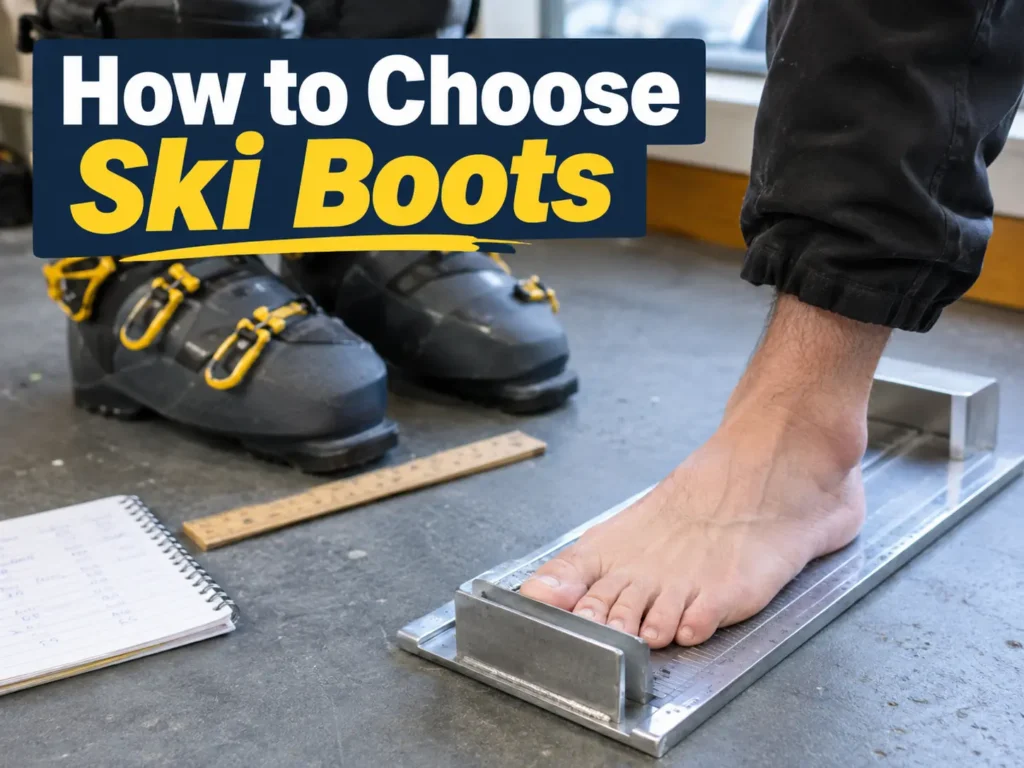
Quick answer: Think in numbers, not brands. Measure your foot length and width, decide how much room your instep and calf need, match a flex range to your level and body, then try every boot on with the socks you will ski in. The boot that passes those checks is the right one, whatever the label says.
Need gloves for the same trip? The Ski Glove Finder lines them up by budget and weather in about a minute.
- Your Boot Card
- Line 1: Length
- Line 2: Width
- Line 3: Volume
- Line 4: Flex
- Line 5: Money and Route
- Line 6: Liner and Footbed
- Reading the Numbers on Your Boot
- Why Boot Size Shapes Your Bindings
- Ten Minutes in the Shop: Six Checks
- What a Boot Fitter Can Change
- Red Flags: Walk Away If
- Four Fit Myths That Cost Money
- A Two-Week Plan Before Your Trip
- Three Sample Boot Cards
- Questions Skiers Ask Before Buying
- The Short Version
Your Boot Card
Before you shop, write six lines on your phone. Call it a boot card. It turns a confusing wall of boots into a short list, and it gives a fitter something to work with in the first minute.
You will not know every line yet, and that is fine. The sections below show how to fill each one in, and the table shows where each number comes from.
| Line | What goes on it | Where it comes from |
| 1. Length | Your foot length in millimeters and a target shell size | A wall, a ruler and a shell fit |
| 2. Width | Narrow, average or wide, ideally in millimeters | Street shoe width and the boot’s last |
| 3. Volume | Low, medium or high, plus any tight spots | Instep, ankle and calf |
| 4. Flex | A flex range for your level and body | Ability, weight and height |
| 5. Money and route | A budget and where you will buy | New, used or shop fitted |
| 6. Liner and footbed | Heat-molding, insoles, comfort needs | A fitter’s advice and your own feet |
Fill in what you know now, and keep the card open as you read. A card with six lines beats a head full of brand names.
Line 1: Length
Ski boots use Mondopoint sizing, which is your foot length. Stand with your heel against a wall, measure to your longest toe in centimeters, and use the longer foot. A foot that measures 26.5 cm gives you an indicated size of 26.5.
Your indicated size is a starting point, not the answer. Boot makers do not build separate shells for half sizes, so a 26.0 and a 26.5 usually share one shell. If a 26.5 feels too big, the next boot down is a 25.5, not a 26.0.
That is why a shell fit matters. Take the liner out, slide your foot into the bare shell until your longest toe just touches the front, and check the gap behind your heel. Fitters often count in fingers, and one finger is about 15 millimeters.
One to one-and-a-half fingers, about 15 to 22 millimeters, is a good performance fit. More than two fingers is usually too big. Less than one finger is race territory, best left to elite skiers who work with an experienced fitter.
| Skier type | Size versus indicated | Why |
| Beginner to intermediate | Indicated size or half a size larger | The liner packs down, and all-day comfort comes first |
| Intermediate to advanced | Indicated size or half a size smaller | Sharper control, paired with a stiffer flex |
| Advanced to expert | Half to a full size smaller | A precise fit, usually shaped with a fitter’s help |
Keep the length question honest, because a boot that is a little small can be enlarged, while a boot that is too big is nearly impossible to shrink. The liner will also pack down after a few days of skiing, so a snug boot in the shop often relaxes on the hill.
Wear the thin sock you plan to ski in for every check. Our ski sock guide explains why a thick sock changes the numbers, and why one thin pair is the standard.
Street shoe size is a last resort. Shoe sizes are inconsistent, and many people wear shoes that do not fit well. A ski boot is far less forgiving than a sneaker.
Most people have one foot a little bigger than the other. Measure both, size for the bigger one, and ask the fitter to ease the tighter side if it bothers you. Fitters measure each foot for this reason.
Line 2: Width
Width is the forefoot width inside the boot shell, called the last. It is listed in millimeters and usually runs from about 97 to 106. A bigger number means more room across the ball of your foot.
Makers usually offer two or three lasts. The table shows the three common groups and the kind of foot each one suits.
| Last | Forefoot width | Street shoe width hint | Who it suits |
| Narrow | 97 to 98 mm | A or B | Narrow, low-volume feet and a precise fit |
| Average | About 100 mm | C or D | Most feet, with a relaxed midfoot and heel |
| Wide | 102 to 106 mm | E or wider | Wide, higher-volume feet and comfort first |
If you know your usual shoe width, you can guess your lane. Treat it as a hint, not a rule, because brands measure a little differently from each other.
Wider lasts normally carry more volume through the rest of the boot too. That is why a wide boot can feel loose around the heel on a narrow foot, even when the toes have room.
Odd foot shapes change the plan. Bunions, bony spots and unusually long toes can create a pressure point in an otherwise good boot. A fitter can often modify the shell at that spot instead of sending you up a size.
Settle width early. It narrows your list faster than any other line on the card.
When a model comes in two widths, try both in the same size. The difference is easy to feel in the first few minutes, and it saves a return later.
Line 3: Volume
Volume is how much total room the boot gives your foot across the forefoot, instep, ankle and heel. Makers do not list it as a number, so you learn it by trying boots on.
Low volume suits slim feet, medium suits average feet, and high volume suits wider feet or a high arch. Some models carry LV, MV or HV in the name, which gives you a quick clue.
Instep height is the one to watch. It is the bony top of your foot just in front of the ankle, and it is very sensitive to pressure. A boot that is too tight over the instep is harder to fix than one that is tight around the edges.
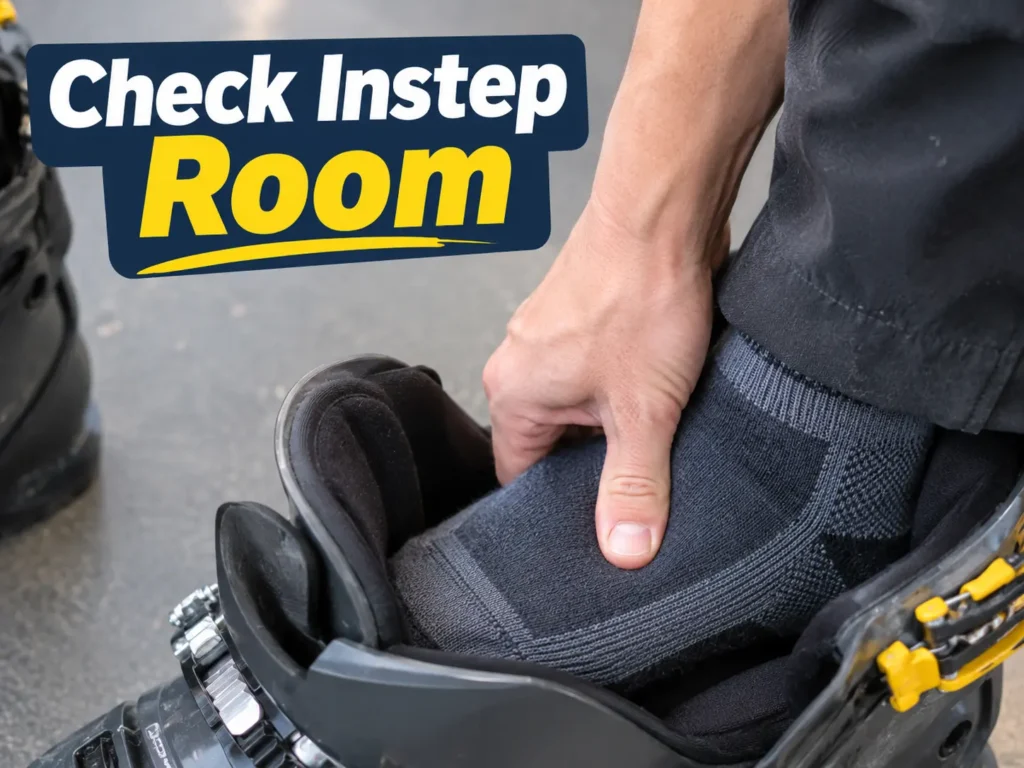
Wear each boot for 10 to 15 minutes before you decide. Instep trouble usually shows up in that window, long before your second run.
Pressure on the top of the foot can also lead to cold, numb toes, because squeezing slows blood flow. It is the same idea as a tight wrist band on a glove. Our circulation guide explains why that matters in the cold.
Calf size counts too. Fitters often check shin and calf diameter, because the cuff has to be closed around it. Women’s boots usually have a lower cuff height than men’s, and a slim or shorter leg often sits better in a women’s fit.
Heel hold finishes the picture. When you lean forward, your heel should stay down in its pocket. A heel that lifts points to too much volume or too long a shell.
Line 4: Flex
Flex is how hard the boot is to bend forward. It is shown as a flex index, usually a number from 50 for soft to 130 for very stiff, and you often find it printed on the cuff.
Brands do not measure flex the same way, so one maker’s 100 is not another’s. Some even use a 1 to 10 scale. Use the number to compare boots within one brand, and to narrow your search across brands.
| Level | Men’s flex | Women’s flex | Feel |
| Beginner to intermediate | 60 to 80 | 50 to 60 | Soft |
| Intermediate to advanced | 85 to 100 | 65 to 80 | Medium |
| Advanced to expert | 110 to 120 | 85 to 100 | Stiff |
| Expert to race | 130 and up | 110 and up | Very stiff |
Women’s numbers run lower because women usually carry less body mass for the same height and foot size. Read your own column, not the other one.
Weight and height shift the range. A short, light skier puts less leverage on the boot, and a very stiff boot can limit natural movement. A taller or heavier skier may need a stiffer boot even as a beginner.
Terrain matters too. Big mountain skiers often pick slightly softer boots than racers, and park skiers go softer still. An athletic skier who is on snow often can also outgrow a soft boot inside a single season.
Treat the table as a range, not a verdict. If you sit between two rows, try one boot from each and spend ten minutes in both. Your legs will tell you which one you can control.
If you are new, start soft and enjoy learning. Our beginner boot picks list comfort-first boots with roomy fits, and they sit in the soft rows of this table.
Line 5: Money and Route
Boots cost real money, so make a plan. Decide your budget first, then decide where you will buy, because the route changes the risk.
| Route | Good for | Watch out for |
| Ski shop, in person | First-time buyers and odd feet | Higher prices and fewer deals |
| Online, then a shop check | Price hunters | Size guesses and return windows |
| Online only | Skiers who know their exact boot | No fitting help at all |
| Used boots | Tight budgets | Packed-out liners and worn soles |
Used boots can work, with care. The liner compresses over time, so a used boot feels roomier than its size suggests. Check the sole for wear and the buckles for damage, and read the boot sole length on the heel.
If you buy online, treat it as a fitting you do at home. Wear the boots for a couple of hours, buckled the way you would ski, before the first trip. A problem found on the couch costs far less than one found on a chairlift.
Do not let price or color make the decision. If you have to save, save somewhere else in the kit and protect the boot budget.
Hands cost money too. The Best Ski Gloves page sorts options by budget, and the same rule holds there: fit first, brand second. For very cold trips, freezing-day gloves cover the extreme end.
Once you own a pair, look after it. The same dry-and-store thinking in our glove care habits applies to boots: dry them fully, keep them away from direct heat and store them loosely.
Line 6: Liner and Footbed
The liner is the soft inner boot. It adds warmth and cushion, and many liners can be heat-molded for a closer fit. A fitter warms the liner and shapes it around your foot, which helps with pressure spots.
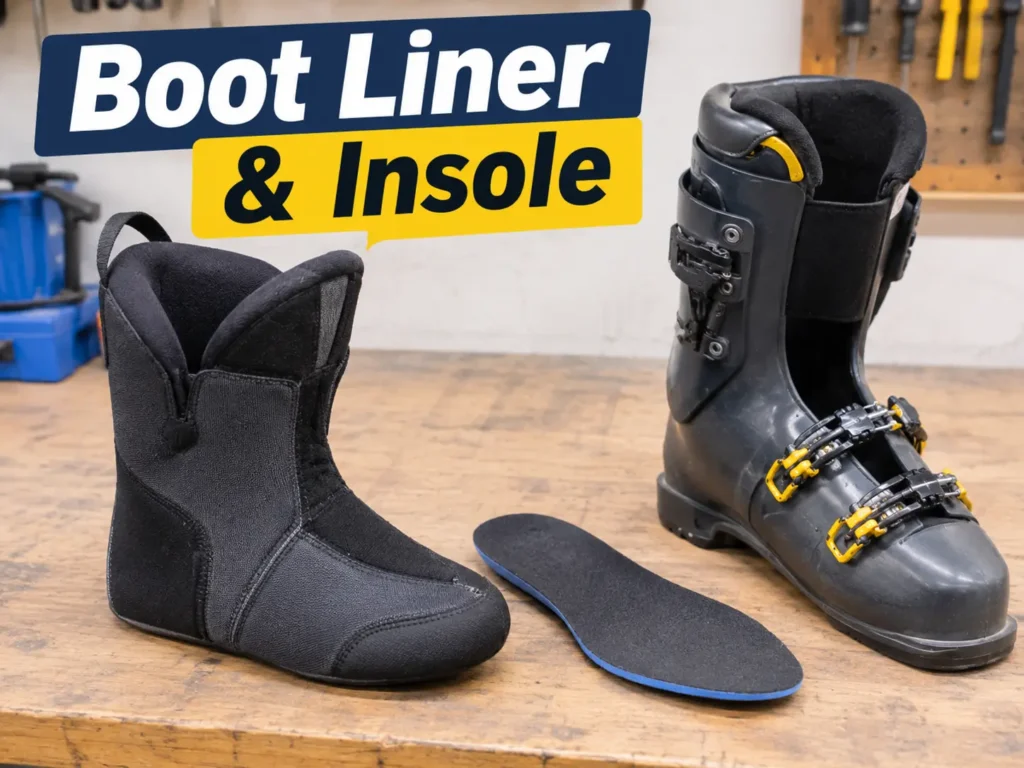
Heat-molding works best when you wear the same thin sock you will ski in. A liner molded over a thin sock will feel snug with a thicker one.
The footbed is the insole. Many boots ship with a basic one, and aftermarket insoles can add arch support and a firmer base. If you have known foot problems, ask a doctor or podiatrist about a physician-made orthotic.
The Cleveland Clinic explains that orthotics range from drugstore inserts to custom devices made by a podiatrist. Store-bought options suit mild symptoms, while custom ones cost more but last longer and give better support.
The same page admits that research on orthotics for flat feet in adults is limited, so do not expect miracles from any insert. A good boot fit still comes first.
Give any new insole time. It says feet can take up to a month to adjust to orthotics, so test new inserts at home before a ski trip, and build up your wearing time slowly.
Some boots also have a small wedge behind the calf, called a spoiler. A fitter can often remove or reposition it if the cuff presses on your calf.
Reading the Numbers on Your Boot
Every boot carries numbers, and they are easier to read once you know what they mean. The Mondopoint size is your foot length. The international Mondopoint standard behind it is based on foot length and width, and its length steps are normally 5 millimeters.
Boot sole length, or BSL, is stamped on the heel. It is the real length of the shell in millimeters, for example 302. Shops use it when they set your bindings.
| Marking | Example | What it tells you |
| Mondo size | 26.5 | Foot length of 265 mm |
| Boot sole length | 302 | Length of the shell in millimeters |
| Flex index | 100 | Stiffness, best compared within one brand |
| Last | 100 mm | Forefoot width inside the shell |
| LV, MV or HV | MV | Low, medium or high volume |
Add your BSL to the boot card once you own a pair. Ski shops ask for it whenever they mount or adjust bindings.
Why Boot Size Shapes Your Bindings
Your boots and bindings work as a system. The release setting, often called the DIN setting, controls how much force it takes for the binding to let go in a fall. Shops set it from your weight, height, age, boot sole length and skier type.
The name comes from an old German standard that was replaced by ISO 11088 in 1993, as this binding standard overview explains. ISO 11088 is written for ski shops and covers the assembly, adjustment and inspection of the ski, binding and boot together.
What this means for you: a different boot can change the setting. When you swap boots, tell your shop so they can re-check the bindings against the new sole length.
Ten Minutes in the Shop: Six Checks
When you reach the shop, bring your boot card, your thin socks and a couple of hours. Rushing is how people end up in the wrong boot.
Check 1: Shell fit. Ask for a shell fit before you try a full boot. One to one-and-a-half fingers behind the heel is your target.
Check 2: Buckles. Buckle the boot the way you would ski, snug but never crushing. Cold feet and numb toes start with buckles that are too tight.
Check 3: Hard flex. Drive your knee forward into the tongue several times. That pushes your heel back and opens space at the toes, and you should feel little pressure there while you flex.
Check 4: Toes. Standing tall, your toes may press the front lightly. They should pull back as you bend your knees. If they jam or tingle when you flex, the boot is too short.
Check 5: Time. Stay in the boot for 10 to 15 minutes. Watch for instep pressure, shin bite and any sharp spot that grows instead of fading.
Check 6: Heel. Lean forward and lift your heel gently. It should stay down. If it rises, the boot has too much room or the wrong shape.
If a boot passes all six, put it on the short list. If two boots pass, take the one you can still comfortably stand in at the end of the visit.
What a Boot Fitter Can Change
A good fitter can fix a lot, and knowing the menu helps you ask for the right thing.
| Problem | Common fix |
| Toe pressure from the liner | Stretch the liner at the toe |
| Pressure from a bunion or bony spot | Stretch or modify the shell at that spot |
| A loose or uneven fit | Heat-mold the liner |
| Tired arches or a sore foot | Aftermarket insole or footbed |
| Calf pressure from the cuff | Remove or reposition the spoiler |
| The whole boot is too big | No real fix; go down a size |
Fixes work best on a boot that is already close. They cannot rescue a boot that is the wrong size or shape, so do not buy a bad fit and hope.
Red Flags: Walk Away If
Some boots are not worth saving. Walk away if you see any of these signs.
The shell has more than two fingers behind your heel, and your heel lifts when you flex. That boot is too big, and it will stay too big.
Your toes go numb within ten minutes, or one spot hurts sharply and the fitter cannot modify it.
You are told to grow into a boot far stiffer than your row on the flex table, with no reason given. A boot that is too hard to bend slows your learning.
The boot only feels good with a thick sock. That tells you the shell or the volume is wrong, and a thick sock only hides it for a while.
Four Fit Myths That Cost Money
Myth: boots should feel like sneakers. They will not, and they should not. A ski boot is a snug shell built to pass your leg’s movement to the ski. Aim for snug without pain, not slippers.
Myth: thick socks mean warm feet. The plastic shell and the foam liner already insulate, and extra sock between your foot and the shell dulls control. Thin socks are the norm, even among strong skiers.
Myth: comfort in the shop is the goal. Boots loosen after a few days, so the aim is a good fit at the end of the season, not a sofa feel on day one. Snug is normal. Pain is not.
Myth: stiffer is always better. A stiff boot rewards a strong skier going fast. For a lighter or newer skier it fights every turn. Match your row on the flex table, then adjust a little.
A Two-Week Plan Before Your Trip
Two weeks out, measure your feet, fill in the boot card and book a fitting if you can. Fittings can book up before holidays and long weekends.
One week out, try your short list. Wear each pair for the full ten to fifteen minutes with your thin socks, and ask about the return or exchange window before you leave the shop.
A few days out, wear the boots at home for a couple of hours, buckled as you would ski. Stay on a clean floor and carpet, not outside. Note any spot that bothers you, and take that list back to the fitter.
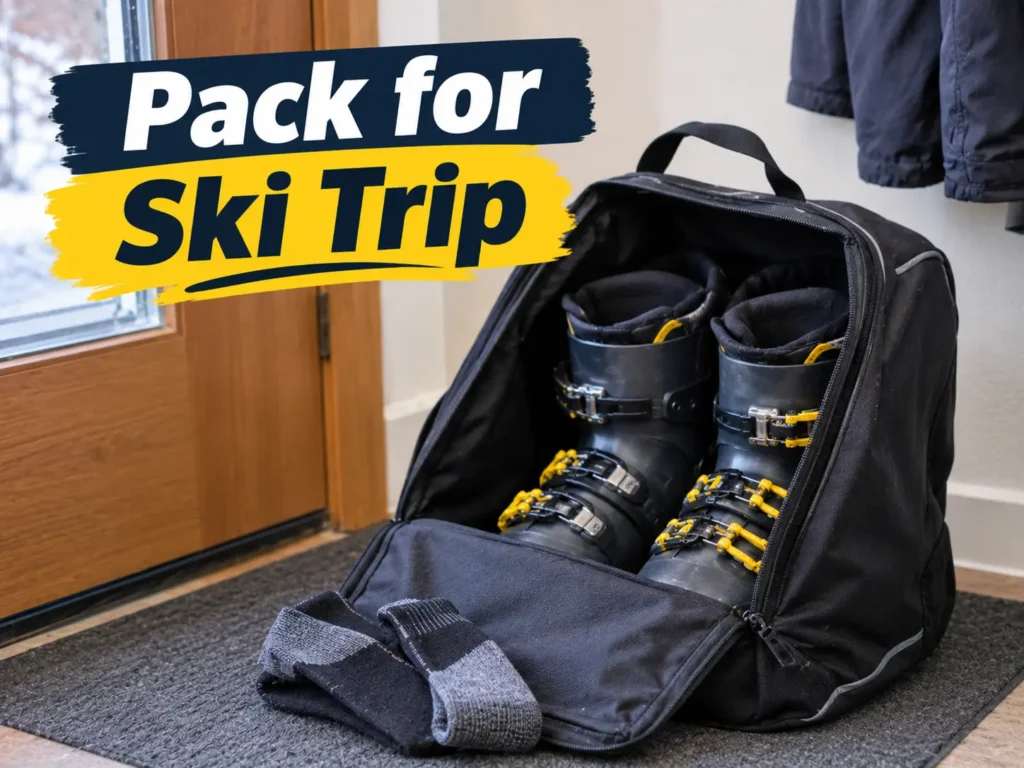
The night before, pack the boots, your thin socks and a spare pair. Keep your boot sole length in your phone so a ski shop can check bindings in minutes.
On the first morning, put the boots on indoors and loosen the top buckle on the first lift ride. A calm start makes the rest of the day easier.
Three Sample Boot Cards
A filled card is easier to understand than an empty one. These three are examples only, not advice for any real person. Yours will look different.
| Line | Skier A: first season | Skier B: wide feet, three seasons | Skier C: slim feet, strong skier |
| Length | Shell fit at one and a half fingers | Indicated size | Half a size below indicated, with a fitter |
| Width | Average, about 100 mm | Wide, 102 to 106 mm | Narrow, 97 to 98 mm |
| Volume | Medium | High | Low |
| Flex | Soft: men’s 60 to 80 | Medium: men’s 85 to 100 | Stiff: men’s 110 to 120 |
| Money and route | Shop fitted | Online, then a shop check | Shop fitted, with modifications |
| Liner and footbed | Stock liner | Heat-mold the liner | Heat-mold plus an insole |
Notice how each card points to a different kind of boot, even though all three skiers face the same wall of boots. That is the point of writing the card first.
Questions Skiers Ask Before Buying
Should I buy boots before skis?
Boots are the one piece of gear that has to match your foot, so they are a smart place to start. Skis can be matched to your height and ability later, and a shop can help with that.
Are there half-size shells?
Usually not. A 26.0 and a 26.5 normally share one shell, so if a 26.5 feels too big, the next size down is a 25.5.
Can a boot that is too big be fixed?
Not really. A boot that is a little too small can often be enlarged, but it is very hard to shrink a boot that is too big. When in doubt between two sizes, ask the fitter about the smaller one.
Will new boots loosen up?
Yes. The liner packs down after a few days of skiing, so most boots fit looser later. Aim for a boot that is snug but not painful in the shop, and judge again after a few days on snow.
What flex should a first-time skier look for?
A soft one: roughly 60 to 80 for men and 50 to 60 for women. A taller or heavier beginner, or an athletic one who skis often, may do better in the next step up.
Do I need custom insoles?
Not always. Drugstore inserts suit mild discomfort, while persistent pain is a reason to see a podiatrist about a custom device. Either way, test any insole at home before a trip.
What if I have wide feet?
Look at lasts of 102 to 106 millimeters, and at boots marked HV. Try each one for 10 to 15 minutes, because width is only part of the room a boot gives you.
The Short Version
Write the boot card. Measure your length and do a shell fit, pick a width, check volume at the instep and calf, match a flex range to your level and body, then decide your budget and your route.
Wear your thin socks, run the six checks, and ask a fitter what can be changed. If a boot needs a thick sock, a loose heel or a long explanation, keep looking.
A boot that fits will do more for your skiing than any brand name, and it will make every day on snow more fun.