As an Amazon Associate, I earn from qualifying purchases.
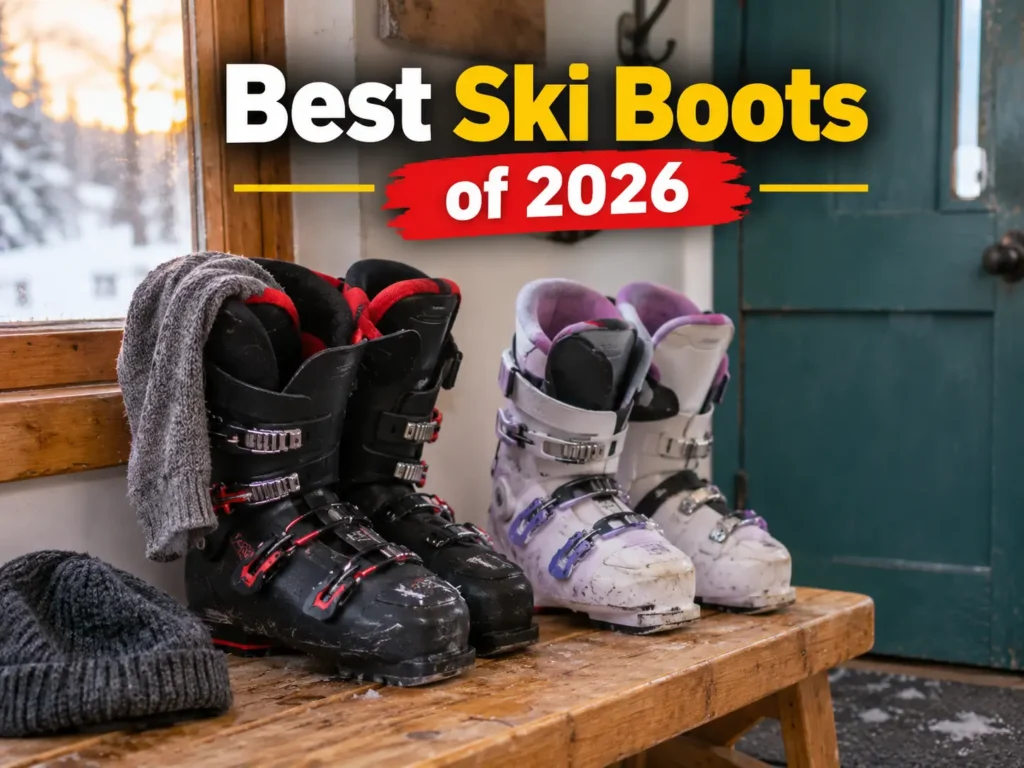
Quick answer: Buy comfort first. The Rossignol Evo 70 is the pick for men, the Rossignol Kelia 50 is the softest pick for women, and the Nordica Cruise S W is the roomiest of the three and starts around $150. All three use a relaxed 104 mm fit, so wider feet get space and a new skier is not fighting the boot all day.
Gloves still on your list? The Ski Glove Finder narrows them down by budget and weather in about a minute.
- The Three Boots at a Glance
- What Rental Boots Cost You Over a Season
- What a First Boot Should Do
- Rossignol Evo 70: The Value Pick for Men
- Rossignol Kelia 50: The Softest Pick for Women
- Nordica Cruise S W: The Roomiest Fit, Lowest Price
- Side by Side
- Men’s and Women’s Boots: What Changes
- Pick Your Boot in One Minute
- Five First-Boot Mistakes to Skip
- Socks First, Then Buckles
- Where the Rest of the Budget Goes
- Getting Your Size Right
- Soles, Bindings and the Walk to the Lift
- Order Online or Buy in a Shop?
- Your First Shop Visit
- Your First Morning in New Boots
- Break-In Days: Normal or Not?
- When You’ll Outgrow Them
- Quick Questions Before You Order
- The Short Version
The Three Boots at a Glance
Here is the short version before the detail. Every boot below is built for comfort first, so a new skier can spend the day learning instead of fighting the fit.
| Boot | Made for | Fit | Getting in | Price seen |
| Rossignol Evo 70 | Men | Relaxed, 104 mm last | Overlap opens easily | About $250 |
| Rossignol Kelia 50 | Women | Relaxed, 104 mm last, women’s cuff | Soft plastic at the instep | About $199 to $250, by size |
| Nordica Cruise S W | Women | Extra-wide comfort, 104 mm last | Dual soft flap instep | From about $150 |
Prices were checked in mid-November 2026. They move with size and seller, so use them as a guide.
What Rental Boots Cost You Over a Season
Rental boots solve one problem: you don’t own anything yet. They create another. The liner has been packed down by many other feet, so yours rarely sits right, and sore shins and numb toes follow.
Own a pair and you learn what a good fit feels like. You also wear the same boots every day, which makes progress easier. That matters more than any spec on this page.
Here is the plain math. Divide the boot price by the number of days you plan to ski. The table uses round prices close to the three boots here.
| Boot price | 5 ski days | 10 ski days | 20 ski days |
| $150 | $30 a day | $15 a day | $7.50 a day |
| $200 | $40 a day | $20 a day | $10 a day |
| $250 | $50 a day | $25 a day | $12.50 a day |
Now check what your local rental shop charges for boots per day and see where you break even. If you plan a second season, the boots win by a wide margin.
What a First Boot Should Do
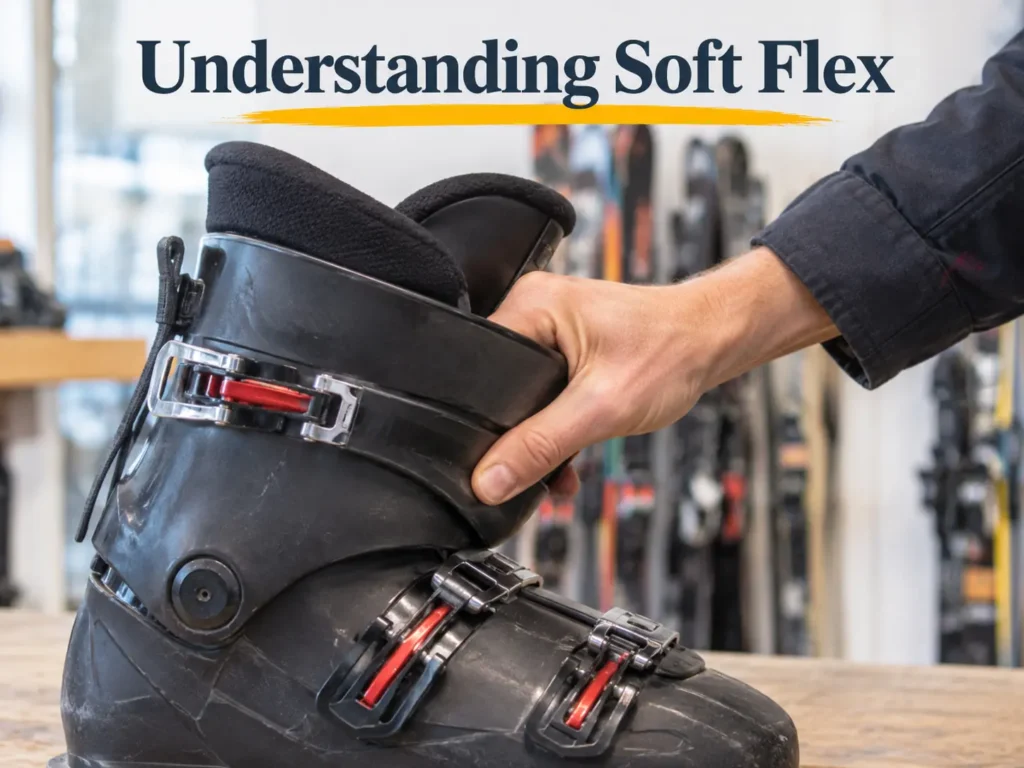
Flex is how hard it is to bend the boot forward. A soft flex lets a new skier bend ankles and knees without wrestling the plastic. Boot makers usually call men’s flex under about 85, and women’s under about 75, soft.
The last width is the inside width at the forefoot, in millimeters. A bigger number means more room. All three boots here use 104 mm, which sits on the roomy end of the range.
Entry matters more than people expect. A boot that opens wide at the throat or instep is easier on cold mornings, when plastic is stiff and fingers are slow.
Liners are the soft inner boots. They cushion and warm your foot, and a snug hold around the heel and ankle keeps your foot from sliding forward in the shell. Buckles close the shell around that liner, and micro-adjustable ones let you change pressure in small steps.
A roomy last is great for wider feet. If your feet are narrow, the same boot can feel loose, and a loose boot lets your heel lift. A shop can suggest an insole or a snugger model, which works better than stacking thick socks.
None of this makes a boot stiff or fast. It makes it forgiving, which is exactly what you want while you learn to turn, stop and ride a lift without stress.
Rossignol Evo 70: The Value Pick for Men

Rossignol Evo 70 Men’s Ski Boots
✓ Relaxed 104mm last with a wider forefoot, toe box, and ankle
✓ Sensor Matrix shell cuts weight and sends energy straight to the ski
✓ Custom fit liner with easy entry, GRIPWALK compatible (sold separately)
~$249.96
★★★★★ (4.8/5 — 73 Amazon reviews)
Check Price on Amazon →Who it suits
Picture a man in his first or second season who wants one boot to learn on and still feel roomy. Rossignol builds the Evo 70 on a 104 mm last with a wider forefoot, toe box and ankle area. If other boots squeeze your toes, this one gives them space.
Returning skiers who remember painful boots from years ago will also find the soft 70 flex easier on their legs.
What you get
Start with the shell. Rossignol calls its design Sensor Matrix. In plain words, the shell is built to stay light while still passing your leg movement to the ski, so a turn starts when you ask for it.
Inside, the liner is made to follow the shape of your foot. The listing points to support at the heel and softer padding around the ankle and instep. Those are the spots where a first-timer usually feels pressure.
Getting in matters too. The overlap opens easily, which helps when your hands are cold and the plastic is stiff. A boot that is hard to get on can sour a morning before you ever reach the lift.
Rossignol also lists GripWalk-compatible soles for this boot, sold separately. They have rubber tread and a rockered toe, which makes the walk from the car to the lift steadier.
What to know before you order
The 70 in the name is the flex number, and it is soft. That helps while you learn, because you can bend your ankles and knees without effort. The design stays simple, with three buckles.
Switchback Travel’s beginner guide lists the Evo 70 as a good-value pick and names two trade-offs: a basic liner and only three buckles. Both are reasonable for the price.
The listing showed about 250(249.96) with sizes from 26.5 to 31.5. Know your Mondopoint size before you order, and read the sizing section further down.
When you ski more and your turns get faster, a stiffer boot will feel better. That day is a sign of progress, and this boot will have done its job.
Rossignol Kelia 50: The Softest Pick for Women

Rossignol Kelia 50 Women’s Ski Boots
✓ Women’s-specific fit with a 104mm last and tulip-shaped cuff
✓ Lightweight Sensor Matrix shell with a forgiving 3-buckle flex
✓ Customizable liner, GRIPWALK compatible (sold separately)
From ~$199.07
★★★★★ (4.6/5 — 48 Amazon reviews)
Check Price on Amazon →Who it suits
Women learning to ski who want the most forgiving option here. Like the Evo 70, the Kelia 50 uses a 104 mm last with room across the forefoot, so it works for average to wider feet.
Rossignol gives the cuff a tulip shape designed around women’s legs, and the listing says it eases pressure on the shin and calf. If cuffs usually squeeze your calves, this boot deserves a close look.
What you get
The shell uses the same Sensor Matrix design as the Evo 70, so it stays light and sends leg movement to the ski. A three-buckle shell keeps adjusting simple: close three buckles and you are ready.
Soft plastic around the instep makes it easier to slide your foot in and out, even when temperatures drop. That small detail saves patience on cold mornings and in crowded lodges.
The liner is described as customizable, meant to follow the shape of your foot for support, warmth and a steady feel. GripWalk-compatible soles are available separately, with the same rubber tread and rockered toe as the Evo 70.
What to know before you order
The 50 in the name is the flex number, and it is very soft. For a true first season, soft is the point. If you want more feedback after a few days on snow, that is your cue to look at a firmer boot.
The listing showed sizes from 22.5 to 27.5, with offers starting around $199 for some sizes and about $250 for others. Check your size early, since price changes from one size to the next.
Nordica Cruise S W: The Roomiest Fit, Lowest Price
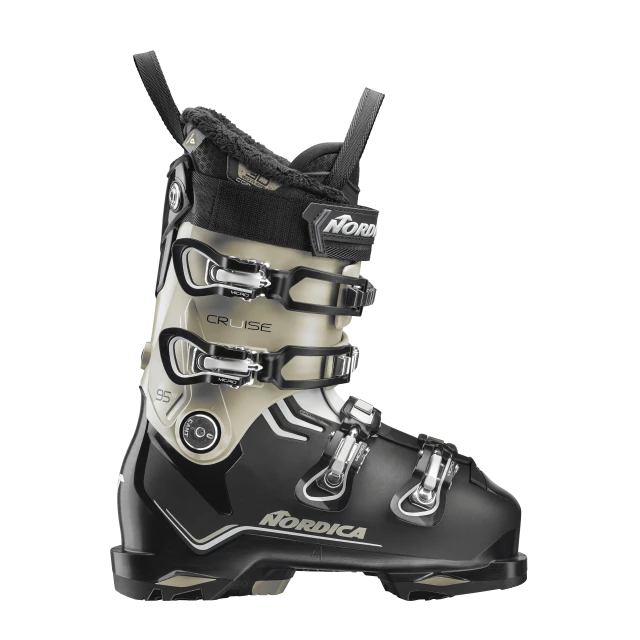
Nordica Cruise S W Women’s Comfort Fit Ski Boots
✓ High-volume comfort fit with a 104mm last, built for beginners
✓ Dual soft flap instep opens the throat wide for easy on and off
✓ Micro-adjustable aluminum shell and cuff buckles
From ~$150.00
★★★★★ (4.6/5 — 43 Amazon reviews)
Check Price on Amazon →Who it suits
Women with wide feet, or anyone who has felt crushed across the forefoot in other boots. The listing describes an extra-wide comfort fit on a 104 mm last, made for beginners who are building skills.
It is also the lowest price of the three, with offers starting around $150. For a skier who is not sure yet how many days a season she will ski, that is a gentle way to stop renting.
What you get
Entry is the headline. Nordica uses a dual soft flap instep that opens the throat of the boot very wide. Sliding a foot in is simpler, and it helps on cold mornings when plastic is stiff.
The buckles are micro-adjustable aluminum on both the shell and the cuff. That lets you fine-tune pressure over the instep and shin without fighting a stiff ratchet.
Nordica describes the shape as streamlined and anatomical. It comes in black, white and mauve, in sizes 22.5 to 27.5.
What to know before you order
The listing showed only two offers, so check size availability early. If your size is out, do not squeeze into a nearby size just to get the deal.
The listing does not state the flex or the sole type. Before you order, check Nordica’s spec sheet and ask the seller which sole ships with the boot, so you know what the shop will need to match to your bindings.
Side by Side
Same three boots, same checks, one view. Where a listing does not say, the table says so instead of guessing.
| Spec | Evo 70 | Kelia 50 | Cruise S W |
| Made for | Men | Women | Women |
| Last width | 104 mm | 104 mm | 104 mm |
| Flex | 70, soft | 50, very soft | Not stated in listing |
| Buckles | Three | Three | Micro-adjustable aluminum |
| Easy entry | Overlap opens easily | Soft plastic at instep | Dual soft flap instep |
| Walking sole | GripWalk-compatible, sold separately | GripWalk-compatible, sold separately | Not stated in listing |
| Sizes shown | 26.5 to 31.5 | 22.5 to 27.5 | 22.5 to 27.5 |
| Price seen | About $250 | About $199 to $250 | From about $150 |
Men’s and Women’s Boots: What Changes
Men’s and women’s boots differ in more than color. Women’s boots usually carry a lower flex number and a cuff shaped around women’s legs. Rossignol describes the Kelia 50’s cuff exactly that way.
Flex numbers are not directly comparable between the two. A women’s 50 and a men’s 70 both sit in the soft group for their category, which is where a first pair should be.
Sizes run differently in the listings too: women’s 22.5 to 27.5 and men’s 26.5 to 31.5. The two ranges overlap at 26.5 and 27.5. Fit matters more than the label, so try what feels right on your foot.
Pick Your Boot in One Minute
Still torn? Find the line that sounds most like you.
| If this sounds like you | Start with |
| You are a man in your first season with average to wide feet | Evo 70 |
| You are a woman and want the softest, most forgiving boot | Kelia 50 |
| Cuffs usually squeeze your calves | Kelia 50 |
| You are a woman with wide feet and a tight budget | Cruise S W |
| Cold fingers make getting boots on a struggle | Any of the three, with entry in mind |
| You are not sure you will ski more than a few days | Cruise S W, then redo the cost table |
Five First-Boot Mistakes to Skip
Most first-boot regrets come from the same few habits. Skip these and you save money and a sore week.
Buying big for comfort. A boot a size too large feels roomy in the shop, then lets your foot slide on snow. That costs control and rubs your heel. Comfort comes from the right shape, not extra length.
Choosing by color or brand. Fit is personal. A boot that suits a friend’s foot can pinch yours. Judge each boot by how it feels, and pick the color last.
Wearing thick socks to the fitting. Thick socks hide how a boot really fits and make it tight on the hill. Use the thin pair you will actually ski in.
Skipping the indoor test. Ten minutes in the boot, buckled, in a ski stance tells you more than a quick stand. Do it before the tags come off.
Buying a stiff boot to grow into. A boot that is hard to bend slows your learning. Soft now and firmer later is the cheaper path.
Socks First, Then Buckles
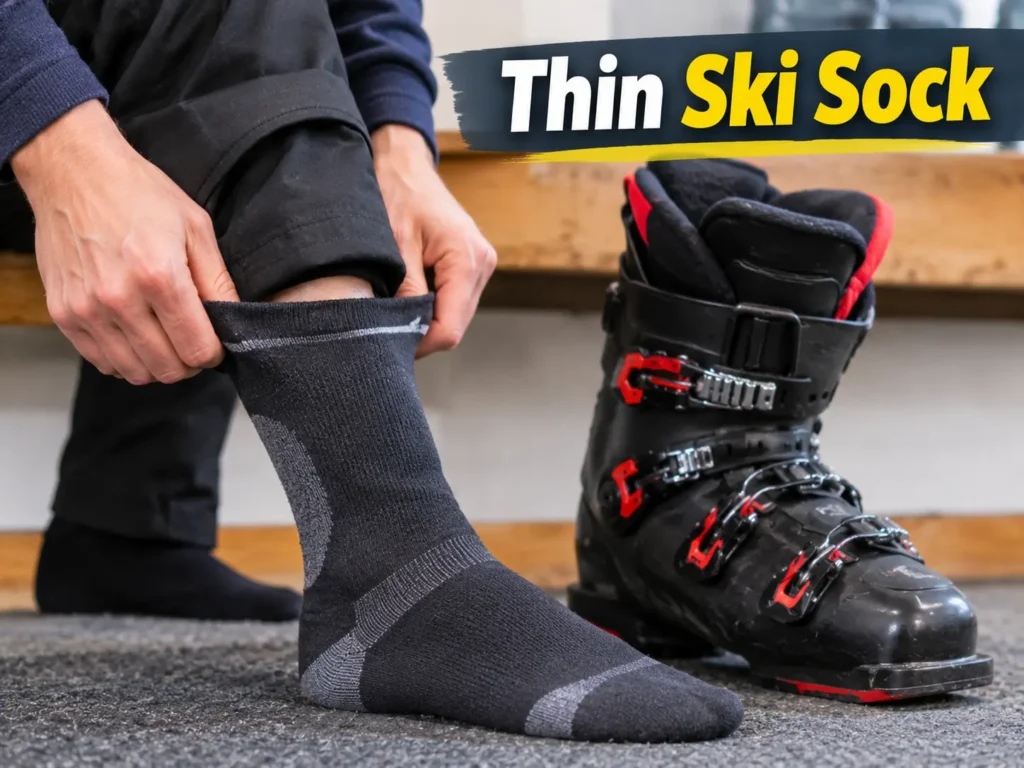
A boot fits differently with every sock. A thick sock can turn a roomy boot into a tight one, and a cotton sock can leave your feet cold and damp by lunch.
Try every boot with the one thin pair you will really ski in. Our ski sock guide covers sizing, cushion and the fabrics that work, so you can pick the sock before you pick the size.
Then buy a second pair of the same sock. A dry pair at lunch beats almost any upgrade on a cold day.
Where the Rest of the Budget Goes
Boots are only part of day one. Our first-day checklist lists what else a new skier needs, in a sensible order, so nothing gets forgotten at the rental counter.
If there is room left in the budget, protect your head first. See the best ski helmets for fit and price notes, then add the cold weather goggles so flat light and wind do not spoil the day.
Hands come next. The Best Ski Gloves page sorts options by budget, and if money is tight after boots, the list of gloves under $50 shows pairs that still keep you warm and dry.
Getting Your Size Right
Ski boots use a system called Mondopoint. The number is your foot length in centimeters, so a 26.5 fits a foot about 265 millimeters long. This page of ski boot basics explains the system and how modern alpine boots are built.
Measure your foot on a hard floor with your heel against a wall, and note the longest toe. Skip your street shoe size. It can point you to the wrong boot.
| Foot length | Boot size (Mondopoint) |
| 225 mm | 22.5 |
| 235 mm | 23.5 |
| 245 mm | 24.5 |
| 255 mm | 25.5 |
| 265 mm | 26.5 |
| 275 mm | 27.5 |
| 285 mm | 28.5 |
| 295 mm | 29.5 |
Because a boot clamps around your foot, no single shape fits everyone. The same page notes that shops can stretch a plastic shell by heating it. Ask whether that is possible for the model you buy.
A shell that is too big lets your foot slide, and you lose control. A shell that is too small pinches and numbs. Aim for snugness without pain, then judge again after ten minutes.
Soles, Bindings and the Walk to the Lift
The sole is the part that meets your binding. Alpine boots follow an international ISO standard called ISO 5355, which sets the size and shape of the toe and heel flanges. That is why boots and bindings from different brands work together.
GripWalk soles are a rockered rubber alternative with their own standard, ISO 23223. They fit GripWalk-compatible bindings, and so do standard alpine soles. The Evo 70 and Kelia 50 listings both mention GripWalk-compatible soles, sold separately.
The Cruise S W listing does not mention the sole, so ask the seller which one ships with the boot. Then tell your ski shop, so the bindings are checked against the exact boot you will wear.
A rubber, rockered sole earns its keep away from the snow. Lodge decks, parking lots and icy paths are where most slips happen, and a grippier sole makes that walk calmer.
Order Online or Buy in a Shop?
Buying online is the easiest way to find a lower price. It is also the way to end up with a boot you could not try on. If you go that route, measure your foot, read the size notes in the listing and keep the return window in mind.
A shop gives you someone who can watch you stand, flex and walk. That person can also stretch a shell or add an insole. Some skiers find a model online, try it in a shop, and then buy wherever the fit and the price are right.
Whichever route you take, ask a shop to check the boots against your bindings before you ski. That one check matters more than where you bought them.
Your First Shop Visit
Even if you order online, a ski shop still has a job to do. The American Academy of orthopaedic surgeons advises buying or renting boots and bindings that a ski shop has set, adjusted and tested to American Society of Testing and Materials standards.
The same guide says lessons matter most for new skiers, since learning to fall safely lowers injury risk. Good boots make a lesson easier, because you can feel your skis instead of your feet.
Bring the socks you plan to ski in, and wear them for the fitting. Ask the shop to check that the boot matches your bindings, and spend at least ten minutes in the boots before you decide they are right.
Keep the box and tags until you have tried the boots indoors on a clean floor, and check the return window before you order. A fit problem is much cheaper to fix before the first ski day than during it.
Your First Morning in New Boots
Plan the morning so the boots help instead of hurt. Put them indoors, not on the lodge deck, where cold fingers rush the job.
Slide your foot in and kick your heel back into the cup. Close the foot buckles first, snug but not crushing, then the cuff buckles, so your shin is held without choking your foot.
Stand up and bend your knees into a ski stance. Your heel should stay put and your toes should feel free. If something feels off, fix it at the base, not halfway up the mountain.
On the lift, loosen the top buckle if your shins feel pressed, and tighten it again before you ski. At lunch, open the buckles fully and give your feet a rest.
At night, take the liners out if the boot allows it, and let everything dry in a warm room away from direct heat. A dry liner is a warmer, fresher liner the next day.
Break-In Days: Normal or Not?
New boots feel firm, and that is fine. What matters is whether the feeling fades or grows. Use the table as a rough guide, and ask a boot fitter about anything that worries you.
| What you feel | Usually okay | Worth a fitter visit |
| Snug heel and ankle hold | Yes, when it feels secure | Your heel lifts when you flex |
| Mild pressure across the top of the foot | Often eases after a few days | It stays sharp or leaves deep marks |
| Toes brushing the front when you stand tall | Common; they pull back as you flex | They jam or tingle when you flex |
| Shin pressure on the first runs | Common while the liner settles | It becomes a deep ache or bruising |
| Numb toes | Not a settling-in feeling | Loosen buckles now, then see a fitter |
| Pain in one exact spot | Not a settling-in feeling | A fitter can often ease that spot |
Pain that points to one spot, toes that stay numb, or marks that last into the next day all say the fit needs work. Fix it early and the boots will serve you for seasons.
When You’ll Outgrow Them
Soft boots are made for learning, and that is a strength. After a season or two, you may link turns on blue runs with ease. At that point a soft boot can feel loose at speed, and your legs start asking for more feedback.
That is your cue to step up. Boot makers call men’s flex roughly 90 to 110, and women’s roughly 80 to 95, medium. A firmer boot with a snugger last gives sharper control, as long as you can keep it comfortable.
Nothing about this means the first pair was a mistake. Skiing in a boot you enjoy gets you on snow more often, and more days on snow is how you improve.
Quick Questions Before You Order
How much should a first pair of ski boots cost?
The three boots here ran from about $150 to $250 in mid-November 2026. That is the entry-level range for a boot built around comfort. Prices change with size and seller, so compare before you order.
Should I buy boots before skis?
Boots are the one piece of gear that has to match your foot, so they are a smart place to start. Skis can be matched to your height and ability later, and a shop can help with that.
How do I know my ski boot size?
Ski boots use Mondopoint sizing, which is your foot length in centimeters. A foot about 265 millimeters long fits a 26.5. Measure on a hard floor, then check the size notes on the listing and with a shop.
How tight should new boots feel?
Snug, not painful. Your heel should stay put when you flex, and your toes should feel free. Toes may brush the front when you stand tall and pull back as you bend your knees. Spend ten minutes in the boots indoors before you decide.
Can I walk around in them?
Short walks to the lift and across the lodge are what ski boots are made for. A rubber, rockered sole makes it steadier on ice, which is why GripWalk-compatible soles are worth checking. Take the boots off for anything longer.
When should I move up to a stiffer boot?
When you link turns on blue runs with ease and your soft boot feels loose at speed. That usually takes a season or two of regular skiing. A firmer boot then gives sharper control, as long as it stays comfortable.
Do narrow feet fit wide-fit boots?
They can feel loose, and a loose boot lets your heel lift. A shop can suggest an insole or a snugger model. Thick socks are not the fix, because they squeeze the toes while the heel still moves.
The Short Version
Match the boot to your foot first. The Evo 70 suits men, the Kelia 50 is the softest option for women, and the Cruise S W offers the widest fit for the lowest price.
Wear your real socks, check the sole and the size, and let a ski shop match the boots to your bindings. Take a lesson early. Comfortable feet make that first week far more fun.
If the price makes you hesitate, go back to the cost table. Over ten ski days these boots work out to about $15 to $25 a day, and a boot you own fits your foot better every single time you wear it.
Affiliate Disclosure: This article contains affiliate links. If you buy through them, we may earn a small commission at no extra cost to you. It helps keep this site running and does not change which boots we recommend.