Quick answer: A glove that fit fine in a warm store rarely fits the same way on the mountain, and it’s almost never because the glove changed size. Seven distinct things can make a correctly-purchased glove feel tight: liner volume you didn’t account for, cold stiffening the shell material, insulation packed into narrow finger tubes, hand swelling from sustained gripping, sizing differences between brands, unbroken-in leather, or a wrist closure cinched tighter than it needs to be. Each has its own mechanism and its own fix.
If you’re not sure your current gloves were even the right shape to begin with, the Ski Glove Finder is a faster starting point than guessing your way through a size chart.
This guide walks through all seven causes, why each one actually happens, and a quick test to identify which one is yours.
- Why a Store Fit and a Mountain Fit Are Different Tests
- Cause 1 — Liner Volume Has Nowhere to Go
- Cause 2 — Cold Temperature Stiffening the Shell
- Cause 3 — Insulation Mapped Poorly Into Narrow Finger Tubes
- Cause 4 — Hands Genuinely Swell During Active Skiing
- Cause 5 — Cross-Brand Sizing Isn't Standardized
- Cause 6 — New Leather Hasn't Broken In Yet
- Cause 7 — An Over-Tightened Wrist Closure
- Step-by-Step: Which Cause Is Yours
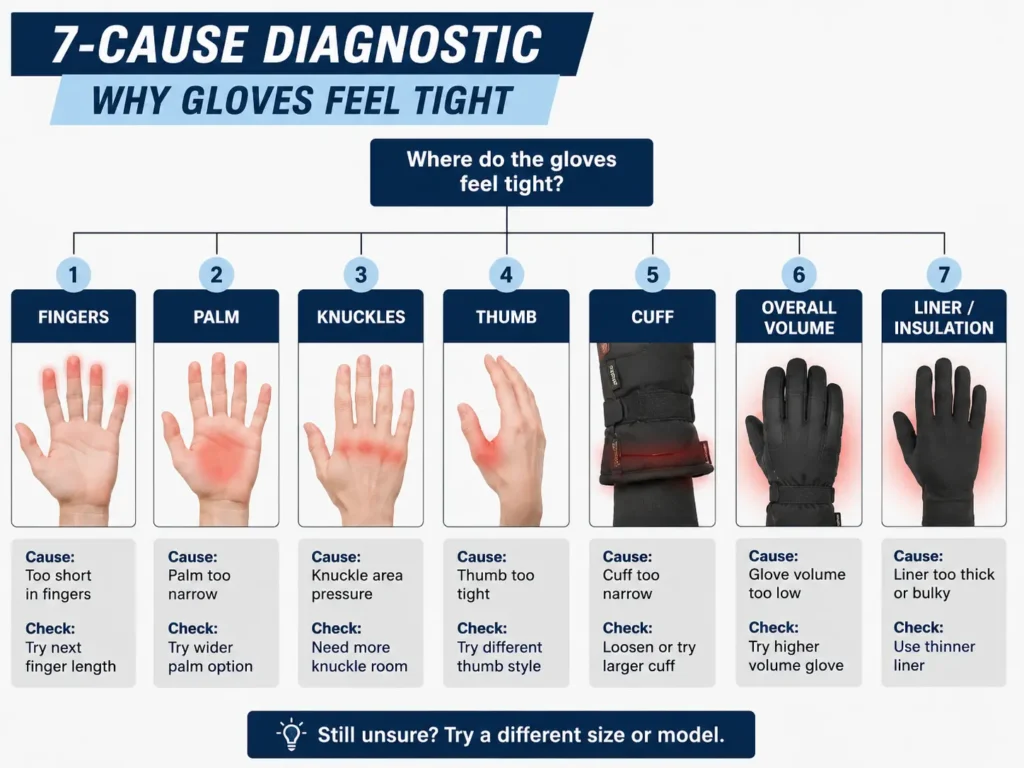
- All Seven Causes at a Glance
- When Tight Isn't Actually a Problem
- When It Actually Means You Need Different Gloves
- When Tightness Becomes a Real Circulation Concern
- Finding the Right Fit Going Forward
- Frequently Asked Questions
Why a Store Fit and a Mountain Fit Are Different Tests
A glove tried on in a heated store is being tested under conditions that don’t resemble skiing at all — bare hand, room temperature, standing still. On the mountain, that same glove is worn cold, often over a liner, during hours of repeated gripping that changes both the glove’s material properties and your hand’s actual size. Neither the store test nor the mountain use is wrong — they’re just measuring different things, which is exactly why a glove that felt right at checkout can feel genuinely tight on the first cold run.
Cause 1 — Liner Volume Has Nowhere to Go
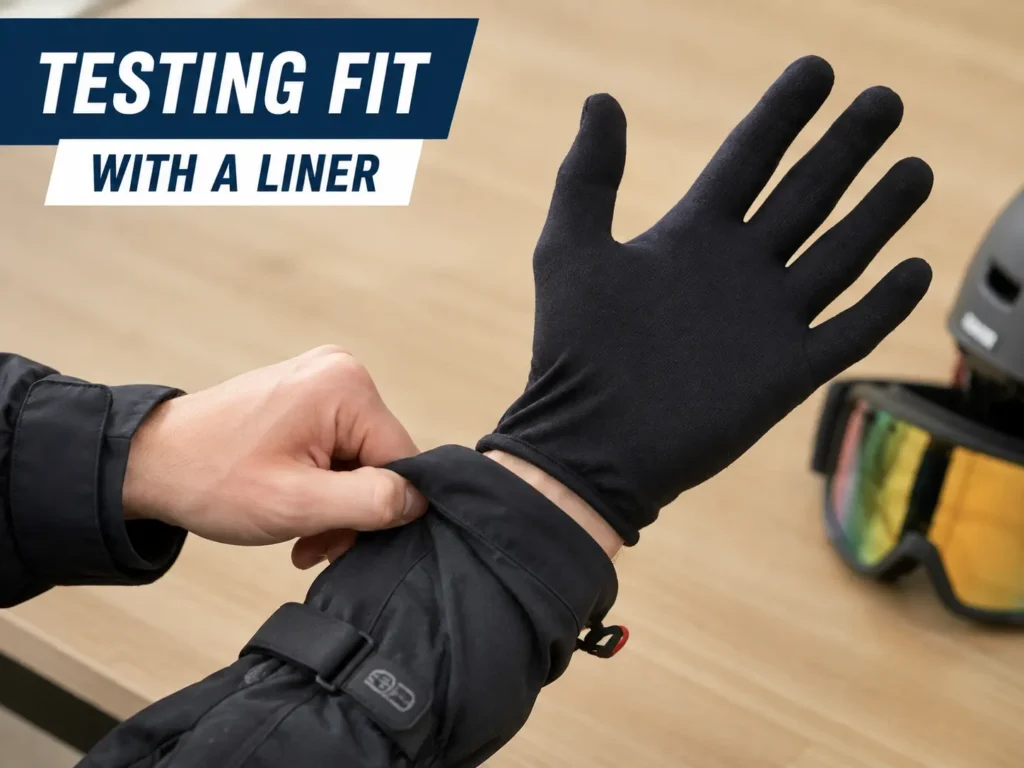
A glove sized correctly for a bare hand has a fixed amount of interior space. Add a liner — even a thin one — and that liner now occupies part of the volume that used to be empty air around your fingers. In a glove that was already a snug fit bare-handed, even a millimeter or two of liner thickness is enough to create real pressure at the knuckles and fingertips.
This is the single most common cause of “my gloves used to fit and now they don’t,” because most people try gloves on bare-handed in a store and never test them with the liner they actually plan to wear underneath.
How to test: Put your liner on first, then try the glove and make a full fist. If you feel resistance at the knuckles or fingertips that weren’t there without the liner, liner volume is your cause. The fix is sizing the outer glove with the liner already on, not sizing it bare-handed and hoping the liner fits in whatever space is left over.
Cause 2 — Cold Temperature Stiffening the Shell
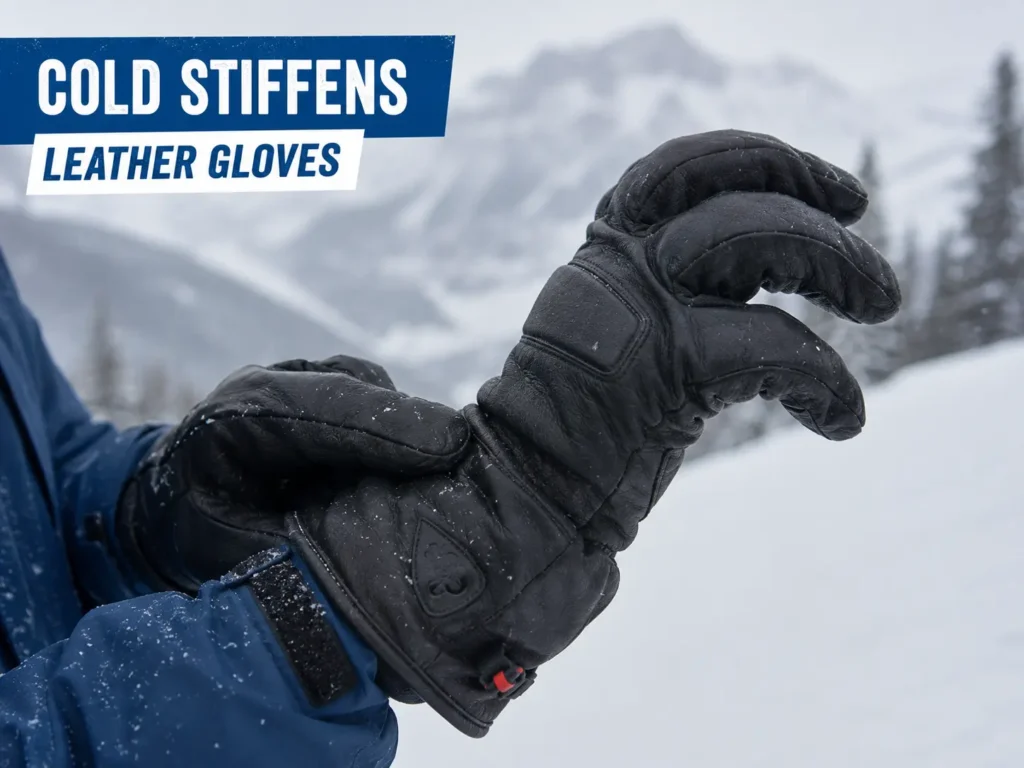
Glove materials behave differently at sub-zero temperatures than they do in a heated shop, and this matters most for leather and dense synthetic shells. Polymer-based materials — including the coatings and plasticized layers used in many synthetic shells — have what materials scientists call a glass transition point: the temperature below which a flexible material starts behaving like a rigid one, resisting the kind of bending a full-hand grip requires. Above that point the material flexes easily; below it, the same material feels noticeably stiffer for the same hand movement.
Leather behaves similarly through a different mechanism — its fiber structure and natural oils lose some flexibility as temperature drops, especially before body heat has had time to warm the glove from the inside. A leather glove that closes into a full fist easily at room temperature can genuinely resist that same motion in the first few minutes of sub-zero exposure.
How to test: If gloves feel fine in the warm lodge but feel tight on the first cold run, and that tightness eases after 5 to 10 minutes of skiing as your body heat warms the material, cold stiffening is your cause. If tightness persists well past that warm-up window, something else is contributing alongside it.
Cause 3 — Insulation Mapped Poorly Into Narrow Finger Tubes
Budget and mid-range gloves often use the same insulation fill weight throughout the entire glove — the same density in the wide palm as in the narrow finger tubes. That’s a construction shortcut, and it has a real fit consequence: the same amount of fill that sits loose and lofted in a wide palm zone gets compressed by the tighter cylindrical geometry of a finger tube, taking up more effective space per finger than the same fill would in a roomier area.
Premium gloves address this with mapped insulation — deliberately lighter fill in the narrow finger zones and heavier fill concentrated where warmth actually matters most, the back of the hand and knuckle area. Uniform fill is simply cheaper to manufacture, which is why it shows up disproportionately in budget gloves.
How to test: Press each finger tube from the outside while wearing the glove. Dense, hard-to-compress fill with little give suggests over-filled finger tubes relative to their diameter. If the palm feels noticeably more lofted than the fingers in the same glove, mapped versus unmapped insulation is likely your cause.
Cause 4 — Hands Genuinely Swell During Active Skiing
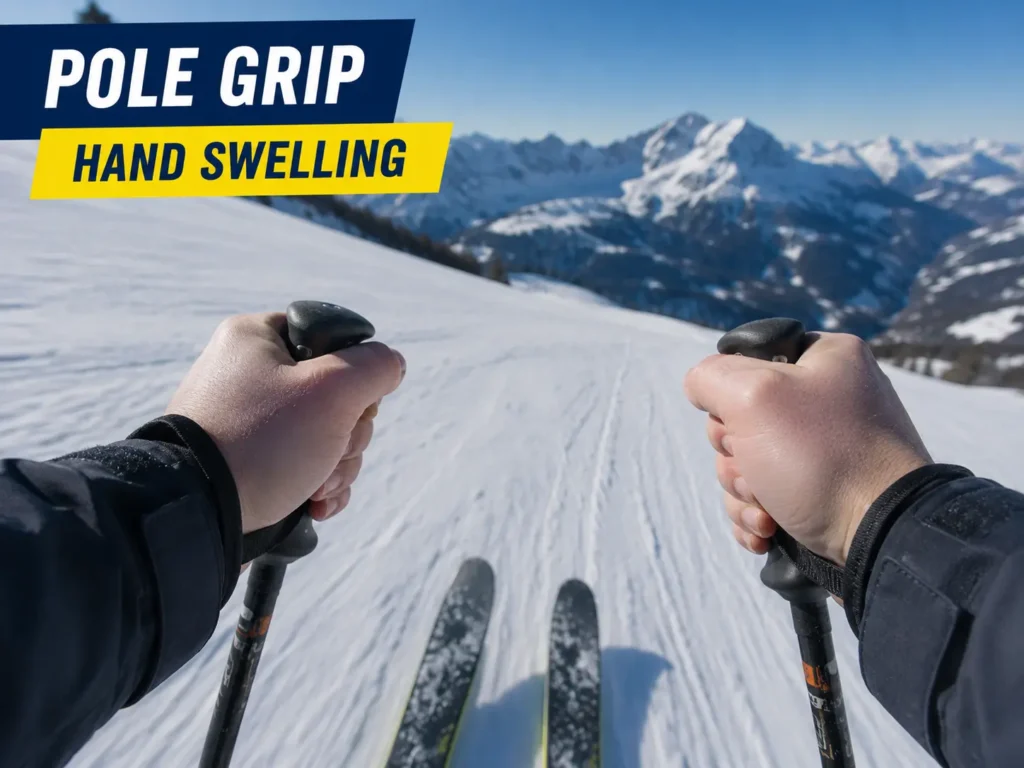
This is real physiology, not a glove problem. Hand swelling during exercise is a well-documented, temporary response — blood vessels dilate to help regulate body temperature, and increased vascular pressure lets some fluid move from blood vessels into the surrounding tissue, the same general mechanism responsible for rings feeling tight after a long hike or run. Repetitive pole gripping over hours of active skiing is exactly the kind of sustained activity that triggers this.
The practical result: a glove that fits comfortably on the first run of the day can feel measurably tighter by the fourth or fifth, without the glove itself having changed at all. The hand has temporarily expanded from the activity, not the material shrinking.
How to test: If tightness builds progressively through the day and peaks after multiple active runs rather than at the start, hand swelling is contributing. The practical fix is sizing gloves with a small amount of extra margin specifically to accommodate this — a glove sized to the absolute minimum comfortable bare-hand fit will almost always feel tight once activity-driven swelling is added on top of it.
Cause 5 — Cross-Brand Sizing Isn’t Standardized
There’s no universal ski glove sizing standard, and a size Large from one brand isn’t guaranteed to match a size Large from another. European brands generally cut narrower across the palm and longer through the finger tubes than US brands, which tend toward a wider palm and shorter finger length at the same nominal size label. A skier correctly sized in one brand’s Large can be genuinely tight in another’s Large — not because their hand changed, but because “Large” means something different at each company.
European brands also frequently size by centimeter measurement (a size 9 corresponding to a 9cm palm circumference) rather than S/M/L, which is a more directly comparable number across brands than a size label ever is.
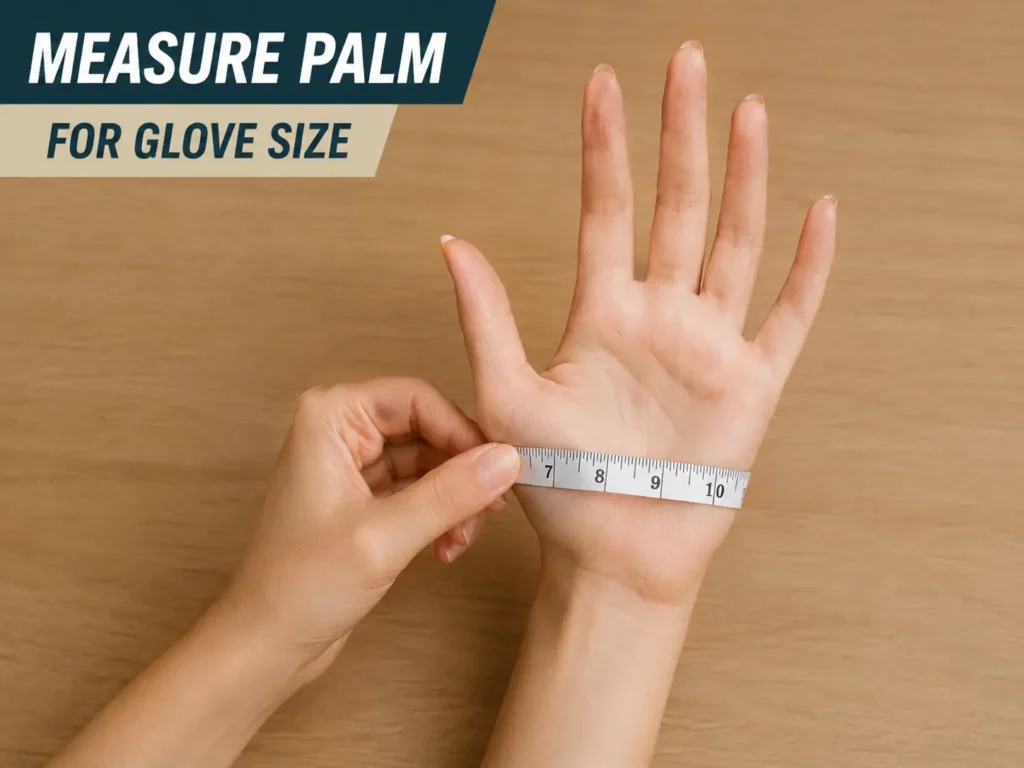
How to test: Measure your palm circumference at the widest point below the knuckles with a soft tape measure, and compare that number directly to the specific brand’s size chart in centimeters or inches — not to a general S/M/L category. If you’re between sizes on a European-cut glove, sizing up is the safer default.
Cause 6 — New Leather Hasn’t Broken In Yet
Genuine leather is tanned animal hide, and the tanning process that preserves the material also leaves the fiber structure somewhat rigid until it softens through heat, moisture, and repeated flexing. A brand-new leather glove resisting a full fist isn’t necessarily undersized — the interior volume may be entirely correct, but the material itself hasn’t loosened enough to move freely yet.
This is a genuinely different problem from circumference-based tightness, and it resolves on its own with use. Applying leather conditioner before first use, and again after each of the first few sessions, replaces some of the natural moisture the tanning process removes and speeds up the softening process.
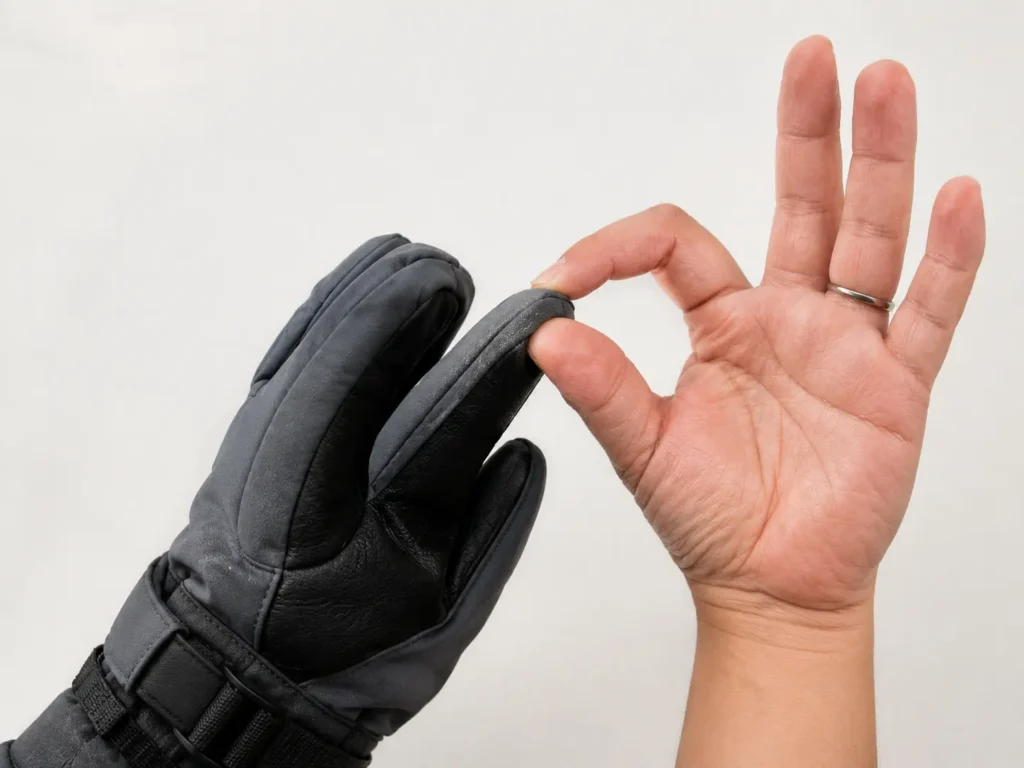
How to test: Make a flat-fingered fist — fingers extended flat rather than curled — and notice where the resistance comes from. If it’s the back of the glove resisting the flex itself (material stiffness) rather than the sides squeezing your knuckles (circumference), leather break-in is your cause, and it should visibly improve within 3 to 5 sessions.
Cause 7 — An Over-Tightened Wrist Closure
Every ski glove has some form of wrist or cuff closure meant to seal against snow entry. Tightened past that sealing point, the closure does more than compress the wrist — on gauntlet-style gloves especially, over-cinching can distort the glove’s overall geometry enough to pull the palm and finger zones slightly inward too, not just the wrist itself.
The correct closure tension is the minimum needed to seal against snow, not the maximum the strap or drawcord allows.
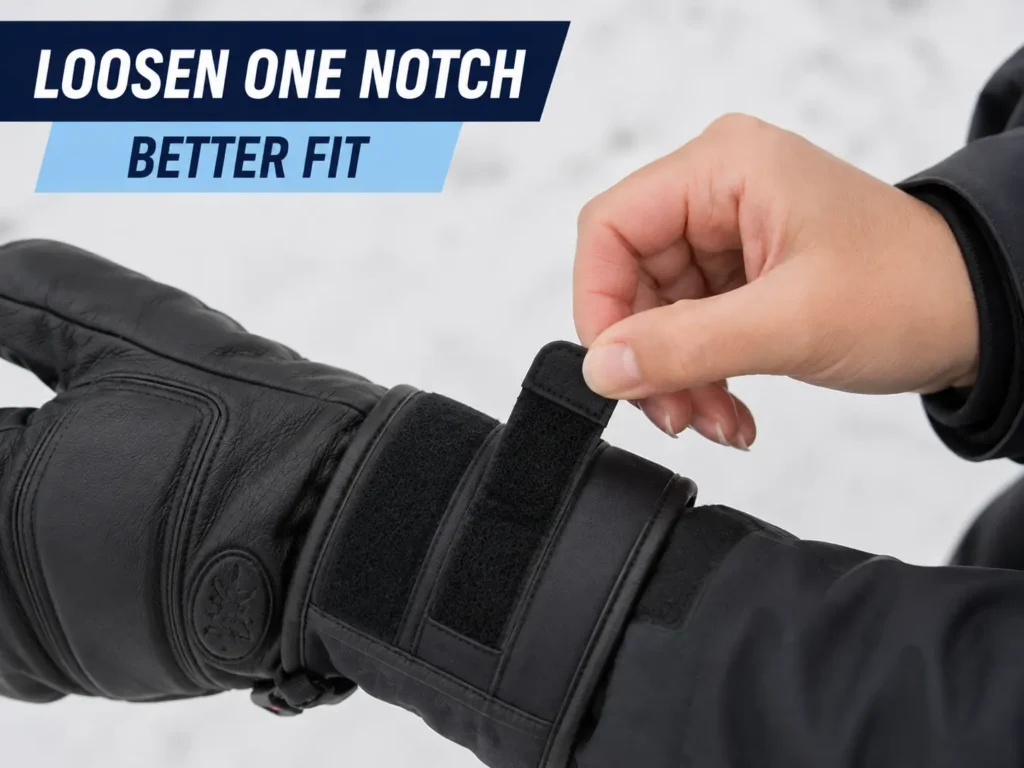
How to test: Loosen the wrist closure by one notch or a quarter-turn of a drawcord and flex your fingers. If the tight feeling in the hand itself eases, an over-tightened closure was contributing. Reset to the minimum point that still seals the cuff and retest from there.
Step-by-Step: Which Cause Is Yours
Run through these in order — most people identify their actual cause by step three or four.
Step 1 — Loosen the wrist closure one notch and flex your hand. If tightness reduces, Cause 7 is confirmed.
Step 2 — Remove the liner if you’re wearing one and retry bare-handed. If the tightness disappears, Cause 1 is confirmed.
Step 3 — Warm the glove with five minutes of body heat in a warm space. If tightness eases noticeably, Cause 2 is confirmed.
Step 4 — Check the timing. Tightness present from the start of the day points toward Causes 2, 5, or 6. Tightness that builds after multiple active runs points toward Cause 4.
Step 5 — Press the finger tubes from outside. Dense, low-loft fill points toward Cause 3; normal-feeling fill with a tight circumference points toward Cause 5.
Step 6 — For new leather gloves, check whether resistance comes from the back-of-finger flex (Cause 6) or from circumference squeeze at the knuckles (a sizing issue instead).
Step 7 — Measure your palm against the specific brand’s size chart in centimeters. If you’re at the top of the stated range, that confirms Cause 5.
All Seven Causes at a Glance
| Cause | When Tightness Appears |
| Liner volume | Present with liner, gone without it |
| Cold shell stiffening | Worst at first cold exposure, eases after warm-up |
| Insulation in finger tubes | Consistent all day regardless of activity or temperature |
| Hand swelling from gripping | Builds progressively, worst after several active runs |
| Cross-brand sizing | Consistent from first wear, unaffected by temperature |
| Leather break-in | New gloves only, resistance in finger flex not circumference |
| Over-tightened closure | Eases immediately when the closure is loosened |
When Tight Isn’t Actually a Problem
A glove that feels snug but still allows a full fist without real resistance is correctly fitted, not tight — and the distinction matters, because over-correcting for any snug feeling by sizing up produces a genuinely loose glove that lets cold air move around inside it and loses warmth faster than a properly fitted one.
New leather gloves in the break-in window feel tight in the flex sense described in Cause 6. That’s a temporary material property, not a sizing mistake, and returning a correctly-sized leather glove during break-in trades is a good fit for a fresh sizing gamble. Race-fit and high-dexterity gloves are also intentionally cut closer than standard gloves, specifically to reduce loose material that would otherwise bunch during precise pole handling — the full-fist test still applies here; if you can close a complete fist without real resistance, a close-cut glove is performing as designed even if it feels snug.
When It Actually Means You Need Different Gloves
If tightness persists after all seven causes have genuinely been ruled out — liner removed, cold stiffening accounted for, closure at minimum tension, break-in period completed — the glove is likely undersized for your hand, and no amount of time or adjustment will resolve that on its own.
A separate pattern worth recognizing: gloves that fit correctly when purchased but feel tight after a season or two in storage have often lost loft to insulation compression from being packed under weight, which reduces effective interior volume the same way undersized fill does in Cause 3, just introduced by storage rather than manufacturing.
When Tightness Becomes a Real Circulation Concern
Ordinary snugness and genuine circulation restriction are different things, and it’s worth knowing where that line sits. Real warning signs that circulation is meaningfully compromised — rather than just feeling snug — include numbness or tingling that doesn’t ease once you loosen the glove, skin that looks pale or takes on a bluish tint, or persistent coldness that doesn’t respond to the usual warm-up window, all worth taking seriously rather than pushing through on a cold mountain day.
Ordinary tightness from any of the seven causes above typically eases with the specific fix for that cause — loosening a closure, warming the material, waiting out a break-in period. Restriction that doesn’t respond to any of those fixes, especially combined with numbness that persists after the glove is fully loosened, is a different situation and worth taking off the glove and warming the hand properly before continuing.
Finding the Right Fit Going Forward
Getting the diagnosis right on a current pair is useful, but it’s also worth applying to how you buy the next one. Testing fit properly with the actual liner you’ll wear, accounting for these seven factors, rather than just the bare-handed store test, avoids most of this guesswork before you’ve even left the shop. And for anyone shopping specifically with budget and warmth priorities in mind, options across budgets is a faster way to compare mapped-insulation and construction quality across brands than reading spec sheets one page at a time.
Frequently Asked Questions
Should new ski gloves feel tight?
New gloves should feel snug, not tight — you should be able to make a full fist without real resistance, with fingertips lightly touching the end of the finger tubes. Genuine leather is the exception in the break-in sense described in Cause 6, where the material itself resists flexing temporarily, separate from circumference-based tightness.
Does sizing up always fix tightness?
No — sizing up only helps if the actual cause is genuine undersizing. If the real cause is an over-tightened closure or unbroken-in leather, a larger glove just becomes loose without actually resolving the original problem.
Why do my gloves feel fine at the start of the day but tight by afternoon?
That pattern points most directly toward hand swelling from sustained activity — a real, temporary physiological response to hours of repetitive gripping, not a sign the glove itself changed.
Can old gloves that used to fit start feeling tight over time?
Yes, most commonly from insulation that’s lost loft after being compressed in storage, or from a liner change since the gloves were first sized. Both change the glove’s effective interior volume without any change to your hand.
Understanding which of these seven mechanisms is actually happening — rather than assuming any tightness means the wrong size — is what separates a five-minute fix from an unnecessary return or an uncomfortable ski day spent fighting gear that was never actually the problem.