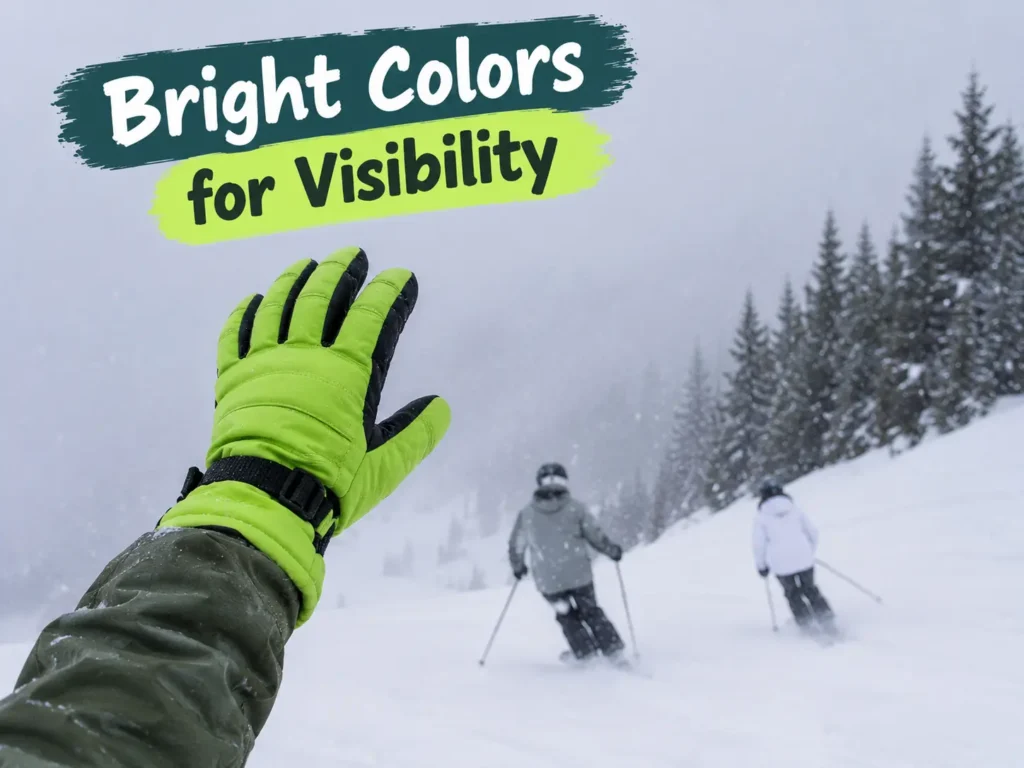
Quick Answer: Pick a glove color that contrasts with the snow, the sky and the trees around you, and skip white, silver and pale grey, which melt into the snow. Neon orange, red-orange and lime-yellow are the safest choices, because they stand out against white snow, blue sky and dark pines. Black and navy show up well on snow but fade against trees and shadows. If you ski a lot in flat light or with kids, go bright. If you ski on quiet days and care about style, you have more room to choose.
Want to see gloves in the colors you like, sorted by budget? The Ski Glove Finder narrows the choice down in about a minute.
| Color family | On snow | Against trees | Flat light | Our take |
| White, silver, pale grey | Poor | Fair | Poor | Avoid for visibility |
| Black, charcoal, navy | Strong | Weak | Fair | Good in open runs only |
| Brown, tan, olive, camo | Fair | Poor | Fair | Blends into the woods |
| Red, royal blue | Strong | Fair | Good | Solid all-rounder |
| Orange, red-orange | Strong | Strong | Strong | Top pick |
| Yellow, lime, neon green | Strong | Strong | Strong | Top pick |
| Pink, magenta, bright purple | Strong | Strong | Good | Bold and easy to spot |
This table comes from contrast logic, not a ski test. Treat it as a guide, and adjust for the terrain you ski most.
- Start With the Background, Not the Color
- How Your Eyes Pick Out a Color
- Flat Light, Whiteout, Dusk and Crowds
- Why Gloves Matter When Your Jacket Is Bigger
- Build a Color Plan: Gloves, Jacket and Helmet
- Who Needs Bright Gloves Most
- When Style Wins, and What to Pick Then
- Mittens, Gloves and Being Seen
- Reflective Trim and Night Skiing
- Why These Colors Make the List
- What Color Cannot Fix
- A Quick Self-Check Before You Buy
- Group Trips: Color Without a Uniform
- A Simple Photo Test Before You Buy
- Mistakes That Make You Hard to Spot
- Keeping Bright Colors Bright
- Questions Skiers Ask
- Which Color to Choose
Start With the Background, Not the Color
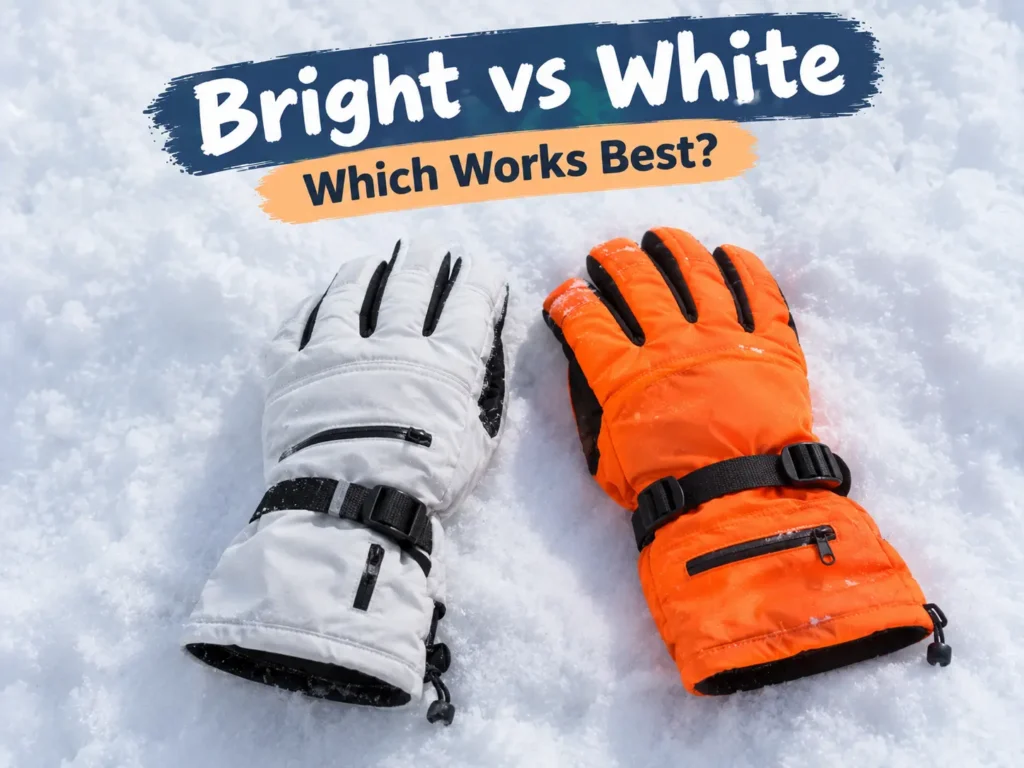
Most people ask which color is brightest. A better question is which color differs most from what is behind you. A bright red glove on a red lift chair vanishes. A black glove on a black jacket sleeve vanishes. Visibility is about contrast with the background, not about how bright the color looks in a store.
A ski slope has three main backgrounds. The snow is white and bright. The sky is grey or blue, and it often blends with the snow on cloudy days. The trees are dark green and brown, and they cast shadows across the run.
A color that works against all three is rare. Black is great against snow and poor against trees. White is fine against trees and useless against snow. Fluorescent orange and lime hold up on all three, which is why they come up again and again in safety gear.
How Your Eyes Pick Out a Color
Your eyes notice two things first: contrast and movement. Contrast means the glove looks different from what is behind it, in brightness or in color. Movement means the glove is changing position, like a hand that waves or a pole that swings. A color that does both is hard to miss.
Fluorescent colors add a boost. These dyes look brighter than normal colors because they give off extra visible light in daylight. That glow is why traffic cones, work vests and safety flags use them. On a slope, a fluorescent glove can look like it is lit from inside, even under cloud.
Dull versions of the same hue do less. A faded orange or a dusty yellow looks like a normal color, not a glowing one. If visibility is the goal, look for words like neon, fluorescent, hi-vis or safety on the product page, and check the photos for a vivid shade, not a muted one.
Flat Light, Whiteout, Dusk and Crowds
Four conditions make glove color matter most. In flat light, clouds spread the sun evenly, shadows disappear, and the snow looks like a blank wall. A pale glove has nothing to separate it from the slope. A bright one still stands out.
In a whiteout, snow and sky merge, and you can lose sight of skiers a few yards away. Color is one of the few cues left. Neon colors keep their punch when everything else turns white.
At dusk, light fades and dark colors fall into shadow. Black, navy and brown gloves can disappear in the trees at the end of the day. A bright color gives other people a chance to spot you as the light drops.
In a crowd, your color has to compete with dozens of others. Red and black are common on slopes, so they get lost in a busy run. A less common bright shade, like lime or orange, is easier to pick out in a lift line or at the base.
Why Gloves Matter When Your Jacket Is Bigger
A fair question: a glove is small, so why bother? Because hands move. A moving color grabs the eye faster than a still one. When you wave, plant a pole or point downhill, your gloves are the part of you that flashes.
Gloves also show up when the rest of you does not. If you fall and your jacket is under snow, a raised hand with a bright glove can be what a skier or patroller notices. And when you stop at the edge of a trail, a bright hand on a pole is a small extra signal.
Gloves are not a replacement for a bright jacket or helmet. They are a cheap, easy add-on. If your jacket is white or grey, bright gloves cover part of the gap. If your jacket is already bright, gloves matter less and you can choose on taste.
Build a Color Plan: Gloves, Jacket and Helmet
Think of your outfit as one set of colors, not three separate items. Your gloves, jacket and helmet should not all disappear into the same background. If two of them are bright, the third can be dark or neutral. If all three are dark or pale, you blend in.
| Jacket | Helmet | Glove choice | Result |
| Dark (black, navy, charcoal) | Dark | Neon orange or lime | Hands stand out; body reads as dark |
| Bright (orange, red, yellow) | Any | Black or navy | Body is visible; gloves are easy to match |
| White or pale grey | Pale | Bright, with a bright helmet too | Fixes the biggest blend-in risk |
| Green or camo | Dark | Orange or hot pink | Contrast with trees and snow |
| Bright and busy pattern | Solid | Solid dark or solid bright | Avoids a messy look; keeps hands clear |
If you can only change one thing, change the one that is the weakest. A white jacket with a pale helmet needs help more than a navy jacket with orange gloves.
Who Needs Bright Gloves Most
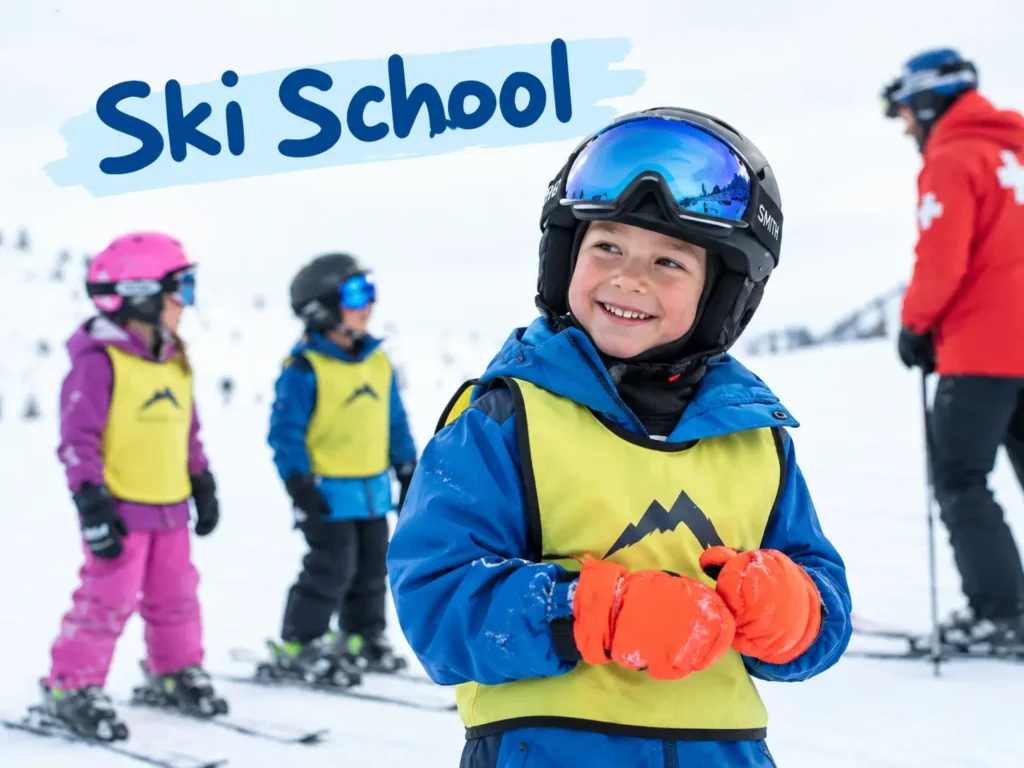
Some skiers should treat color as a safety choice. Kids come first. They are small, they stop suddenly and they often ski in groups. A parent scanning a run finds bright mittens faster than dull ones. Our guide to kids ski gloves covers fits and styles for children.
Beginners are next. They fall more, stop in odd places and may not know where to stand. Bright gloves help others see them from uphill. The same goes for anyone skiing alone, on busy weekends, or in trees where a rescue could take longer.
Skiers in poor light also benefit, whether it is a snowstorm or the last run of the day. Instructors, ski hosts and patrol often wear bright colors for this reason.
Who has more room to choose? Confident skiers on open, quiet runs in good light. If you ski with a group that wears matching colors or you ski mostly in clear weather, black or navy gloves are a fair pick.
When Style Wins, and What to Pick Then
Not everyone wants neon gloves, and that is fine. Style is a real part of buying gloves. The trick is to give up as little visibility as you can.
If you like dark gloves, choose black or navy with a bright accent, such as an orange cuff, a lime logo or a reflective strip. If you like muted colors, go for a saturated one, like deep red or royal blue, instead of grey or beige. And if your jacket is dark, a brighter glove adds contrast without clashing.
Price rarely decides color. Most brands sell bright and dark gloves at the same price, so you can pick for visibility without paying more. Our best ski gloves picks span many budgets and colors, so you can choose a style and a price together.
Mittens, Gloves and Being Seen
Mittens give you a bigger block of color than gloves, since the fingers sit together. A bright mitten can look like a flag when you wave. Gloves split the color into thin fingers, which look smaller from far away, though a bright glove still reads well.
The trade-off is control. Gloves give better grip and finer movement. Many kids and cold-handed skiers pick mittens for warmth, and bright mittens add an easy visibility bonus. If you choose gloves, a bold color helps make up for the smaller shape.
Reflective Trim and Night Skiing
Color works in daylight. At night, light matters more. Many ski areas run night skiing under floodlights, and dark gloves fade into the dark spots between lights. Reflective trim on a cuff or back of the hand can catch light and glow when a headlamp or floodlight hits it.
Reflective strips are small and often cost nothing extra. Look for them on the cuff, the knuckles or the pull tab. Pair them with a bright base color, and you get both day and night visibility. Do not rely on trim alone in daylight, since it does little without direct light.
Dusk is the tricky part. The light is low, but not dark enough for floodlights, and dark colors disappear first. If you ski until the lifts close, treat the last hour as a low-visibility condition and choose a brighter glove for that day.
Why These Colors Make the List
No study has measured glove color on ski slopes, so the advice here rests on related research. A field study for highway workers looked at which colors people spot first in daylight. It found fluorescent red-orange had the longest average detection distance, and fluorescent yellow-green was not significantly different. The Work Zone Safety Clearinghouse summarizes daytime visibility research in plain terms.
Roads are not ski slopes, so treat this as a guide. Still, the idea carries over: fluorescent colors stand out because they look brighter than the scene around them. That is why safety gear uses orange and yellow-green, and why those two lead our list.
Other studies suggest that a busy scene reduces how far away people notice a bright garment, more than the exact color does. On a crowded slope, a bright color helps, but you still need to ski aware and in control.
The honest pros and cons by family: orange and lime are the most visible but the loudest in style. Red and royal blue are common and safe but easier to lose in a crowd. Black is cool and works on snow but fades in trees and at dusk. White and grey look clean but are the worst for being seen.
What Color Cannot Fix
Color helps other people see you. It does not stop a collision. Many skiers point out that a rider who is out of control will hit you whatever you wear. The best protection is still skiing in control and knowing where others are.
The National Ski Areas Association sets out ten rules in Your Responsibility Code. One says to stop only where you are visible from above and do not block traffic. You can read it on the NSAA safety page.
Alta Ski Area gives similar advice. If you stop during a run, make sure uphill skiers can see you, and look uphill before you start again. Alta also urges skiing with a buddy and keeping visual contact. Its safety tips are short and worth a read.
Think of color as one layer of safety, next to a helmet, good goggles and a plan for where to meet your group. A bright glove is cheap and takes no effort, which makes it a good extra layer.
One last tip for the lift line. When you reach the top, step off and move clear of the ramp before you adjust your gear. Stopping in the exit path is a common cause of pile-ups, and a bright glove does not make up for blocking traffic. Move to the side, where uphill skiers can see you, and then fix your straps.
A Quick Self-Check Before You Buy
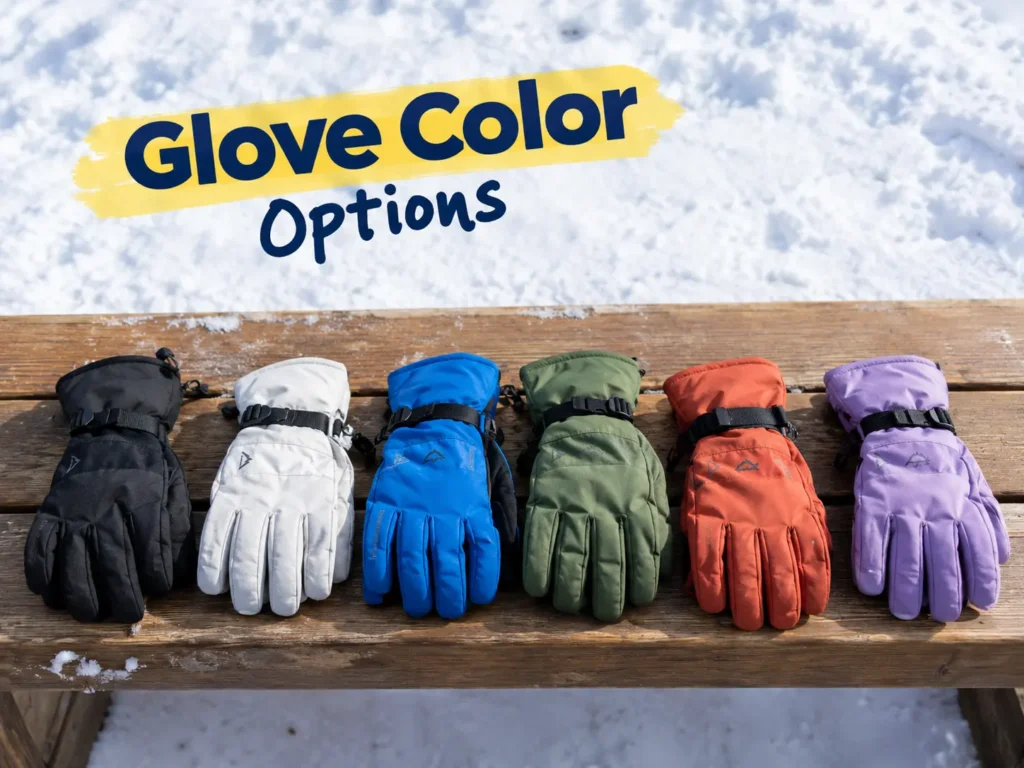
Run through this table with the glove you are thinking of. It takes a minute and can save you from a color you regret.
| Question | If yes | If no |
| Is the glove white, silver or pale grey? | Pick another color or add a bright trim | Good |
| Is it the same color as your jacket sleeve? | Choose a contrasting shade | Good |
| Do you ski in trees or at dusk? | Avoid black, brown and olive | Dark colors are fine |
| Do you ski in flat light or snowfall? | Pick orange, red-orange or lime | Any strong color works |
| Is this for a child or a beginner? | Choose the brightest you can find | You have more freedom |
| Does it have a bright trim or reflective strip? | A plus for a dark glove | Consider a brighter color |
Group Trips: Color Without a Uniform
When you ski with friends or family, color can also help you keep track of each other. Agree on one bright piece each, such as a glove, a hat or a helmet, so you can spot people from the lift. It does not need to match. It only needs to be easy to pick out of a crowd.
For a group with kids, give each child a different bright color. A parent scanning a run can then find each child by color. Set a meeting spot and a time, and remind kids to stop where others can see them, as the Responsibility Code advises.
On a crowded day, check your group at every lift top. A quick head count, using colors as a guide, is easier than asking each person to call out. It also saves time when someone drifts off the trail.
A Simple Photo Test Before You Buy
You can check contrast with your phone. Lay the glove on snow, or on a white sheet, and take a photo. Then switch the photo to black and white. If the glove nearly disappears in the grayscale version, it will likely blend in on a flat-light day.
Try the same trick against a dark background, like a pine branch or a dark jacket. A color that still separates from both in black and white has strong contrast. This is a quick way to compare two gloves when the colors look similar in a store.
It will not replace real conditions, but it helps you catch a weak color early. Take a photo of any glove you are about to buy, and compare it side by side with your jacket. It takes less than a minute.
Mistakes That Make You Hard to Spot
The first is buying white or grey gloves because they look clean. They look great in photos and vanish on snow. If you love the look, add a brighter jacket or helmet.
The second is assuming any bright color will do. A pale yellow or light pink can wash out in flat light. A saturated, strong shade is what stands out.
The third is matching everything. A glove that matches your jacket cuff exactly blends into the sleeve. A small contrast helps your hands read as separate from your arms.
The fourth is ignoring the trees. Many runs are lined with dark pines, and black gloves fade against them. Think about where you ski, not only the snow.
The fifth is trusting color alone. A bright glove does not make up for skiing too fast or stopping in a blind spot.
Keeping Bright Colors Bright
Bright gloves can fade with time. Sun, harsh soap and hot dryers all dull dyes. Read the care label, wash gently and dry the gloves away from direct heat. A glove that has gone pale after two seasons does less for your visibility than it did when it was new.
Check your gloves at the start of each season. If the color looks washed out, or the reflective trim has peeled, think about replacing them. It is a small cost for a color that does its job.
Questions Skiers Ask
What is the most visible color for ski gloves?
Fluorescent orange, red-orange and lime-yellow are the safest picks. They contrast with snow, sky and trees, and safety gear often uses them.
Are black gloves a bad choice?
Not bad, but limited. Black stands out on snow and fades against dark trees, shadows and dusk. They suit open, well-lit runs better than wooded ones.
Do white gloves cause problems?
They can. White blends into snow, especially in flat light and snowfall. If you like white, add a bright jacket, helmet or trim so you still stand out.
Does glove color matter if my jacket is bright?
Less, but it still helps. Moving hands catch the eye, and a bright glove makes waving and pole planting easier to see. You have more freedom to choose on taste.
What color is best for kids?
The brightest you can find. Small skiers are hard to see, and neon gloves or mittens help parents and other skiers spot them.
Can goggle lenses change how colors look?
Yes. Tinted lenses shift how colors appear. If you wear a strongly tinted lens, check that your glove color still stands out through it.
Which Color to Choose
Skiing in trees, flat light or dusk? Choose neon orange or lime. Skiing with a child or as a beginner? Pick the brightest option you can find. Skiing mostly on open runs in good light? Black or navy with bright trim works. Want white or grey? Pair it with a bright helmet or jacket.
Whatever you pick, make sure your glove contrasts with your jacket and the terrain, and ski in control. Color helps others see you, and it works best alongside good habits.