
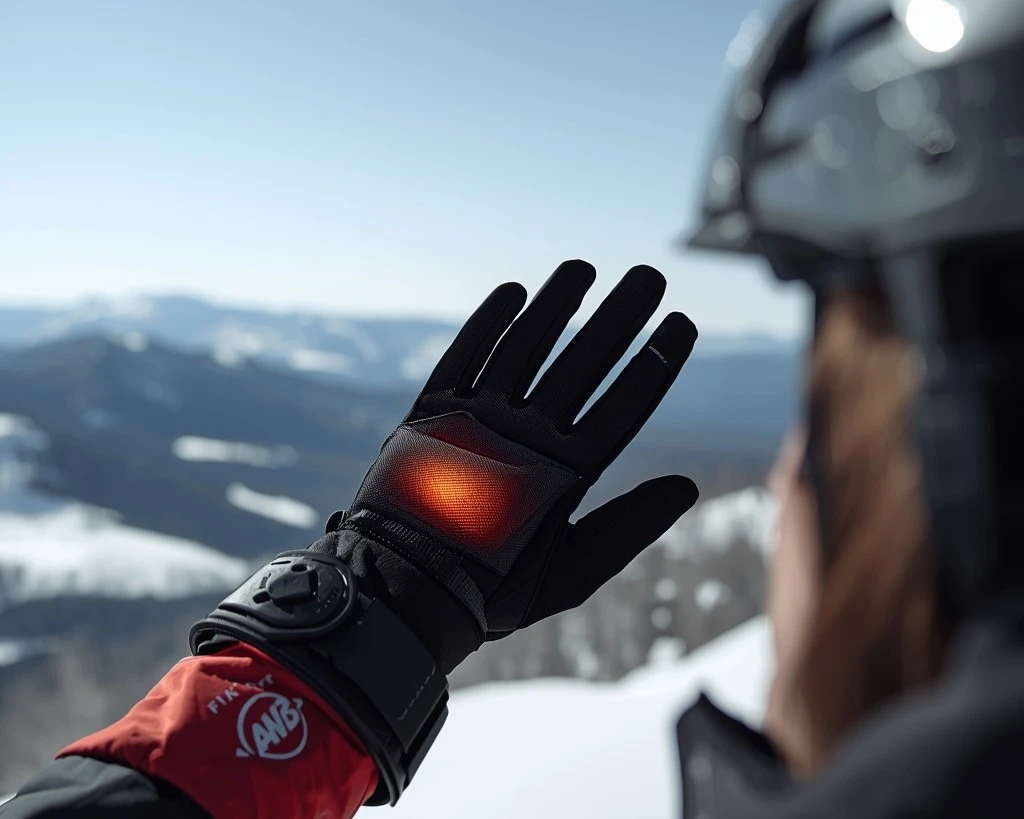
Heated ski gloves work by running a low-voltage electrical current through a network of thin resistive elements woven into the glove lining. When electricity flows through these elements, they heat up — just like the wires in a heater or electric blanket. That heat conducts through the lining into the hand. A rechargeable lithium-ion battery pack, usually housed in a small pocket at the cuff, supplies the current. Heat settings control how much current flows through the elements, which determines both the heat output and how quickly the battery depletes. To understand how do heated ski gloves work, you need to understand these three components — elements, battery, and insulation — and how they interact with each other and with the conditions outside the glove.
The heating element does not replace insulation. It works in combination with it. The insulation traps the heat the elements generate and prevents it from dissipating into the cold air around the glove. A heated glove with inadequate insulation loses heat to the environment faster than the elements can produce it. The correct mental model is that the element raises the baseline temperature inside the glove, and the insulation holds that temperature against the external cold. Removing either component from that system reduces the glove’s effectiveness significantly.
This article covers the mechanics in detail — how elements are positioned, how batteries behave across a ski day, what the heat settings actually produce, and how to manage the system to get consistent performance. Buying decisions, whether heated gloves are worth the cost, and specific model comparisons are covered in separate guides. The focus here is how the system works and what to do when it does not.
How do Heated Ski Gloves Work: The Heating Element System
The resistive elements in a heated glove are typically thin wires or flat ribbon elements made from alloys with consistent and predictable resistance — commonly carbon fibre composite, stainless steel alloy, or nichrome wire. These materials are used because they produce consistent heat, even when temperatures drop well below freezing.
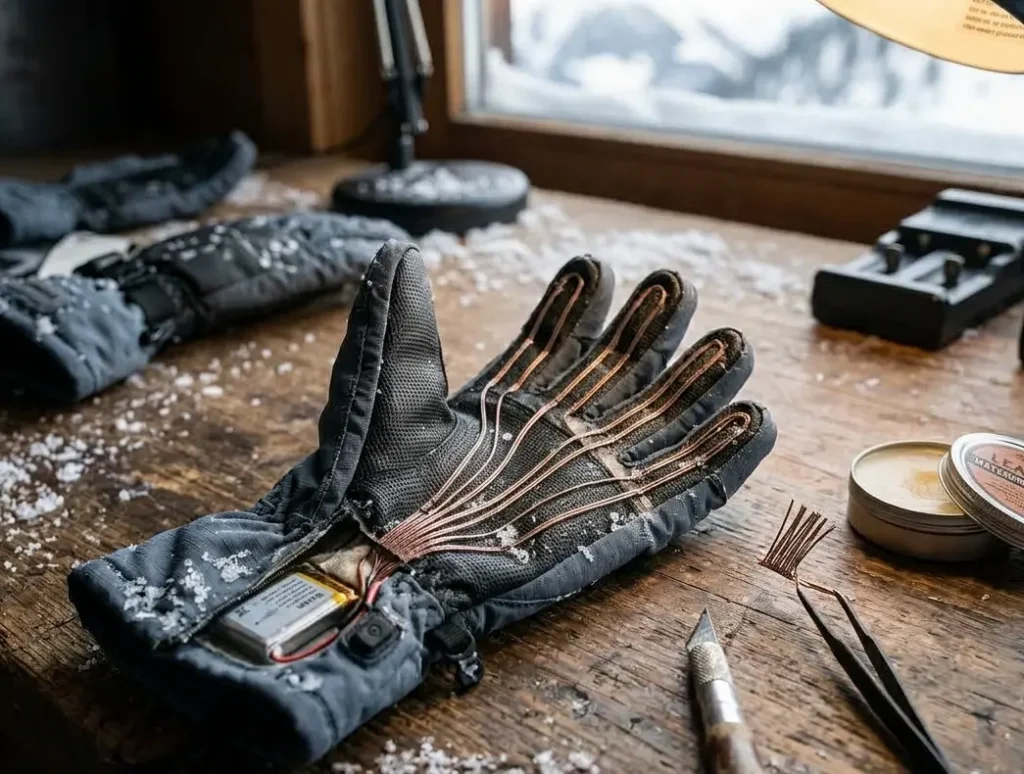
The elements are laminated into a thin fabric layer that sits between the outer shell and the insulation, usually on the back of the hand and along the fingers. Element placement is one of the most significant variables between models, and it is not always clearly specified in product descriptions.
Back-of-hand placement is standard across most models — it covers the zone with the most surface area and produces the most perceptible warmth quickly. Fingertip coverage is the more critical variable for most skiers, because the fingertips are the first zone to cool. A glove with elements only on the back of the hand relies on conduction through the hand to warm fingertips — which is slower and less reliable in extreme cold.
The element circuit in each glove is typically a single continuous path from the battery connection through all heated zones and back. This means a break at any point — a wire failure at a flex point, a connection fault at the battery terminal — stops all heating in that glove rather than just the zone near the break. This is why one glove sometimes stops working entirely while the other continues normally. It is a circuit failure, not a battery failure, and it is not field-repairable.
Element placement varies significantly between models. A glove with elements only on the back of the hand warms the palm area but relies on conduction to reach fingertips. If cold fingertips are your specific problem, confirm that the model you are considering has elements that extend to the fingertip zone.
In simple terms, heated ski gloves work like a wearable heater for your hands. A small battery sends power through thin heating wires inside the glove, which warm up and transfer heat to your hands. You control the heat level using a button, and the insulation keeps that heat from escaping.
The system is simple: battery → heating wires → insulation → your hands stay warm.
The Battery System — How It Behaves Across a Ski Day
The battery packs in heated ski gloves are lithium-ion cells — the same chemistry used in smartphones and laptops. Two characteristics matter specifically for ski use: their capacity decreases in cold temperatures, and their rated capacity represents performance at moderate temperatures, not cold ones.
A battery rated for six hours of use was tested at approximately 20°C during manufacture. This drop in performance is well documented in lithium-ion battery research, where cold temperatures reduce efficiency and available energy. At -10°C, the same battery delivers less energy per charge cycle because cold reduces the mobility of lithium ions within the cell. A heated glove that lasts five hours on medium at room temperature may last three to four hours at -15°C in real ski conditions.
This is not a defect — it is normal lithium-ion behaviour in cold. Most lithium-ion systems are designed to operate within specific temperature ranges, and performance outside those ranges drops significantly. Rated battery life figures should be treated as upper bounds rather than guaranteed performance. Setting management across the ski day matters because of this gap between rated and real-world duration.
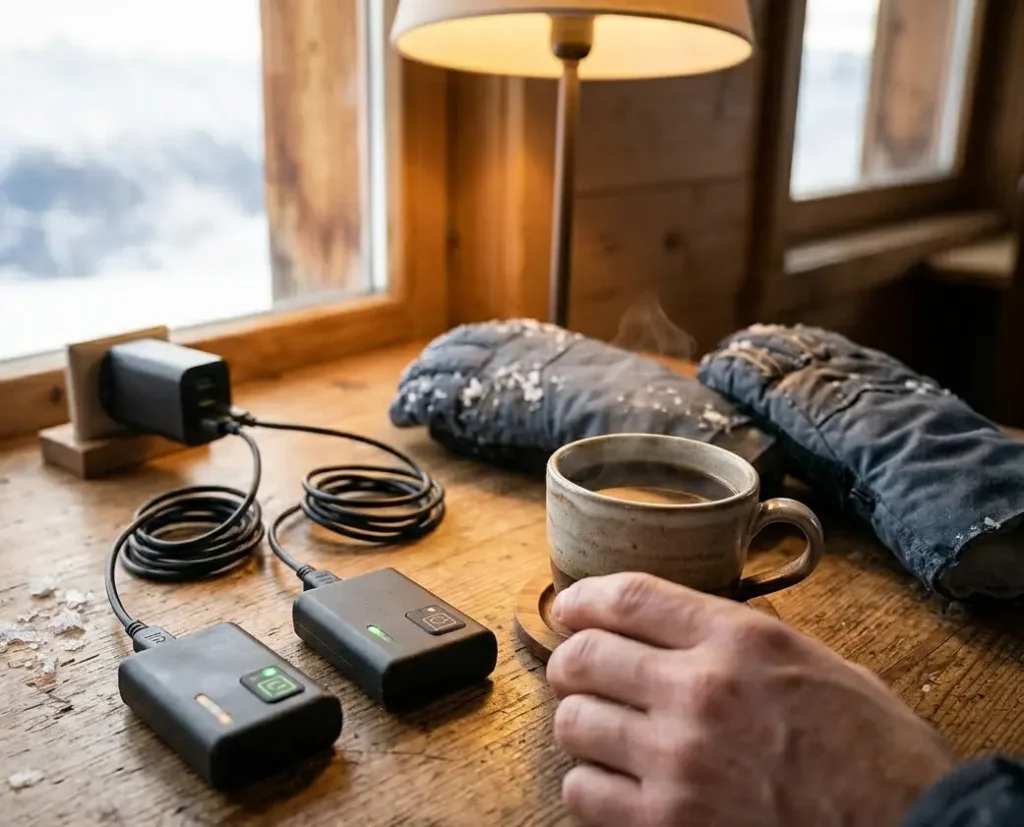
Battery temperature also affects charging. A lithium-ion cell charged at temperatures below 0°C charges more slowly and, if charged at very low temperatures repeatedly, can develop internal lithium plating that permanently reduces capacity. Charging should always be done at room temperature — inside the lodge or accommodation, not in a cold car.
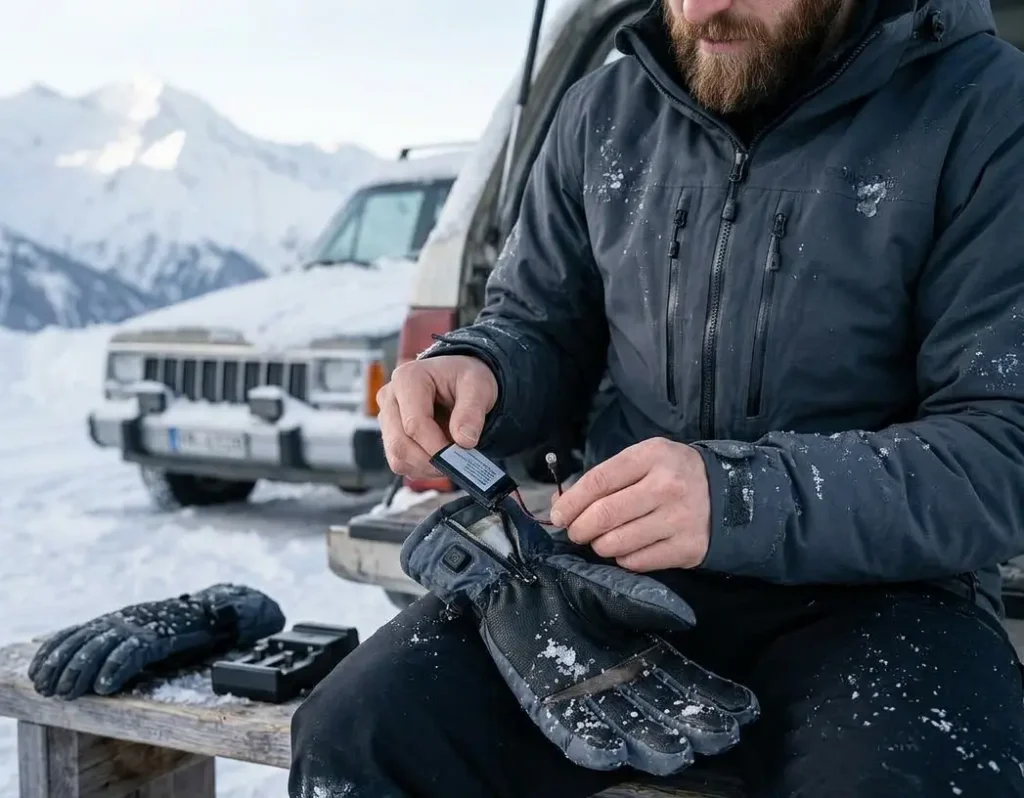
The storage charge level matters for long-term battery health. Long-term studies on lithium-ion cells show that storage conditions directly impact capacity loss over time. A lithium-ion cell stored fully charged or fully depleted for the length of an off-season degrades faster than one stored at 40 to 60 percent charge. This single off-season habit accounts for a significant portion of premature battery capacity loss across a glove’s lifespan.
Heat Settings — What Each Level Actually Produces
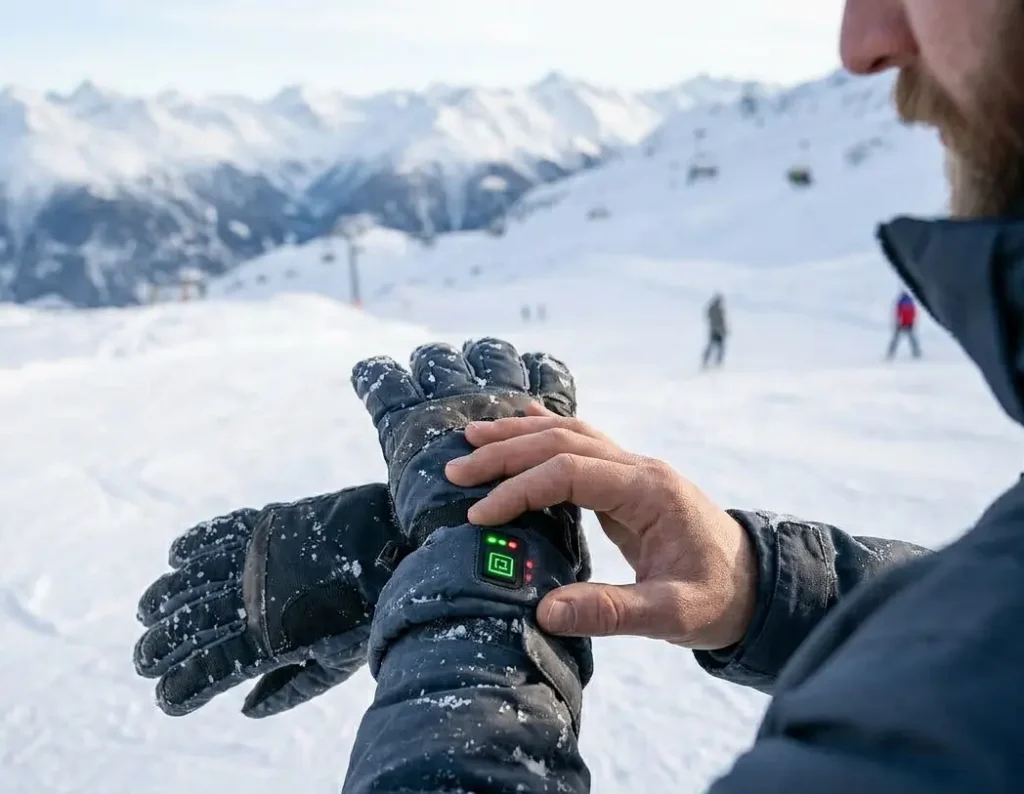
Most heated gloves offer three settings — low, medium, and high — controlled by a button on the back of the glove. The settings correspond to different levels of current flowing through the elements, which determines both heat output and battery drain rate. The relationship between settings is not linear: high typically produces roughly twice the heat of low but depletes the battery three to four times faster, because heat output scales with current and battery drain scales with the square of current.
Low setting (5–8 hours typical)
Best for mild to moderate cold and active groomed skiing where hands warm through activity. The heat maintains a baseline that keeps hands comfortable without working hard. Extending battery across a full ski day is straightforward on low.
Medium setting (3–5 hours typical)
The right choice for cold resort days, chairlift exposure, and moderate wind. Most standard ski conditions are covered adequately on medium. This is the best balance of heat output and battery life for most skiers.
High setting (1.5–3 hours typical)
Reserved for extreme cold, severe wind chill, and long exposed chairlift rides. In extreme environments, temperatures can drop far below freezing, increasing the rate at which heat is lost from exposed skin. Battery drains three to four times faster than on low. High setting is a resource to manage in bursts — not a continuous operating mode.
The most effective approach is to start on low for the first run when body heat from exertion is still active, increase to medium on chairlifts, and reserve high specifically for peak wind exposure. Starting on high at the first lift spends battery before the coldest part of the day arrives.
Wind chill on chairlifts is where high setting earns its value. Stationary hands in direct wind cool faster than hands during an active descent. Using high during lifts and stepping back to medium on runs extends battery while targeting the part of the day where heat matters most.
Do heated gloves work in extreme cold?
Yes, but only if the insulation is also designed for those temperatures. Heating alone cannot compensate for poor insulation.
How I Tested Heated Glove Performance — What I Measured and What I Found
The most informative test I ran was tracking battery duration at each heat setting across three consecutive ski days in consistent conditions at approximately -8°C ambient temperature with moderate wind. I used the same gloves across all three days, fully charging both battery packs each evening.
On day one, I ran both gloves on low setting throughout, switching to medium during chairlift rides. Battery indicators showed adequate charge remaining at the end of a six-hour session. Hands were comfortable throughout, with the expected exception of fingertip coolness on long chairlift rides in wind — a limitation of the element placement on that model, which did not extend fully to fingertips.
On day two, I ran both gloves on medium throughout without any setting adjustment. Both batteries depleted in approximately four hours — before the end of the ski day. The last ninety minutes were in increasingly cold hands as the elements stopped producing heat. This specifically showed the mid-day failure that many skiers experience: warm in the morning, cold by mid-afternoon, incorrectly attributed to temperature drop when the actual cause was unmanaged battery depletion.
On day three, I ran low during groomed runs, medium during chairlift rides, and high for a fifteen-minute exposed ridge traverse in strong wind. Both batteries lasted the full six-hour session with charge remaining. Hands were comfortable throughout including the ridge section.
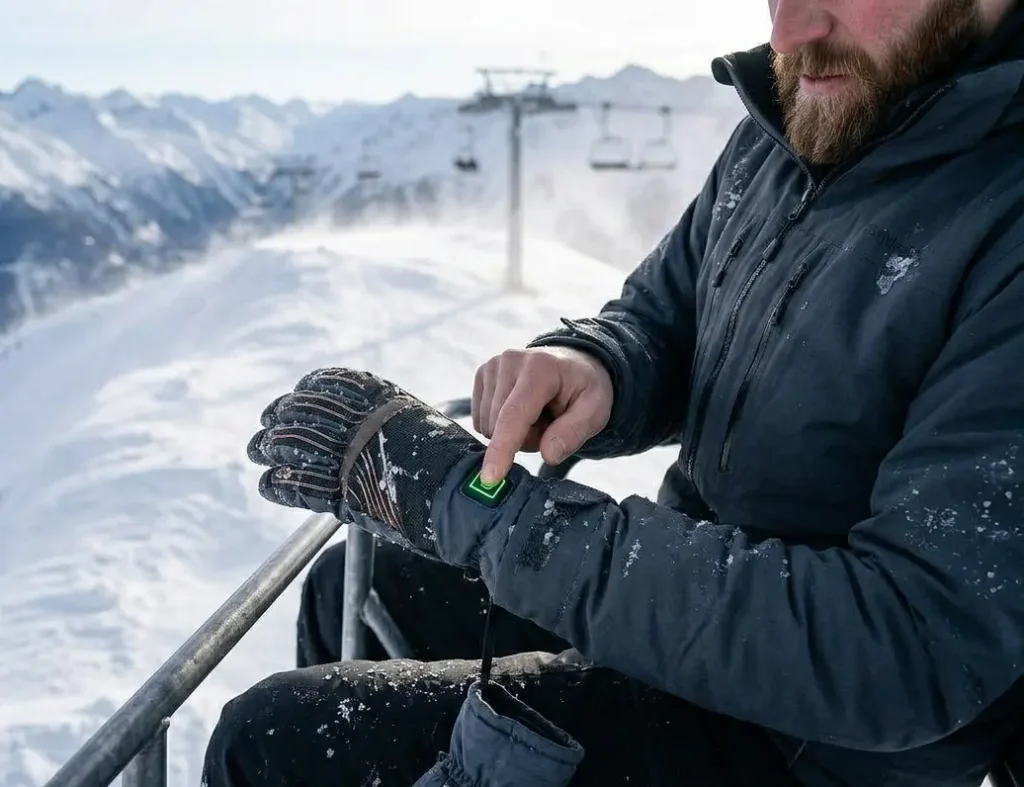
The secondary observation across all three days was element coverage: the back of the hand was consistently warm on all settings, but fingertips required active setting increases on cold chairlift rides. A model with fingertip elements would address this specifically.
These tests were conducted over multiple ski days using the same glove model under controlled conditions. Battery levels were recorded at the start and end of each session, and temperature conditions were tracked using on-mountain weather data. While results will vary by brand and model, the patterns observed here are consistent with how lithium-ion heated gloves perform in cold environments.
How the Insulation Works With the Heating Element
The insulation in a heated glove serves two functions: it provides baseline warmth when the heating elements are off, and it traps and holds the heat the elements generate when they are on. The interaction between these two functions determines how effectively a given insulation weight works with a given heat output.
Thin insulation paired with a high-output element produces hands that are warm when the element is on and cold quickly when it is off. The element is doing most of the work. Adequate insulation paired with a moderate element produces more stable warmth because the insulation holds the temperature the element builds, extending warmth beyond the moment current is flowing.
This is why heated gloves with heavier insulation often feel warmer across a full day than those with minimal insulation despite identical element specifications — the insulation is doing thermal storage work that lighter insulation cannot.
Element heat output cannot compensate for fundamentally inadequate insulation in extreme cold. A heated glove rated to -10°C in its insulation spec will not perform adequately at -25°C regardless of heat setting. The insulation loses heat to the outside faster than the element replaces it at extreme temperature differentials. Matching insulation weight to the actual temperature range of intended use is as important as element specification.
Common Mistakes That Reduce Heated Glove Performance
Starting each day on high setting. High heat drains the battery much faster than low — often several times quicker. A skier who starts on high at the first lift has spent a large portion of daily battery capacity before the coldest part of the day — typically mid-morning on the mountain when wind picks up and initial exertion warmth has faded. Starting on low and increasing in response to actual cold consistently produces better battery management than pre-emptively running high.
Charging in cold temperatures. A lithium-ion battery charged repeatedly at near-freezing or sub-zero temperatures develops internal plating that permanently reduces cell capacity. This is the most common cause of premature battery degradation in heated gloves. Charging should always be done at room temperature — inside accommodation, not in a cold car or unheated boot room.
Storing at full or empty charge off-season. Both extremes damage lithium-ion cells during storage. Full charge causes gradual oxidation of the cathode. Empty charge risks deep discharge that permanently damages cell chemistry. Off-season storage at 40 to 60 percent charge in a cool dry location extends battery lifespan significantly. Most skiers store gloves plugged in or fully depleted — both are incorrect.
Assuming any cold hands problem is an element or battery fault. Cold fingertips despite active heating are frequently a coverage issue — the elements do not reach the fingertip zone in that model — or a setting management issue where battery depleted mid-day. Diagnosing the specific cause before attributing failure to the hardware prevents both incorrect returns and unnecessary purchases of replacement gloves.
Running both gloves on the same setting regardless of conditions. The dominant hand grips the pole more consistently than the non-dominant hand in most skiing styles, producing slightly more circulation and warmth on that side. Some skiers find they can run the dominant hand on a lower setting than the non-dominant hand and maintain equivalent comfort — extending overall battery life without reducing warmth.
When Heated Gloves Are Not the Right Mechanism
When cold hands come from circulation, not temperature. Heated elements raise glove interior temperature. They do not improve blood flow to fingers. A skier with active Raynaud’s syndrome or significant peripheral circulation issues may find that even high-setting heated gloves do not adequately warm fingers because the blood supply reaching the fingers is too reduced. Heated gloves help meaningfully in this situation but may not fully resolve it — the circulation issue is the limiting factor, not the heat output.
When the ski day is short and conditions are moderate. A two-hour groomed resort day in moderate cold with low wind is not a context that requires heated gloves to maintain hand comfort. Standard insulated gloves in the appropriate weight for the temperature handle this adequately. Heated gloves in these conditions are functional but unnecessary — the battery and element system is not being used in a way that justifies its cost, weight, or maintenance requirements.
When the hands are cold from a wrist strap gap rather than temperature. Cold fingers arriving specifically during chairlift rides despite adequate insulation are often caused by an unsealed wrist cuff allowing wind to reach the wrist zone, not by insufficient glove warmth. Adding a heated glove to this situation warms the glove interior while the wrist gap continues to cool the blood supply at the wrist. Closing the wrist strap correctly addresses the actual cause. Diagnosing before upgrading prevents spending on heated gloves for a problem that strap adjustment solves.
How to Get Consistent Performance from Heated Gloves — Practical Steps
Full charge the night before every ski day
Partial charges produce proportionally shorter heat duration. Both gloves should be charged simultaneously from the same power source to ensure equal charge levels. Verify both are fully charged before packing — an indicator light check at room temperature before leaving accommodation takes ten seconds and confirms the day’s battery baseline.
Start on low setting for the first run
The body generates warmth through the exertion of preparing to ski — walking to the lift, adjusting equipment, the first descent. Low setting during this period maintains comfort without depleting the battery. Increase to medium when chairlift exposure makes low insufficient.
Use high setting in bursts, not continuously
High is most effective on exposed chairlift rides, long ridge traverses in wind, and static cold exposure during equipment adjustments. For the active descent phase of most runs, medium or low maintains adequate comfort. Reserving high for high-exposure events extends battery to the end of the ski day consistently.
Check battery level at mid-day
The battery pocket should be accessible with gloves on — practice this before the ski day. A mid-day check identifies whether the day’s remaining battery is adequate for the afternoon session and allows setting adjustment if depletion is ahead of expectation.
Store batteries at 40 to 60 percent charge off-season
After the last ski day of the season, use the gloves briefly on low setting to partially-deplete from full, or charge briefly from empty to reach the target range. Store in a cool dry location — not in a hot car, not in direct sunlight, not in a sealed bag with moisture. This single habit extends battery lifespan more than any other storage practice.
Decision Checklist: Getting the Most from Heated Gloves
| Action | When |
| Both batteries fully charged before every ski day — charge both simultaneously the night before | Every day |
| Start on low or medium — not high — for the first run; increase only when conditions require it | Every day |
| Match heat setting to actual conditions — medium covers most standard ski days adequately | Each session |
| Check element placement before buying — confirm whether model extends to fingertips if that is your cold zone | Before buying |
| Store batteries at 40–60% charge off-season — both full and empty storage degrade lithium-ion cells | Seasonal |
| Verify charge before multi-day trips — a damaged cable may not fully charge overnight | Each trip |
| Understand heat supplements insulation — it does not replace adequate insulation for the temperature | Understand |
| Practice accessing the battery pocket with gloves on before relying on it mid-mountain | Once |
Warning Signs: What Each Problem Indicates
Uneven warmth — one zone hot, others cold
Element coverage gap or a wire failure at a specific zone. The heating circuit is incomplete at that point. This is not field-repairable.
Heat stops working mid-session suddenly
Battery depletion — charge was insufficient for the setting and conditions used. Charge fully and test before attributing this to element failure.
One glove warmer than the other
Asymmetric battery charge. Both gloves must be charged simultaneously from the same power source to ensure equal charge cycles.
Battery indicator shows full but heat fails
Battery cells have degraded from repeated deep discharge. The indicator reads voltage, not actual capacity. Battery replacement may be needed.
Heat active but hands still cold
Element placement covers the back of the hand; fingertip zone may not be covered in this model. Or the insulation is insufficient for the conditions independent of heating.
Burning smell or unusual odour during use
Stop use immediately. Element or battery fault. Do not continue using until the glove has been inspected — this is not normal operation.
Quick Problem Diagnosis
Heat stops after 2 hours on high
Battery depleted faster than rated. High drains three to four times faster than medium. Switch to medium for baseline warmth and use high only for chairlifts and peak exposure.
One glove warmer than the other
Asymmetric charge — one glove charged less than the other. Always charge both simultaneously. Use a two-port charger if available.
Cold fingertips despite heat active
Element placement in this model covers the back of the hand, not the fingertip zone. Check the element map. This is a model selection issue, not a performance failure.
Heat works but hands still cold in extreme cold
Conditions exceed what the insulation layer can hold at this temperature. Increase heat setting. Or the insulation weight in the glove is insufficient for those specific conditions.
Battery shows charged but duration shorter than expected
Battery capacity has degraded from repeated deep discharge or age. Avoid fully depleting before recharge. Store at 40–60% off-season.
Heat activates then cuts out after a few minutes
Thermal protection cutout triggered. Let the glove cool for five minutes. If recurring, there is a battery or connection fault — inspect before further use.
Warm in the morning, cold after lunch
Battery depleted mid-day from starting on high. Start on low, increase to medium on lifts, reserve high for peak exposure only.
The most common performance misattribution: mid-afternoon cold hands attributed to glove failure when the actual cause is battery depletion from running high setting all morning. Before diagnosing a hardware problem, confirm battery level and review setting management across the day. In most mid-day failure cases, the hardware is working correctly and setting discipline is the variable.
If your heated gloves are performing correctly and you are confident in how the system works, the next question most skiers face is whether the cost, weight, and maintenance requirements are justified for their specific skiing pattern. That assessment — covering the conditions and skier types where heated gloves produce a clear return versus where standard insulated gloves are the better choice — is in Are Heated Ski Gloves Worth It?.
About the Author
Awais Rafaqat has spent over 15 years testing ski gear across North America — from the dry sub-zero conditions of the Rockies to the wet, heavy snow of the Pacific Northwest. His focus is real-world performance: what gear actually does in the conditions skiers encounter, not what the spec sheet says it should do.
© SkiGlovesUSA.com — Performance observations drawn from direct multi-season testing of heated glove systems. No sponsored product mentions.