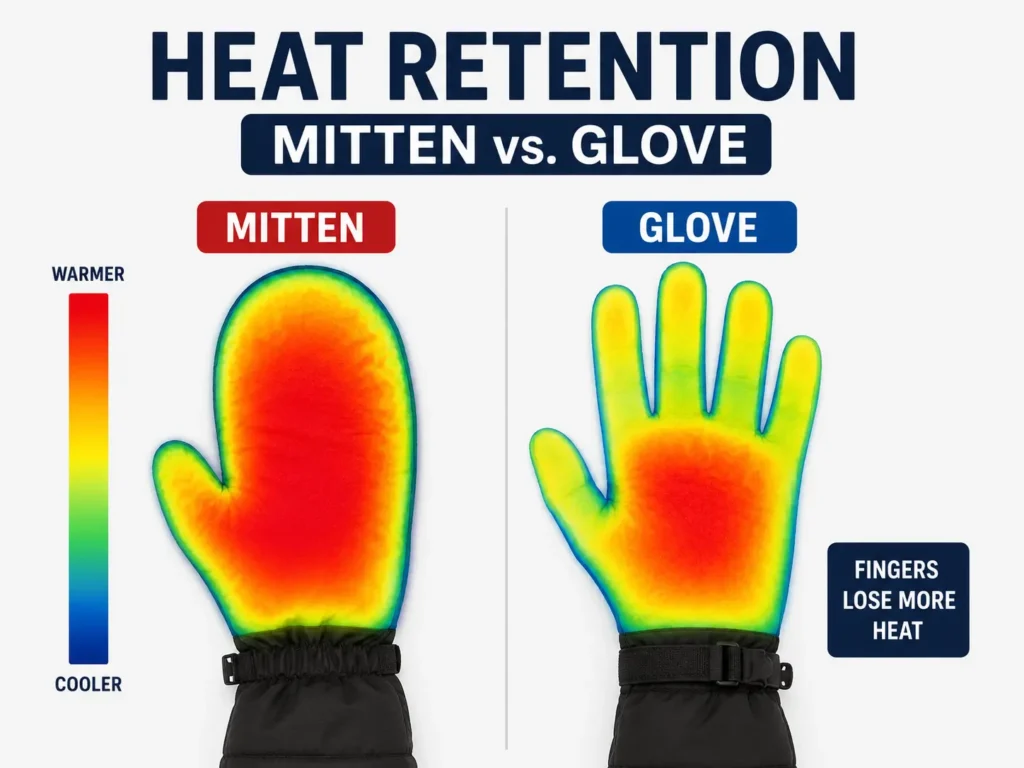
Quick answer: Neither one is objectively better — mittens win on warmth, gloves win on control, and the right choice depends on what your skiing actually demands from your hands that day. Mittens keep your fingers in one shared air pocket, which cuts heat loss compared to a glove that isolates each finger in its own sleeve of fabric. Gloves give up some of that warmth in exchange for the finger independence you need to grip a pole properly, work a zipper, or adjust a buckle without taking anything off.
If you already know which one you need but aren’t sure about cuff length, insulation weight, or sizing, the Ski Glove Finder narrows both categories down to options that actually match your conditions instead of guessing off a size chart.
This isn’t a “mittens are secretly better” or “gloves are secretly better” argument — both claims are wrong depending on the day. What follows is the actual mechanism behind why each one wins in different situations, so you can match the choice to your hands instead of your ego.
- The Two Mechanisms Behind Every Warm-Hands Argument
- Why Dexterity Loss Isn't Just "My Fingers Are Stuck Together"
- When Warmth Should Decide It
- When Dexterity Should Decide It
- Insulation Type Changes the Comparison Too
- Hybrid Options Exist Because This Trade-Off Is Real
- Common Mistakes People Make With This Choice
- A Practical Way to Decide
- Real Scenarios Where the Trade-Off Plays Out
- What This Doesn't Fix
- Frequently Asked Questions
- The Takeaway
The Two Mechanisms Behind Every Warm-Hands Argument
Cold hands come down to two separate things happening at once, and mittens and gloves address them differently.
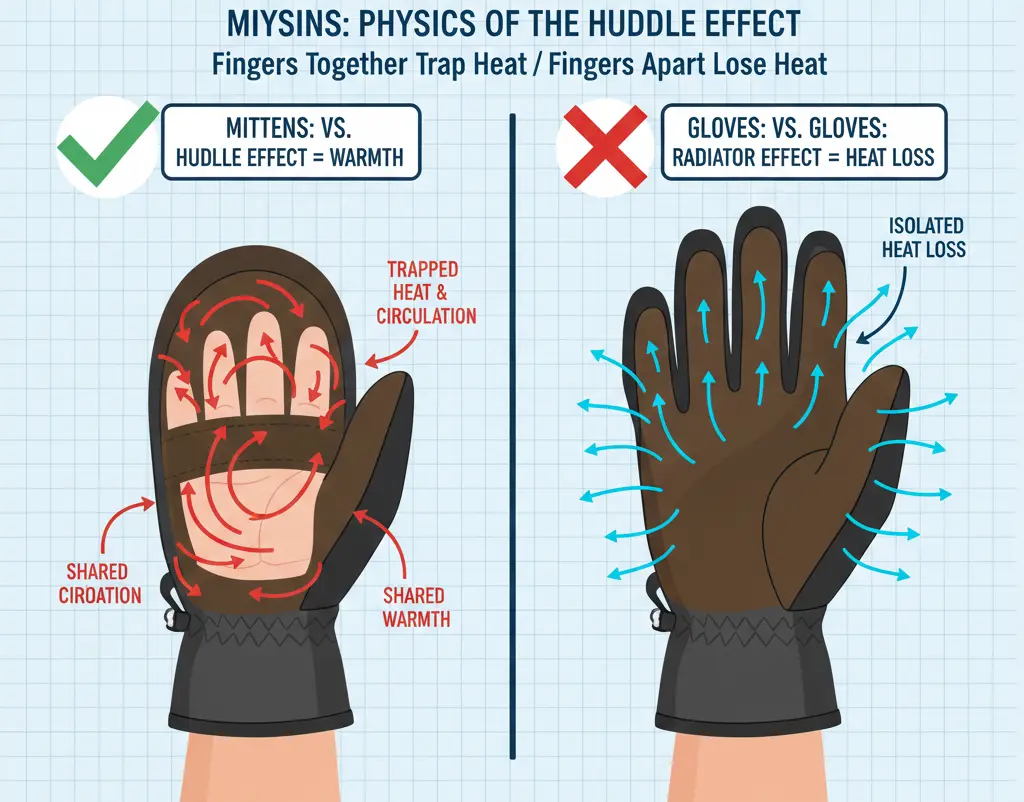
The first is surface area. A glove wraps each finger in its own layer of shell and insulation, which means each finger has its own boundary of cold fabric pressed close to it on nearly every side. A mitten groups four fingers into a single chamber, so the total fabric surface exposed to outside air per unit of hand volume is smaller, and the fingers radiate heat toward each other rather than each one losing it independently into its own sleeve.
The second is circulation, and this one matters more than people think. When your body senses cold, it protects your core by restricting blood flow to your extremities — this response is well documented in cold-exposure physiology research, where blood flow to the hands measurably drops as skin temperature falls, redirecting circulation away from the periphery to preserve core temperature. In a glove, a finger that loses circulation priority is isolated with no adjacent heat source. In a mitten, that same finger sits against its neighbors, so it can pick up some warmth by proximity even when your body has deprioritized sending blood there directly.
Neither mechanism is a small effect, and they compound. This is why the warmth gap between a well-made mitten and a well-made glove of similar insulation weight tends to be larger than people expect walking into a gear shop.
Why Dexterity Loss Isn’t Just “My Fingers Are Stuck Together”
The dexterity argument for gloves usually gets reduced to “mittens don’t have separate fingers,” which is true but misses half of what’s actually happening to your hands in the cold.
Grip strength and fine motor control both decline as skin temperature drops, independent of whether your fingers are separated or not. Research on manual dexterity under cold stress has found measurable declines in dexterity tasks as hand and finger skin temperature fall, with the threshold effect showing up well before hands feel painfully cold. That means a pair of gloves that’s too thin for the conditions can leave you with numb, clumsy fingers despite having full finger separation — the separation doesn’t help if the skin underneath has already cooled past the point where fine motor control holds up.
This matters for the mittens-vs-gloves decision because it reframes what gloves are actually buying you. A glove’s dexterity advantage is real, but it only holds up if the glove is warm enough to keep your finger skin temperature in a functional range in the first place. An underinsulated glove in genuinely cold conditions can leave you with worse functional dexterity than a properly insulated mitten, because your fingers have gone cold enough to lose fine control regardless of how they’re grouped.
When Warmth Should Decide It
Certain conditions make the warmth argument strong enough that dexterity becomes a secondary concern.
Sustained exposure without much hand activity — long chairlift rides in exposed terrain, standing around waiting for a group, or slow groomer cruising where you’re not constantly working poles and gear — favors mittens because there’s no ongoing dexterity demand to trade against the warmth gain. The colder the ambient temperature and the more wind exposure involved, the more that trade tilts toward mittens, since both factors accelerate the surface-area heat loss that mittens are structurally better at resisting.
People who run cold relative to others in their group, or who’ve noticed their hands are consistently the first thing to go numb on a ski day, get more practical benefit from the mitten’s warmth advantage than the average skier does, simply because they’re starting from a worse baseline and the margin matters more. For anyone landing on mittens after working through this, matching insulation type and construction to your specific cold tolerance is the next real decision, since not every mitten on the shelf is built for the same severity of cold.
When Dexterity Should Decide It
The reverse holds when your hands are doing real work throughout the day rather than just riding along.
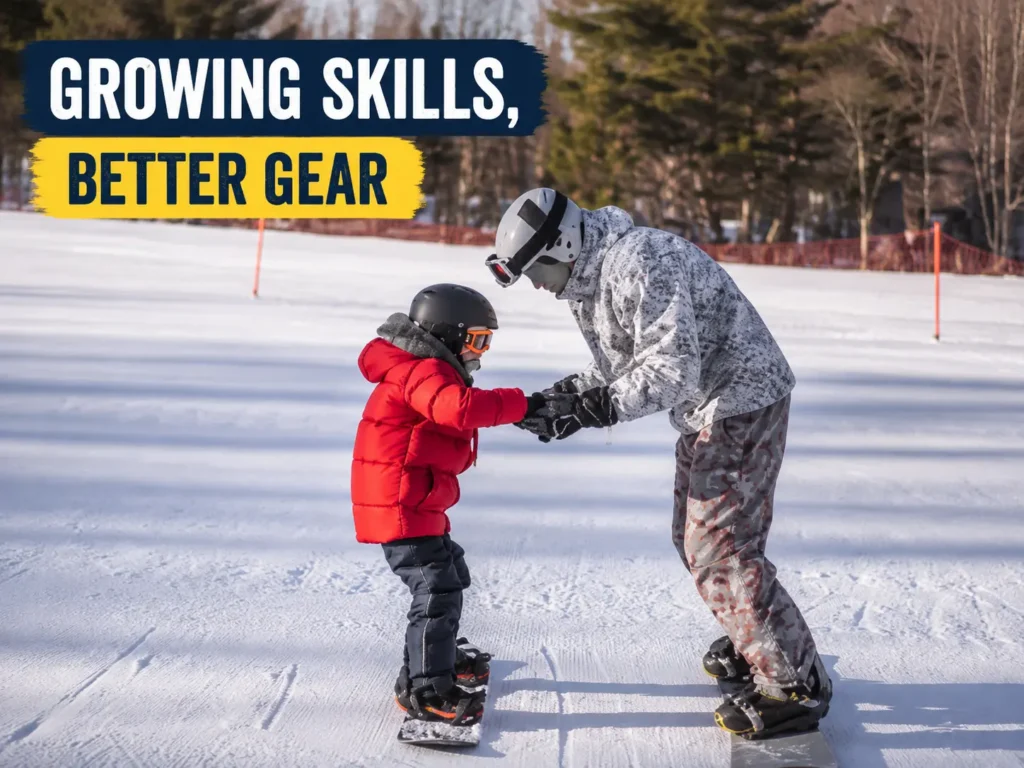
Skiing with young kids who need help constantly — zippers, goggles, boot buckles, tissues — means taking handwear on and off repeatedly, and every one of those moments is an opportunity to expose bare skin to cold air if you’re wearing something that’s slow to remove and replace. Gloves that stay on while you handle small tasks avoid that repeated exposure entirely.
Technical terrain where you’re constantly adjusting grip on your poles, using your hands for balance on moguls or trees, or need to reach into pockets for a map or phone without stopping to strip off handwear all favor the finger independence gloves provide. The dexterity tax on mittens isn’t really about any single task being impossible — it’s about how often you’re paying that tax throughout the day, and frequent small hand tasks add up fast. If gloves are the right call for your situation, a range of options across price points makes the sizing and insulation-weight decision easier once the shape question is settled.
Insulation Type Changes the Comparison Too
The mitten-versus-glove shape is one variable, but the insulation inside either one matters just as much, and it’s worth understanding separately from the shape question.
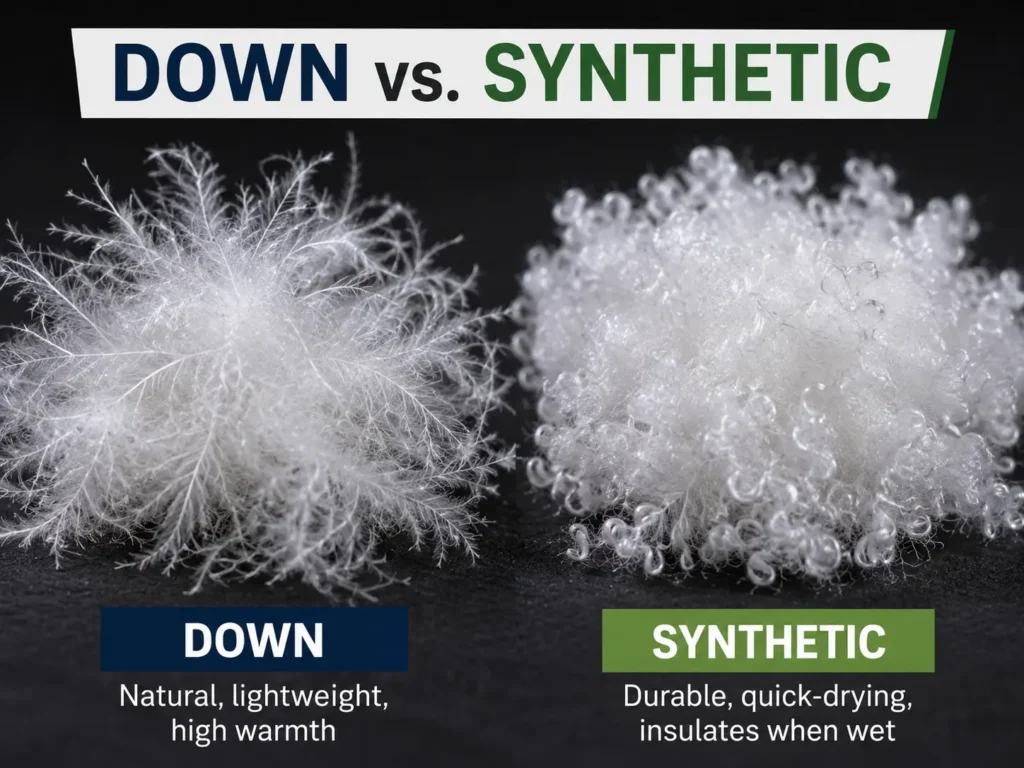
Down insulation has the best warmth-to-weight ratio of anything commonly used in winter handwear, but it has a real weakness: once down gets wet, the clusters that trap air collapse, and the material loses most of its insulating capacity until it fully dries out — a process that can take hours in field conditions. Synthetic insulation doesn’t match down’s warmth-to-weight efficiency when both are dry, but it keeps a meaningful amount of its insulating value even when damp, which matters a lot for anyone whose hands sweat inside their gloves or mittens over a full ski day.
This means a down mitten and a synthetic mitten aren’t interchangeable even though they’re the same shape. If you run warm and your hands sweat inside handwear, a down mitten’s dry-weather warmth advantage can get erased by the same moisture problem that would barely touch a synthetic one. Matching insulation type to your actual moisture pattern matters as much as matching shape to your dexterity needs.
Hybrid Options Exist Because This Trade-Off Is Real
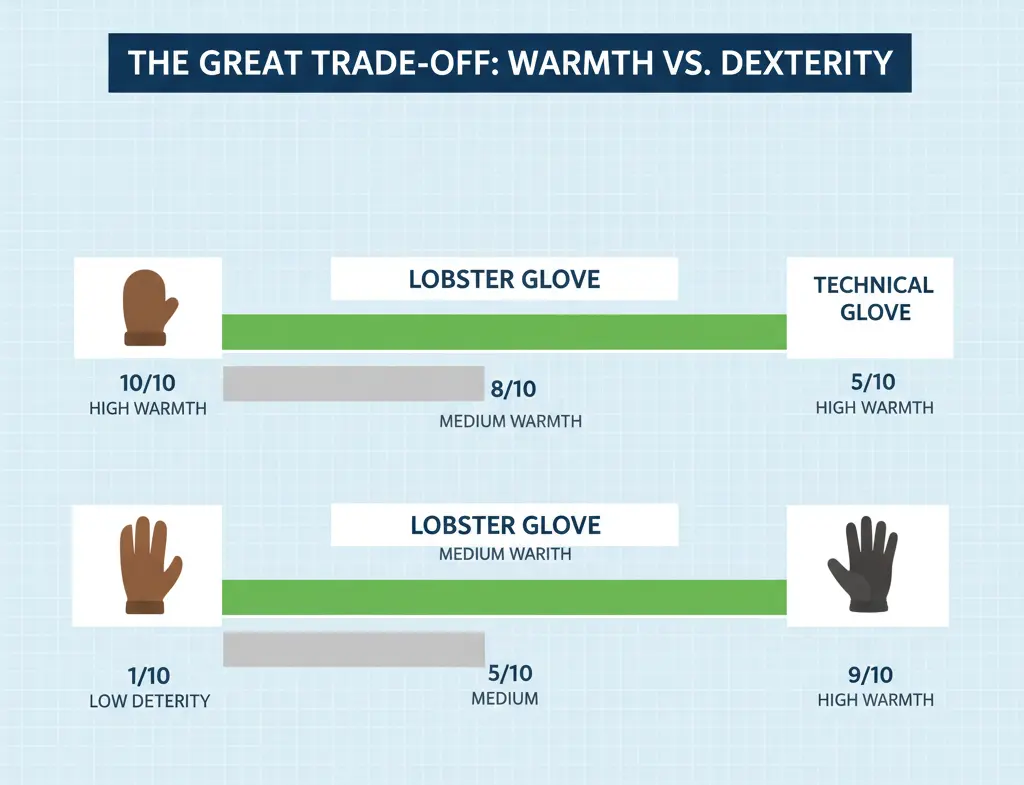
The fact that lobster-style gloves exist — grouping the ring and pinky finger together while keeping the index and middle finger separate — is itself evidence that the mitten-versus-glove trade-off isn’t something manufacturers have solved. It’s a genuine compromise, not a marketing gimmick.
Grouping the two coldest, least independently useful fingers together captures a meaningful chunk of the mitten warmth advantage, since those two fingers were contributing the least to actual dexterity anyway. Keeping the index and middle finger separate preserves the specific grip functions people actually rely on — pole grip, trigger-style pole releases, phone use. The trade-off doesn’t disappear, it just gets redistributed toward the fingers where you can afford to give some warmth back.
Convertible mitten-glove hybrids, where a mitten shell flips back to expose separated fingers underneath, aim at the same problem from a different angle — full glove dexterity available on demand, full mitten warmth the rest of the time. The trade-off here is mechanical rather than thermal: moving parts and flip-back shells add failure points and bulk that a simpler fixed design doesn’t have.
Common Mistakes People Make With This Choice
The most frequent mistake is picking based on what looks technical or what a group defaults to, rather than what the day’s actual conditions and activity level call for. A glove that photographs well in a gear review isn’t automatically the right call for a windy, single-digit chairlift day.
A closely related mistake is buying one pair to cover every condition you’ll ever ski in. Given how differently mittens and gloves perform depending on temperature, wind, and activity level, expecting one pair to be correct on both a 30°F groomer day and a single-digit powder day is asking one piece of gear to solve two different problems.
Sizing mistakes compound whichever choice you make. A too-tight glove or mitten compresses its own insulation and restricts the circulation that both designs depend on to stay warm — buying tight “for control” actively works against the warmth mechanism in both categories, not just gloves.
Ignoring your own sweat pattern is another common one. Someone who runs warm and sweats inside handwear gets less real-world benefit from a heavily insulated mitten than the temperature rating alone would suggest, because trapped moisture undercuts the insulation regardless of shape.
There’s also a timing mistake worth naming: deciding mid-run, once hands are already cold, rather than before the lift. Once fingers have cooled enough to lose fine motor control, switching handwear becomes harder to do cleanly — cold, clumsy hands struggle with buckles and zippers on replacement gear just as much as on the gear that got them cold in the first place. Making the mitten-or-glove call at the base, based on the day’s forecast rather than how your hands feel in the moment, avoids having to solve the problem after it’s already underway.
A Practical Way to Decide
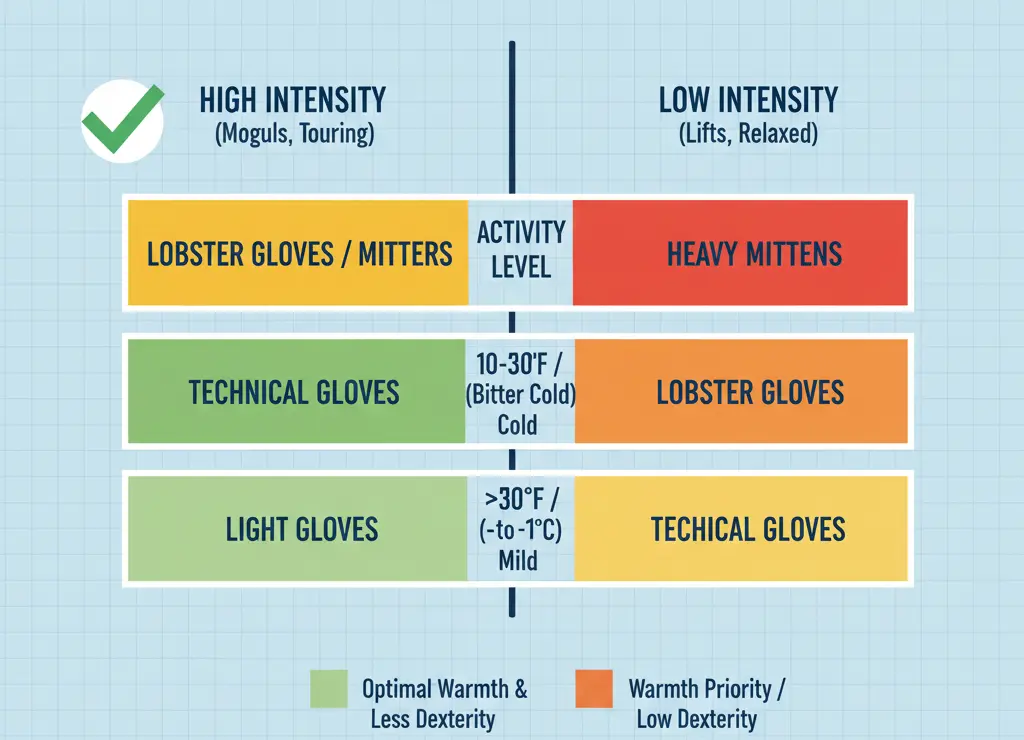
Start with your coldest expected exposure for the day, not your average conditions — a single exposed chairlift ride in wind matters more to this decision than how the base of the run feels. If that coldest exposure is in the single digits Fahrenheit or involves sustained wind chill, weight the decision toward mittens before considering anything else.
From there, count how often your hands actually need to work independently during a typical run — pole grip adjustments, helping other people, phone or camera use, technical terrain requiring hand balance. High frequency shifts the decision back toward gloves even in genuinely cold conditions, because the cost of constant on-off cycling in a mitten can outweigh its raw warmth advantage.
If you land in the middle — cold enough that pure gloves feel marginal, but with real dexterity needed throughout the day — that’s exactly the situation lobster-style hybrids and glove-liner combinations exist to solve, rather than a sign you need to compromise on both fronts equally.
Real Scenarios Where the Trade-Off Plays Out
A parent skiing with a six-year-old who needs help every few runs is trading warmth for the ability to keep gear on their hands while they help — gloves win here even on a genuinely cold day, because the alternative is repeatedly exposing bare skin during every assist.
Someone doing long, slow groomer laps in a wind-exposed alpine bowl with minimal hand activity is in the opposite situation — mittens win clearly, since there’s no ongoing dexterity cost being traded away, only warmth being gained.
A backcountry tourer hiking uphill in a liner glove, sweating the entire ascent, then switching to a heavier shell mitten pulled on over that same liner for the descent is using both categories deliberately for two different phases of the same day, matched to two very different activity levels and moisture conditions.
Someone whose hands run cold regardless of the actual air temperature is better served defaulting toward mittens more often than the raw thermometer reading would suggest, since their baseline circulation response means they’re losing the warmth argument faster than an average pair of hands would in the same conditions.
What This Doesn’t Fix
Insulation only traps heat that’s already reaching your hands through blood flow — it can’t manufacture warmth your circulation isn’t delivering in the first place. For people with circulation conditions that severely restrict blood flow to the extremities regardless of ambient temperature, neither a well-insulated mitten nor a well-insulated glove addresses the underlying limitation, since both designs depend on your body actually sending warm blood to the area to have something to trap.
That’s a genuinely different problem from the mitten-versus-glove question this article is about, and it’s worth recognizing as its own category rather than assuming a warmer mitten will eventually solve it.
Frequently Asked Questions
Are mittens always warmer than gloves at the same insulation weight?
Generally yes, because the shared-chamber design reduces surface area and lets fingers benefit from each other’s proximity, but the gap narrows as ambient temperature rises and hand activity increases — on a mild, active ski day, a good glove can perform close enough to a mitten that the dexterity advantage becomes the deciding factor instead.
Can a liner glove close the gap between gloves and mittens?
Partially. A liner adds a layer of trapped air and can meaningfully extend a glove’s comfortable range, but it doesn’t restructure the finger-isolation problem that drives most of the mitten warmth advantage — it helps, but it doesn’t erase the underlying difference.
Do lobster gloves actually work as a middle ground?
Yes, functionally — grouping the two least dexterity-critical fingers captures real warmth while preserving grip on the fingers that matter most for pole control. The trade-off doesn’t disappear, but it’s redistributed to where most skiers can tolerate it better.
Should I buy two pairs instead of trying to find one that does everything?
If your ski days span a wide temperature and activity range — cold exposed mornings, warmer active afternoons, occasional technical terrain — two purpose-matched pairs will consistently outperform one compromise pair across all of those conditions.
Does hand size affect which one makes more sense?
It affects fit more than the underlying decision — a mitten or glove that’s correctly sized for your hand will perform close to what’s described here regardless of hand size, but an incorrectly sized one of either type loses the warmth benefits from compressed insulation and restricted circulation, which matters more than the raw size number itself.
The Takeaway
The mittens-versus-gloves decision isn’t a style preference or a question with one universally correct answer — it’s a genuine physical trade-off between two mechanisms your hands are actually fighting against in the cold: heat loss through surface area and dexterity loss through cooling skin. Mittens address the first better. Gloves are built around preserving function against the second. Neither one cancels out the other’s weakness completely.
The most reliable way to choose is matching the decision to your coldest expected exposure and how often your hands need to work independently that specific day, not to whatever your last pair happened to be or what looks right in a gear shop. Once you’ve got the shape sorted, dialing in cuff style, insulation weight, and actual sizing is what turns a reasonable choice into gear you stop noticing entirely once you’re on the mountain.