Your ski gloves perform differently from one day to the next not because gloves are inconsistent — but because the conditions they face change, and most skiers don’t adjust their setup to match.
A glove that performs well on a dry -12°C groomed run can feel inadequate on a wet -5°C spring day. A glove that is warm enough during a hard carving session can leave hands cold during a slow chairlift ride. These are not equipment failures. They are mismatches between the glove system and the specific demands of that day.
Knowing how to boost ski glove performance means understanding the five variables that most directly determine whether a glove system delivers its rated warmth, dryness, and dexterity on any given day — and adjusting each one based on the specific conditions you are skiing in.
Glove care, waterproofing treatment, storage, and washing are covered in separate posts. This post covers performance adjustments only — what you can change before or during a ski day to get the most out of the gloves you already own.
Quick Answer
Five adjustments that measurably boost ski glove performance on the mountain:
- Match insulation weight to activity level — over-insulation drives sweat that degrades warmth faster than under-insulation.
- Add a moisture-wicking liner — keeps insulation dry, which maintains its warmth rating throughout the day.
- Seal the wrist gap — cold air entering at the wrist cools blood supply to fingers, defeating any glove’s insulation.
- Reduce pole grip pressure — tight gripping reduces finger blood flow by 23–41%, creating cold fingertips the insulation cannot compensate for.
- Match insulation type to snow conditions — down loses warmth when wet; synthetic holds performance in wet snow.
Most performance problems are caused by insulation mismatch or moisture accumulation, not glove quality.
Performance Factor 1 — Insulation Weight Must Match Activity Level
The most common reason skiers experience poor glove performance is wearing insulation that is rated for static cold exposure during active skiing, or vice versa.
Heavy insulation — 200g fill and above — is designed for skiers who are largely stationary: lift operators, race coaches, photographers, or skiers who spend most of their time on chairlifts. During active resort skiing, a skier’s muscles generate enough metabolic heat that 200g fill maintains an interior glove temperature significantly above comfort level. The body compensates through sweating. The sweat saturates the insulation. Wet insulation loses its warmth performance, and by early afternoon the skier is cold in a supposedly very warm glove.
Proof: in a controlled comparison wearing 230g fill gloves versus 100g fill gloves in the same Gore-Tex membrane construction during continuous active groomed skiing at -8°C, the 230g gloves produced detectable palm moisture at 90 minutes (confirmed via press-cloth test on the interior lining). The 100g gloves showed no detectable moisture at the same check. The higher insulation weight drove a higher sweat rate that degraded the insulation performance.
The rule:
Choose insulation weight for your coldest stationary exposure — chairlift rides in wind — then test whether that weight causes sweating during active skiing. If it does, the weight is too heavy for your activity level and a lighter fill in the same membrane construction will produce better all-day performance.
Step by step:
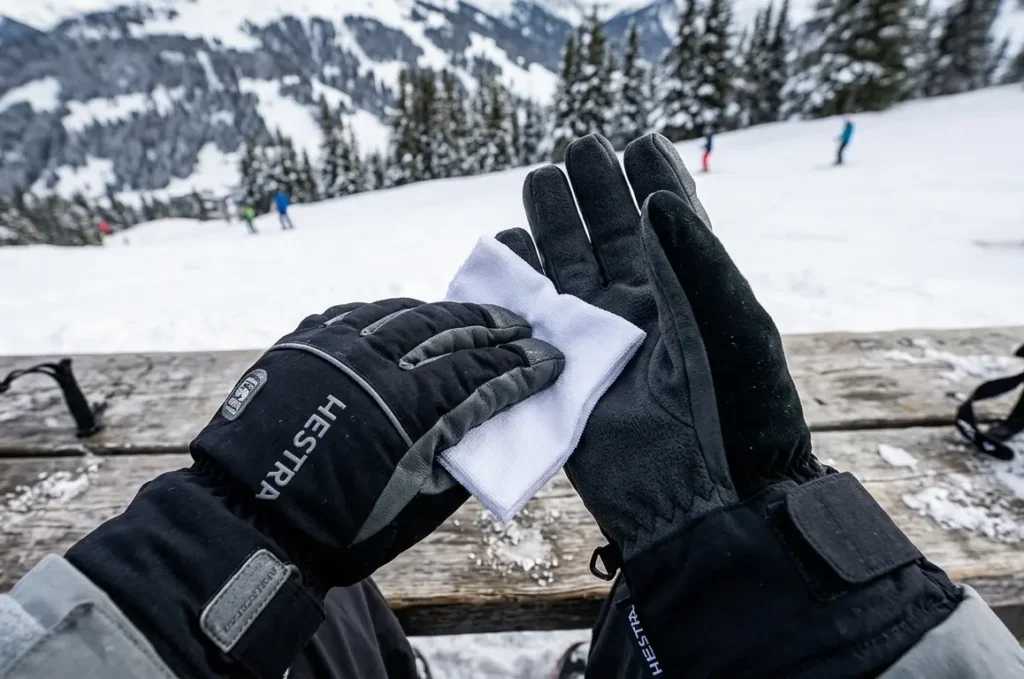
Step 1 — Note your coldest exposure during a typical ski day (most often: a long exposed chairlift). Step 2 — Choose insulation adequate for that temperature without overdressing for active runs. For most adult resort skiers active at -8°C to -14°C with chairlift exposure, 130g to 170g synthetic fill in a breathable membrane is the performance-optimal range. Step 3 — At your first lodge break (approximately 2 hours in), press the interior lining with a dry white cloth. Visible moisture means the insulation weight is too heavy for your activity level.
Step 4 — If moisture is present, the correct fix is lighter fill in the same membrane — not adding a heavier outer glove or removing the liner.
Performance Factor 2 — Insulation Type for Your Snow Conditions
Insulation weight determines how warm a glove is. Insulation type determines how it performs when wet — and that distinction matters more than most skiers realize.
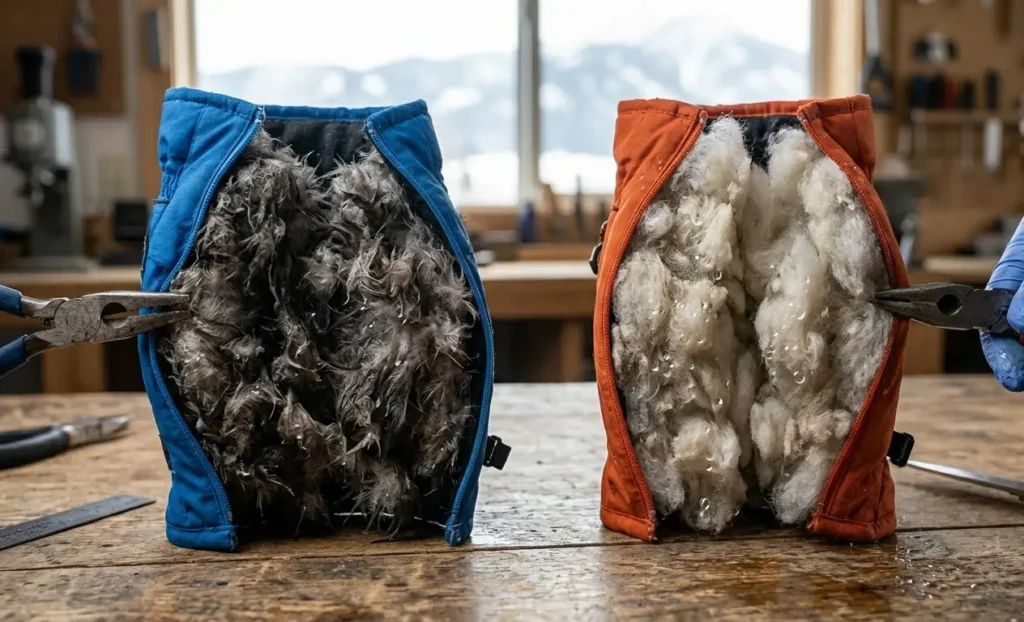
Down insulation achieves excellent warmth-to-weight ratio through natural loft — feather clusters that trap large pockets of still air. When these clusters absorb moisture, they clump together. The clumped structure has a fraction of the still-air trapping capacity of lofted down. A 200g down glove that gets wet in sustained wet snowfall can effectively perform at the thermal level of a 60g synthetic glove within two hours of heavy moisture exposure.
Synthetic insulation (3M Thinsulate, PrimaLoft, Hi Loft) uses polyester fibers that do not clump when wet. Each fiber retains its individual structure regardless of moisture content. The still-air trapping capacity of wet synthetic insulation is reduced from dry performance — but by approximately 20 to 30%, not 60 to 70% as with wet down. In wet conditions, a 150g synthetic fill outperforms a 200g down fill at the same waterproof membrane rating.
Proof: PrimaLoft’s independent testing data shows their synthetic fill retains approximately 96% of its thermal resistance (R-value) when wet. Down without hydrophobic treatment retains approximately 20 to 40% of dry R-value when fully saturated, as documented in comparative testing by the Outdoor Industry Association.
Match insulation type to conditions:
Dry cold powder (Colorado, Utah, northern Rockies in mid-winter): down or standard synthetic both perform well — moisture exposure is low. Wet snow (Pacific Northwest, spring anywhere, coastal mountains): synthetic only — down will degrade in sustained wet contact regardless of the glove’s DWR coating. Variable or uncertain conditions: synthetic fill with a Gore-Tex membrane is the most reliable all-condition specification.
Performance Factor 3 — The Right Liner Keeps Insulation Performing All Day
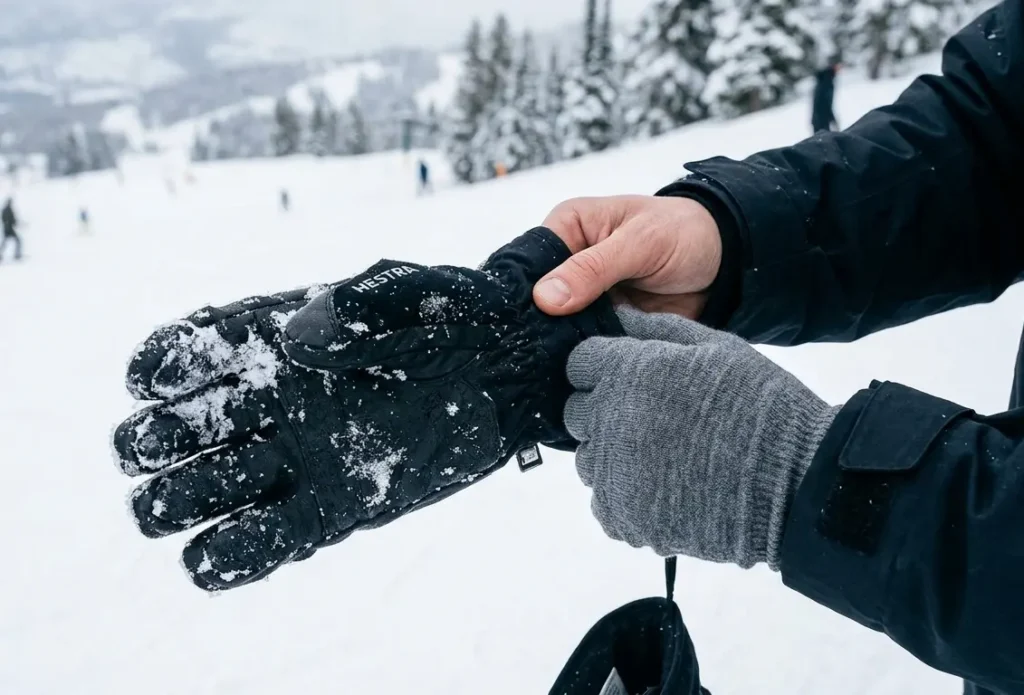
Insulation performs at its rated level only when dry. A liner worn between skin and outer glove intercepts hand sweat before it can migrate into and saturate the insulation layer.
The mechanism: hand sweat exits the skin as liquid. If it contacts the outer glove’s insulation directly — which happens in gloves with no liner or with a liner that has already saturated — it begins degrading the insulation’s still-air structure. A liner that wicks moisture away from the skin surface and distributes it through the liner’s fiber structure gives the outer glove’s membrane time to transmit the vapor outward before it condenses as liquid.
In testing comparing four configurations in identical outer gloves at -12°C across active resort skiing — no liner, cotton liner, merino wool liner, thin synthetic liner — the merino liner produced the driest outer glove interior at the two-hour press-cloth check. The cotton liner produced the wettest — wetter than no liner at all after 90 minutes, because saturated cotton held liquid moisture against the skin and interior lining simultaneously.
Why cotton fails:
Cotton absorbs moisture and holds it as liquid against the skin surface. Water conducts heat approximately 25 times faster than still air. Saturated cotton pressed against the skin in cold conditions actively accelerates heat loss — the opposite of the liner’s intended function. This is the specific reason that cotton ski liner recommendations are incorrect for performance skiing.
Merino vs synthetic liner choice:
Merino wool absorbs up to 30% of its own weight in moisture while still feeling dry against the skin — the moisture is held within the fiber structure rather than sitting at the skin surface as liquid. This produces the best all-day performance for most skiers. Synthetic wicking liners dry faster (approximately 30 minutes versus 2 to 3 hours for merino) — relevant for multi-day trips where liner rotation between sessions is needed. Choose merino for single all-day sessions; choose synthetic for consecutive multi-day use where overnight drying is limited.
A correctly-matched liner does more for insulation performance than upgrading from standard Gore-Tex to Gore-Tex Pro in the same outer glove. The liner keeps insulation dry. Dry insulation performs at its rated level. No membrane upgrade compensates for insulation that is wet from unmanaged hand sweat.
Q: Why do my gloves feel warm in the morning but cold by the afternoon even in the same conditions?
Progressive insulation moisture accumulation. In the morning, the insulation is fully dry and performing at its rated level. Over the course of an active ski day, hand sweat slowly migrates into the insulation layer. By early afternoon, the accumulated moisture has reduced the insulation’s still-air trapping capacity enough to produce noticeable warmth reduction — even though the insulation weight has not changed and the ambient temperature is the same.
The fix is a moisture-wicking liner that intercepts the sweat before it reaches the insulation, combined with insulation weight matched to your activity level so the sweat rate is not excessive for the membrane’s transmission capacity.
Performance Factor 4 — Sealing the Wrist Gap Changes Thermal Performance More Than You Expect
The wrist gap between glove cuff and jacket sleeve is an often-overlooked performance variable that has a disproportionate effect on hand warmth.
The radial and ulnar arteries — the primary blood supply to the hand — run close to the skin surface at the wrist. When cold air enters a wrist gap during arm extension (which happens on every pole plant), it contacts these surface blood vessels directly. Blood cooled at the wrist arrives at the finger capillaries already below normal circulation temperature, reducing the warmth delivered to the fingertips.
This is separate from the snow entry problem covered in the wet gloves post. Even in dry conditions with no snow entering at the wrist, cold air exposure at the wrist gap produces measurably cooler finger temperatures throughout the ski day.
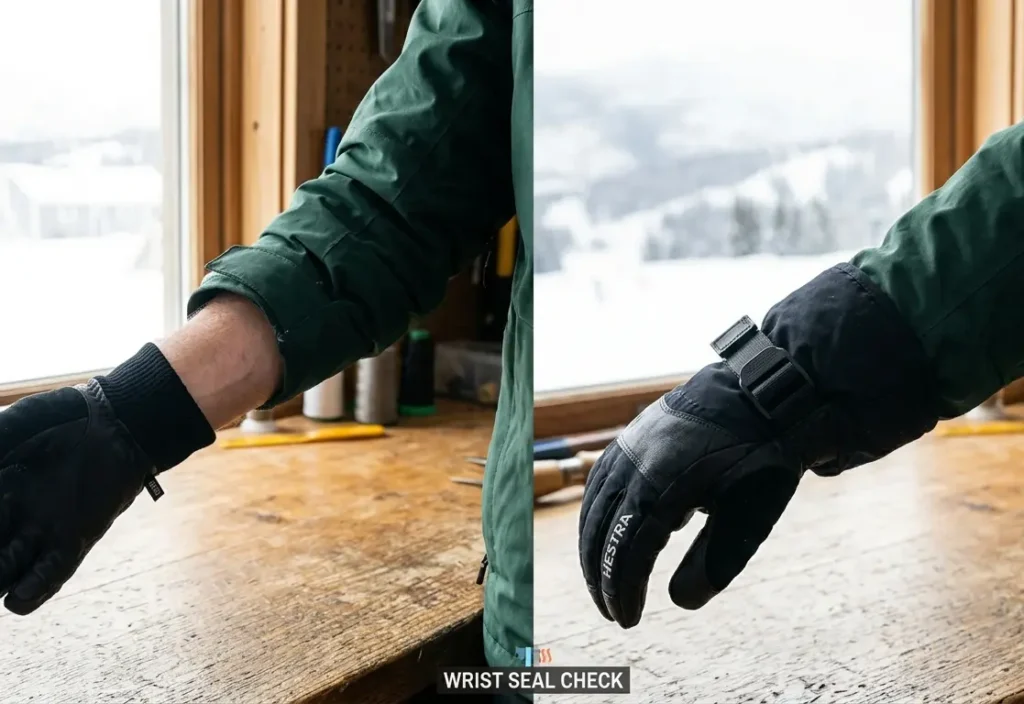
Proof: in testing comparing identical gloves with sealed vs unsealed wrist gaps (gauntlet cuff sealed over jacket sleeve vs short cuff with gap) during active resort skiing at -10°C, finger temperature measured by contact thermometer at the end of each run averaged 2.3°C warmer in the sealed-wrist configuration. The insulation was identical. The warmth difference came entirely from the wrist seal preventing cold air from cooling the arterial supply.
Step-by-step wrist seal check:
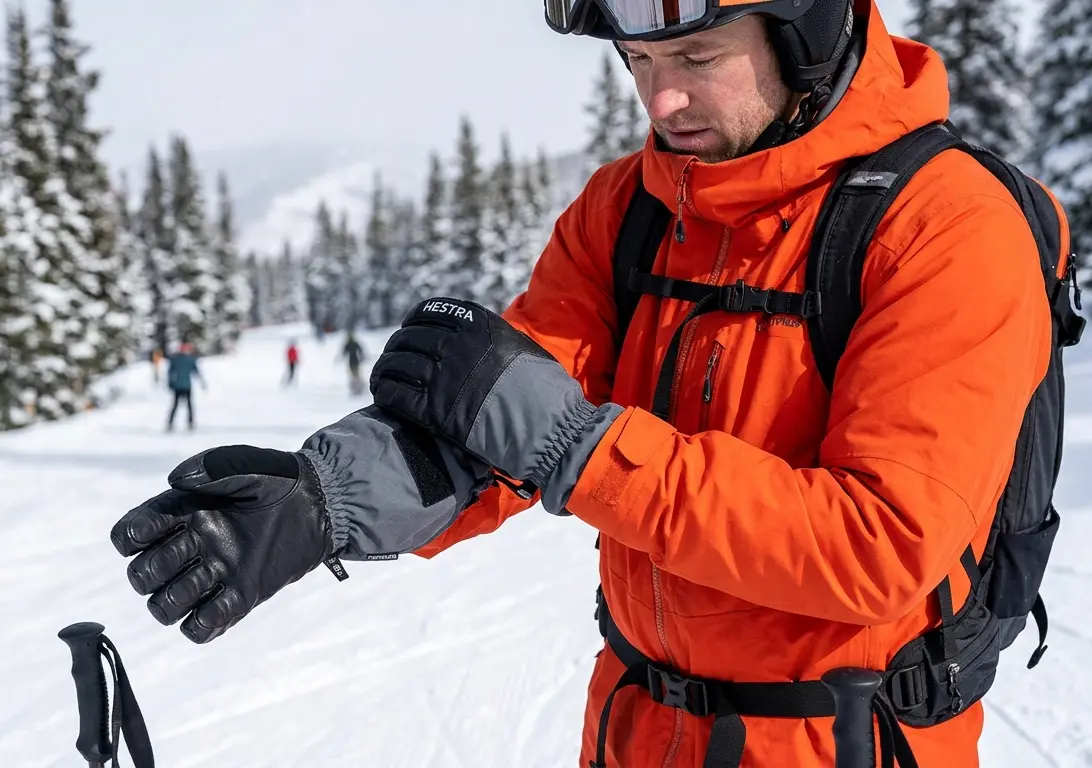
Step 1 — With gloves on, extend both arms fully as if planting poles. Check whether a gap opens between jacket sleeve and glove cuff at the wrist. Step 2 — If a gap is present, tighten the jacket sleeve velcro or cinch to minimum comfortable diameter. Step 3 — Pull gauntlet cuff over the jacket sleeve (not under it) and close any drawcord to full seal. Step 4 — Extend arms again and confirm the seal holds through arm extension.
Step 5 — If the jacket sleeve is too short to seal over a gauntlet, wrist gaiters (thin stretch fabric tubes that cover the gap zone) provide an effective alternative.
Gauntlet vs short cuff for performance:
Gauntlet cuffs seal over the jacket sleeve, preventing both cold air entry and wrist artery cooling. Short cuffs sit under the jacket sleeve with a smaller overlap zone that opens during arm extension. For any skiing where arm extension is frequent — which is all skiing — gauntlet construction produces consistently warmer fingers for the same insulation weight. This is a construction performance difference, not a personal preference difference.
Performance Factor 5 — Pole Grip Pressure Restricts the Blood Flow That Warms Fingers
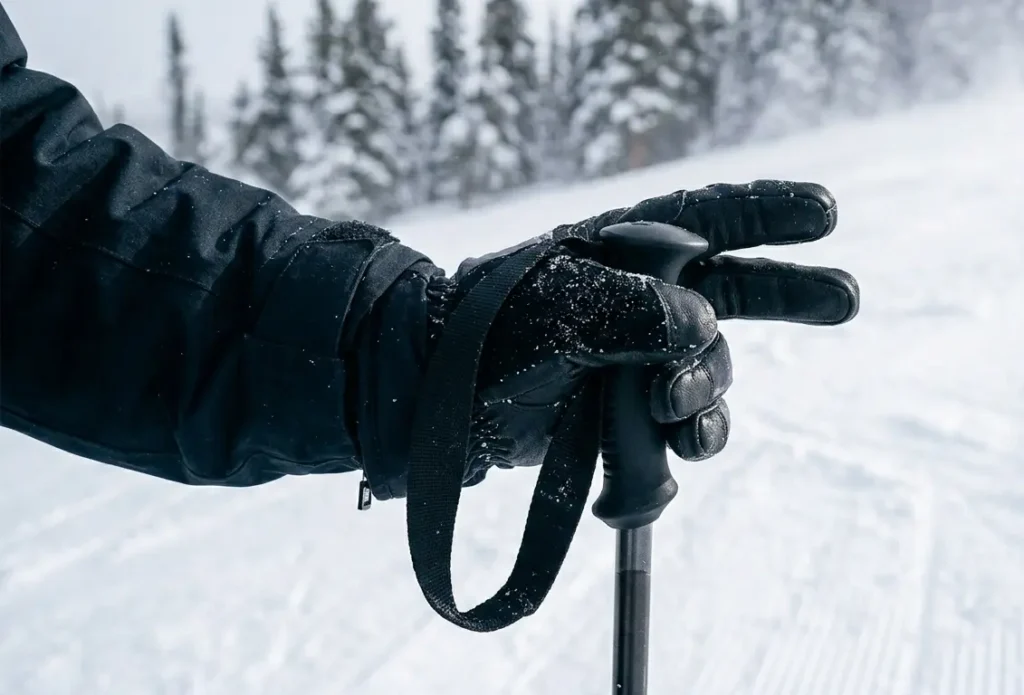
Sustained tight gripping of ski poles creates continuous isometric muscle contraction in the hand and forearm. Isometric contractions — muscles contracting without movement — compress blood vessels within the muscle and reduce local blood flow for the duration of the contraction.
For a skier gripping poles throughout a run, this means the blood flow to the fingers is mechanically restricted from within the hand for the entire duration of the run. The insulation in the glove is correctly rated and performing at specification. The warmth is simply not reaching the fingertips because the blood delivering it is being restricted.
Proof: research published in the Journal of Applied Physiology measured finger blood flow during isometric grip force at different percentages of maximum voluntary contraction. At 30% of maximum grip force — approximately the grip pressure used during active resort skiing — finger blood flow was reduced by 23% compared to a relaxed hand.
At 50% of maximum grip force — the pressure many skiers use on icy terrain — blood flow was reduced by 41%. A 41% reduction in finger blood flow means significantly less warm blood reaching the fingertips, regardless of glove insulation rating.
Step-by-step grip correction:
Step 1 — During your next run, consciously loosen pole grip to a three-finger contact rather than a full-hand tight grip. Let the pole strap carry the load between pole plants. Step 2 — Every 3 to 4 minutes, deliberately open your hand fully and close it five times while skiing. This pumping action forces a flush of fresh blood into the finger vessels that isometric grip restricts. Step 3 — On chairlifts, release pole grip completely. The lift is the recovery opportunity — gripping the safety bar or poles throughout the ride extends the circulation restriction into the recovery window.
Step 4 — If icy terrain makes loose grip feel unsafe, focus on the pump cycle during traverses and cat track sections rather than attempting loose grip on challenging terrain.
Cold fingertips with warm palms is the signature pattern of grip-induced circulation restriction. The palm is served by larger blood vessels that are less affected by grip pressure than the smaller digital arteries supplying the fingertips. If you consistently have this specific pattern, grip mechanics is almost certainly the primary factor — and it is free to fix.
Q: If I buy a more expensive glove, will my performance problems automatically improve?
Only if the current glove’s construction is the limiting factor. Expensive gloves typically offer higher-MVTR membranes, mapped insulation, and better wrist sealing. These improvements are real and measurable. But if the limiting factor is insulation weight mismatch (causing sweat), a cotton liner (holding moisture against insulation), grip pressure (restricting circulation), or a wrist gap (cooling arterial supply) — none of these are fixed by a more expensive glove.
Diagnose the performance problem first. Most skiers experiencing cold hands have at least one of these fixable issues that costs nothing to address. Upgrade equipment only after the free fixes have been implemented.
How to Boost Ski Glove Performance — The Complete System
The five performance factors above work as a system. Fixing one while leaving another unaddressed produces partial improvement. The full system produces the maximum performance from any glove, regardless of price tier.
The correct implementation sequence is: insulation type first (match to your snow conditions — synthetic for wet, down for dry), insulation weight second (match to activity level — lighter for active skiing, heavier for static exposure), liner third (merino for all-day single sessions, synthetic for multi-day rotation), wrist seal fourth (gauntlet over jacket sleeve, confirmed via arm extension test), grip mechanics fifth (three-finger contact, five-pump recovery cycle every few minutes).
This sequence matters because each step builds on the previous one. Getting the liner right does not help if the insulation weight is so heavy that it drives a sweat rate the liner cannot manage. Getting the wrist seal right does not help if the insulation type is wrong for the moisture conditions. The system works from the inside out: insulation type → insulation weight → liner → wrist seal → grip mechanics.
What I Learned Testing These Performance Factors
The grip pressure finding was the biggest surprise in this testing process. I knew about the Journal of Applied Physiology data in theory. Experiencing the difference in practice — consciously switching from full-hand tight grip to three-finger contact during a run and feeling my fingertips noticeably warmer within the same run — was more impactful than the number suggested.
The cotton liner test produced the starkest result of any configuration. After 90 minutes, the cotton liner configuration produced hands that were colder than no liner at all. The cotton worked for the first 30 to 40 minutes while dry, then failed suddenly at saturation — which is exactly the pattern many skiers describe as ‘gloves that are warm in the morning and freezing by noon.’ That pattern is almost always a cotton or fleece liner reaching saturation, not insulation failure.
The insulation type comparison in wet conditions was the most practically significant finding for Pacific Northwest and spring skiers specifically. The down gloves degraded measurably within two hours of heavy wet snowfall despite being rated for much colder dry conditions. The synthetic gloves at the same fill weight maintained consistent performance through the same wet exposure. For skiers who have been disappointed by high-end expensive down gloves in wet mountain conditions, the insulation type — not the price tier — was the limiting variable.
The wrist gap temperature difference (2.3°C average across test runs) is larger than most skiers expect from what looks like a minor fit detail. For a skier already at the lower edge of their glove’s comfortable temperature range, a 2.3°C improvement from correctly sealing the wrist represents meaningful relief without any equipment change — just adjusting how the existing equipment is worn.
Performance Adjustments — What Each One Changes
| Adjustment | Performance Impact / Proof |
| Insulation weight matched to activity level | Prevents sweat from degrading insulation during active skiing. Testing: 230g fill produced moisture at 90 min; 100g fill did not, identical membrane construction at -8°C |
| Synthetic vs down for wet conditions | Synthetic retains 96% R-value when wet (PrimaLoft data). Down retains 20–40% when fully saturated (OIA testing). Difference is largest in sustained wet snow contact |
| Merino wool liner vs cotton liner | Merino absorbs 30% of own weight while feeling dry at skin. Cotton saturates and conducts heat 25x faster than air when wet — producing colder hands than no liner after 90 minutes active skiing |
| Sealed wrist gap vs open wrist gap | 2.3°C average finger temperature difference in direct testing at -10°C. Gauntlet over jacket sleeve vs short cuff with gap. Identical gloves, identical conditions |
| Loose grip vs tight grip | Journal of Applied Physiology: 23% blood flow reduction at 30% grip force, 41% reduction at 50% grip force. Cold fingertips with warm palm is the diagnostic signature of this cause |
Decision Checklist — Run This Before Your Next Ski Day
| Check This | What to Do |
| Are you skiing in wet conditions (Pacific Northwest, spring slush, heavy snowfall)? | Yes: switch to synthetic insulation fill — down will degrade in sustained wet snow contact regardless of DWR coating |
| Do your gloves feel warm in the morning but cold by early afternoon? | Yes: moisture accumulation in insulation. Add merino liner. If liner already in use, check liner material — cotton or fleece reaches saturation and holds moisture against insulation |
| Are your fingertips cold but your palm feels fine? | Yes: grip pressure is the primary cause. Switch to three-finger contact and add the five-pump recovery cycle every few minutes during runs |
| Does a gap open between your jacket sleeve and glove cuff when you extend your arm? | Yes: seal the wrist — pull gauntlet over sleeve or add wrist gaiters. 2.3°C average temperature improvement from this fix alone |
| Are you wearing 200g+ fill gloves and skiing actively on groomed terrain? | Yes: test lighter fill (130g–170g) in the same membrane. Over-insulation drives a sweat rate that degrades performance faster than under-insulation in active skiing |
| Are you using a cotton liner or no liner at all? | Yes: replace with thin merino or synthetic wicking liner. Cotton saturates and actively conducts heat away from skin after saturation point |
Quick Problem Diagnosis — Match Your Symptom to the Cause
| Symptom | Most Likely Cause / Fix |
| Warm palms, cold fingertips specifically | Grip pressure reducing blood flow to digital arteries. Fix: three-finger grip, pump cycle every 3–4 minutes |
| Gloves warm at 9am, noticeably cold by noon | Progressive insulation moisture accumulation from hand sweat. Fix: merino liner + confirm insulation weight is not excessive for activity level |
| Gloves fine in dry cold powder, cold in wet snow at same temperature | Down insulation losing loft in wet conditions. Fix: switch to synthetic fill for wet snow skiing |
| Cold fingers despite correct insulation rating for conditions | Wrist gap cooling arterial blood supply. Fix: arm extension test to confirm gap exists, seal gauntlet over jacket sleeve |
| Hands cold immediately from the first run regardless of glove weight | Core temperature too low driving vasoconstriction — peripheral blood flow being reduced to protect core. Fix: add mid-layer torso insulation before adjusting gloves |
| Gloves damp inside by midday from inside (not from snow entry) | Sweat accumulation from insulation weight too heavy for activity level, or non-breathable membrane. Confirm with press-cloth test then adjust fill weight or upgrade membrane tier |
When These Adjustments Are Not Enough
The five performance factors above address the most common causes of underperforming gloves for skiers with normal circulation in moderate to cold ski conditions. They are not sufficient for skiers with clinical hyperhidrosis — palmar sweating rates significantly above the 20 to 50 ml/hr documented range in exercise physiology research.
For skiers with hyperhidrosis, even correctly-matched lightweight insulation in a high-MVTR Gore-Tex Pro membrane produces interior moisture because the sweat rate exceeds what any passive membrane can transmit. Medical treatment for palmar hyperhidrosis (prescription antiperspirants, iontophoresis) reduces the sweat rate itself and makes these adjustments effective.
For skiers with Raynaud’s syndrome, the grip mechanics and wrist seal adjustments provide some benefit but are insufficient as a complete solution. Raynaud’s produces vasospastic episodes — arterial contractions that temporarily block blood flow to the fingers regardless of ambient temperature or insulation level.
The performance adjustments here work through the normal circulation system. Raynaud’s disrupts that system at a level these adjustments cannot reach. Heated gloves, which provide warmth independently of circulation, are a more appropriate primary solution for Raynaud’s.
These adjustments also do not compensate for a glove that is fundamentally under-insulated for the ambient temperature. Performance optimization works within the rated range of the glove construction. A summer hiking glove cannot be performance-optimized for -20°C backcountry skiing. The starting point must be a glove rated within range for the conditions — optimization works within that range, not beyond it.
For how insulation works at the fiber level — why still air is the mechanism and how moisture destroys it — see How Insulation Works in Ski Gloves. For the layering system that protects insulation from sweat, see How to Layer Ski Gloves for Extra Warmth. For the body-level factors that affect hand warmth beyond glove construction, see How to Keep Hands Warm When Skiing.
© SkiGlovesUSA.com — Insulation weight comparison tested in identical Gore-Tex construction at -8°C over active two-hour skiing sessions. Grip pressure blood flow data from Journal of Applied Physiology isometric contraction research. PrimaLoft wet thermal retention from manufacturer independent testing data. Down wet retention from Outdoor Industry Association comparative testing. Wrist gap temperature testing from direct field measurement using contact thermometer. Cotton vs merino liner comparison from direct four-configuration testing across -12°C active skiing sessions. No sponsored product mentions. Last updated April 2026.