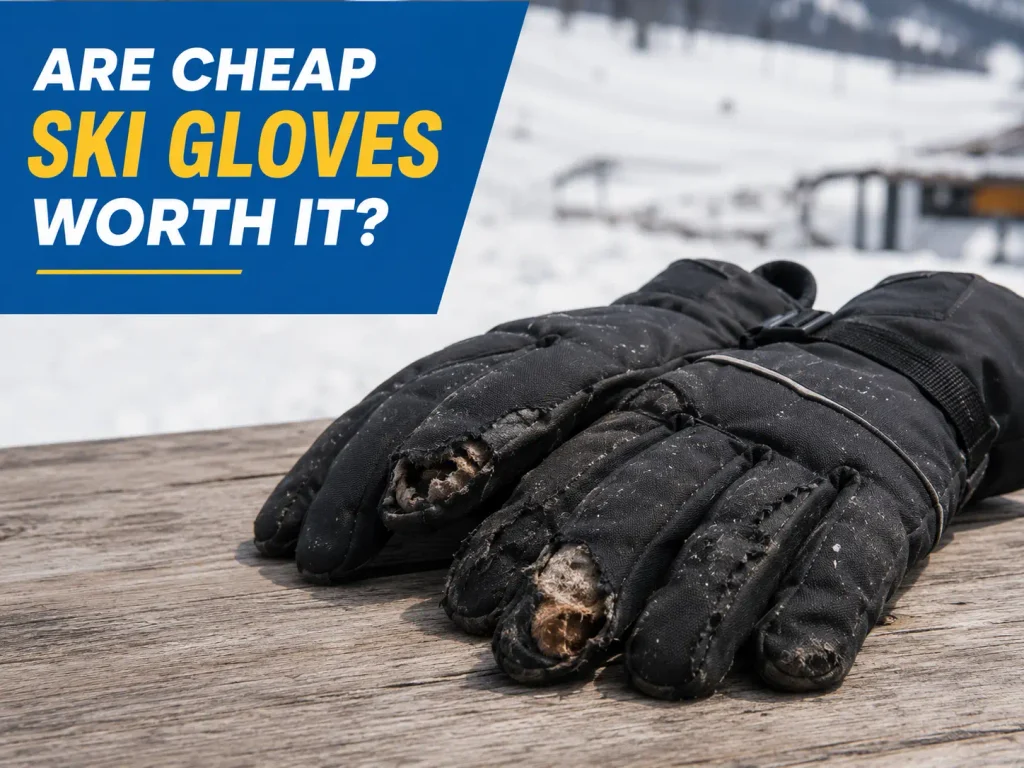
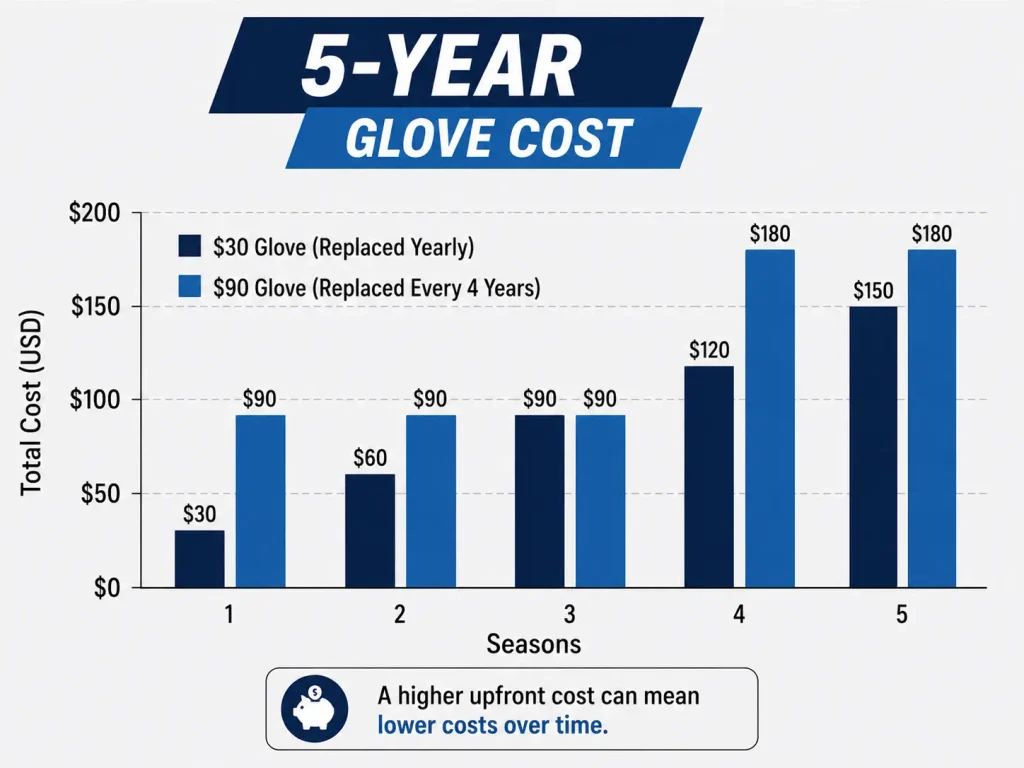
Quick answer: A budget glove is sometimes the smarter buy. If you ski a handful of days a year in mild, dry weather, a cheap pair is fine. If you ski 8 or more days a season, the math usually goes the other way. A $30 glove you replace every year costs more over five years than a $90 glove that lasts four or five seasons.
Not sure which group you’re in? The ski glove finder sorts that out based on how often you ski, not just your budget.
Most people treat this as a spending question. It’s really a frequency question. A cheap glove isn’t a bad deal because it’s cheap. It’s a bad deal only if you end up buying three of them for the price of one good pair.
Once you know how long each price tier actually lasts, this stops being about taste or brand names. It turns into simple math anyone can do.
- What "Cheap" Actually Cuts
- It Depends on What Replaced the Expensive Parts
- Construction Reference
- The Choices That Actually Matter
- Where the Cost-Cutting Actually Happens
- When Cheap Gloves Are the Right Call
- The Cost-Per-Season Math
- Why the Price Tag Isn't the Number That Matters
- Common Mistakes When Buying a Cheap Glove
- Two Gloves, Same Price, Different Outcomes
- Warning Signs a Cheap Glove Won't Make It Through the Season
- Matching Your Usage to the Right Price Tier
- Self-Check Before You Buy
- When Standard Advice Doesn't Apply
- Decision Checklist
- Frequently Asked Questions
What “Cheap” Actually Cuts
A $25–$40 glove isn’t a worse version of a $90 glove. It’s a different set of choices, made to hit a lower price. Six things usually get cut: named insulation, real leather, double-row stitching, good adhesive, a real waterproof membrane, and a cinch-style cuff.
None of these cuts are sneaky or dishonest. They’re just trade-offs a brand makes to sell a glove for $30 instead of $90. Knowing which ones got cut — and which didn’t — is most of what tells you if a cheap glove was actually worth the money.
It Depends on What Replaced the Expensive Parts
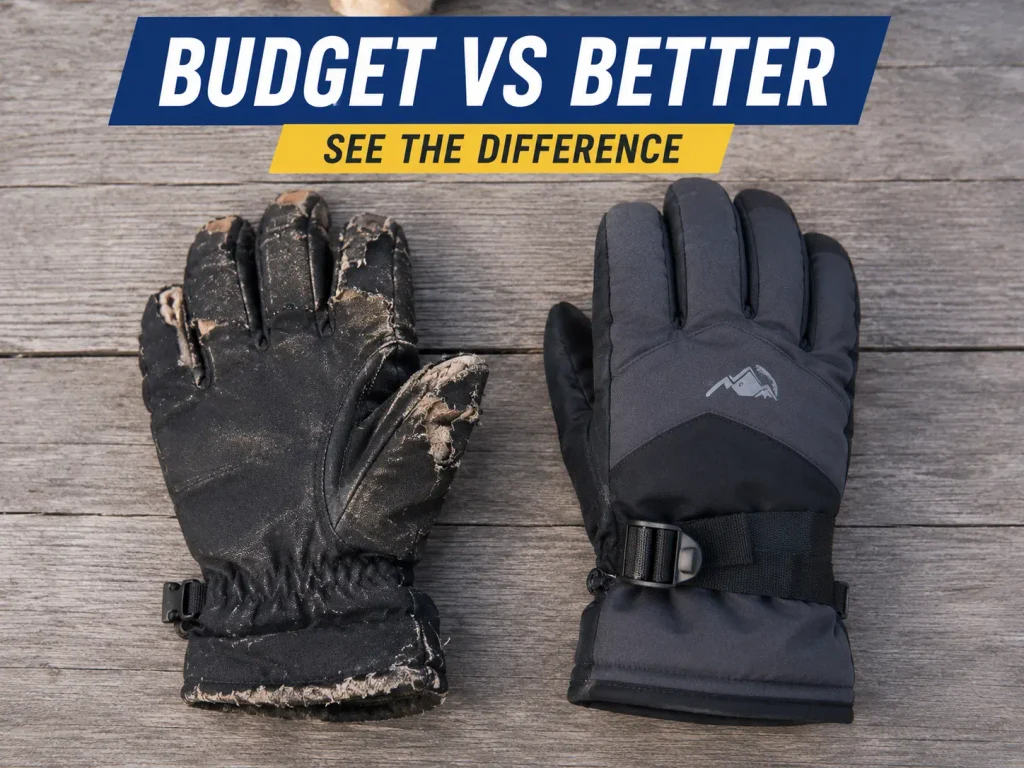
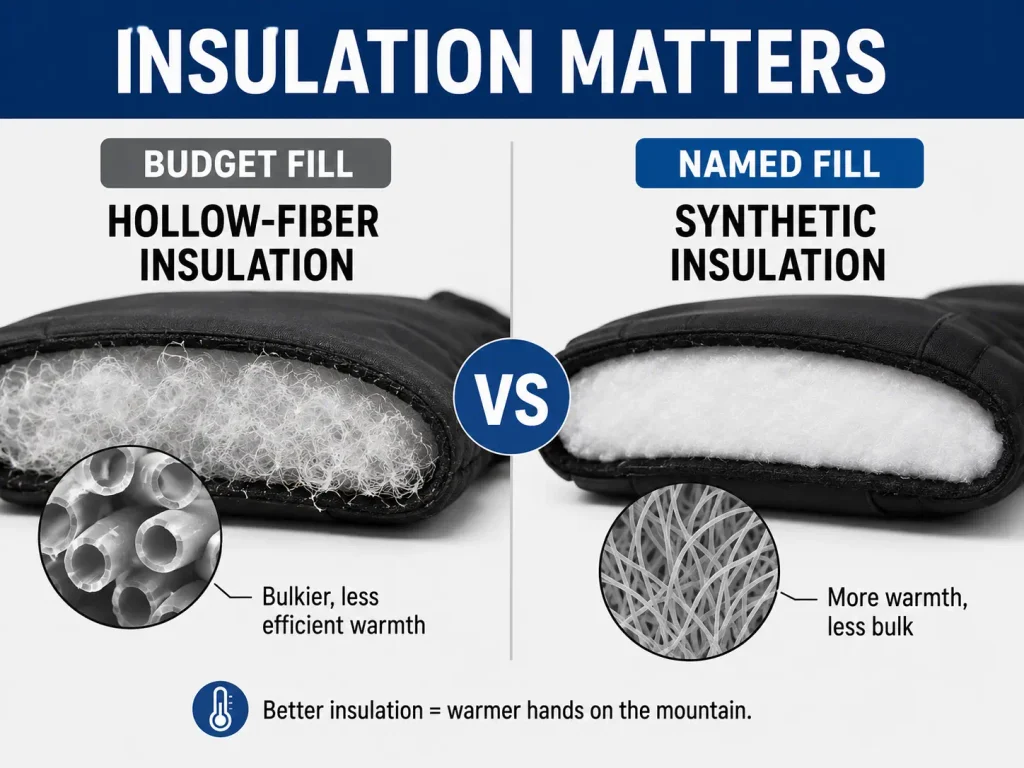
Plain hollow-fiber insulation replaces named fill like PrimaLoft or Thinsulate. It works fine on day one. The fiber traps air just like the pricier version does. The problem shows up later: hollow fibers have thin walls, and they stop bouncing back after enough grip pressure and pole contact over a season.
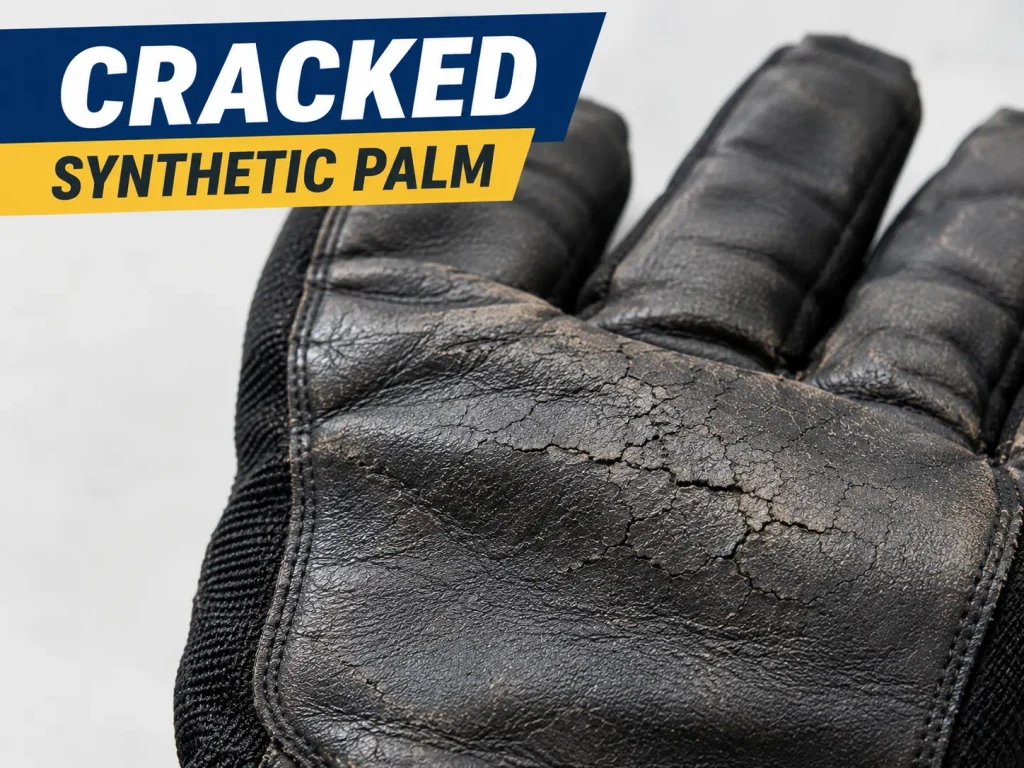
PU (polyurethane) leather replaces real leather at the palm. It looks and feels close to leather in the store. In cold weather it stiffens up and cracks, and the top layer eventually peels off — the flaking most skiers notice on a cheap glove after a while.
Single-row stitching replaces the double-row stitching used at stress points on better gloves. One row of thread holds up for a bit. It doesn’t hold forever, and it fails first exactly where you’d expect: the thumb base and the edge of the palm.
Construction Reference
| Component | Budget Version | Mid-Range/Premium Version | What Changes |
| Insulation | Generic hollow-fiber polyester | Named fill (PrimaLoft, Thinsulate) | Whether it bounces back after being squeezed |
| Palm material | PU (polyurethane) leather | Full-grain or top-grain leather | Cracking and peeling vs. staying flexible |
| Seams at stress points | Single-row stitching | Double-row stitching | How soon the seam opens under grip stress |
| Internal bonding | Standard adhesive | Polyurethane/hot-melt adhesive | Holding up through repeated freeze-thaw |
| Waterproofing | DWR coating only, no membrane | Named membrane (Gore-Tex, eVent, proprietary) | How long the glove stays water-resistant |
| Wrist cuff | Knit elastic | Cinch cord or drawcord | Whether it still seals after washing and in cold |
The Choices That Actually Matter
Match the glove to how often you actually ski, not your ideal budget. Someone skiing 4 days a year and someone skiing 40 days a year shouldn’t buy the same $30 glove for the same reasons.
Look for at least one named part, even on a budget glove. A $35 glove with a named insulation fill, even with no membrane, usually outlasts a $35 glove with nothing named at all. Insulation is often the first thing to fail, so it’s the most important cut to avoid if you can.
Don’t assume a higher price always means it lasts longer. Plenty of overpriced gloves cut the same corners as cheap ones and just charge more for the name. If you’re shopping at the lower end, gloves under $50 are a faster way to spot which ones kept a named part than reading every spec sheet yourself.
Where the Cost-Cutting Actually Happens
Insulation is the biggest cut, because you can’t see it fail until it already has. PrimaLoft builds its fill specifically to resist compression and bounce back, which is exactly what plain hollow-fiber batting was never designed to do. You won’t notice the difference in a store. You’ll notice it after ten or fifteen ski days of grip pressure.
Palm material is the cut you can actually see. Real leather, even a lower grade, has a fiber structure that gets more flexible with cold and wear, not less. As the leather guide explains, that fiber structure is what gives any leather its strength — and it’s exactly what PU leather doesn’t have. PU is a coated fabric, not leather, which is why it acts like plastic once it’s cold.
Stitching is the cut almost nobody checks. A stitching study backs up what budget-glove owners eventually learn the hard way: more stitches at a given point means a stronger seam. That’s why a second row of stitching at the thumb base lasts noticeably longer than a single row — not just a little longer.
When Cheap Gloves Are the Right Call
Occasional skiers — 3 or fewer days a season — rarely use a glove enough to hit the point where these cuts matter. A fresh budget glove each season, or every other season, makes sense here.
Kids’ gloves are an easy case for budget. Kids outgrow gloves faster than any construction flaw catches up with them, so paying extra for insulation and leather they’ll outgrow next season doesn’t make sense.
Backup gloves kept in a jacket pocket for a sudden weather change don’t need to survive daily use. They need to survive the occasional emergency, and a budget glove handles that fine.
The Cost-Per-Season Math
Here’s the actual math. A $30 glove you replace every season costs $30 a year, every year, forever.
A $90 glove with named insulation, real leather, and double-row stitching that lasts 4 to 5 seasons costs $18 to $22.50 a year over that same stretch — and it keeps you warmer and drier the whole time, not just in season one.
Once you ski more than a handful of days a year, this isn’t close. The pricier glove only loses if it breaks sooner than expected, or if you ski so rarely it would outlast your interest in the sport.
Why the Price Tag Isn’t the Number That Matters
The price tag tells you what you pay today. It says nothing about what you’ll pay over the next several years, which is the number that actually decides if a glove was a good deal. Two gloves can have very different price tags and cost almost the same in the long run — or the opposite.
This is the same logic behind any tool you use a lot versus rarely. A cheap tool is a bad buy if you use it daily. It’s a fine buy if you use it twice a year. The tool doesn’t change — how often you use it does.
Ski gloves work the same way. A $30 glove isn’t a bad deal or a good deal on its own. It depends entirely on how often you’re back at the store buying another one.
Common Mistakes When Buying a Cheap Glove
Assuming every budget glove cuts the same six things. Some keep the insulation but skip the membrane. Others do the opposite. A quick look at the listing tells you which cuts a specific glove made.
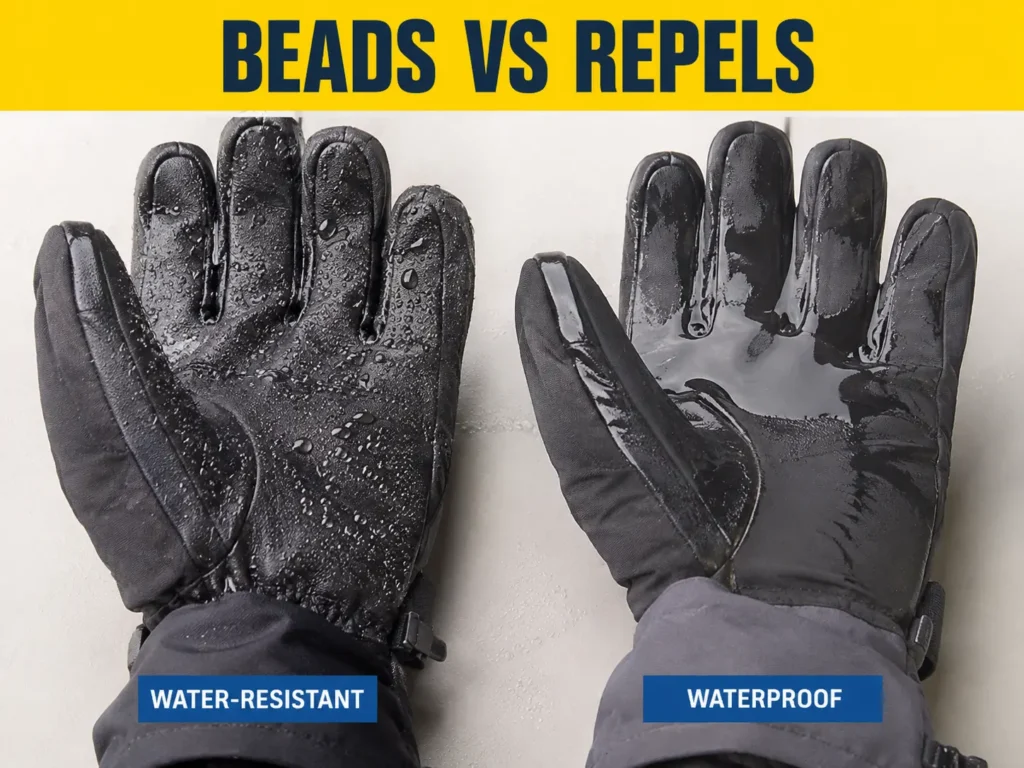
Trusting the “waterproof” label by itself. Almost every budget glove uses this word. Very few name an actual membrane behind it, which means it’s just a coating that wears off within a couple weeks of real use.
Ignoring the stitching entirely. Most listings don’t mention it, but flexing the thumb outward a few times in the store and watching the seam takes ten seconds and tells you more than the spec sheet will.
Treating “cheap” and “disposable” as the same thing. A budget glove with even one named part can genuinely last two full seasons. The mistake isn’t buying cheap. It’s buying without checking anything.
Two Gloves, Same Price, Different Outcomes
Two budget gloves can both cost $32 and still turn out completely different a season later. One kept a named insulation and skipped the membrane. The other skipped everything except a nice zipper pull. Same price, same shelf, same marketing — different glove underneath.
This is why checking specific parts matters more than checking price alone. Price only tells you what a brand decided to charge. It doesn’t tell you which of the six components actually survived that decision.
The habit worth building is simple: before buying, scan the listing for one thing — a named insulation, a named leather grade, or a named membrane. Finding none of these isn’t automatically a dealbreaker, but it tells you exactly what you’re accepting.
Warning Signs a Cheap Glove Won’t Make It Through the Season
| Warning Sign | What It Means |
| Insulation listed only as “polyester,” no brand name | Likely hollow-fiber batting that flattens permanently with use |
| Palm listed only as “leather,” no grade given | Often PU (synthetic) leather, not real hide |
| No mention of double stitching or reinforced seams | Single-row stitching — the first place a budget glove fails |
| “Waterproof” claim with no membrane named | Coating only — water resistance fades fast |
| Knit-only wrist cuff, no cinch or drawcord | Elastic loosens after a few washes, letting snow in at the wrist |
Matching Your Usage to the Right Price Tier
| Your Situation | Reasonable Price Tier | Why |
| 3 or fewer ski days a season | Budget (25–40) | You won’t use it enough to hit the failure point |
| 8+ ski days a season | Mid-range or premium ($70+) | Cost-per-season favors the pricier glove |
| Buying for a growing child | Budget | They’ll outgrow it before it wears out |
| Wet, coastal, or humid climate | Mid-range or premium | Coating-only waterproofing fails fastest here |
| Backup pair for emergencies | Budget | Light, rare use won’t stress the weak points |
| Cold-sensitive hands | Mid-range or premium | Warmth loss over time is a real problem here, not just discomfort |
Self-Check Before You Buy
Scan the listing for one named part. A named insulation, leather grade, or membrane — any one of these means the glove isn’t cutting every corner at once.
Do the thumb-flex test in the store. Flex the thumb outward, hard, about ten times with the glove on. Any thread pulling or whitening at the seam means it’s already under stress before you’ve even paid for it.
Work out your real cost-per-season, not just the price tag. Divide the price by how many seasons you expect it to last based on how often you ski. Compare that number, not the sticker price, to the next tier up.
When Standard Advice Doesn’t Apply
Skiers who go once a year can skip most of this and just buy the cheapest glove that fits. At that frequency, the wear these cuts cause never really builds up.
Anyone whose glove failed unusually fast should check which specific part failed before writing off budget gloves entirely. A cracked palm points to PU leather, not the insulation or stitching — so next time, just check that one thing instead of upgrading everything.
Buyers on a strict one-time budget are better off with the best-built cheap glove they can find — one with at least one named part — instead of skipping a purchase to save for a pricier pair later.
Decision Checklist
| Your Situation | Action | Priority |
| Skiing 3 or fewer days a season | A budget glove is reasonable | Low risk either way |
| Skiing 8+ days a season | Run the cost-per-season math first | Mid-range usually wins |
| Listing names zero parts (insulation, leather, membrane) | Treat it as a maximum-cut glove | Check before buying |
| Wet or coastal climate | Look for a named membrane over price | Membrane comes first |
| Buying for a child | Budget makes sense | Fit matters more than construction |
| Cold-sensitive hands | Skip budget-tier insulation | Steady warmth matters most |
Price alone never tells you if a budget glove is worth buying. How often you ski. A $30 glove and a $90 glove aren’t really $60 apart once you divide each by how many seasons it survives — sometimes they land close together, sometimes they don’t, and checking what got cut is the only way to know which. For the full breakdown on knowing when any glove, cheap or expensive, has actually reached the end of its life, the replacement guide covers the specific tests in more depth than fits here.
Frequently Asked Questions
Is a $30 ski glove ever a genuinely good deal?
Yes — for occasional skiers, kids, and backup gloves, where a glove never gets used enough for these cuts to matter. If you ski regularly, that same $30 glove usually ends up costing more over time than a pricier one that lasts several seasons.
What’s the single most important thing to check on a cheap glove?
Whether the insulation names an actual brand or fill type. It’s the part most likely to fail first, and it’s also the hardest one to spot just by looking at the glove — which is exactly why it’s worth checking.
Do all budget gloves cut the same corners?
No. Some keep a named insulation but skip the membrane. Others do the opposite. Reading the specific listing tells you which cuts a particular glove made, instead of assuming every cheap glove is equally bad.
Is it better to buy one expensive glove or replace a cheap one every year?
It depends on how many days you ski each season. Past about 8 days a year, the pricier glove usually wins on cost. Below that, either choice is reasonable.
Can a budget glove with real leather still be worth it?
Yes. Leather grade matters more than price tier by itself. A budget glove with real leather at the palm — even a lower grade — will usually outlast one with PU leather, since the palm takes the most wear on any glove.