
QUICK ANSWER: Ski gloves wear out faster than most gear because they take mechanical stress from three directions at once — constant pole-grip friction at the palm, repeated flexing at every seam every time you close your hand, and direct UV exposure that’s more intense at altitude than at sea level. None of these three stresses alone would wear a glove out quickly. Combined, and repeated across dozens of ski days, they compound faster than most people expect.
This is exactly why every skier asks, “why do their ski gloves wear out so fast?” — a glove that looked fine in October can be visibly thinning by February, and it’s rarely one dramatic event causing it.
- Three Different Stresses, Working at Once
- Why the Palm Goes First
- Why Seams Fail Before the Fabric Around Them Does
- The UV Factor Most Skiers Never Consider
- Normal Wear vs. an Actual Defect
- How Long Different Skiers Should Actually Expect a Glove to Last
- Common Mistakes That Accelerate All Three Mechanisms
- Decision Checklist
- Frequently Asked Questions
- Final Thoughts
Three Different Stresses, Working at Once
Most gear wears out from one dominant type of stress. Ski gloves are unusual because they take real damage from three separate mechanisms simultaneously, and each one attacks a different part of the glove.
The palm takes friction. The seams take repeated flexing. The shell takes UV exposure. A glove can look completely fine in one of these categories while quietly failing in another, which is part of why “wearing out” often feels sudden even though the underlying damage was gradual.
Why the Palm Goes First
Every time you grip a ski pole, adjust a binding, or catch yourself after a stumble, your palm is in direct, weighted contact with a hard surface.
Across a single ski day, that’s thousands of individual contact points. Across a season, it’s a genuinely enormous number of repetitions concentrated on a small area of fabric or leather.
Leather resists this specific stress better than most synthetic fabrics, which is exactly why so many mid-range and premium gloves put leather only on the palm rather than the whole shell — it’s not about looks, it’s about putting the more abrasion-resistant material where the abrasion actually concentrates.
Synthetic palms wear thin here first, often visibly, well before the rest of the glove shows comparable wear.

Why Seams Fail Before the Fabric Around Them Does
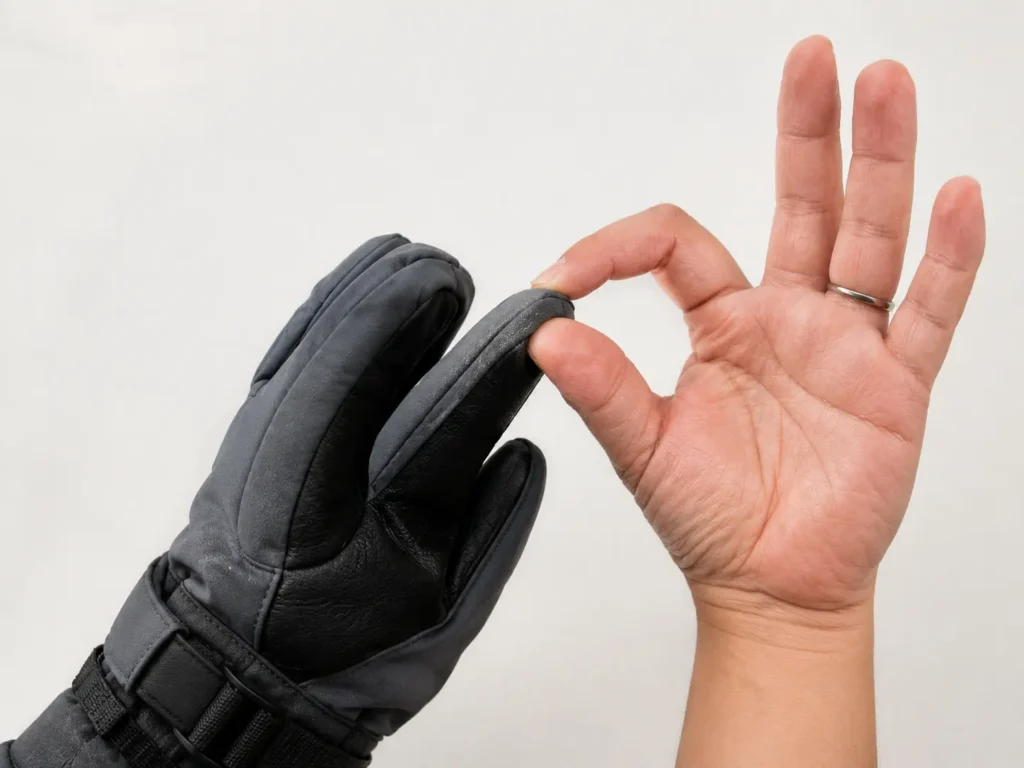
Stitching takes a different kind of stress than open fabric — every time you close your hand, seams flex at exactly the same points, over and over.
Thread has a fatigue limit the same way metal does, just at a different scale. Repeated flexing at the thumb crotch and finger joints — the tightest bend points on any glove — eventually causes stitching to fail there before the surrounding fabric shows comparable wear.
This is why seam failure often looks disproportionate: a glove can seem otherwise intact while a single seam at the thumb has fully separated, simply because that specific point absorbed far more flex cycles than anywhere else on the glove.
The UV Factor Most Skiers Never Consider
Sun exposure at altitude is measurably more intense than at sea level, and synthetic glove shells are not immune to it.
Nylon is particularly vulnerable — research on synthetic textile UV exposure has found nylon can lose up to 30% of its tensile strength after around 500 hours of UV exposure, a level of cumulative sun exposure a regular skier can rack up over a few seasons of full days on bright, high-altitude slopes.
This shows up as gradual stiffening, fading, or a slightly chalky surface texture — distinct from moisture damage or abrasion, and easy to misattribute to “old age” when it’s actually a specific, measurable degradation process.
Polyester generally resists UV better than nylon, which is part of why shell material choice affects lifespan in ways that have nothing to do with waterproofing or insulation.
Normal Wear vs. an Actual Defect
Not every sign of aging means a glove has failed — some wear is simply cosmetic, and some is a real functional problem.
| Sign | Normal Wear | Likely Defect |
| Palm surface smoothing or shining | Yes — cosmetic | — |
| Slight color fading on shell | Yes — cosmetic, often UV-related | — |
| Single seam separating at thumb or finger | — | Yes — repairable if caught early |
| Insulation visible through thinned fabric | — | Yes — usually replacement territory |
| Reduced water beading on the shell | — | DWR wearing down, not a defect but worth addressing |
| Multiple seams failing at once | — | Yes — structural, glove nearing end of life |
The distinction matters because cosmetic wear doesn’t need action, while structural signs — especially multiple failure points appearing together — are worth acting on before they compound.

How Long Different Skiers Should Actually Expect a Glove to Last
Lifespan expectations vary enormously by usage, and treating every glove owner as the same skier leads to unrealistic expectations either way.
Occasional skiers — a handful of days a season — put comparatively little cumulative stress on any of the three mechanisms above, and a reasonably built glove can last many seasons before wear becomes a real issue.
Regular skiers — roughly 10 to 30 days a season — accumulate meaningfully more palm friction, seam flex cycles, and UV exposure each year, and should expect visible wear within two to four seasons depending on glove quality and material.
Frequent or professional-context skiers — 30+ days, instructors, patrollers — put enough cumulative stress on all three mechanisms that even well-built gloves often need real attention within a single season, particularly at the palm and thumb seam.
Common Mistakes That Accelerate All Three Mechanisms
Buying based on insulation and waterproofing alone. Shell durability at the palm and seam strength rarely make it into a buying decision, even though they’re what actually determines how long a glove survives regular use.
Using bare gloved hands for tasks they weren’t built for. Scraping ice, hauling gear, or repeated hard-surface contact adds abrasion beyond what normal pole-gripping already puts on the palm.
Ignoring early seam separation. A small gap at the thumb crotch caught early is a five-minute fix. Left alone, the same flex stress that started the separation keeps working on it every time you close your hand.
Assuming all wear is the glove’s fault rather than usage intensity. A frequent skier’s glove and an occasional skier’s glove face fundamentally different cumulative stress — expecting identical lifespans from both leads to disappointment that isn’t really about glove quality.
Decision Checklist
- Palm looks smooth or shiny but seams and fabric are intact: cosmetic wear, no action needed yet
- A single seam has separated at the thumb or finger joint: repairable now, worth fixing before it compounds
- Multiple seams are failing at once: structural end-of-life signal, budget for replacement
- Shell has faded or feels slightly stiff and chalky: likely UV degradation — normal for nylon shells with heavy sun exposure over time
- You ski 10+ days a season and bought based on insulation alone: revisit palm material and seam construction next purchase, not just warmth rating
Frequently Asked Questions
Is it normal for gloves to wear out within one or two seasons?
For frequent skiers — 30+ days a season — yes, particularly at the palm and thumb seam, which take the most concentrated stress. For occasional skiers, that timeline usually points to a lower-quality glove or a specific usage habit (like ice-scraping with bare hands) accelerating wear beyond what’s typical.
Does UV damage actually matter for ski gloves, or is that overstated?
It’s a real, measurable process — nylon specifically loses meaningful tensile strength after sustained UV exposure, and altitude increases that exposure. It’s slower and less obvious than palm abrasion or seam failure, which is why it often gets misattributed to general aging rather than recognized as its own mechanism.
Why does one seam fail while the rest of the glove looks fine?
Stitching at the thumb crotch and finger joints absorbs far more repeated flexing than seams elsewhere on the glove, since those are the tightest bend points every time you close your hand. Concentrated stress at a specific point, not overall glove age, is usually the actual cause.
Can better care meaningfully extend how long a glove lasts?
Yes, particularly for the palm-friction and seam-stress mechanisms — reducing unnecessary abrasion and catching seam separation early both make a real difference. For the specific habits that extend lifespan day to day, ski glove care tips covers that in depth rather than repeating it here.
How do I know when a glove has actually reached the end of its life versus just needing a repair?
A single seam or a small palm wear spot is usually repairable. Multiple simultaneous seam failures, insulation visible through the shell, or membrane failure that no longer beads water are the signals that point toward replacement rather than repair — how often should you replace ski gloves breaks down that specific decision in more detail.
Final Thoughts
Ski gloves wear out faster than a lot of gear specifically because they’re absorbing three different kinds of stress at once — friction at the palm, flex fatigue at the seams, and cumulative UV exposure on the shell — and none of those three show up the same way or on the same timeline. Knowing which one you’re actually looking at changes whether something needs fixing now, needs monitoring, or is just cosmetic and fine to ignore.
If you’re trying to figure out whether it’s time to replace what you have entirely, or you want a glove built to hold up better against these specific stresses from the start, the Ski Glove Finder matches you to options based on how many days a season you actually ski.