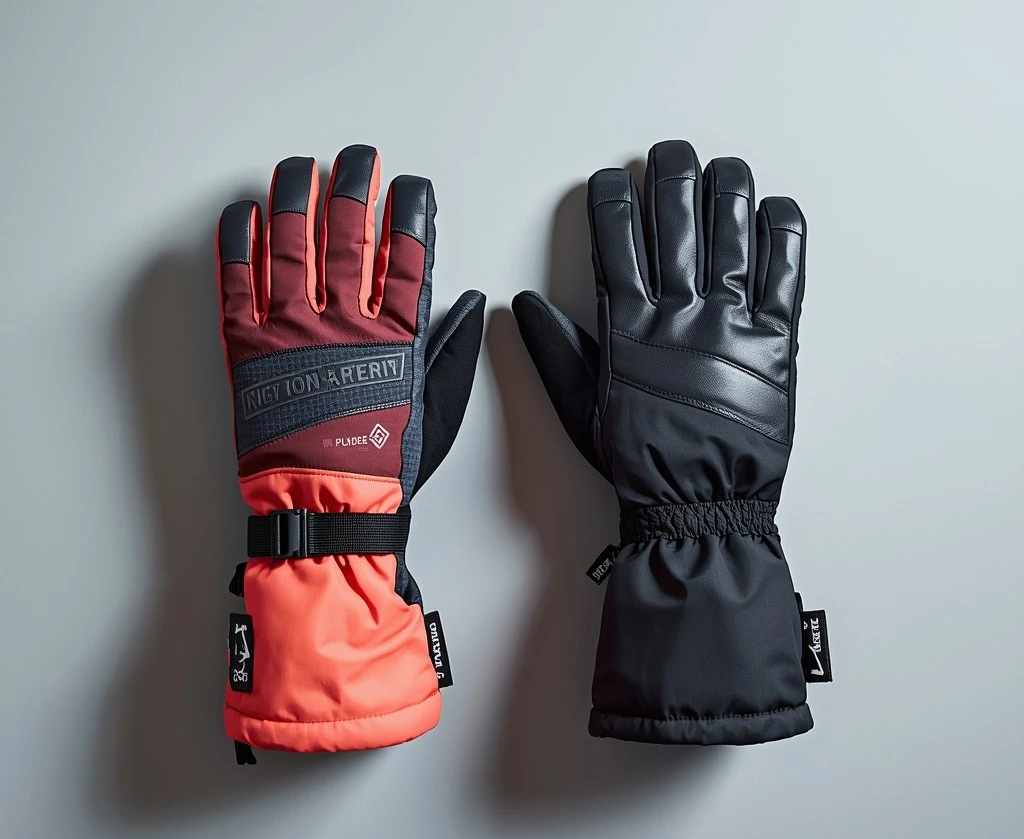
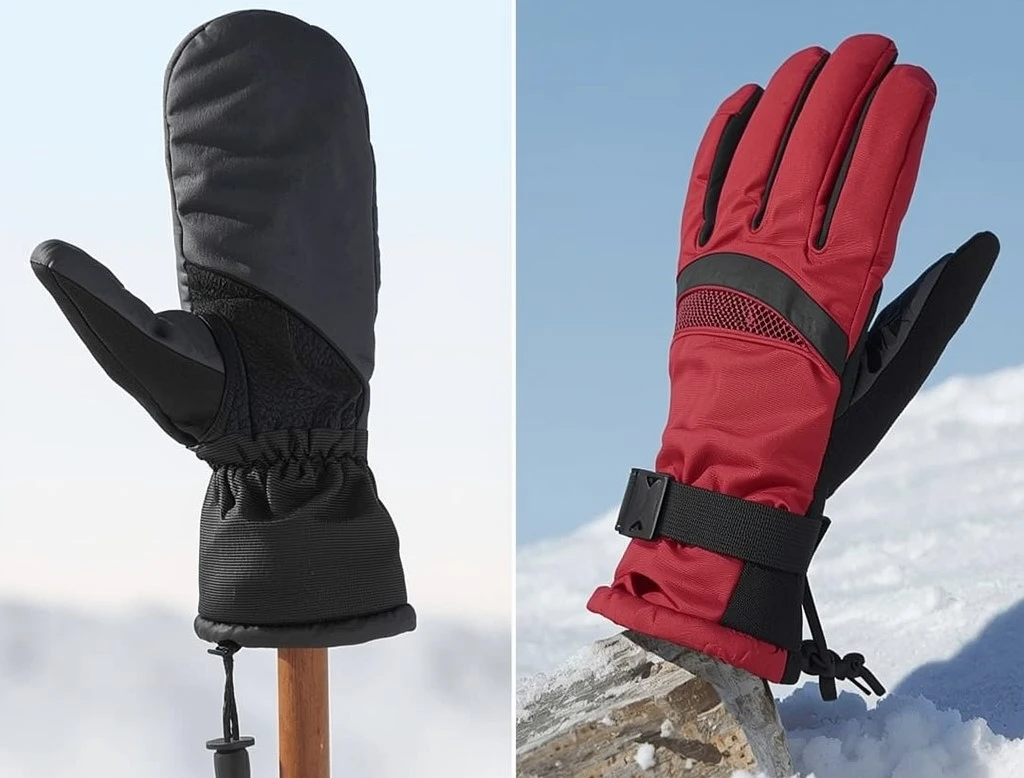
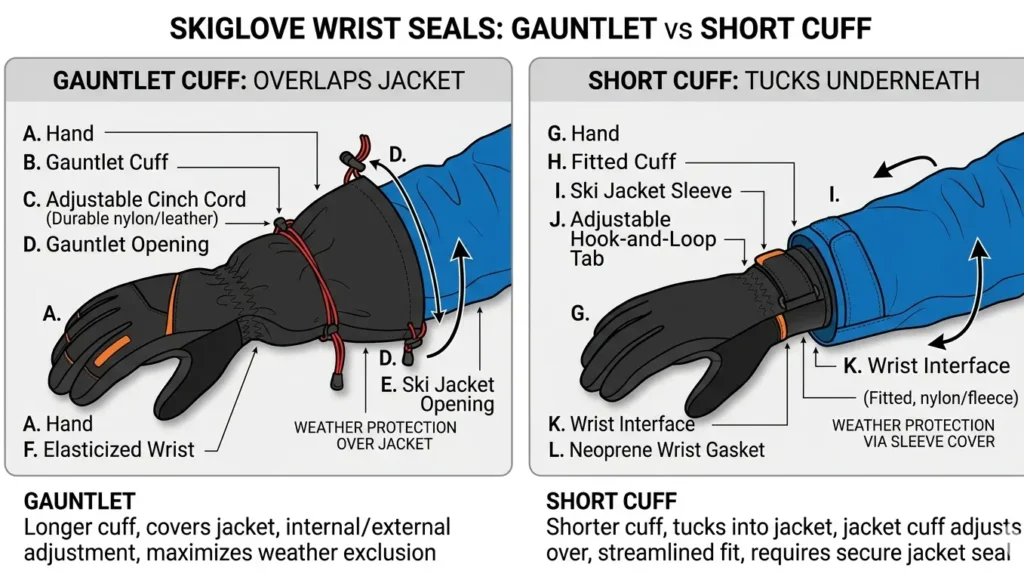
The main difference between gauntlet and short cuff ski gloves is how they seal the wrist. Gauntlet gloves extend over the jacket sleeve to block snow and wind, while short cuff gloves sit under the sleeve and prioritize wrist mobility and quick removal. For powder skiing and frequent falls, gauntlets provide better protection. For groomed terrain and frequent glove removal, short cuffs are usually more practical.
The first time I wore a short cuff glove in heavy powder, I had warm hands for about forty minutes. Then I fell — not dramatically, just a routine edge catch — and the sleeve gap did exactly what it would always do in that situation: let snow in. By the second run the insulation was working against moisture it had absorbed rather than cold air, and my hands were noticeably colder than the temperature warranted. I switched to a gauntlet for the afternoon and did not have the same problem once.
The choice between gauntlet vs short cuff ski gloves matters specifically because the two types fail in different conditions, and most skiers do not know which conditions they are in until they experience the failure. This guide is about making that choice before you’re on the mountain rather than after, by understanding exactly what each type does well, where each one fails, and how to match the choice to your actual skiing — the terrain, the conditions, and how often you fall.
This is not a warmth comparison. Both cuff types can be built with identical insulation. The choice is about snow entry, wrist mobility, and practical usability across a ski day — and those three things produce genuinely different answers depending on who is asking.
How I Tested Both Types — the Setup and What I Was Looking For
The most informative single test I ran was wearing a gauntlet on one hand and a short cuff on the other for a full powder day — both gloves with equivalent insulation, both fitted correctly, both with intact DWR (Durable Water Repellent) coating. I wanted to isolate cuff type as the only variable. The short cuff was paired with a jacket sleeve that fit reasonably well at the wrist — not loose, not a technical sealing sleeve, just a standard ski jacket fit.
By midday the difference was clear and measurable. The short-cuff hand had been exposed to snow entry on three falls. Two of those were minor enough that I shook the snow out quickly and the hand stayed reasonably dry. The third was a longer fall in deep snow and the sleeve filled enough to saturate the wrist zone of the glove interior. The gauntlet hand stayed completely dry across the same falls. The cuff drawcord had been tightened at the start of the day and held through all three falls without any adjustment.
I also ran a dexterity test across both hands — pole planting rhythm, glove removal speed, and grip feel around the pole handle. The gauntlet cuff added perceptible bulk above the wrist that affected how naturally the wrist flexed on pole plants, particularly on the downhill side of turns where the wrist cocks forward. It was not dramatic, but it was there. With a flexible gauntlet cuff the difference was smaller than with a stiffer one, which points to cuff flexibility as a significant variable within the gauntlet category — not all gauntlets perform the same way.
I repeated versions of this comparison across two full seasons, varying conditions from groomed-only resort days to multi-day backcountry trips. The pattern held consistently: short cuff is adequate when falls are infrequent and jacket sleeve fit is good; gauntlet is clearly better the moment powder or off-piste terrain enters the picture.
What Gauntlet Gloves Actually Do Well
The gauntlet’s core function is structural: it positions the cuff over the jacket sleeve and seals the gap between glove and sleeve that is the primary snow entry point for any ski glove. This is not a marginal improvement — it is the difference between the gap existing and not existing. In powder conditions, in tree skiing, in storm days with wind-driven snow, that gap is the mechanism through which most hand-cold problems happen, and the gauntlet simply removes it.
The wrist seal also protects in wind conditions that many skiers underestimate. Most modern ski gloves rely on surface treatments, such as durable water-repellent coatings, to prevent moisture from saturating the outer fabric before it reaches the insulation. On a groomed run in cold, calm conditions, a short cuff gap is relatively benign. On an exposed ridge or in strong wind, that same gap channels cold air directly onto the wrist — one of the zones with the highest density of blood vessels near the skin surface.
Windproof materials used in technical ski gear exist specifically to block wind chill while remaining breathable during activity. A gauntlet cuff that covers that zone maintains hand warmth at ambient temperatures that would make a short-cuff hand meaningfully colder even without any snow entry at all.
For skiers who fall frequently — beginners, skiers pushing into new terrain, anyone in unfamiliar conditions — the gauntlet’s protection is worth the trade-offs on every session. The short-cuff skier who falls twice per run is dealing with a consistent snow entry problem. The gauntlet skier in the same conditions is dealing with none. That asymmetry becomes very significant over a full ski day.
Where gauntlets genuinely struggle:
The over-sleeve fit that makes gauntlets effective also makes them slower to remove and replace. For a skier who takes gloves off once at the summit and once at the lodge, that is a minor inconvenience. For a backcountry skier removing gloves to adjust skins every transition — four to eight times per day in cold conditions — the gauntlet’s repositioning requirement adds real time and frustration. The drawcord has to be released, the glove removed, the sleeve resettled, and the cuff repositioned over the sleeve before retightening. Short cuffs slide on and off without any of that.
The flexibility variable within gauntlets:
Gauntlet cuffs vary significantly in how much they restrict wrist movement. A stiff leather gauntlet cuff from a traditional ski glove affects wrist flexion noticeably. A modern soft-shell gauntlet with a pre-curved cuff and stretch panels does not. This is one of the most under-discussed aspects of the gauntlet vs short cuff comparison — the performance difference between gauntlet types is sometimes larger than the difference between a short cuff and a flexible gauntlet. A skier who tried a stiff gauntlet and hated it may find a flexible one entirely acceptable.
What Short Cuff Gloves Actually Do Well
Short cuff gloves sit under the jacket sleeve, which means the sleeve does the work of covering the wrist and the glove does not need to overlap or position over anything. That simpler fit produces two genuine advantages: wrist mobility and usability.
Wrist mobility matters more in ski gloves than most skiers realise before they notice the difference. The pole plant is a wrist movement, not just an arm movement — the wrist cocks forward on the downhill side and the hand grips and releases the pole strap in a rhythm that repeats hundreds of times per ski day. Any restriction on that wrist movement affects skiing efficiency. Short cuff gloves do not add any material above the wrist, so there is nothing to restrict that movement. The hand moves exactly as it would without a glove.
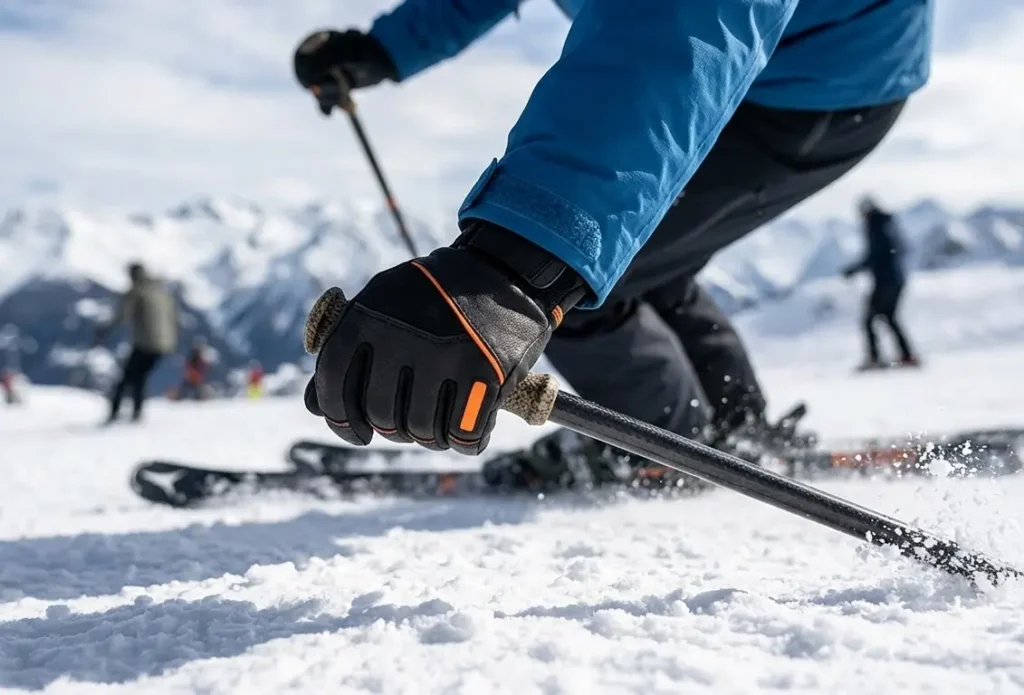
The usability advantage is related: short cuffs come on and off quickly, work with any jacket sleeve, and do not require positioning or adjustment. For instructors, for skiers who transition frequently between indoor and outdoor, for backcountry skiers managing layers across multiple terrain types — the short cuff’s simplicity has real practical value. Over a ten-hour ski day with multiple glove removals, the time difference adds up.
Short cuffs also work better in spring and warm conditions. In temperatures approaching freezing, hand sweat becomes a warmth issue before cold does. The short cuff does not seal the wrist, which means it ventilates at that zone — allowing some moisture escape that a gauntlet’s sealed cuff prevents. This is not a designed feature but a functional consequence of the gap that causes problems in cold conditions actually assisting in warm ones.
Where short cuffs genuinely struggle:
The jacket sleeve becomes a critical variable. A technical ski jacket with a neoprene or tight-cuffed sleeve creates a reasonable seal between sleeve and glove. A resort jacket with a wide, loosely finished sleeve creates a gap that is unmanageable regardless of how well the glove fits. Short cuff skiers who switch jackets can find that a glove that worked fine with one jacket is inadequate with another — because the glove was never providing the protection, the jacket sleeve was.
When a Gauntlet Is the Wrong Choice
Gauntlets are the wrong choice when removal frequency is high and conditions do not justify the protection they provide. A backcountry skier doing five skin transitions per day removes gloves at every stop to manage clothing layers and equipment. The gauntlet’s over-sleeve positioning has to be redone at each replacement — the sleeve has to be tucked back under the cuff and the drawcord retightened in cold temperatures with fingers that may already be cooling. Some skiers manage this without complaint; others find it genuinely frustrating enough to switch mid-trip.
They are also the wrong choice when wrist mobility is central to the skiing style. Park skiers, racers, and skiers working on precise technical movements feel the gauntlet cuff as an interference above the wrist that short cuffs do not create. The pole plant timing and grip feel that experienced skiers develop is partly tactile — they feel the pole through the glove and through the wrist. A stiff gauntlet cuff muffles that feedback.
The jacket compatibility issue is worth taking seriously before buying. A gauntlet that cannot fit cleanly over a jacket sleeve — because the sleeve is too wide or too thick — creates bunching under the cuff that is in some ways worse than the gap it was meant to eliminate. It creates pressure points, restricts movement more than either option alone, and still does not seal cleanly. If you own a jacket with wide technical sleeves and you are considering a gauntlet, put both on before buying and confirm the cuff seats properly.
When a Short Cuff Is the Wrong Choice
Short cuffs are the wrong choice when fall frequency is high and snow conditions are deep. These two factors together are the specific combination that consistently produces soaked-glove problems. A skier who falls frequently on groomed packed snow is not exposing much sleeve gap to snow — the falls are shallow, the snow is dense and does not flow, and the gap does not fill. The same skier in waist-deep powder falls in a way that buries hands and arms, snow moves into every available gap under pressure, and the sleeve gap is exposed and filled on almost every fall.
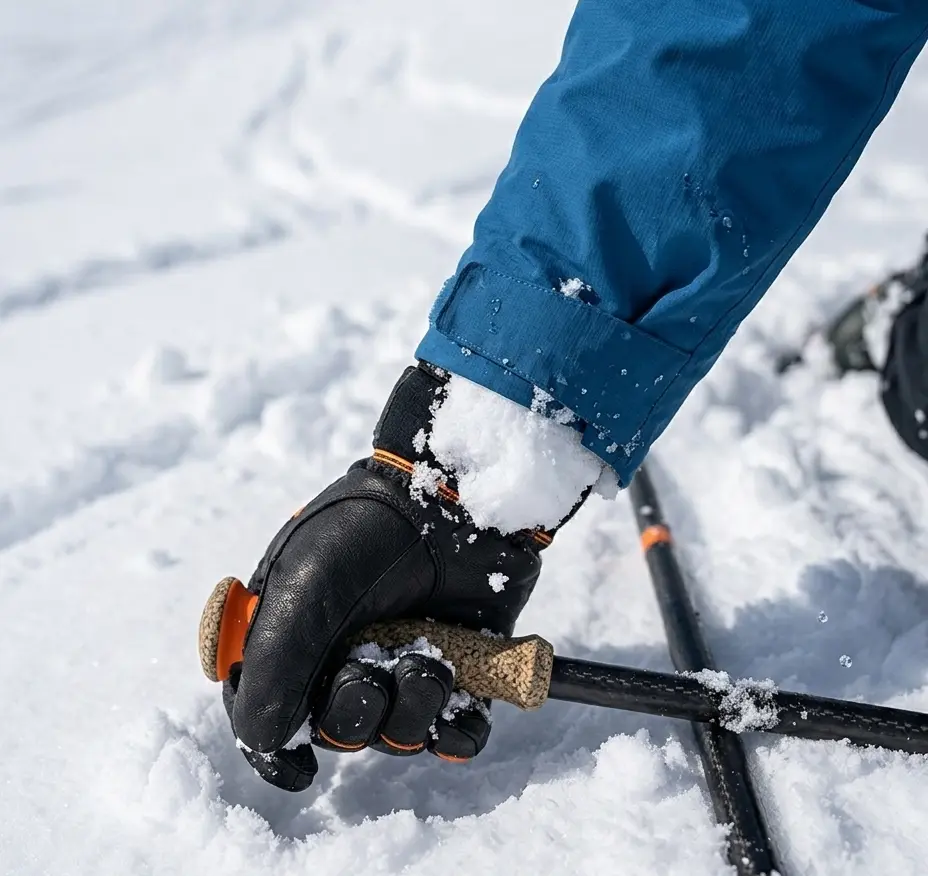
They are also wrong when jacket sleeve fit is poor. This is the most under-appreciated factor in the short-cuff recommendation. Skiers who ask whether a short cuff will work for them are often assuming their jacket sleeve fits well — but many mid-range and budget ski jackets have wide, poorly finished sleeve openings that do not close around a glove cuff at all. For those jackets, a short cuff is structurally inadequate in anything other than the mildest conditions, not because the glove failed but because the system that the short cuff depends on — the jacket sleeve — is not providing what it needs to.
Wind-driven snow is a condition that exposes short cuffs on groomed terrain where they would otherwise be adequate. A skier who never has issues on calm groomed days can find the same glove failing on a storm day with strong wind because the wind forces fine snow into gaps that are not exposed in still air. If your skiing regularly includes exposure to strong wind — ridge lines, open faces, storm days — the short cuff gap is a real vulnerability even without powder.
How I Decide Between Them — My Personal Decision Logic
The question I ask first is not about the glove — it is about the jacket. If I am wearing a jacket with a sealing sleeve that closes cleanly around my wrist, the short cuff becomes viable in a wider range of conditions than if I am wearing a jacket with a loose sleeve opening. The glove is not working alone; it is working with the jacket, and knowing which jacket I have narrows the decision significantly.
The second question is about terrain and falls. If the day is groomed runs or spring conditions where I am confident in my skiing and falls are occasional, short cuff. If I am going into powder, trees, or new terrain where falls are likely and unpredictable, gauntlet — without exception. The single fall in deep powder that soaks a short cuff interior produces cold hands for the rest of the day. That cost is high enough that the gauntlet’s trade-offs are clearly worth it in those conditions.
The third consideration is removal frequency. If I am guiding or instructing and my gloves come on and off repeatedly across a day, short cuff. If I am doing a full powder day or a backcountry trip where gloves stay on except for a lodge break, the gauntlet’s removal inconvenience almost disappears because I am not removing them enough for it to matter.
When I am unsure — which genuinely happens at season boundaries or in mixed conditions — I default to gauntlet. The gauntlet’s failure modes are inconvenience. The short cuff’s failure mode is wet hands, which is functional and not just uncomfortable. An inconvenient gauntlet is worse than a short cuff on a groomed day; wet short-cuff hands are worse than any gauntlet inconvenience on a powder day. The asymmetry tips toward gauntlet as the safer default when conditions are uncertain.
The gauntlet’s failure modes are inconvenience. The short cuff’s failure mode is wet hands. When uncertain, gauntlet is the lower-risk choice.
Quick Summary
Choose gauntlet ski gloves if:
* You ski powder or off-piste terrain
* You fall frequently
* You ski in storm or windy conditions
Choose short cuff ski gloves if:
* You mostly ski groomed runs
* You remove gloves frequently
* Wrist mobility is important for your technique
Head-to-Head Comparison: The Factors That Actually Matter
| Factor | Short Cuff | Gauntlet |
| Snow entry when falling in powder | High — snow enters cuff from sleeve gap | Low — cuff overlaps sleeve, gap sealed |
| Wrist mobility during pole planting | Full — no cuff bulk above wrist | Reduced — stiff cuffs restrict; flexible cuffs minimal impact |
| Time to put on and take off | Fast — no drawcord, no over-sleeve fit | Slower — over-sleeve positioning plus drawcord |
| Off-mountain use (lodge, café) | Easy — slips on and off without readjusting jacket | Awkward — pulling cuff over sleeve every time |
| Jacket compatibility | Works with tight tech sleeves or loose resort sleeves | Requires sleeve that fits under cuff; wide sleeves bunch |
| Performance in groomed conditions | Adequate — snow entry rare when upright | Unnecessary protection; added bulk with no benefit |
| Performance in powder / off-piste | Poor — single fall can soak the inside | Strong — cuff seal prevents snow entry through falls |
| Pole strap compatibility | No interference — glove stays under sleeve | Can conflict with pole strap position above wrist |
| Layering flexibility | Works with any wrist layer underneath | Limits what fits under the cuff |
| Cold wind on wrist (above glove) | Gap between cuff and sleeve — cold air enters | Sealed — no exposed wrist zone |
Most skiers assume the difference between these glove types is small, but the situations where each one fails are very different. The table above shows that the trade-offs are not about warmth but about how the cuff interacts with snow, wind, and wrist movement throughout a ski day.
Condition-Based Recommendations: If Your Situation Is X, Choose Y
| Your Situation | Choose | Why |
| Groomed runs, dry cold days | Short cuff | Snow entry not a realistic risk when upright; short cuff gives cleaner movement and easier transitions |
| Resort skiing with occasional powder | Short cuff | If jacket sleeve fits snugly and you ski with reasonable technique, short cuff handles most resort days |
| Heavy powder, frequent falls | Gauntlet | Single fall can soak short cuff glove interior; gauntlet cuff prevents this regardless of fall frequency |
| Tree skiing or off-piste | Gauntlet | Branches and terrain push snow into sleeves in ways groomed runs don’t; gap protection critical |
| Storm days with wind-driven snow | Gauntlet | Wind forces fine snow into gaps that are not exposed in calm conditions; sealed cuff essential |
| Warm spring conditions | Short cuff | Less snow volume, less fall risk, more overheating risk; short cuff ventilates better at the wrist |
| Racing or high-precision technique | Short cuff | Wrist mobility and pole feedback matter; gauntlet cuff bulk interferes with fine hand movements |
| Beginner skiers who fall often | Gauntlet | Fall frequency and unpredictable technique mean snow entry risk is high every session |
| Backcountry touring with glove changes | Short cuff | Frequent removal for skins, adjustments; short cuff far more practical when hands go on and off constantly |
| Instructors on groomed runs all day | Short cuff | Repeated demonstration gestures and client handling; dexterity and quick removal matter more than coverage |
A Self-Check You Can Run Right Now Before Buying
Check your jacket sleeve
Put your current ski jacket on and look at the sleeve opening. Try to close it around your bare wrist with your other hand. If it closes snugly with no gap, your jacket can support a short cuff in most conditions. If there is a visible gap when it closes, or if the sleeve is wide and finished with loose elastic, your jacket cannot provide the sealing function that a short cuff depends on — the gauntlet is the right choice regardless of other factors.
Count your falls per ski day honestly
This is harder to answer accurately than it sounds, because most skiers underestimate fall frequency. If you are on familiar groomed terrain you have skied for years, falls are genuinely infrequent and a short cuff is adequate. If you ski new terrain, powder, or off-piste even occasionally, assume falls are frequent enough to matter. One fall in deep powder per session is enough to make the short cuff the wrong choice for that session.
Count your glove removals per day
Think through a typical ski day. Gloves come off for: lodge stops, lift ticket adjustments, food, sunscreen, jacket adjustments, boot buckle changes, equipment checks. If you remove gloves more than three or four times per day, the gauntlet’s repositioning requirement becomes a real daily friction. If gloves come off once at the lodge and once at the end of the day, it is essentially irrelevant.
Try the gauntlet fit test with your actual jacket
If you are considering a gauntlet, put it on over the sleeve of the jacket you actually ski in. The cuff should sit over the sleeve without bunching. The drawcord should close without forcing the sleeve fabric into a compressed ridge. If either of those things happens, the jacket sleeve is incompatible with that specific gauntlet cuff — not necessarily with all gauntlets, but with that one.
Common Mistakes Skiers Make With This Choice
Assuming the glove does all the work. Short cuff gloves are frequently blamed for cold hands when the actual failure is the jacket sleeve creating a gap the glove cannot close. The glove fits under the sleeve — it cannot compensate for a sleeve that does not close. Before concluding that short cuffs do not work, check whether your jacket sleeve is the actual problem.
Buying a gauntlet based on powder protection, then wearing it for everything. Some skiers buy a gauntlet for the one powder day they plan, then wear it for the entire season including groomed resort days, spring skiing, and warm conditions where the short cuff would be clearly more comfortable. The right glove is condition-matched, not one-size-season.
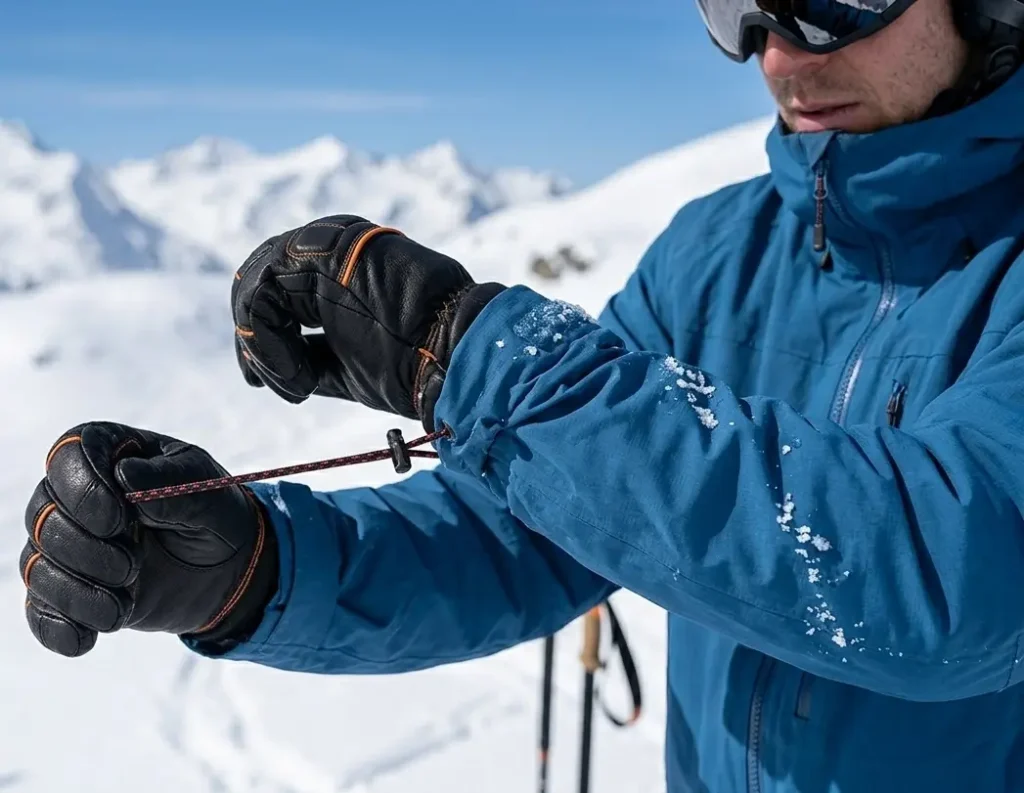
Not tightening the gauntlet drawcord before runs. A gauntlet cuff that is not tightened provides significantly less snow protection than the design implies. The drawcord exists to close the cuff over the sleeve. A gauntlet worn with the drawcord loose or untightened sits partially over the sleeve with a gap that is, in some conditions, worse than a well-fitted short cuff — because the loose gauntlet cuff creates a funnel rather than a seal.
Choosing based on appearance rather than cuff flexibility. Two gauntlets that look similar in photographs can have completely different cuff flexibility. A leather-reinforced cuff designed for traditional alpine skiing restricts wrist movement visibly. A soft-shell stretch gauntlet cuff from a modern freeride glove barely does. Skiers who tried one and hated it often assume all gauntlets are the same. They are not. The cuff flexibility is worth testing specifically before buying any gauntlet.
Ignoring the jacket-glove system on powder days. Some skiers bring their groomed-terrain short-cuff gloves to a powder day because they own them and they fit. The jacket sleeve that works adequately on groomed runs does not provide adequate protection when hands are sinking into powder on every turn and every fall. The conditions change the requirements, and the glove that was adequate yesterday can be wrong today.
When Each Choice Is Clearly Wrong — Situations to Avoid
| Situation to Avoid | Why It Fails |
| Short cuff in powder when falling frequently | Snow entry per fall is near-certain; interior soaked within a morning |
| Short cuff with a loose, wide jacket sleeve | Gap at wrist is unmanageable — wind and snow enter on every cold run |
| Gauntlet during backcountry with frequent skin stops | Removing gauntlet repeatedly in cold is slow and risks losing the cuff drawcord tightening |
| Gauntlet with a stiff cuff in racing or park | Wrist mobility loss affects pole timing and tricks; short cuff is clearly better here |
| Gauntlet when your jacket sleeve is incompatible | A wide technical sleeve that won’t fit under the gauntlet cuff creates bunching that is worse than the gap it was meant to fix |
| Short cuff in wind-driven storm conditions | Fine wind-driven snow penetrates the gap between glove and sleeve even when the sleeve fits well |
Decision Checklist: Which Type Fits Your Skiing
Work through each row honestly. The pattern of answers will point clearly toward one type.
| Your Situation | What It Suggests | Weight |
| I ski primarily groomed runs with occasional powder | Short cuff is likely fine | Low |
| I ski off-piste or powder more than groomed runs | Gauntlet — not optional | Medium |
| I fall frequently (beginner or new terrain) | Gauntlet — each fall is a snow entry risk | Medium |
| My jacket sleeve fits tightly at the wrist | Short cuff can work in most conditions | Low |
| My jacket sleeve is wide or loose at the wrist | Gauntlet — the gap cannot be managed otherwise | High |
| I remove gloves frequently during the day | Short cuff — gauntlet is impractical to reposition repeatedly | Low |
| I ski in storm conditions or wind-driven snow | Gauntlet — gaps that are fine in calm conditions fail in wind | Medium |
| Wrist mobility is critical to my technique | Short cuff — gauntlet bulk affects pole feedback | Low |
| I ski trees or aggressive off-piste terrain | Gauntlet — branches and terrain expose the gap in unpredictable ways | High |
| I ski spring conditions with less fall risk | Short cuff — protection benefit is low, ventilation benefit is real | Low |
| I need one glove for all conditions | Gauntlet — the short cuff fails in the conditions the gauntlet handles easily; the reverse is not true | Medium |
If most of your answers point to gauntlet but removal frequency is your main concern: the gauntlet is still the right choice for protection — address the removal inconvenience by building the repositioning step into your routine rather than switching to a type that cannot handle the conditions you are skiing.
Quick Problem Diagnosis: What Your Current Problem Is Telling You
| Problem You’re Having | Most Likely Cause | What It Tells You |
| Hands cold after first fall in powder | Snow entered via cuff — short cuff gap exposed | Switch to gauntlet; short cuff is wrong for this terrain |
| Wrist feels restricted during pole plant | Gauntlet cuff too stiff or positioned wrong | Check cuff flexibility; reposition over sleeve; may need different gauntlet |
| Hands cold in wind on groomed runs | Gap between short cuff and jacket sleeve | Either switch to gauntlet or ensure sleeve fits tight at wrist |
| Cold fingertips but warm palm | Not a cuff type issue — insulation or fit problem | Cuff choice does not solve this; different problem entirely |
| Glove annoying to remove in lodge | Gauntlet over-sleeve fit every time | Short cuff for conditions where this is frequent; accept trade-off for powder |
| Snow inside glove despite gauntlet | Cuff drawcord not tightened, or sleeve incompatible | Tighten drawcord before each run; check sleeve fits cleanly under cuff |
| Hand sweat building up in groomed conditions | Gauntlet limiting ventilation unnecessarily | Short cuff ventilates better at wrist — consider switching for warmer days |
| Pole strap sits awkwardly | Gauntlet cuff and strap overlap above the wrist | Reposition strap below cuff or use strapless poles; short cuff eliminates this |
Who Should Avoid Each Type — Honest Assessment
Avoid short cuffs entirely if:
Your jacket sleeve is wide or does not close snugly around your wrist. Your skiing includes powder or off-piste terrain where falls are realistic. You ski in storm or strong wind conditions regularly. You are a beginner and fall frequency is genuinely high. In any of these cases the short cuff’s gap is a structural problem that cannot be solved by glove quality or care — the gap exists and conditions will exploit it.
Avoid gauntlets entirely if:
You do backcountry touring with multiple transitions per day and removing gloves in cold temperatures is already a frustration point. Your jacket sleeve is incompatible — too wide or too thick to fit cleanly under the gauntlet cuff. Your skiing is precision-focused and wrist mobility is a genuine performance variable. You ski exclusively in groomed, low-fall conditions where the gauntlet’s protection provides no functional benefit over a well-matched short cuff and jacket sleeve.
The one-pair skier:
If you ski varied conditions across a season and you own one pair of gloves, buy a gauntlet. The conditions that make a gauntlet worse than a short cuff — groomed runs, warm days, high removal frequency — produce inconvenience. The conditions that make a short cuff worse than a gauntlet — powder, off-piste, storms — produce wet hands and cold fingers that end ski days early. The gauntlet’s ceiling in the right conditions is higher, and its floor in the wrong conditions is tolerable. The short cuff’s ceiling in the right conditions is comfort; its floor in the wrong conditions is a problem.
The Right Choice Is Situational — Here Is How to Land on It
Gauntlets and short cuffs are not better or worse than each other — they are right and wrong for different conditions, and the conditions that matter most are the ones you actually ski in, not the ones featured in glove marketing. A skier who genuinely only skis groomed resort terrain on calm days does not need a gauntlet. A skier who spends any meaningful time in powder or off-piste does.
The most reliable approach is to assess the three variables that actually determine the outcome: jacket sleeve fit, fall frequency in your typical conditions, and how often you remove gloves during the day. Those three answers will produce a clear answer in the large majority of situations. Where they do not — mixed conditions, variable terrain across a season — the gauntlet is the safer default because its downsides are inconvenience and its protection is real.
Cuff type is one dimension of glove choice — construction purpose is another. Ski gloves and snowboard gloves are built around different hand movements and different fall patterns, and using the wrong type affects grip and wrist function in ways cuff length alone doesn’t explain. That comparison is covered in our detailed guide on Ski Gloves vs Snowboard Gloves: Real Differences That Matter on the Mountain.
About the Author
Awais Rafaqat has over 15 years of experience testing ski gear in some of the harshest conditions across North America, from the dry sub-zero peaks of the Rockies to the wet, freezing slopes of the Pacific Northwest. He specializes in real-world gear testing to help skiers find equipment that keeps them warm, dry, and performing at their best on every run.
© SkiGlovesUSA.com — Comparisons drawn from direct multi-season testing across glove types, terrain, and conditions. No sponsored product mentions.