
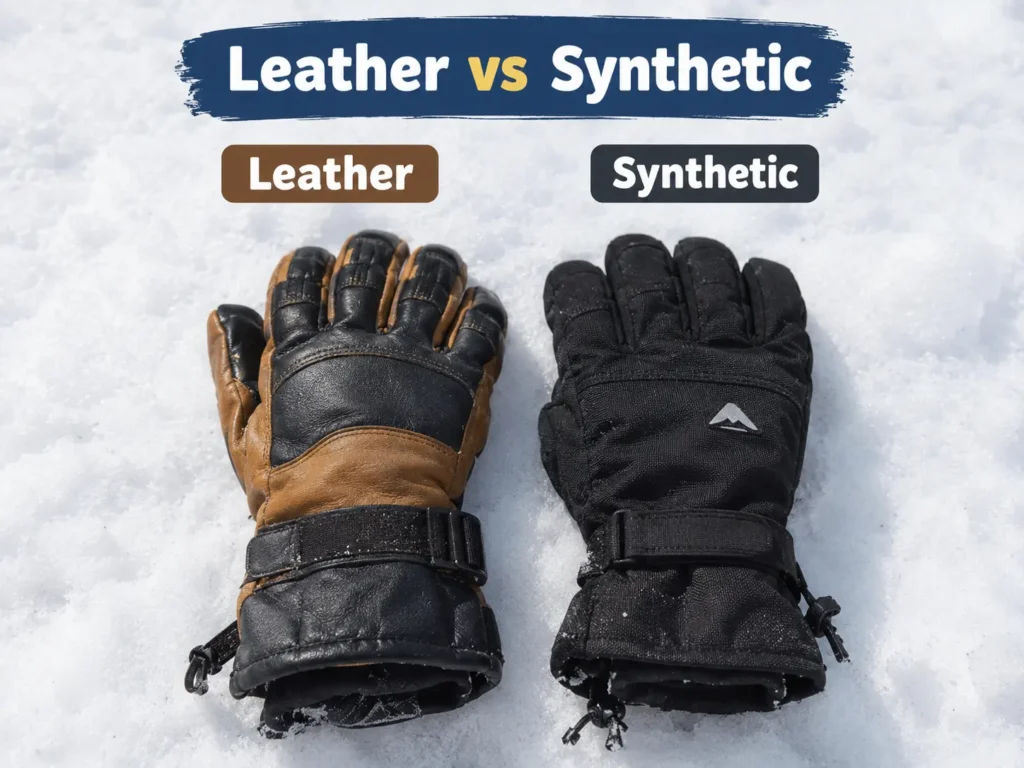
Quick answer: There’s no universal winner in the leather vs synthetic ski glove debate — the honest answer comes down to your climate and how much maintenance you’re actually willing to do, not which material is objectively “better.” Leather rewards dry, cold climates and a willingness to condition it regularly. Synthetic rewards wet climates and a want-it-and-forget-it approach. Getting this wrong is why so many skiers cycle through gloves every season insisting neither material works, when really they bought the wrong one for their conditions. If you’re not sure which category your climate and habits actually point toward, ski glove finder walks through that before you spend money on either.
- What Actually Makes Leather Work
- What Actually Makes Synthetic Work
- How We Actually Know Which Wears Out Faster
- The Head-to-Head Comparison
- Matching Material to Where You Actually Ski
- Real Scenarios Where the Material Choice Actually Shows Up
- Common Mistakes People Make Choosing Between Them
- What Aging Actually Looks Like on Each Material
- When a Hybrid Makes More Sense Than Either Pure Option
- FAQ
What Actually Makes Leather Work
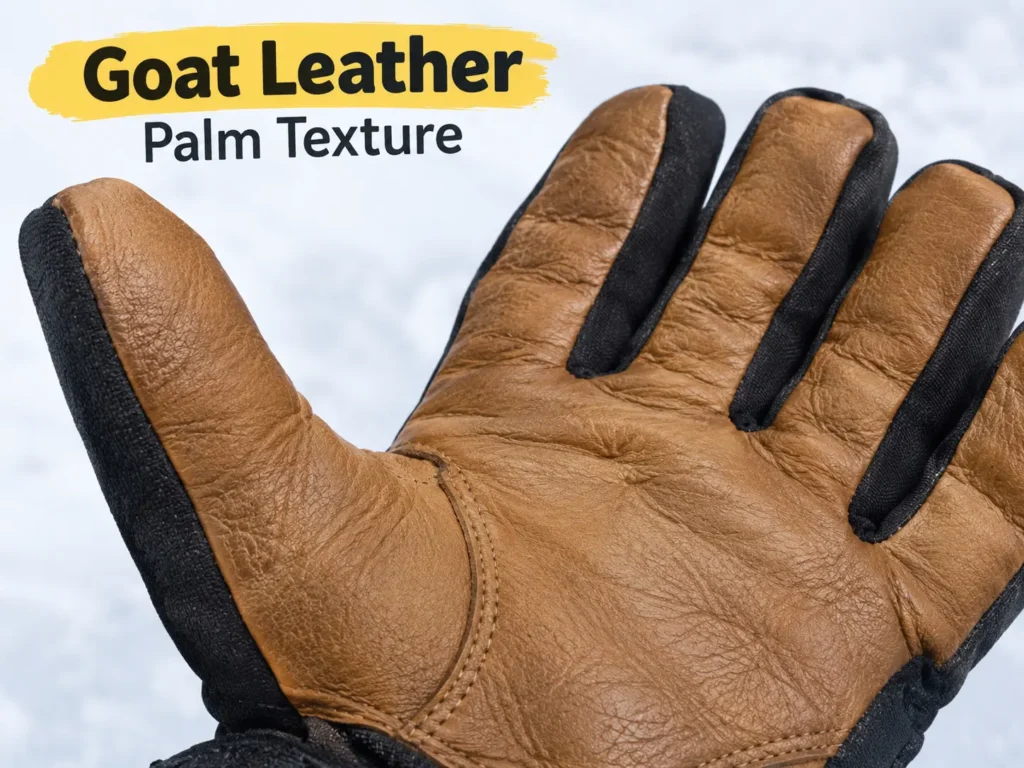
Most quality ski gloves use goat leather specifically, and the reason comes down to one natural property: lanolin. According to Hilton Glove, a work glove manufacturer, goatskin retains natural lanolin oils even after tanning, and that waxy substance acts as an internal conditioner that keeps the leather supple and moisture-resistant without any added chemical treatment.
This is also why goat leather holds up differently than other leathers under repeated wet-dry cycling. The same lanolin content that gives it natural water resistance is also what keeps it from stiffening and cracking the way a drier hide would after repeated exposure to snow and cold air — as long as that lanolin isn’t stripped out faster than it naturally replenishes.
That last part is the entire maintenance conversation in one sentence. Skiing, sweating, and drying out in a heated car all strip lanolin faster than the hide replaces it on its own. Conditioning isn’t pampering a glove — it’s putting back exactly what daily use removes.
What Actually Makes Synthetic Work
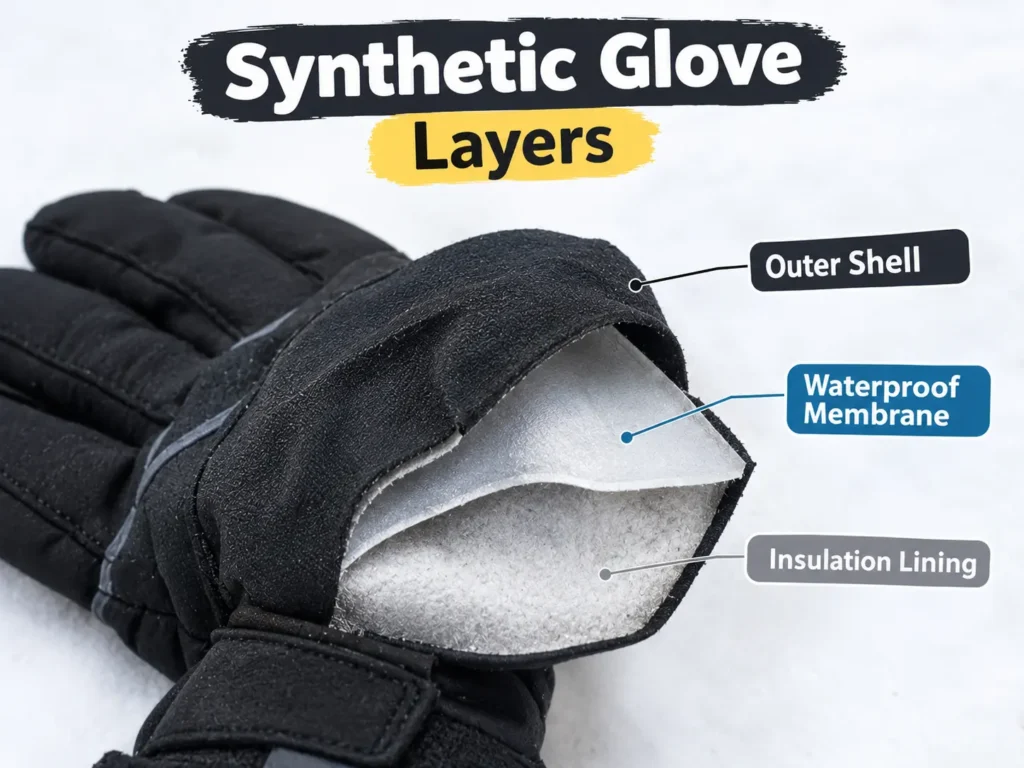
Synthetic ski gloves rely on an entirely different mechanism, and understanding it explains both the strengths and the specific ways synthetic gloves eventually fail. Most use a microporous membrane, commonly PTFE-based, sandwiched between the outer shell and the insulation.
According to a technical breakdown from SUNGOD Technology, a membrane manufacturer, these membranes work because of a size mismatch: the micropores are far larger than a water vapor molecule but far smaller than a droplet of liquid water, so sweat vapor escapes outward while rain and snowmelt can’t force their way in from the other direction.
This is a genuinely elegant piece of material engineering, and it’s also inherently fragile in a specific way leather isn’t. The membrane is thin, it’s bonded rather than grown as a single piece of material, and it has no self-repairing property at all. Once it’s punctured or delaminates at a flex point, that exact spot lets water through permanently — there’s no conditioning routine that fixes a torn membrane the way oiling helps aging leather.
If you’re trying to figure out how much longer your current pair realistically has before this kind of failure catches up with it, it’s worth checking against realistic glove lifespan expectations by material rather than waiting for an obvious failure to force the decision for you.
How We Actually Know Which Wears Out Faster
Vague claims about which material “lasts longer” are hard to evaluate without some objective reference point, so it’s worth knowing that textile durability actually has one. The Martindale test, described by manufacturing resource Xometry, rates fabric abrasion resistance by counting how many rubbing cycles a material withstands before visible wear appears — a higher cycle count means a more abrasion-resistant material.
This matters here because it explains, in concrete terms, why synthetic palms tend to show wear faster than leather palms under the same use. Leather’s fiber structure resists abrasion differently than a woven synthetic textile does, which is measurable rather than anecdotal — it’s the same reason heavy-duty upholstery fabric and decorative fabric get different Martindale ratings for the same reason.
None of this means synthetic is a worse material overall. It means the wear you’ll actually see, and when, differs by mechanism: leather degrades primarily through drying out and losing flexibility, while synthetic degrades primarily through abrasion at contact points and eventual membrane failure underneath an outer layer that can still look fine.
The Head-to-Head Comparison
| Feature | Leather | Synthetic |
| Primary failure mode | Drying out, cracking at flex points | Membrane puncture, seam abrasion |
| Maintenance needed | Regular conditioning | Occasional DWR re-treatment |
| Water resistance out of the box | Moderate, needs treatment | Strong, factory-applied |
| Best climate fit | Dry, cold | Wet, variable temperature |
| Break-in period | Several days | Minimal to none |
| Typical lifespan with proper care | Longer | Shorter |
Matching Material to Where You Actually Ski
Dry, cold climates are where leather’s advantages compound rather than just holding steady. Utah, Colorado, and similar Rocky Mountain conditions rarely expose leather to the kind of sustained soaking that strips lanolin fast, which means the maintenance burden stays manageable across a full season.
Wet, maritime climates flip that equation. The Pacific Northwest and similar coastal ranges see enough consistently wet, heavy snow that leather needs conditioning far more often just to keep pace, while a synthetic membrane shrugs off that same moisture exposure without needing constant attention.
Occasional skiers — a handful of trips a season — genuinely don’t need to worry about this decision as much as frequent skiers do. Neither material accumulates enough wear at low usage volumes for the differences discussed here to matter much, which makes synthetic the more sensible default simply because it needs zero maintenance between infrequent trips.
Skiers who ski aggressively through trees, handle sharp equipment constantly, or put in 20-plus days a season are where the choice actually has teeth. That volume of use is exactly where leather’s abrasion resistance and synthetic’s membrane fragility diverge enough to genuinely change how long a glove lasts.
Real Scenarios Where the Material Choice Actually Shows Up
A cold, dry powder day in a place like Utah is close to the ideal scenario for leather, and it’s worth understanding why rather than just accepting the general climate advice. Dry snow doesn’t saturate the hide the way wet snow does, so the glove spends the day fending off wind and cold rather than fighting moisture absorption — exactly the condition leather handles best with the least maintenance burden.
A wet, 34-degree slushy day in the Pacific Northwest is close to the worst-case scenario for untreated leather specifically. Snow at that temperature is already partially melted on contact, which means sustained saturation rather than the brief exposure leather tolerates well, and that’s when synthetic’s factory membrane earns its reputation.
A multi-day trip with no time to properly dry gloves overnight changes the calculation for both materials, but affects leather more severely. Synthetic dries faster because the membrane itself doesn’t absorb water the way leather fibers do, which matters directly if you’re skiing the same pair three days running with only a few hours indoors between sessions.
Ski school instructors and patrol staff — anyone outside all day, every day, regardless of conditions — represent the extreme case for both materials, and it’s telling that hybrid gloves dominate in that specific population. When you can’t choose your weather, betting entirely on one material’s ideal conditions is a riskier strategy than a hybrid that handles a wider range reasonably well.

Common Mistakes People Make Choosing Between Them
Buying leather without any intention of maintaining it wastes the material’s biggest advantage. Leather left unconditioned actually fails faster than a comparable synthetic glove, since it loses the exact property — lanolin-driven flexibility — that made it worth choosing in the first place.
Choosing synthetic purely because it’s described as “low maintenance” without checking palm reinforcement is a common and avoidable mistake for anyone skiing aggressively. A fully synthetic palm handling repeated contact with ski edges and pole grips wears through faster than a reinforced leather palm, regardless of how good the membrane underneath is.
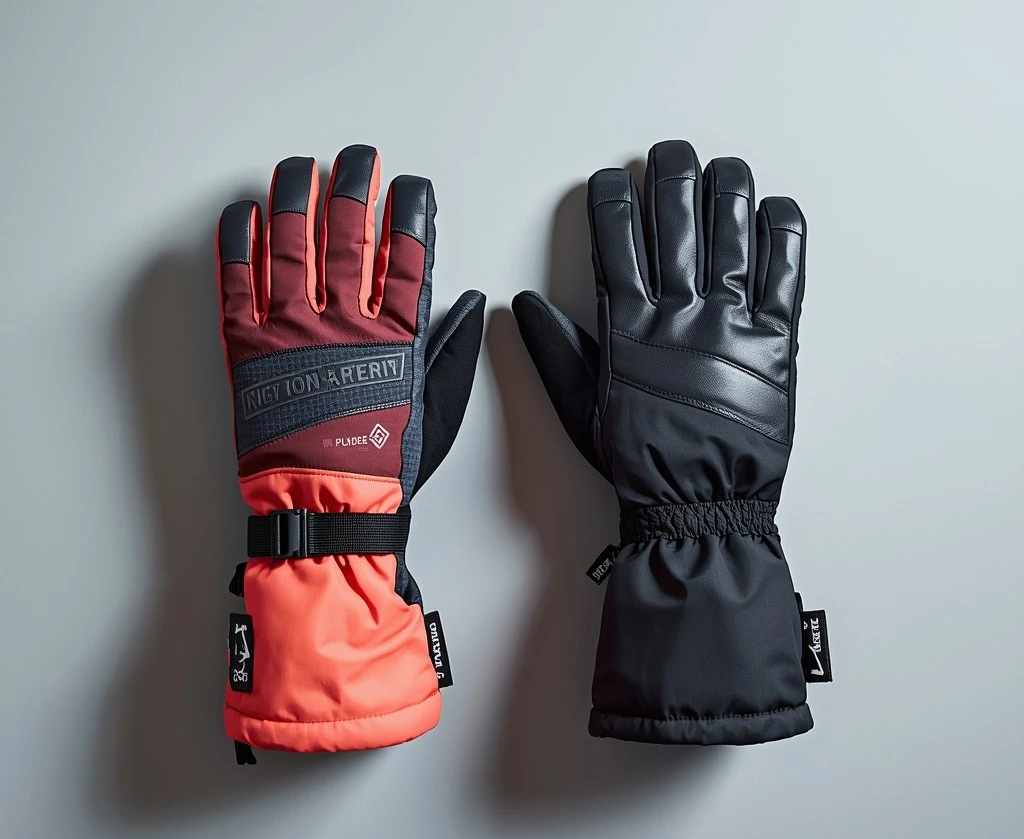
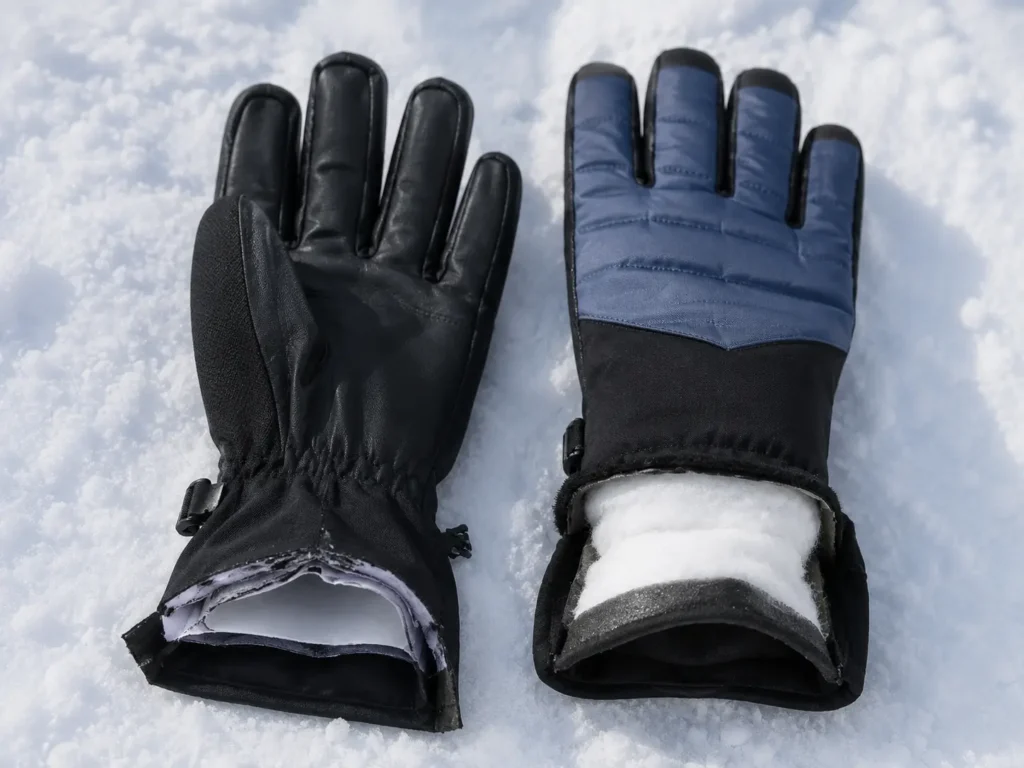
Assuming a glove’s outer material tells you everything about its durability ignores that most quality gloves in either category are hybrids — synthetic shells with leather-reinforced palms, or leather exteriors with synthetic membrane inserts. Judging a glove purely by whether it’s “leather” or “synthetic” on the label misses this increasingly common middle ground.
Storing either material improperly at season’s end undoes a full season of good care. Leather left damp encourages mold and accelerated drying-out once it does dry; synthetic membranes stored compressed for months can develop the same flex-point stress that causes mid-season failures.
What Aging Actually Looks Like on Each Material
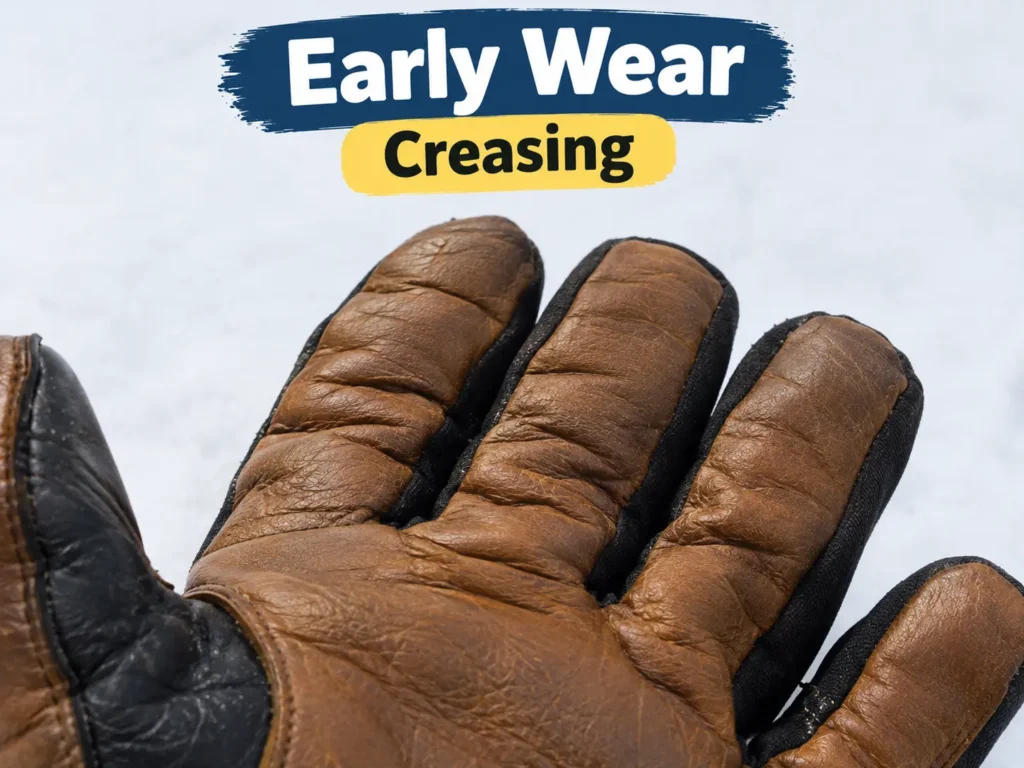
Leather aging is visible and gradual, which is actually an advantage most people don’t give it credit for. A leather glove that’s drying out shows it — the surface dulls, small flex-point creases start showing lighter coloring, and the material stiffens slightly before any real failure happens. That gives you a genuine warning window to condition it before a crack actually forms.
Synthetic aging is far less visible from the outside, which is the harder-to-manage side of an otherwise low-maintenance material. A membrane can be developing pinhole failures at flex points while the outer shell still looks completely intact, which is why synthetic glove failures tend to arrive as a surprise — a suddenly wet finger on an otherwise normal-looking glove — rather than a visible warning sign building over weeks.
This difference is worth factoring into how often you actually inspect either material rather than waiting for a problem to announce itself. Leather rewards a quick visual and flex check every few weeks. Synthetic rewards periodically testing actual water resistance directly — a few drops of water on the shell and a few minutes of deliberate hand-in-snow contact — since looking normal and functioning normally aren’t the same thing for a membrane glove the way they are for leather.
When a Hybrid Makes More Sense Than Either Pure Option
For a lot of skiers, the honest best answer isn’t leather or synthetic — it’s a hybrid that uses each material where it’s actually strongest. A synthetic shell and membrane handle the broad waterproofing job efficiently, while a leather-reinforced palm handles the specific high-abrasion contact zone that pure synthetic struggles with.
This isn’t a compromise so much as matching each material to the job it does best. The back of the hand rarely experiences the kind of repeated abrasive contact the palm does, which is exactly why hybrid construction has become the standard in mid-range and premium gloves rather than a marketing gimmick.
If budget is a real constraint rather than a starting preference, it’s worth comparing what a well-built hybrid actually costs against pure options at a lower price point before assuming you have to choose a side in the leather-versus-synthetic debate entirely.
FAQ
Does leather or synthetic keep your hands warmer?
Neither material provides warmth directly — insulation does that job regardless of shell material. What the shell material affects is how well that insulation stays dry and effective, which is where leather and synthetic diverge based on climate and maintenance rather than raw warmth output.
Can synthetic gloves be repaired the same way leather ones can?
Only partially. A torn synthetic shell fabric can be patched, but a punctured internal membrane generally can’t be repaired the way leather can be conditioned back toward functional. This is one of the more overlooked practical differences between the two materials.
Is goat leather actually better than cowhide for ski gloves?
For dexterity and natural water resistance, generally yes — goat leather’s higher lanolin content and finer grain give it an edge for glove-specific use over thicker, less flexible cowhide. Cowhide can still make sense in gloves prioritizing raw abrasion resistance over fine dexterity.
How do I know if my glove is a true hybrid or just marketed as one?
Check the palm and back-of-hand material separately rather than trusting the product title alone. A genuine hybrid clearly uses leather specifically at contact points — palm, thumb, fingertips — with synthetic elsewhere, rather than a synthetic glove with a small decorative leather patch that doesn’t cover actual wear zones.

I precisely desired to appreciate you again. I am not sure the things I would have accomplished without those creative ideas shared by you over such question. It was actually an absolute troublesome situation for me personally, nevertheless taking note of a new expert avenue you resolved that took me to jump over contentment. I am just happier for your information and thus hope you know what a powerful job you have been undertaking teaching people by way of your website. I am certain you have never come across any of us.