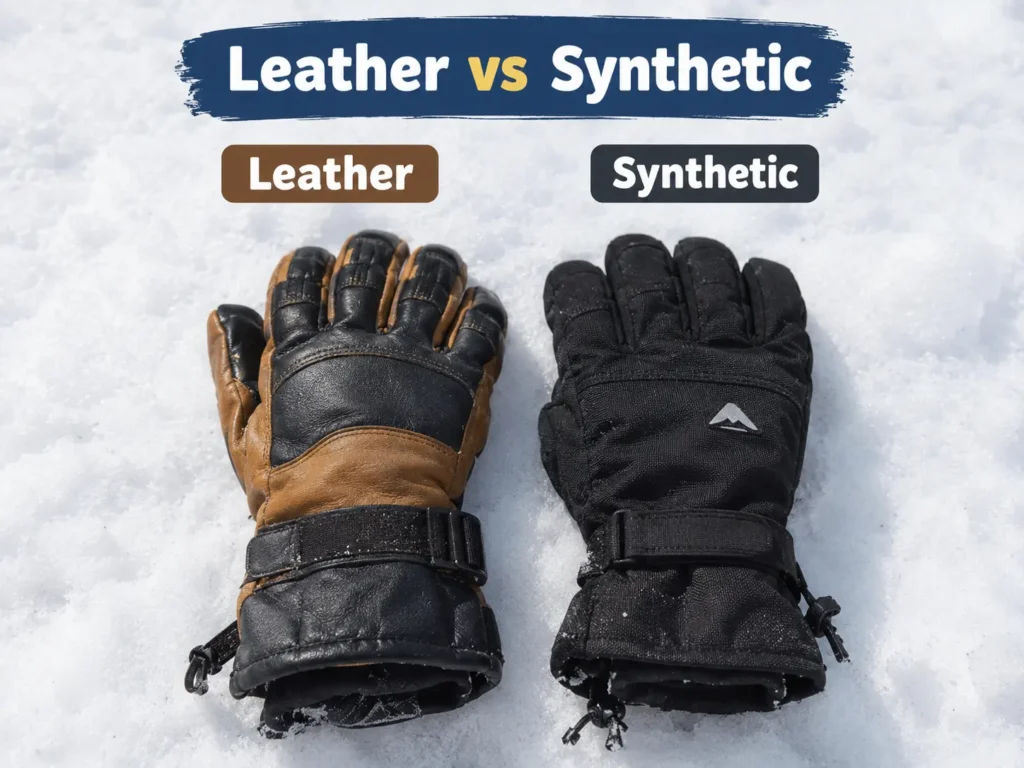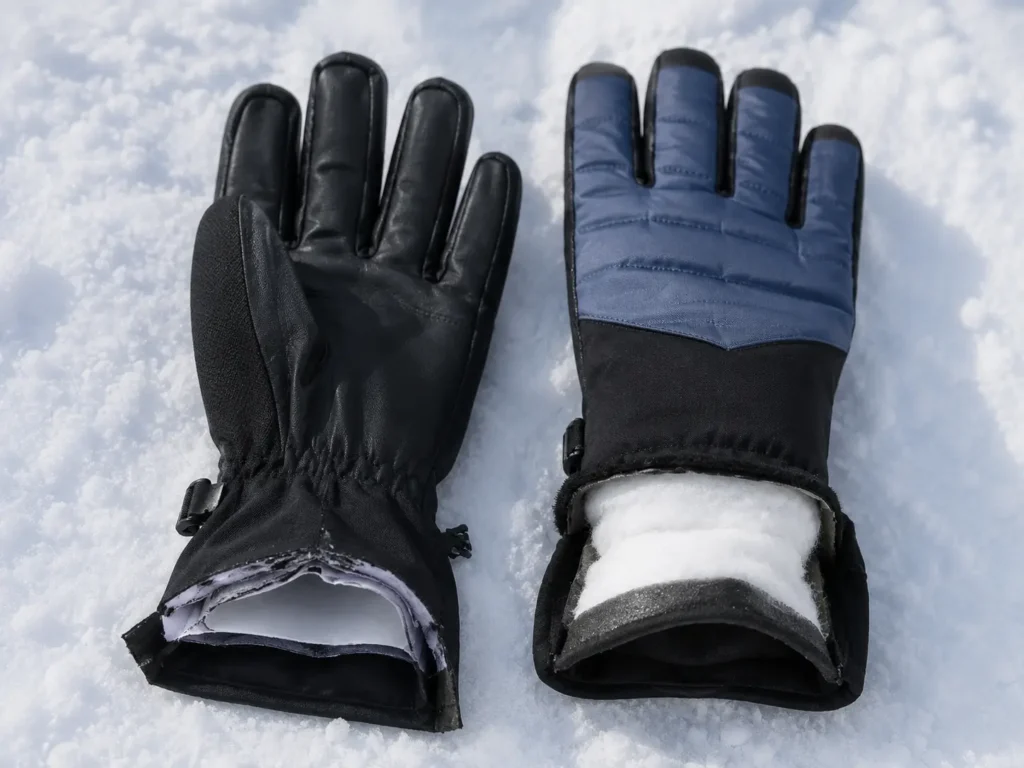
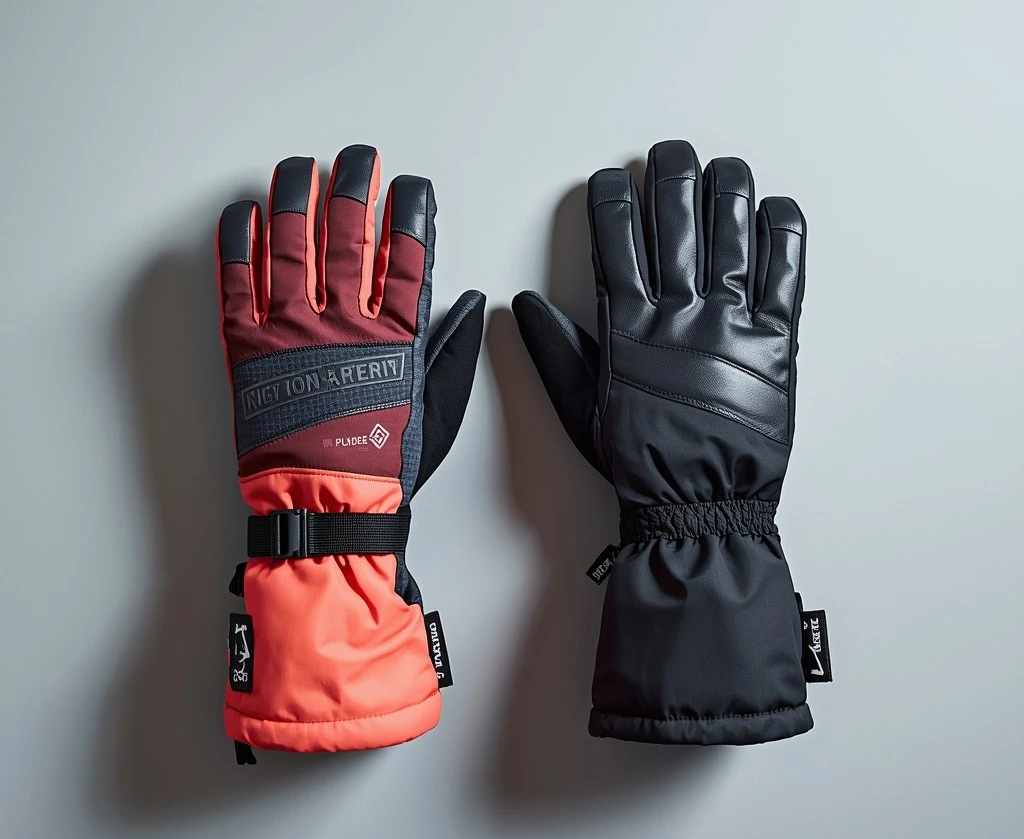
Quick answer: Ski gloves and snowboard gloves solve different hand problems, not the same problem with different branding. Ski gloves are built thin and close-fitting through the palm so you can feel a pole handle and adjust your grip constantly. Snowboard gloves are built with thicker palm padding and often a wrist guard, because snowboarders fall on open hands far more often than skiers do. If you only do one sport, get the glove built for it — a glove finder can help you narrow down the right fit and insulation level once you know which category you’re actually shopping in.
- What Actually Separates These Two Glove Types
- Why Palm Construction Is the Real Dividing Line
- Cuff Design: Why Length Isn't Arbitrary
- Wrist Protection: Where Snowboard Gloves Pull Ahead
- Why Falls Load the Hands Differently
- Material and Insulation Differences
- Side-by-Side: What Actually Changes
- When Ski Gloves Are the Wrong Choice
- When Snowboard Gloves Are the Wrong Choice
- Common Mistakes People Make Choosing Between Them
- Can One Pair Realistically Do Both?
- Exact Situation, Exact Recommendation
- Who Should Choose Which
- Making the Right Call
- FAQ
What Actually Separates These Two Glove Types
Set a ski glove and a snowboard glove from the same brand next to each other and they can look almost identical. Same outer shell fabric, similar insulation weight, comparable waterproof claims on the tag. The real difference is in the palm, the cuff, and whether there’s a wrist guard, and none of those three details are cosmetic. Each one is a direct response to how a skier’s hand is used versus how a snowboarder’s hand is used over a full day.
A skier’s hand spends most of the day doing one repetitive job: gripping a pole, releasing it slightly, adjusting the angle, gripping again. A snowboarder’s hand spends the day doing something completely different: strapping and unstrapping bindings, bracing against the snow when balance shifts, and absorbing impact when a fall happens with the hands out first. Those are different jobs, and a glove built for one does the other one badly.
Why Palm Construction Is the Real Dividing Line
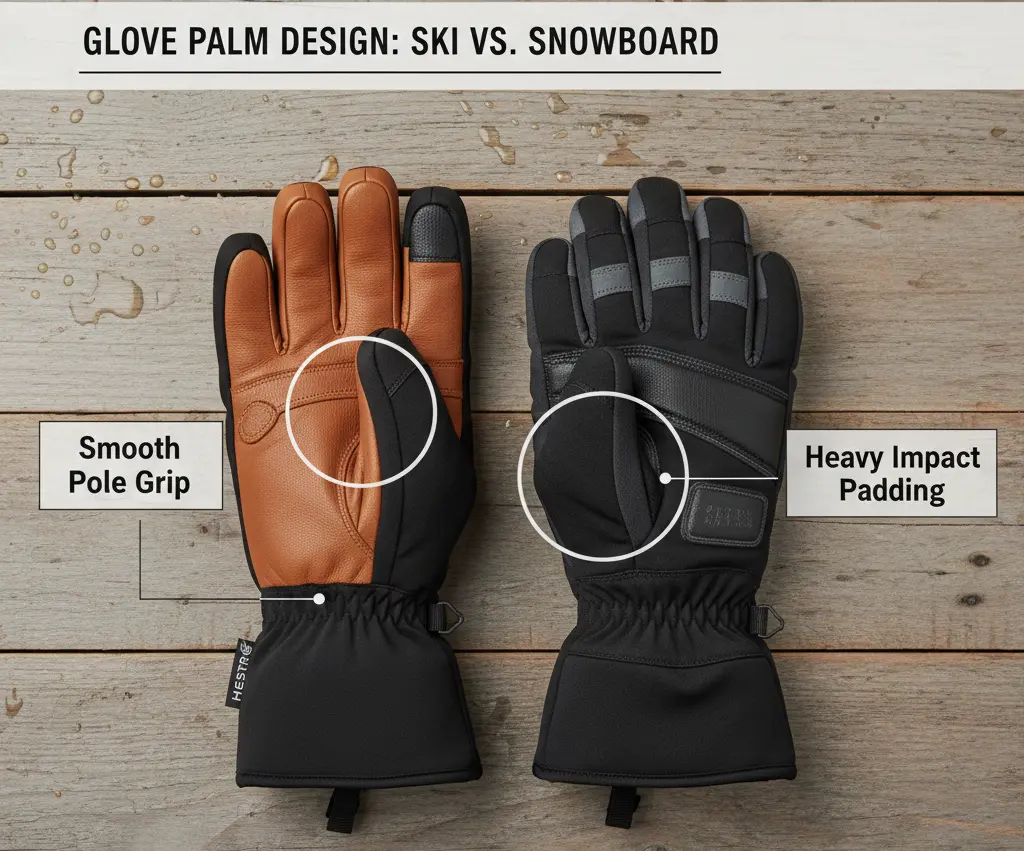
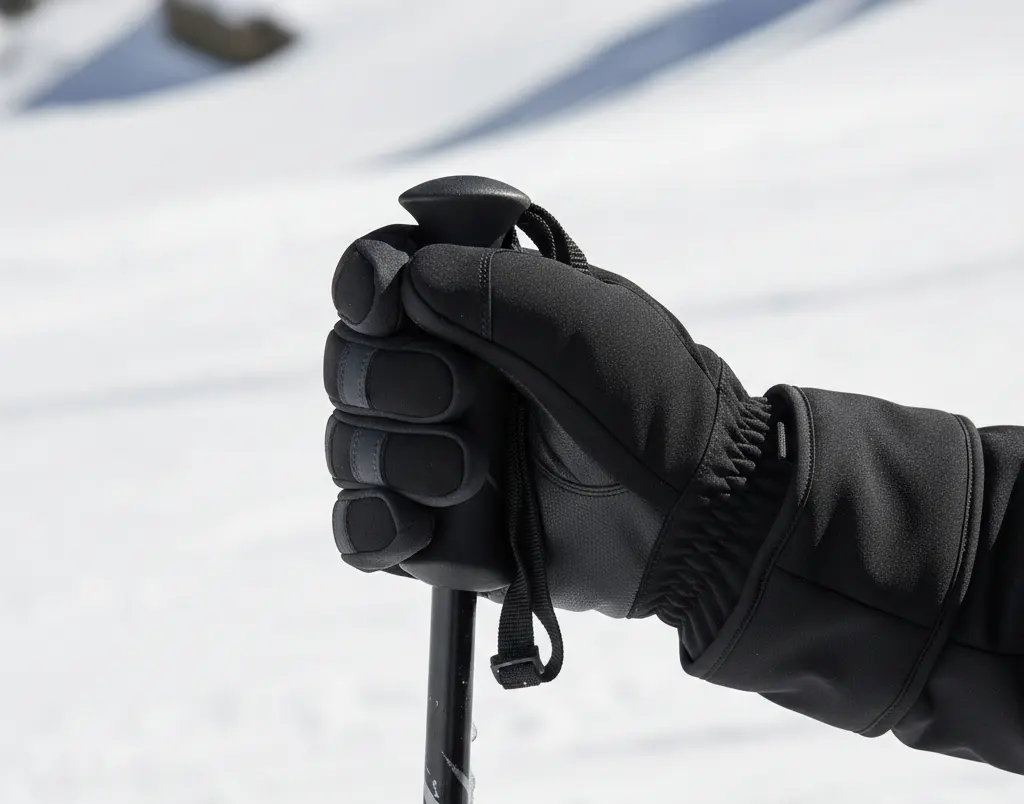
Ski glove palms are built thin on purpose. Thinner material means more of the pole handle’s shape and pressure comes through to your hand, and that feedback is what lets you make small grip adjustments without thinking about it. A padded palm sitting between your hand and the pole doesn’t just feel bulkier — it actually reduces the tactile information reaching your fingers, which is exactly what a lab study measured directly: thicker glove material lowers both grip force and tactile sensitivity compared to a bare hand or a thin glove.
That reduction compounds if the glove doesn’t fit snugly in the first place — a palm that’s already loose loses even more precision once padding is added on top, which is worth checking against a proper fit guide before assuming the glove type is the only variable at play.
Snowboard glove palms go the opposite direction on purpose. Snowboarders land on open palms constantly, especially while learning, and that padding is there to absorb impact rather than transmit feel. The trade-off is real: a snowboard glove’s palm padding that protects a falling hand is the same padding that gets in the way of feeling a ski pole properly.
Neither design is wrong. They’re solving opposite problems, and a glove optimized for one problem is, by definition, worse at the other.
This is also why seam placement differs between the two. Ski gloves keep seams away from the direct pole-contact zone across the palm, since a seam ridge under constant pressure creates a pressure point over hours of gripping. Snowboard gloves often reinforce seams right through the high-impact zones instead, because that’s precisely where repeated falls put the most stress, and a seam without reinforcement there is the first thing to blow out.
Finger articulation follows the same logic in a less obvious way. Ski gloves are usually cut with a slight pre-curve at the first knuckle to match a relaxed grip position, since that’s the shape your hand holds for hours at a time. Snowboard gloves are more often cut flatter, prioritizing a full range of motion for strapping bindings and gripping the board edge, over holding one consistent curved position.
Cuff Design: Why Length Isn’t Arbitrary
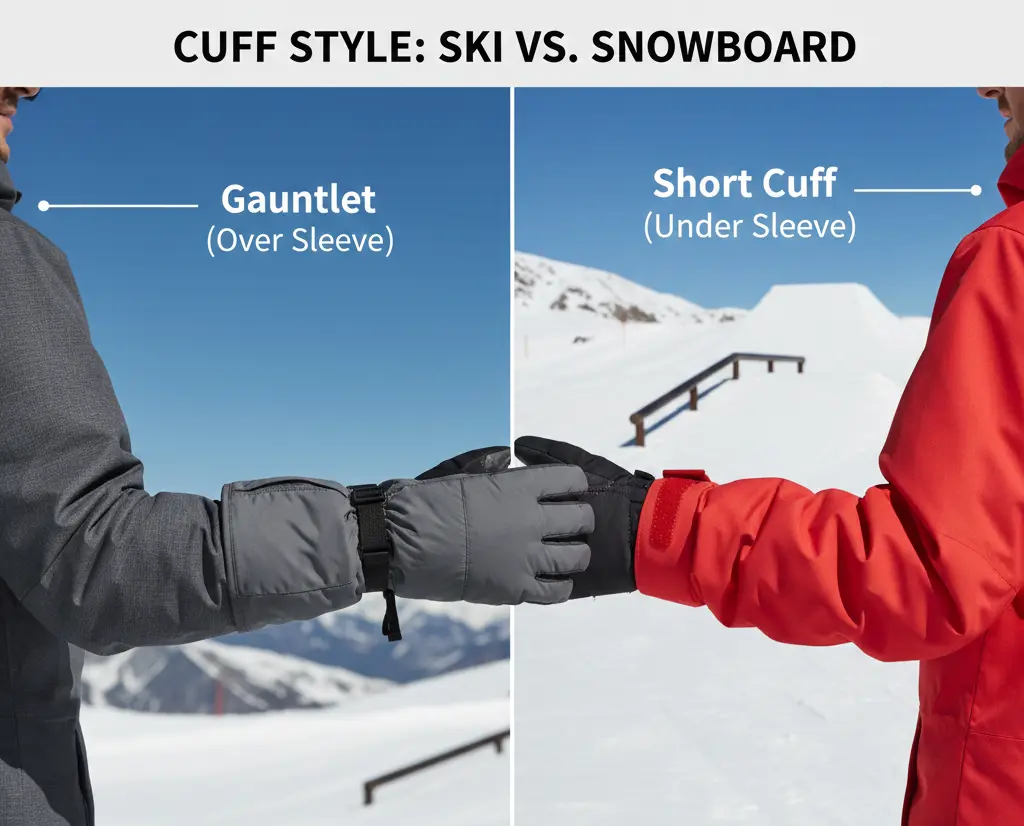
Ski gloves typically use a long gauntlet cuff that goes over the jacket sleeve and seals against it. Skiing generates a lot of sustained airflow, and a longer over-the-sleeve seal blocks wind and snow from working up the arm during a normal day of continuous movement.
Snowboard gloves usually use a shorter cuff that tucks under the jacket sleeve instead. Snowboarders are constantly bending down to strap and unstrap bindings, adjusting boots, and reaching toward their feet, and a long gauntlet cuff catches and binds during those motions in a way a shorter cuff doesn’t.
Neither cuff style is objectively better. A long gauntlet on a snowboarder gets in the way every time they bend down. A short cuff on a skier leaves a gap where wind and snow can work up the sleeve on a cold, fast run.
There’s a secondary reason cuff length matters that’s easy to miss: how much snow actually enters the glove during a fall. A skier’s typical fall involves sliding on a hip or shoulder, which rarely drives snow directly up into a sleeve gap. A snowboarder’s typical fall involves the hands and forearms making direct contact with the snow surface, often repeatedly during a single tumble, which pushes far more snow toward the wrist opening. The shorter, snugger cuff on a snowboard glove is partly a response to that different snow-contact pattern, not just a mobility choice.
Wrist Protection: Where Snowboard Gloves Pull Ahead
This is the one area where the two glove types aren’t just different — one is genuinely better equipped for its sport’s actual injury pattern. Snowboarders fall forward and backward with their hands out to catch themselves far more often than skiers do, and wrist injuries are one of the most common injuries in the sport as a result.
A large case-control study looking at snowboarders across multiple ski areas found wrist guard use was associated with a meaningfully lower rate of hand, wrist, and forearm injury compared to snowboarders without one. That’s the reasoning behind why wrist guard integration shows up standard in beginner and park-focused snowboard gloves and almost never in ski gloves — skiers falling with poles in hand tend to land on hips and shoulders rather than open palms, so the same protection isn’t solving a problem ski gloves actually have.
It’s worth being precise about what a wrist guard actually changes, because it’s not a universal fix. The research on this is mixed on one specific point: some studies have found wrist guards reduce wrist and forearm injuries substantially, while a smaller number have raised the possibility that a rigid guard can shift the impact point further up the arm, toward the elbow, rather than eliminating the load entirely. The overall injury reduction is still strongly positive, but it’s a trade-off, not a guarantee of zero risk.
Why Falls Load the Hands Differently
The reason wrist guards matter so much more for snowboarding comes down to how the two sports actually fail when balance is lost. A biomechanics study measuring hundreds of simulated snowboarding falls recorded real impact forces and wrist angles across both forward and backward landings, and found backward falls in particular generate significantly higher peak force on the wrist than forward falls.
Skiing falls follow a different pattern. A ski binding is designed to release under enough rotational force, and a skier holding poles tends to fall sideways or backward onto the hip and shoulder rather than bracing with flat, open hands the way a snowboarder does. That’s the mechanical reason ski gloves were never built with the same wrist-guard expectation — the fall pattern they’re protecting against is different.
Ski bindings add another layer to this difference. A properly adjusted ski binding is designed to release the boot under enough rotational or forward force, which removes a lot of the twisting energy that would otherwise transfer up through the leg and torso during a fall. Snowboard bindings keep both feet locked to the board through the entire fall, which means more of that energy has nowhere to go except into whichever body part hits the ground first — very often, the hands.
Material and Insulation Differences
Shell material choices follow the same logic as everything else here. Ski gloves often prioritize breathability in the membrane, since skiers generate steady heat through continuous movement and need moisture to escape rather than build up inside the glove. Snowboard gloves often prioritize shell durability over breathability, since more direct snow and ground contact from sitting, strapping in, and falling puts more abrasive wear on the outer material.
Insulation weight tends to run slightly higher in snowboard gloves as well. Snowboarders spend more stationary time — sitting to strap in, waiting at the top of a run, riding a lift with less continuous muscle activity than a skier who’s actively skating and poling. Less movement means less generated body heat, so the glove itself needs to carry more of the warmth.
Waterproofing strategy follows the same divide. A ski glove’s membrane usually needs to manage moisture from two directions at once — external snow contact and internal sweat from sustained aerobic effort — so breathability is weighted almost as heavily as waterproofing itself. A snowboard glove faces more direct saturation from sitting and falling in snow, so the shell fabric and coating are often built thicker and more abrasion-resistant, even at some cost to how well trapped moisture escapes from inside.
Side-by-Side: What Actually Changes
| Feature | Ski Gloves | Snowboard Gloves |
| Palm construction | Thin, close-fitting for pole feel | Padded, built to absorb impact |
| Cuff style | Long gauntlet, over the sleeve | Short or mid, under the sleeve |
| Wrist guard | Rarely included | Common in beginner/park models |
| Insulation | Moderate — movement generates heat | Slightly higher — more stationary time |
| Shell priority | Breathability | Abrasion durability |
| Best suited for | Continuous pole-based movement | Frequent falls, binding adjustments |
When Ski Gloves Are the Wrong Choice
Using ski gloves for a day of snowboarding, especially in the park, puts real stress on a palm that wasn’t built for open-hand impact. The seam pattern and material thickness assume repeated pole-gripping loads, not the flat, sudden impact of catching a fall. A thin palm designed for pole feedback has no cushioning to absorb that kind of hit, and repeated impact in that zone is a common way ski glove palms fail early when used for boarding.
Ski gloves also lack the wrist support most beginner snowboarders actually benefit from. Without that structure, a hard fall transmits more force directly into the wrist joint than it would with a snowboard glove’s guard in place.
When Snowboard Gloves Are the Wrong Choice
Snowboard gloves cause the opposite problem for skiers: the added palm padding sits directly between your hand and the pole, and that reduction in tactile feedback makes it harder to sense whether your pole plant landed correctly. For a beginner this is a minor annoyance. For anyone skiing technical terrain where quick pole adjustments matter, it becomes a real handicap.
The shorter cuff is also a liability at ski speeds. Skiing generates more sustained airflow than snowboarding does, and a cuff built to tuck under a sleeve rather than seal over it leaves more of a gap for wind and snow to reach the wrist on a long, fast run.
Common Mistakes People Make Choosing Between Them
The most common mistake is assuming “gloves are gloves” and grabbing whichever pair is available, regardless of which sport it was built for. The two categories look similar enough on a shelf that the difference isn’t obvious until you’re already on the mountain fighting your own equipment.
A second common mistake is prioritizing looks or brand over the actual palm and cuff construction. A glove can be well-made and still be the wrong tool if it’s built for the other sport’s demands.
A third mistake, more relevant for beginners specifically, is skipping wrist protection when learning to snowboard because it feels unnecessary before the first real fall happens. It’s exactly the group most likely to benefit from it.
Can One Pair Realistically Do Both?
For someone who splits their season between skiing and snowboarding and doesn’t want two separate pairs, a hybrid mid-cuff glove is a real option, just not a perfect one. These gloves aim for a middle ground: a cuff short enough to tuck under a sleeve for binding access, but snug enough through the palm to still give reasonable pole feedback, usually with modest rather than heavy palm padding.
The honest trade-off is that a hybrid glove won’t match a dedicated ski glove’s pole feel or a dedicated snowboard glove’s fall protection. It’s a compromise built for convenience, and it works fine for someone who does both sports casually. It’s a poor choice for someone skiing technical terrain seriously or snowboarding park features aggressively, where the dedicated version of each glove earns its keep.
Budget plays into this decision more than people expect. A genuinely capable hybrid glove usually costs more than a basic dedicated glove of either type, because it’s trying to satisfy two different design briefs with one product. If money is tight and someone does one sport far more often than the other, buying the dedicated glove for the sport they do most and simply tolerating a worse-fit day on the occasional other sport is usually the more practical call than paying a premium for a mediocre-at-both compromise.
Exact Situation, Exact Recommendation
| Your Situation | Right Choice |
| You ski with poles most runs | Ski gloves |
| You snowboard and fall on your hands often | Snowboard gloves with wrist guard |
| You split your season between both sports | Hybrid mid-cuff glove |
| You’re a beginner snowboarder | Snowboard gloves with wrist guard, non-negotiable |
| You ski technical or icy terrain | Ski gloves — pole feedback matters more here |
| You run cold hands regardless of sport | Prioritize insulation level over glove category |
Who Should Choose Which
Beginner skiers benefit from a ski glove with a proper long gauntlet, since they’ll be falling more often while learning pole technique and picking up snow in their sleeves without that seal.
Beginner snowboarders should treat a wrist guard as close to mandatory, not optional. The injury pattern research above exists specifically because this group falls on open hands more than any other segment of either sport.
People with consistently cold hands, regardless of which sport they do, are often better served by prioritizing insulation weight over strict glove-category rules. A snowboard glove or mitten’s higher baseline warmth can matter more to someone whose circulation runs cold than the dexterity trade-off costs them.
Anyone teaching either sport, spending long stretches on the ground helping other people with boots and bindings, benefits from the more abrasion-resistant, higher-durability build snowboard gloves typically offer, even if they’re teaching skiing.
Experienced riders pushing into park features or aggressive terrain on a snowboard should treat wrist and palm protection as increasingly important rather than less, despite having more control than a beginner. Higher speed and bigger features simply raise the impact forces involved when a fall does happen, and better technique reduces fall frequency without reducing what a bad fall costs you physically.
Making the Right Call
The two categories exist because skiing and snowboarding put genuinely different demands on your hands — one is a repetitive-grip sport, the other is a fall-and-impact sport, and the gloves reflect that at the design level, not just in marketing. Match the glove to what your hands actually do on the mountain, not to which one looks better on the rack, and pick your cuff length and insulation weight based on real snow contact and how much time you spend moving versus standing still.
If warmth is your bigger concern than dexterity in either sport, ski mittens are worth considering over either glove category — a trade you might not have thought about before reading this.
FAQ
Can I use snowboard gloves for skiing?
You can, but pole feedback will suffer, and the shorter cuff leaves more of a gap for wind at ski speeds. It works fine for casual, low-speed skiing.
Are ski gloves bad for snowboarding?
Yes, for anything beyond very light use. The thin palm isn’t built for repeated open-hand impact, and most ski gloves lack the wrist support beginner snowboarders benefit from most.
Do I need a wrist guard if I only snowboard occasionally?
Occasional and beginner riders are actually the group most likely to benefit, since falls happen more often before technique is dialed in.