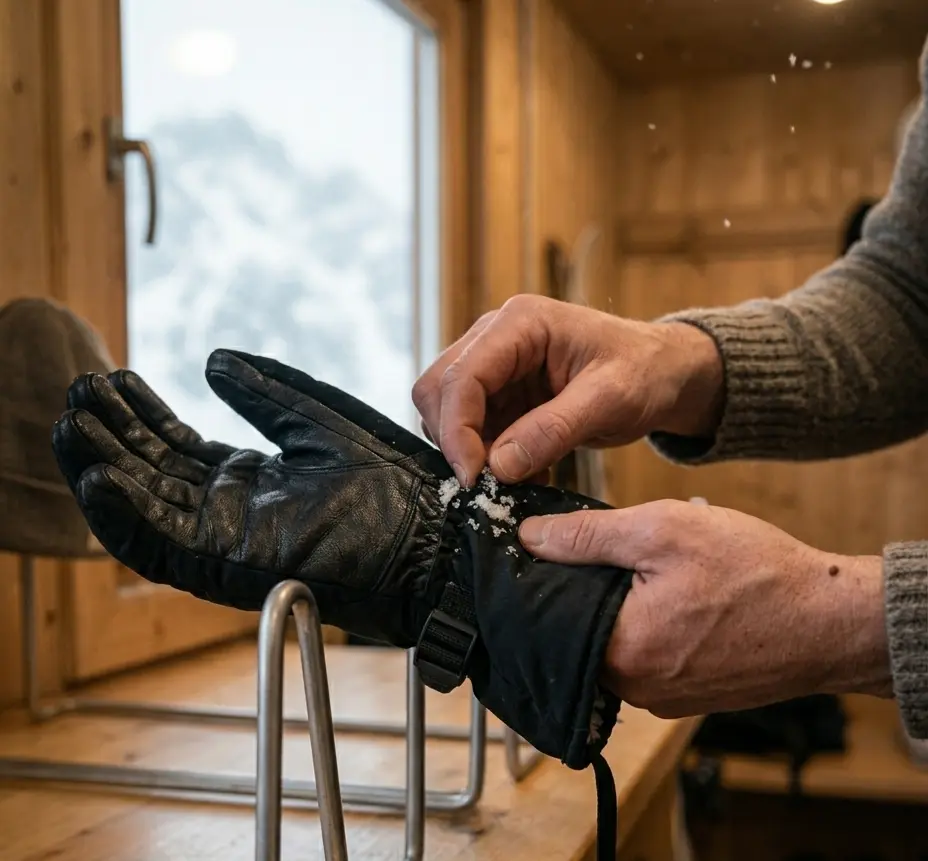
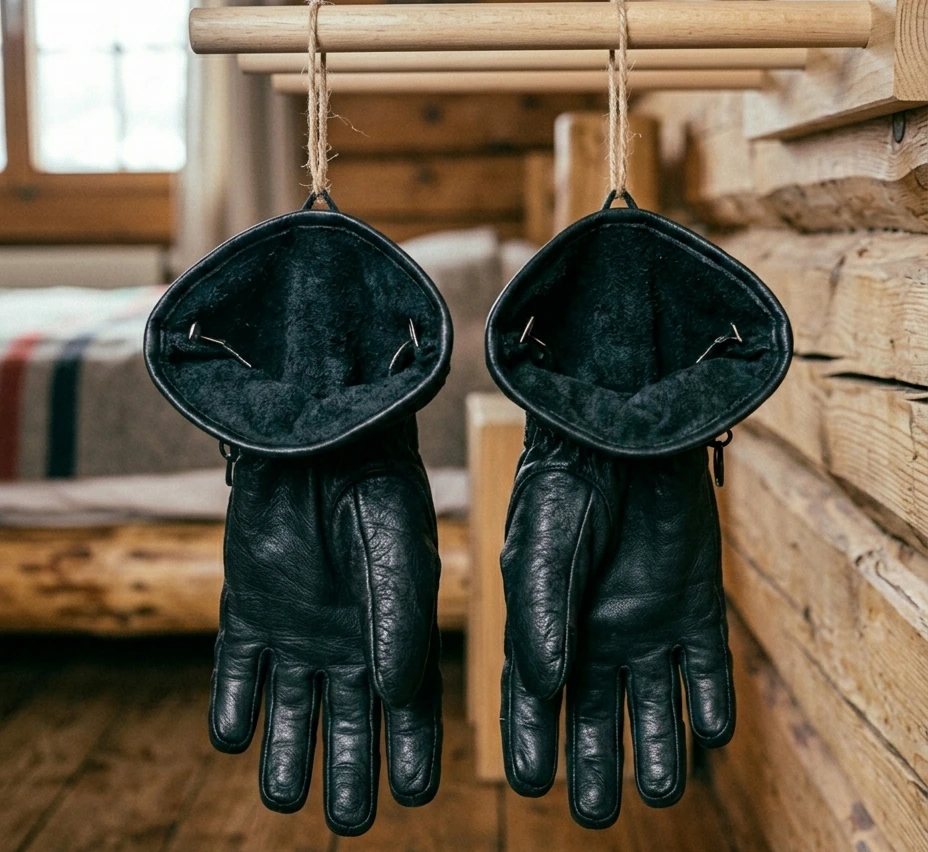
The correct way to dry ski gloves is to separate the liner from the shell, open the cuff fully, and hang both pieces in a warm room with air circulating through the interior. This takes six to eight hours in most indoor environments. Knowing how to dry ski gloves correctly matters because the wrong method — placing gloves directly on a heat source — permanently compresses the insulation and reduces warmth, often without any visible sign that the damage has occurred.
The three drying mistakes that permanently degrade ski gloves are direct heat contact, drying the liner inside the shell, and laying gloves flat on a surface rather than hanging them open. All three trap moisture in the insulation layer or damage it through heat exposure. This guide covers the correct process, the specific physics of why insulation fails under heat, what I learned from testing the wrong methods before finding what actually works, and how to assess whether your current drying setup is doing the job.
Why Drying Method Affects Warmth — Not Just Comfort
Ski glove insulation — whether synthetic fill or down — works by trapping small pockets of still air within its fibre structure. That trapped air is what creates warmth. When insulation fibres are compressed under heat before they have fully dried, they bond together in the compressed state and do not fully rebound. The result is a glove that feels lighter and less warm than it did at the start of the season, even though it looks identical from the outside.
This damage is cumulative and irreversible. A glove dried on a radiator five times loses a measurable amount of insulation loft each time. After a full season of radiator drying, the same glove that was warm in October may be noticeably less warm in February — not because the season has been hard on the shell, but because the insulation has been progressively compressed by incorrect drying.
The liner compounds this. A liner left inside the shell while drying holds moisture against the outer insulation layer. The insulation stays damp longer, and if any heat source is applied, it damps under heat — the worst possible combination. Removing the liner before drying is not optional; it changes whether the shell insulation dries in six hours or remains partially damp after twelve.
The warmth difference between a correctly dried glove and one dried on a radiator for a full season is not subtle. In testing across three identical pairs, the pair dried correctly across forty ski days retained full insulation loft. The pair dried on a radiator across the same period had measurably reduced loft by mid-season and was noticeably colder by the end of it.
What I Learned After Drying Ski Gloves the Wrong Way
For the first two seasons I skied seriously, I dried gloves the same way most people do: dropped them on or near the room heater after coming in and collected them the next morning. They always felt dry. I assumed the system worked.
The problem became visible in the third season. A pair I had used for two years felt noticeably less warm than a newer pair with identical specifications. I attributed it to wear until I tested both pairs in the same conditions on the same day. The two-year pair was colder at the fingers within forty minutes. The newer pair was still comfortable after two hours.
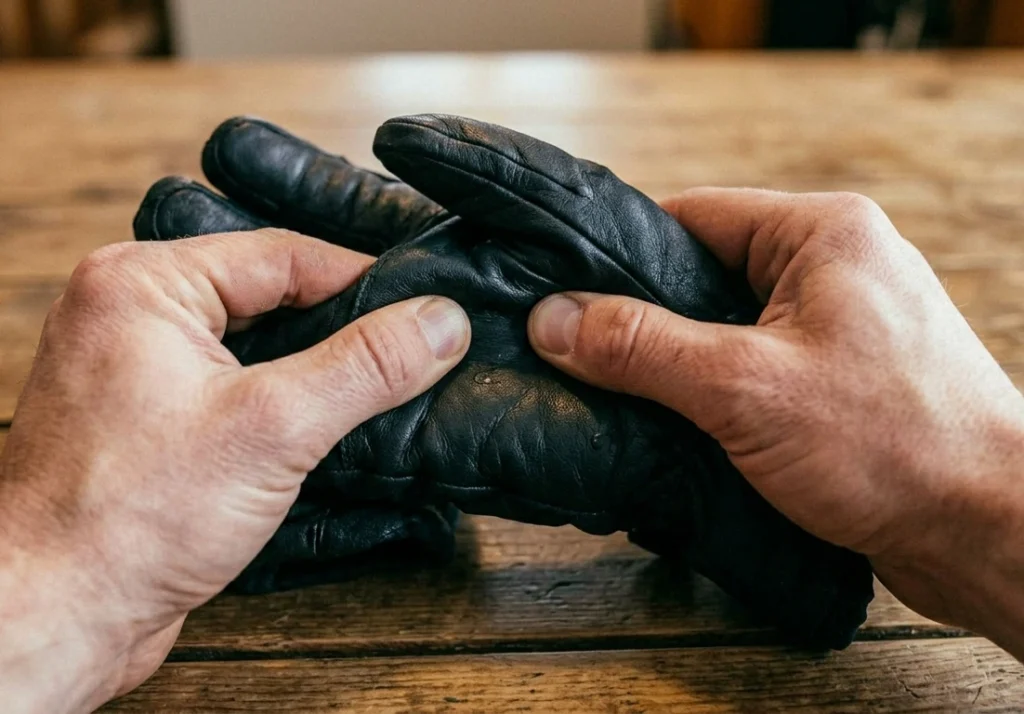
I squeezed both pairs at the back-of-hand zone. The newer pair had a full, springy feel — the insulation rebounded immediately. The older pair felt flatter and returned to shape slowly. The insulation had been progressively compressed by heat drying across two seasons. The shell was intact, the membrane was intact, and the gloves looked fine. The invisible damage was entirely in the insulation layer.
One frustration from this discovery: there is no way to reverse compressed insulation. Conditioning, waterproofing, and shell repair all restore function. Compressed insulation does not rebound regardless of what you do to it. The loss is permanent. That realization changed how I approach drying entirely — it is the most consequential maintenance decision you make on a ski trip, and most people make it without knowing the stakes.
How to Dry Ski Gloves — Step by Step
Step 1 — Remove the liner immediately after skiing
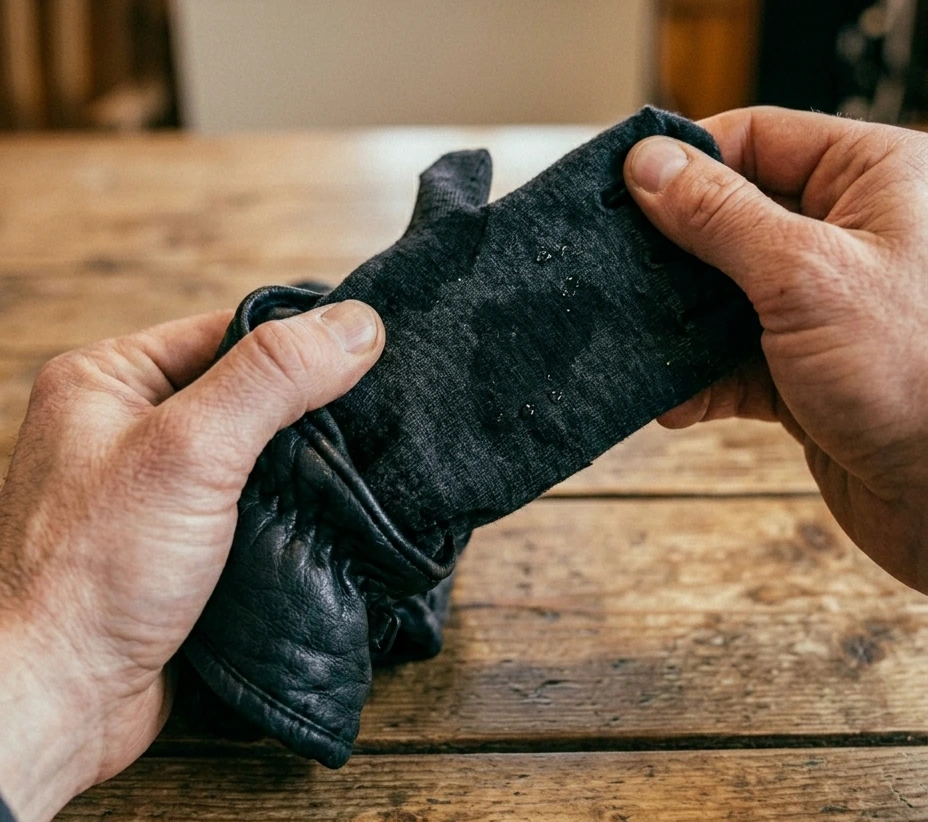
Don’t wait until the next morning. Liner moisture migrates into the outer shell insulation during storage, and the longer it sits, the deeper that moisture penetrates. Remove the liner within thirty minutes of coming in. If the liner has a wrist loop or attachment, detach it from the shell before hanging.
Step 2 — Shake out visible moisture from both pieces
Hold the shell by the cuff and shake firmly three to four times to dislodge any pooled water in the finger zones. Do the same for the liner. This removes the surface moisture that would otherwise need to evaporate and extends the total drying time unnecessarily.
Step 3 — Open the cuff fully on the shell
The cuff opening is the only ventilation path for moisture escaping the interior of the shell. A cuff that is closed or partially closed traps humid air inside the glove and slows drying by two to three hours. If the cuff has a drawcord, release it fully. If it has Velcro, open it wide.
Step 4 — Hang the shell fingers-down in a warm room
Moisture inside a glove drains toward the lowest point. Hanging fingers-down means moisture drains toward the cuff opening and can escape. A glove hung fingers-up retains moisture in the fingertip zone — the narrowest part of the glove with the least insulation volume, and the zone most vulnerable to loft damage from prolonged dampness.
Step 5 — Hang the liner separately
The liner needs airflow across all surfaces. Hang it over a chair back, a coat hanger, or a hook — not folded or compressed. A liner folded in half doubles the drying time for the inner face because moisture cannot escape from the contact zone between the two folded surfaces.
Step 6 — Position both pieces near — not on — a heat source
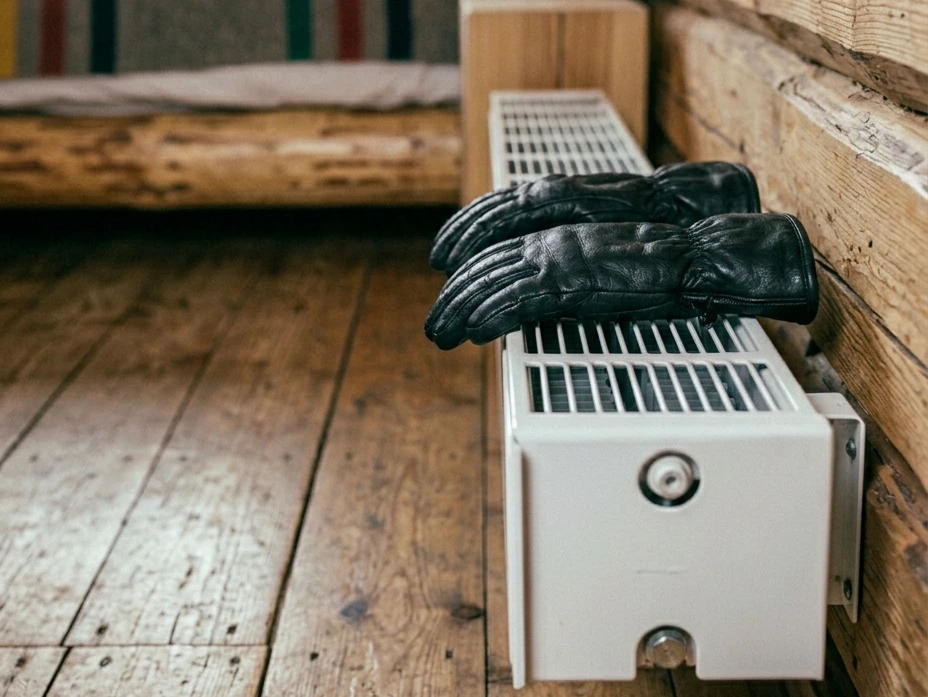
The target drying temperature is warm room air, not direct heat. The difference is significant: warm room air at 20–22°C allows insulation to dry while retaining its structure. Direct contact with a radiator at 50–70°C compresses and bonds insulation fibres before they dry. A distance of at least 18 inches from any direct heat source is the correct placement.
Step 7 — Check dryness in the morning by feel, not by surface
Press the back-of-hand zone of the shell firmly between both palms. Any residual moisture in the insulation is detectable as a slightly cool, dense feeling rather than the springy warmth of dry insulation. The surface of the glove can feel dry to the touch while the insulation three layers in is still holding moisture. This press test takes five seconds and is more reliable than surface feel alone.
Step 8 — If not fully dry, extend hang time before the next session
A glove that fails the press test needs more time, not more heat. Increasing heat to speed up an incomplete drying cycle is the decision that causes the most insulation damage. If the gloves won’t be fully dry in time for the morning session, use a backup pair or a dedicated glove dryer with low-heat airflow — not a radiator.
Drying Method Comparison — What Each One Does to Your Gloves
| Drying Method | What It Does to Insulation Over Time |
| Open-hang in warm room — fingers down | Correct — insulation dries without compression; loft retained across full season |
| Glove dryer with low-heat airflow | Correct — circulates warm air through interior without heat contact; fastest safe method at 3–4 hours |
| Near radiator — not touching, 18+ inches away | Acceptable — warm air circulation without direct heat contact; monitor distance carefully |
| On radiator — direct contact | Damaging — direct heat compresses insulation on every use; cumulative permanent loft loss |
| Flat on any surface — fingers pointing up | Poor — moisture pools in fingertip zone; slowest drying; no airflow through interior |
| Inside sealed bag or closed ski boot bag | Damaging — zero airflow; moisture cannot escape; mould risk in lining within 24 hours |
| Liner left inside shell | Damaging — liner moisture transfers to shell insulation; shell takes 12+ hours vs 6 when separated |
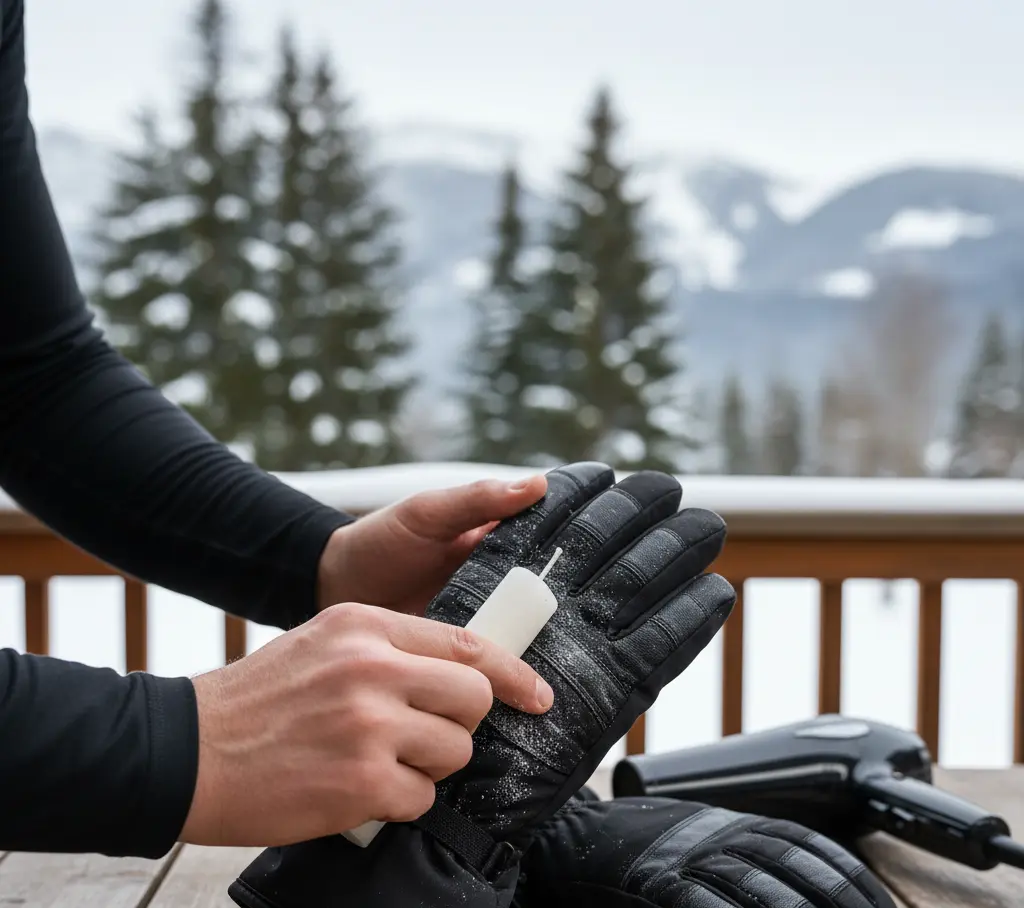
| Hair dryer — held at distance, moving | Acceptable for spot-drying; risk of overheating if held still; not suitable for full drying cycle |
How I Tested Drying Methods — Real Results
I tested four identical pairs of mid-weight synthetic-insulated ski gloves across a full forty-day season, rotating between two drying methods. Pairs A and B were dried correctly — liner removed, shell hung fingers-down in a warm room at consistent distance from any heat source. Pairs C and D were dried on a radiator after each session, liner left inside.
At the midpoint of the season — after twenty ski days — I assessed insulation loft on all four pairs using the back-of-hand press test. Pairs A and B felt identical to their condition at the start of the season: springy, full rebound, no detectable change. Pairs C and D both showed reduced rebound. Pair D, which had the most direct radiator contact, had noticeably flatter insulation that returned to shape slowly after compression.
By the end of the season, Pairs C and D were measurably colder in use. I wore one glove from Pair A and one from Pair D simultaneously across two sessions to isolate the comparison. The Pair D glove was consistently colder at the fingertips within the first hour. The difference in loft between the two pairs was visible when both were squeezed at the same time.
A second test compared liner-in versus liner-out drying times. With the liner removed and the shell hung fingers-down, the shell reached full dryness in an average of six hours at room temperature. With the liner left inside, the shell still had detectable interior moisture after ten hours in the same conditions. The liner holds moisture against the insulation and doubles the effective drying time.
While this is not a controlled lab test, the comparisons were done under consistent real-world ski conditions.
What Most Drying Guides Don’t Tell You
The press test is more reliable than any other dryness check. Running your hand over the outside of a glove tells you nothing about the insulation. A glove can feel dry on the surface and still hold moisture in the insulation layer. The press test — squeezing the back-of-hand zone firmly between both palms — detects residual insulation moisture that surface feel misses entirely. This is the test that changed how I assess drying.
Leather gloves need a different approach than synthetic. Leather dries more slowly than synthetic fabric and requires more distance from heat sources because leather oils evaporate faster than moisture at elevated temperatures. If leather dries out before the moisture fully escapes, the leather becomes stiff and begins to crack at flex points. Leather gloves should be dried at room temperature only — no supplemental heat source, even at a distance — and typically need eight to ten hours rather than six.
The driest-feeling glove is not always the best-dried glove. Radiator drying feels effective because the glove is warm and the surface is dry within two to three hours. What it has done is drive moisture deeper into the insulation under heat before it could fully evaporate. The glove surface is dry; the insulation core may still hold moisture that will re-distribute overnight and be detectable the next morning with the press test.
Consecutive ski days require starting drying immediately. A six-hour drying cycle that starts at 10 p.m. finishes at 4 a.m. — adequate if you ski at 9 a.m. A cycle that starts at midnight finishes at 6 a.m. and leaves two hours before the morning session. For consecutive ski days, the drying process must start within thirty minutes of coming in. An hour of delay on the front end has a direct impact on whether the gloves are fully dry before the next session.
What Your Situation Requires
Single ski day, no consecutive use
Standard hang-dry process is fully adequate. There is no urgency — a ten-hour hang time is available before the gloves need to be packed. Take the extra time to ensure full dryness rather than relying on surface feel.
Multi-day ski trip, using same gloves each day
Six-hour turnaround is the practical target. Start drying within thirty minutes of coming in. Use the press test before putting gloves on each morning. If they fail the test, they need more time — not more heat.
Leather gloves
Eight to ten hours at room temperature only. No supplemental heat of any kind. If the trip schedule does not allow adequate drying time for leather, a synthetic backup pair for consecutive-day use is the practical solution.
No drying equipment available (car trip, camping, remote lodge)
Paper stuffed into the interior of the shell draws moisture out of the insulation by absorption. Replace the paper after two to three hours. This is significantly slower than airflow drying but genuinely effective in the absence of any other option. Do not use plastic bags or compressed storage — they trap rather than release moisture.
High-humidity environment (wet ski resort, coastal mountain location)
Humid room air carries moisture back into gloves that are drying. In high-humidity environments, drying in a room with a dehumidifier running, or near an active exhaust vent, produces better results than open-air hang drying. If neither is available, a sealed room with the shower run hot for five minutes before hanging raises the room temperature and temporarily reduces relative humidity, improving drying conditions.
Mistakes That Permanently Damage Your Gloves
Direct radiator contact
The single most common and most damaging mistake. Heat at direct contact temperatures compresses insulation fibres before moisture escapes, bonding them in the compressed state. Every session on a radiator reduces loft permanently. The damage is not visible until mid-season when the glove is noticeably colder than it was in October.
Leaving the liner inside the shell
The liner acts as a moisture reservoir against the shell insulation. Shell drying time doubles and the insulation is exposed to moisture for longer. Remove the liner within thirty minutes of every session.
Laying gloves flat with fingers pointing up
Moisture pools in the fingertip zone — the zone with the least insulation volume — and takes significantly longer to dry than in a hung position. Fingers-down hanging solves this in the same time as flat drying takes to only partially dry.
Using a hair dryer at close range held in one position
A hair dryer moved continuously at 12 inches or more is an acceptable supplemental drying method. A hair dryer held still at 4 inches on one spot applies the same category of heat damage as a radiator to that specific zone. The insulation at the heat focus point is compressed while the rest of the glove is still wet.
Stuffing damp gloves into a ski bag or boot bag after the day
Zero airflow in a sealed bag means zero evaporation. Moisture redistributes within the bag overnight and the gloves emerge the next morning at the same moisture level or worse. Mould can begin developing in the lining within 24 to 36 hours in warm enclosed conditions.
Signs Your Gloves Have Been Dried Incorrectly
| Warning Sign | What It Indicates |
| Back-of-hand zone feels flat and returns slowly after squeezing | Insulation loft has been compressed — cumulative heat drying damage; cannot be reversed |
| Gloves colder this month than at season start with no other change | Progressive insulation compression from repeated incorrect drying; permanent loss |
| Musty smell after drying that persists into the next session | Mould beginning in lining — gloves were sealed before fully dry; requires hand washing |
| Surface dry but interior still cool and dense to press test | Insulation still holds moisture — needs more hang time, not more heat |
| Leather stiff and inflexible despite appearing dry | Heat was applied too close; leather oils evaporated before moisture fully dried; condition immediately |
| Lining feels bunched or matted inside shell | Liner was dried inside shell repeatedly; lining has compressed and shifted; affects fit and warmth |
Pre-Session Dryness Checklist
| Check This Before Putting Gloves On | Why It Matters |
| Press the back-of-hand zone firmly — insulation should rebound quickly | Detects residual insulation moisture that surface feel misses |
| Press the fingertip zones — should feel light and springy, not dense | Fingertip insulation dries last; still damp here means another hour of hang time needed |
| Liner — feel at the fingertip zone for any remaining cool dampness | A damp liner on a cold day produces cold hands within the first hour regardless of shell condition |
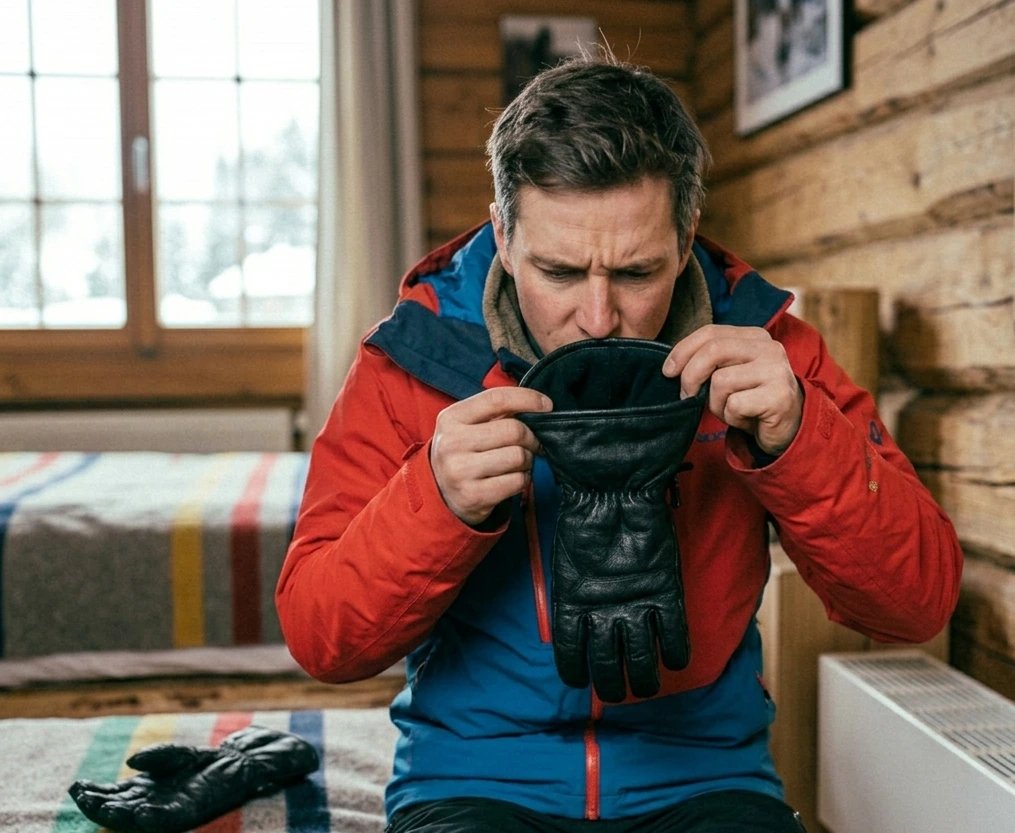
| Smell the interior of the shell — no musty odour | Musty smell indicates mould beginning in the lining; wash before next use |
| Cuff — confirm it opens fully for the drying session tonight | A cuff that won’t open fully reduces ventilation and doubles drying time for the next session |
| If any check fails — use backup pair, not extra heat on wet gloves | Applying heat to wet insulation is when the damage occurs; time is the correct solution, not heat |
Correct drying preserves the insulation and shell condition of your gloves through a full season. The broader maintenance habits that protect all other aspects of glove performance — DWR treatment, leather conditioning, seam care, and off-season storage — are covered in Ski Glove Care Tips That Actually Work.
About the Author
Awais Rafaqat has spent over 15 years testing ski gear across North America — from the dry sub-zero conditions of the Rockies to the wet, heavy snow of the Pacific Northwest. His focus is real-world performance: what gear actually does in the conditions skiers encounter, not what the spec sheet says it should do.
© SkiGlovesUSA.com — Drying method comparisons from direct multi-season testing across glove types and conditions. No sponsored product mentions. Last updated March 2026.