
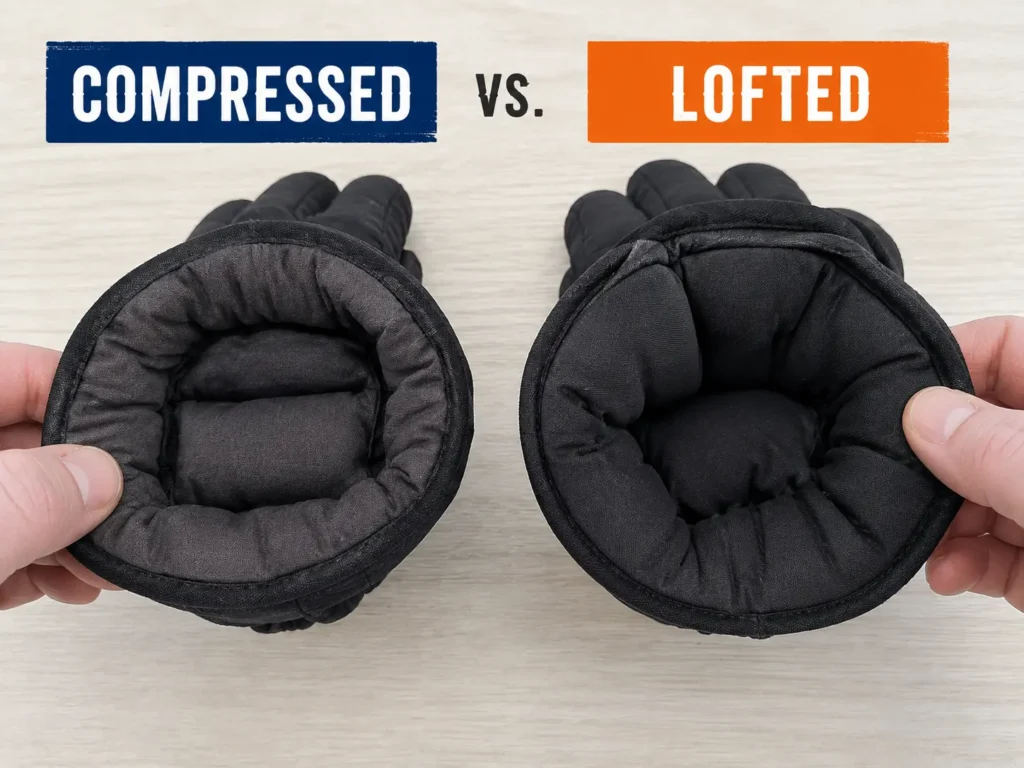
Quick answer: Loose ski gloves are almost never a sizing mistake. In most cases, the same gloves that fit fine last season have simply changed — the interior padding has compressed from repeated use, the wrist closure has lost tension, or the shell material has stretched from cycles of sweat, snow, and warm storage. Buying a new size fixes nothing if the actual cause is one of these three, and it wastes money on gloves that will loosen the same way within a season or two.
If you’re not sure whether your current gloves are even the right shape for your hand to begin with, the Ski Glove Finder can help rule that variable out before you spend time chasing a fit problem that was never about sizing in the first place.
- Why "Loose" Almost Always Means Something Changed, Not Something Was Wrong
- How the Liner Actually Loses Its Shape
- Why the Shell Stretches Even Though You Never Pulled on It
- The Wrist Closure Is Doing More Work Than People Realize
- Checking Which Cause You're Actually Dealing With
- Fixes That Actually Address Each Cause
- Temporary Fixes vs. Fixes That Actually Last
- When Fixing Stops Being Worth It
- Preventing It From Happening Again
- Who Runs Into This Fastest
- Frequently Asked Questions
- The Takeaway
Why “Loose” Almost Always Means Something Changed, Not Something Was Wrong
A glove that fits correctly in November and feels sloppy by February hasn’t magically become the wrong size. Ski gloves are made of several materials working together — insulation, shell fabric, a lining, and a closure system — and every one of those materials degrades at a different rate under normal use.
The insulation packs down. The shell stretches slightly with heat and moisture exposure. The wrist strap or elastic cuff loses some of its original tension. None of these changes happen because the glove was defective. They happen because a glove absorbs mechanical stress every single day it’s worn, and none of its components are designed to hold their exact original dimensions forever.
The mistake most skiers make is treating all three of these as the same problem and reaching for the same fix — usually buying a size down, which creates a new problem (tightness across the knuckles) without solving the original one, since a smaller size doesn’t restore compressed insulation or a stretched-out shell.
How the Liner Actually Loses Its Shape
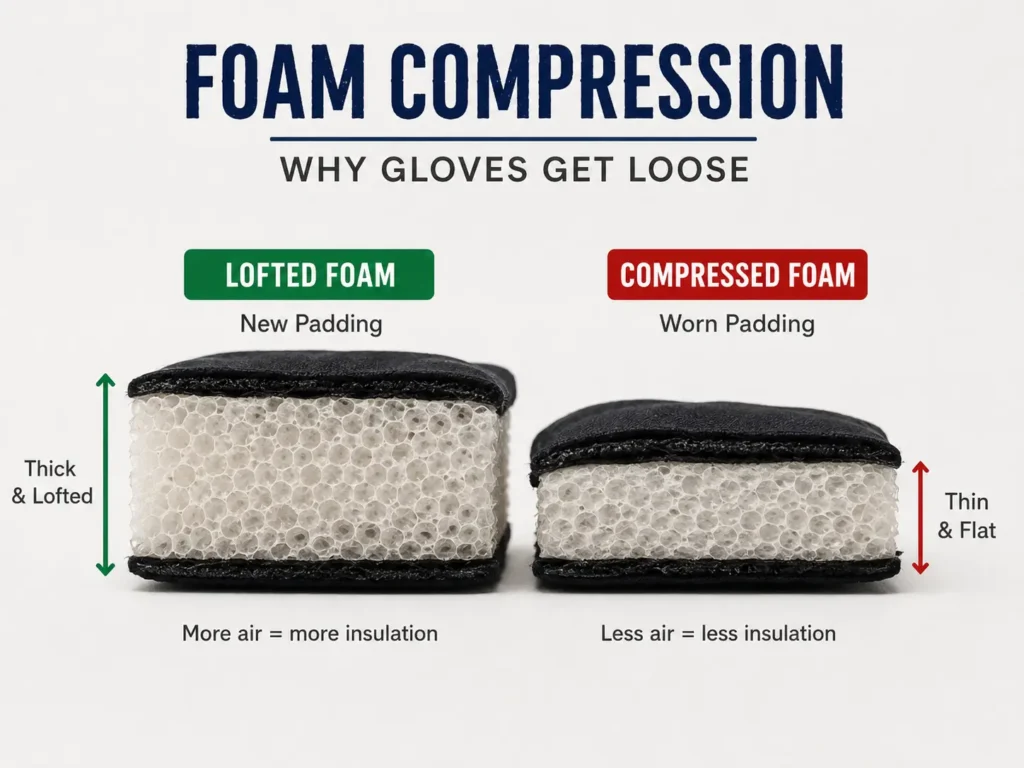
The soft padding lining the inside of a glove is a type of foam or fiber fill, and like any cushioning material, it has a physical limit on how many times it can be compressed and still spring back to its original thickness. Materials engineers call this compression set — the permanent loss of a foam’s ability to recover its full height after being squeezed repeatedly.
Every time you make a fist, grip a pole, or flex your fingers inside a glove, the padding gets compressed and released. A single ski day involves thousands of these small compression cycles. Over a season, the cumulative effect is a liner that no longer fully expands back to its original thickness — which means there’s now more empty space between your hand and the glove’s inner surface than there was when the glove was new.
This is why gloves that felt snug in their first season commonly feel noticeably roomier by their second or third, even with zero change in the outer shell’s actual dimensions. The shell hasn’t grown. The cushion inside it has permanently thinned.
Denser, higher-quality foams resist this longer than thin, budget padding, which is part of why cheaper gloves tend to feel loose sooner than premium ones — not because the outer shell is a worse fit, but because the interior material gives up its shape faster under the same amount of use.
Why the Shell Stretches Even Though You Never Pulled on It
Separately from the liner, the outer shell fabric itself can stretch — and the mechanism here has almost nothing to do with physical force and almost everything to do with heat and moisture.
Most synthetic glove shells rely on some elastic fiber content, or at minimum a woven or knit structure that has some give built in to allow hand movement. That stretch capacity depends on the fabric’s molecular structure holding its shape after being flexed. Heat disrupts that structure. Sweat trapped inside a glove for hours, followed by drying near a heater or car vent, subjects the fabric to exactly the kind of repeated heat-and-moisture cycling that gradually degrades a fiber’s ability to spring back to its resting shape.
Elastic recovery in textile fibers isn’t instantaneous or complete even under ideal conditions — fibers stretched under load don’t fully snap back the moment tension is released, and the amount of permanent stretch that remains depends heavily on moisture content and how much time the fiber gets to recover between stress cycles. A glove that goes straight from a sweaty, flexing ski day into a warm boot bag with zero recovery time between wears is accumulating that kind of permanent stretch faster than a glove that gets a full day to dry and rest between uses.
This is a slower process than liner compression, which is why shell stretching tends to show up as a second-season or third-season problem rather than something you’d notice after a handful of days. But it compounds with liner compression rather than replacing it — a glove suffering from both at once loosens noticeably faster than one dealing with either issue alone.
The Wrist Closure Is Doing More Work Than People Realize
A glove can have a liner and shell in reasonably good shape and still feel loose overall, because the wrist and cuff closure is what actually anchors the glove to your hand in the first place. If that closure has lost its grip, the whole glove shifts and rotates even when the finger and palm fit is technically fine.
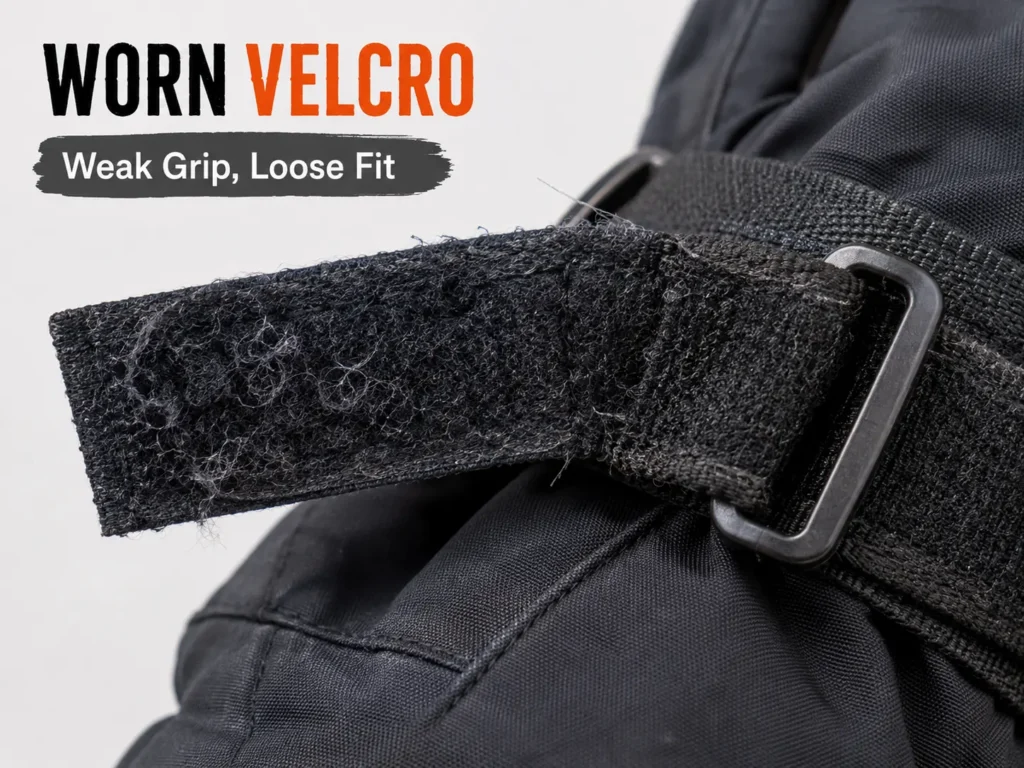
Hook-and-loop closures — the Velcro-style strap most gloves use — have a defined lifespan measured in open-and-close cycles. Every time hook-and-loop tape is opened, the rigid hooks pull against the softer loop fibers, and that repeated pulling gradually wears down the loop side’s ability to grab. Snow, dust, and lint caught in the hooks accelerate this by physically blocking the hooks from engaging the loops fully, which is why a glove strap that still looks intact can quietly stop holding tension the way it used to.
Elastic cuffs fail through a related but distinct mechanism — the same heat-and-moisture fatigue described above, applied specifically to the small band of stretch material sewn into the cuff opening. Once that elastic has permanently stretched even slightly, the cuff no longer cinches down to its original circumference, and cold air has a direct path in at the wrist even if the rest of the glove fits perfectly.
This is the piece of the puzzle most skiers overlook entirely, because a worn-out closure doesn’t look broken. The strap is still there, the elastic still stretches when you pull it — it just doesn’t spring back with the same force it did when the glove was new.
Checking Which Cause You’re Actually Dealing With
Before trying any fix, it’s worth figuring out which of the three mechanisms is actually responsible, because the right fix depends entirely on which one is happening.
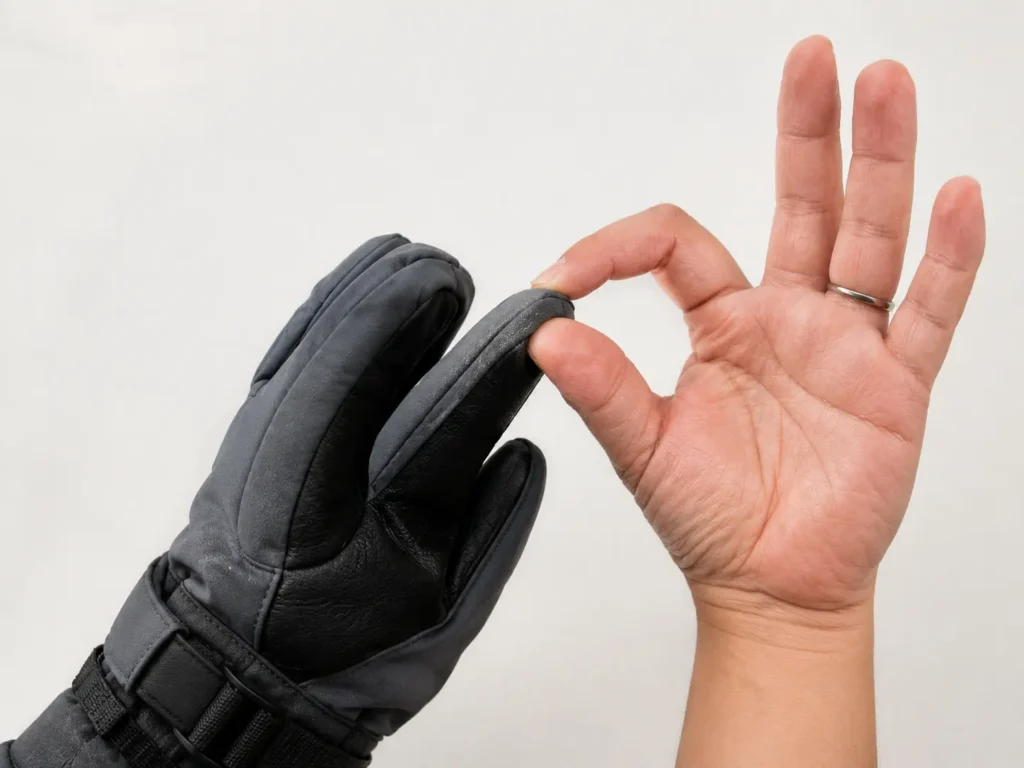
Put the gloves on and make a loose fist. If your fingertips have noticeably more room than they used to, and the glove feels generally roomier through the whole hand rather than just at the wrist, that points to liner compression. Compare against a newer glove of the same model if you have one — the difference in interior volume is usually obvious side by side.
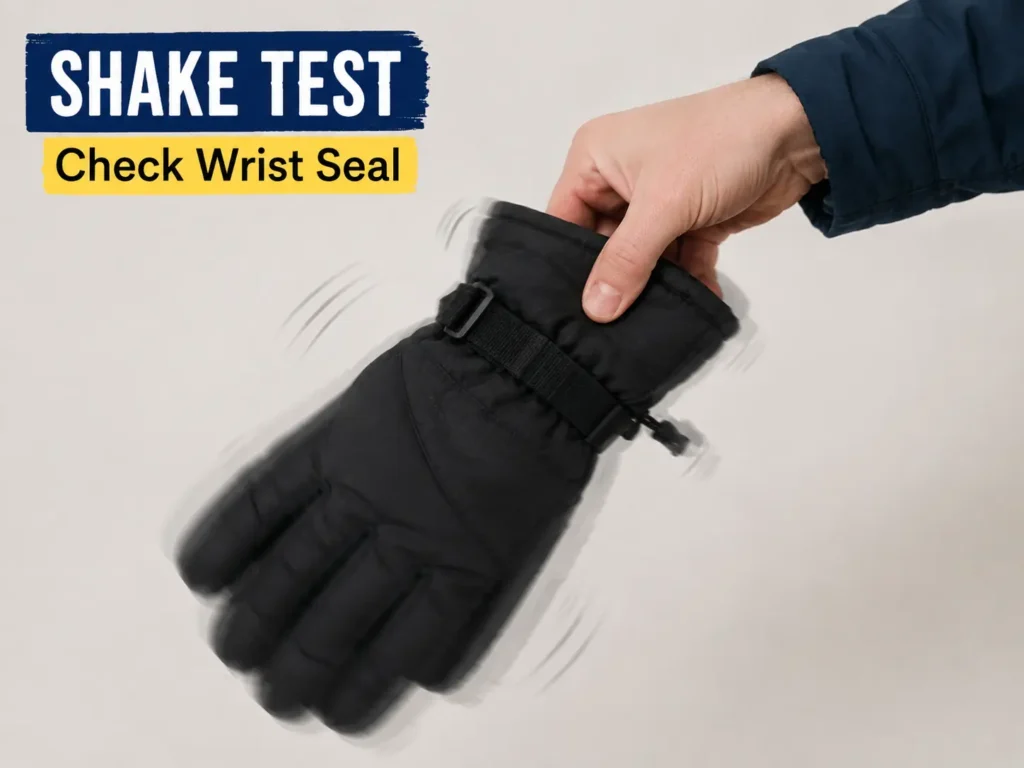
Next, check the wrist specifically, separate from the rest of the fit. Fasten the closure as tight as it goes and gently shake your hand. If the glove still shifts or rotates around your wrist even at maximum closure tension, the strap or elastic has lost its holding power, regardless of how the fingers and palm feel.
Finally, look at the shell fabric itself under slight tension — pull gently at the back of the hand and release. Fabric that feels noticeably slack, or that shows visible looseness across the knuckles even before you’ve made a fist, suggests the shell material itself has stretched rather than just the interior padding compressing.
Most gloves that have been worn hard for more than a season show some combination of all three, which is exactly why a single fix rarely solves the whole problem on its own.
Fixes That Actually Address Each Cause
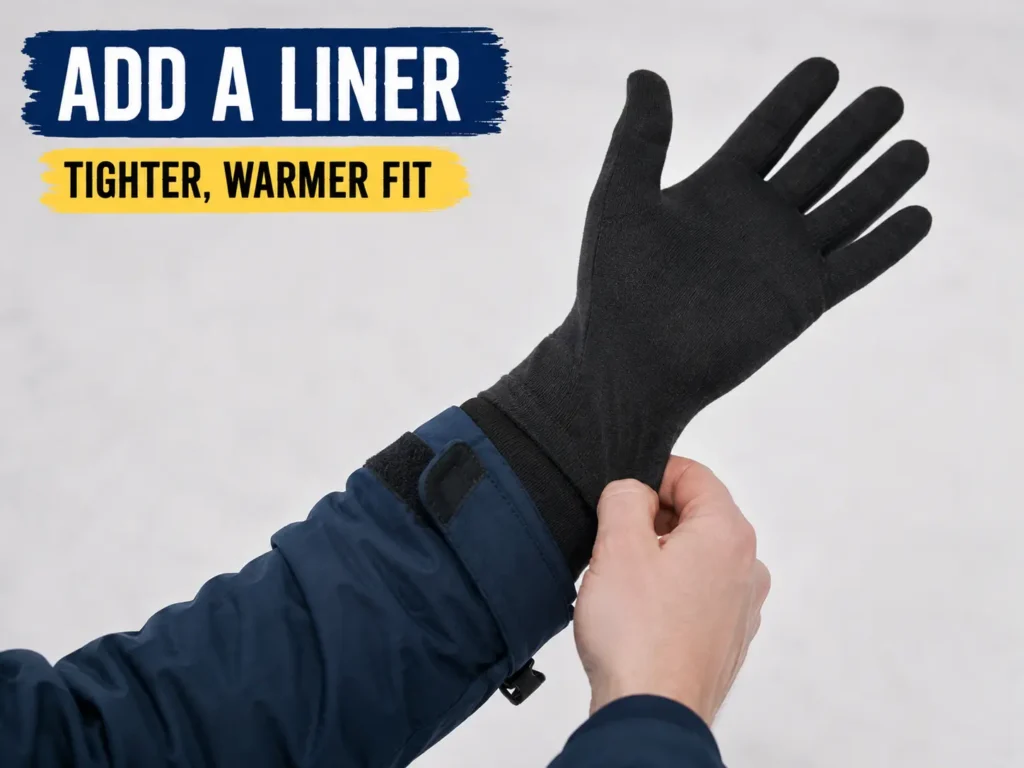
For liner compression, adding volume back inside the glove is the most direct fix, since you can’t un-compress foam that’s already lost its shape. A well-fitted thin liner — merino wool holds its shape better than cheap acrylic and manages moisture better than cotton — fills the extra space the compressed padding left behind and restores some of the snugness the glove had when new. This works best when the liner is genuinely thin; a liner heavy enough to make the whole system feel tight defeats the purpose and just trades one fit problem for another.
Removable liners that have stretched slightly can sometimes be brought back closer to their original size with careful, gentle drying rather than aggressive heat — air-drying in a warm room, never directly on a heater or in a clothes dryer, since high heat is precisely the thing that caused the fiber degradation in the first place and more of it won’t reverse the damage.
For a worn wrist closure, replacement is usually more reliable than trying to restore the original one. Hook-and-loop strap material is inexpensive and straightforward to sew in as a replacement for a section that’s stopped gripping, and aftermarket elastic cord or replacement cuff elastic can restore cinch tension to a cuff that’s gone slack. This is a cheap, quick fix compared to replacing the whole glove, and it directly addresses the mechanism — a fresh hook-and-loop surface hasn’t accumulated the wear cycles the old one has.
For shell stretching, there’s honestly less you can do to reverse it once it’s happened, which is part of why prevention matters more here than for the other two causes. What you can do is compensate: pulling the cuff fully over your jacket sleeve rather than tucking the sleeve inside the glove reduces the effective gap a stretched cuff creates, and tightening the wrist closure as the primary point of contact takes some of the security burden off a shell that’s lost some of its original snugness elsewhere.
Temporary Fixes vs. Fixes That Actually Last
Not every fix here has the same shelf life, and it’s worth being honest about which category each one falls into before deciding how to spend your time.
Adding a liner is fast and genuinely restores fit, but it’s compensating for lost volume rather than reversing the underlying compression — the liner itself will eventually compress too, and at that point you’re layering a fix on top of a fix rather than solving anything permanently. It’s a legitimately good solution, just one with its own expiration date.
Retightening a wrist strap harder, without replacing anything, buys almost no time at all. A worn hook-and-loop surface doesn’t grip better because you pulled it tighter — the loop fibers are already damaged, and cranking down on a failing closure just wears it further without restoring the holding force that’s actually missing.
Replacing the closure hardware itself — new hook-and-loop material, new elastic — is the fix that actually lasts, because it addresses the specific worn component directly instead of working around it. It costs a little more effort than the other options, but it’s solving the mechanism rather than managing the symptom.
When Fixing Stops Being Worth It
There’s a point where these fixes stop making sense, and it’s worth recognizing it rather than continuing to patch the same gloves indefinitely.
If the liner has compressed to the point where even a liner glove underneath still leaves noticeable slack, the foam has likely lost enough of its original loft that no amount of layering will fully restore the snugness the glove had when new. Similarly, if you’ve replaced a wrist closure once already and it’s already failing again within the same season, that’s usually a sign of a broader construction or material quality issue rather than a fluke with one worn part.
Combine that with visible shell stretching — fabric that looks and feels genuinely slack rather than just slightly roomier — and you’re looking at a glove where every one of the three failure mechanisms has run its course. At that point, the honest math favors replacement over another round of fixes, and browsing gloves matched to your actual budget is a more productive use of time than sinking more effort into a pair that’s already worn through all three of its major components.
Preventing It From Happening Again
Since all three causes are use-driven rather than manufacturing flaws, slowing them down comes down to a handful of habits rather than a different purchase decision.
Letting gloves fully dry between uses matters more than almost anything else here, since the heat-and-moisture cycling that degrades both the shell fabric and the wrist elastic requires exactly that combination to do its damage. A glove that gets a full day to air out between ski days is accumulating that stress far slower than one going straight from a sweaty run into a sealed boot bag.
Avoiding direct heat when drying — no radiators, no car heater vents, no clothes dryers — protects both the elastic components and the shell fabric from the accelerated degradation that high heat specifically causes. Room-temperature air drying is slower but doesn’t cost you any of the material’s remaining lifespan the way direct heat does.
Closing the hook-and-loop strap before storing gloves, rather than leaving it open and dangling in a bag, reduces unnecessary wear cycles on the loop fibers and keeps the hooks from snagging on other gear in storage — a small habit that adds real cycles to a closure’s working life over a full season.
Who Runs Into This Fastest
Skiers who put in high-volume seasons — 20-plus days rather than a handful of long-weekend trips — compress liner padding and cycle wrist closures through far more open-and-close repetitions than casual skiers, which is why frequent skiers tend to notice looseness developing within a single season rather than gradually over several.
Warm-hand skiers who sweat more than average inside their gloves are accelerating the heat-and-moisture degradation of both the shell fabric and any elastic components faster than someone whose hands run cooler, independent of how many days they actually ski.
Anyone storing gloves in a heated boot bag, car trunk in direct sun, or near a home heating vent between trips is compounding the problem regardless of skiing frequency, since that storage environment recreates the exact heat exposure that damages elastic recovery, just without the skiing. If you’re already past the fixing stage on more than one front, the broader signs that a pair has reached the end of its useful life go beyond just fit and are worth checking before you invest more time in repairs.
Frequently Asked Questions
Is it my hand or the glove that changed?
In the overwhelming majority of cases, it’s the glove. Hand size in adults is stable enough that a noticeable fit change within a season or two almost always traces back to liner compression, shell stretch, or a worn closure rather than any real change in your hand’s dimensions.
Can I just size down instead of fixing anything?
You can, but it treats a symptom rather than the cause, and it introduces a new problem — a smaller shell with compressed insulation and a worn closure will eventually feel loose again on the same timeline, just from a smaller starting point, while also potentially fitting too tight in the meantime if the compression hasn’t happened yet in the new pair.
Will a liner glove fix a loose fit permanently?
It restores fit for as long as the liner itself holds its shape, which is genuinely useful, but it’s compensating for the underlying compression rather than reversing it. Think of it as a real fix with its own eventual expiration date, not a permanent solution.
How long should a wrist closure actually last?
It varies by construction quality and how often it’s opened and closed, but a closure that’s failing within its first season — rather than gradually loosening over two or three — usually points to a lower-quality hook-and-loop material rather than normal wear.
Does washing gloves make them looser?
It can, particularly with machine washing on standard cycles, since that combination of water agitation and heat is close to the worst-case scenario for both elastic components and shell fabric recovery. Gentle hand cleaning, avoiding high heat entirely during drying, is the safer default for gloves if you want to keep them fit as long as possible.
The Takeaway
Loose ski gloves are rarely a sizing mistake — they’re almost always the predictable result of foam padding that’s been compressed thousands of times, shell fabric that’s cycled through heat and moisture more than it was built to handle gracefully, or a wrist closure that’s simply worn out its holding power. Each of those has a specific fix, and none of them require buying a new pair in a different size.
Figuring out which mechanism is actually responsible before you act on it saves both money and frustration — a liner won’t fix a worn-out strap, and a new strap won’t restore compressed padding. Once you know which one you’re dealing with, the fix is usually cheap, fast, and a lot more effective than starting over with a different size of the same problem.

Pingback: Loose Ski Gloves: How to Fix Them – Ski Gloves USA