As an Amazon Associate, I earn from qualifying purchases.
Short answer: Two separate safety nets protect a ski glove purchase, and they don’t overlap the way most people assume. The store’s return window covers “these don’t fit” or “these aren’t what I wanted,” and it usually gets smaller the moment you’ve worn the pair outside. The brand’s warranty covers manufacturing defects, like a seam that splits in the first few outings, and it almost never covers wear, fading, or a fit that’s off. Most rejected claims come from mixing the two up, so it pays to know which one applies before you contact anyone. If you haven’t picked a pair yet, the ski glove finder narrows it down before any return clock starts ticking.
This article walks through how return windows work at two big outdoor retailers, what two well-known glove brands promise in writing, where the line between a defect and normal wear gets drawn, and what to keep in a folder so a claim doesn’t die on paperwork. Everything here is general information, not legal advice. Stores and brands change their terms often, so treat the numbers below as a snapshot from fall 2026 and check the current page before you rely on any of them.
- Two Safety Nets, Not One
- Test Them Indoors Before They Ever Touch Snow
- Cheap Pair or Premium Pair: Where Coverage Really Changes
- How Long You Really Have to Send Gloves Back
- What a Brand Warranty Actually Promises
- Defect or Wear? How the Line Gets Drawn on Gloves
- The Federal Baseline Behind Every Written Warranty
- Where You Buy Changes What You Get
- Building the Paper Trail Before You Need It
- Repairs Come First, and They Take Time
- Heated Gloves and Other Electronics Follow Their Own Rules
- Why Generous Windows Come With Strings
- Mistakes That Cost People Their Coverage
- Questions People Ask
- Before You Order, and Before You Wear Them Outside
Two Safety Nets, Not One
A return is a deal between you and the store. You ordered something, it arrived, and inside the store’s window you decide to send it back for a refund or credit. The reason can be as small as “the fingers feel too long.” Nothing has to be wrong with the glove. The store cares about the window, the condition of the item, and whether you’ve got proof of purchase, and that’s about it.
A warranty claim is a different deal, and it’s between you and the brand. The glove has to have a fault that came from how it was made, and you’re asking the brand to repair or replace it. Retailers treat the two as separate tracks too. Backcountry’s own policy page sends plain returns through one process and defect problems to a warranty email address once the return window has closed. If you send a “these are too cold” complaint down the warranty track, or a split seam down the return track after the window is gone, you’ll lose time either way.
| Store return | Brand warranty | |
| Who handles it | The retailer | The manufacturer |
| What triggers it | Any reason the store allows, including fit or a change of mind | A defect in materials or workmanship |
| Time limit | A set window counted in days or months | A stated period, or the “useful life” of the product |
| What you usually get | Refund, store credit, or exchange | Repair first, replacement at the brand’s discretion |
| Common deal-breakers | Dirty or damaged gear, a missed window | Normal wear, accidental damage, poor fit, altered or wrongly washed gloves |
Test Them Indoors Before They Ever Touch Snow
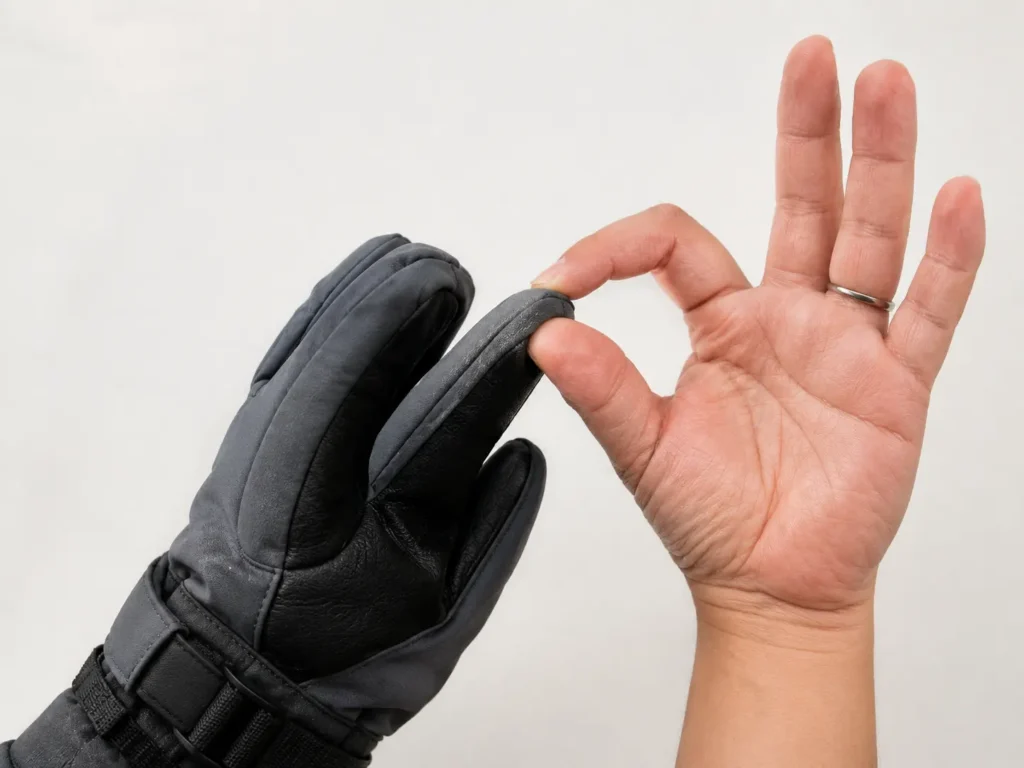
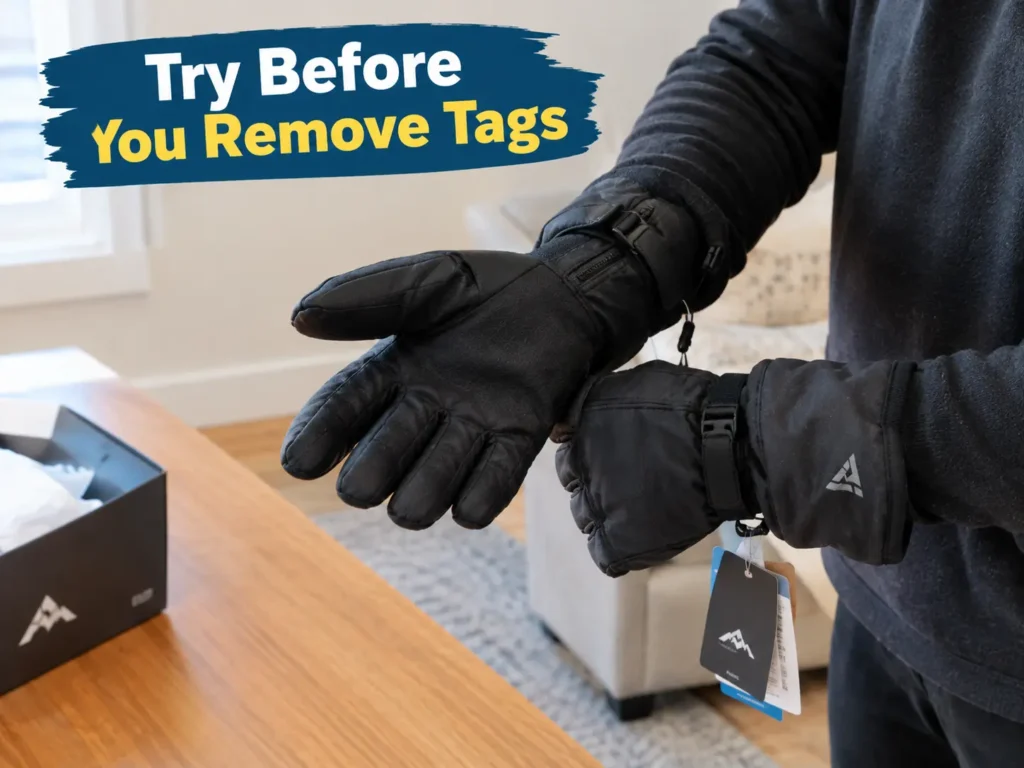
The easiest way to protect a purchase is to treat the first hour like an audition, and to hold it indoors. Put both gloves on, make ten tight fists, pick up a coin, work a zipper and a buckle, and wear them around the house while you do something ordinary like sorting laundry or typing. Fingertips shouldn’t press against the ends of the glove, and the palm shouldn’t wrinkle and bunch when you grip something. Keep the tags on and the packaging nearby while you do this, because stores that take worn gear back still expect it to come back clean and undamaged.
New leather can feel stiff at first, so it helps to separate stiffness from a real fit problem. Stiffness usually eases with a few days of wear. Pinched fingers, a cuff that won’t close over your jacket sleeve, or a thumb that sits in the wrong place won’t ease, and those are exactly the problems the return window exists for. Judge them in the first few days rather than in the last week before the window closes.
Measure before you order so the indoor test confirms your size instead of surprising you. Two numbers, hand circumference and hand length, checked against the brand’s own chart, prevent most fit returns. Our hand sizing walkthrough covers both measurements and the usual mistakes, and it’s worth ten minutes when the pair costs real money. If a chart puts you between two sizes, some buyers order both and send one back. That only works smoothly when the store gives unworn gear a long, no-fuss window.
Keep the pair clean while you test them. Retailers that accept worn items tend to ask for them clean, and some brands list incorrect washing or drying among the things they won’t cover. Read the care label before anything goes near a washing machine, and use the care tips routine that protects the waterproofing and the leather instead of quietly voiding your coverage.
Cheap Pair or Premium Pair: Where Coverage Really Changes
Price changes which safety net does most of the work. On a low-priced glove, the store’s return window is often the only protection you can count on in practice, so it makes sense to use all of it. Test indoors, judge the warmth on the first cold day you can still send them back, and don’t let a new pair sit in a closet until December. Some budget listings say nothing at all about a brand warranty, so look for a stated warranty on the listing or the brand’s own site before you assume one exists.
On a premium glove, the brand’s warranty adds real value, but it’s a defect warranty and not an insurance policy. It won’t replace a palm that wore through after a hard season, and it usually won’t cover a cut from a ski edge. A higher price doesn’t automatically mean more protection against the problems skiers run into most, which are wear, fit, and warmth. What the extra money buys on a premium pair is materials, liner systems, and repairability. That’s a different kind of value from coverage.
A simple way to think about it: divide the price by the number of seasons you expect the glove to last, then ask whether a warranty would even matter if it failed in season one. A $30 pair that gets you through two winters costs $15 a season. The two brands covered below both make the buyer pay to ship a claim in, so on a very cheap glove a claim can cost more than a replacement. If you’re still weighing options at that level, compare a few budget gloves against what you’re used to before paying extra for a name.
How Long You Really Have to Send Gloves Back
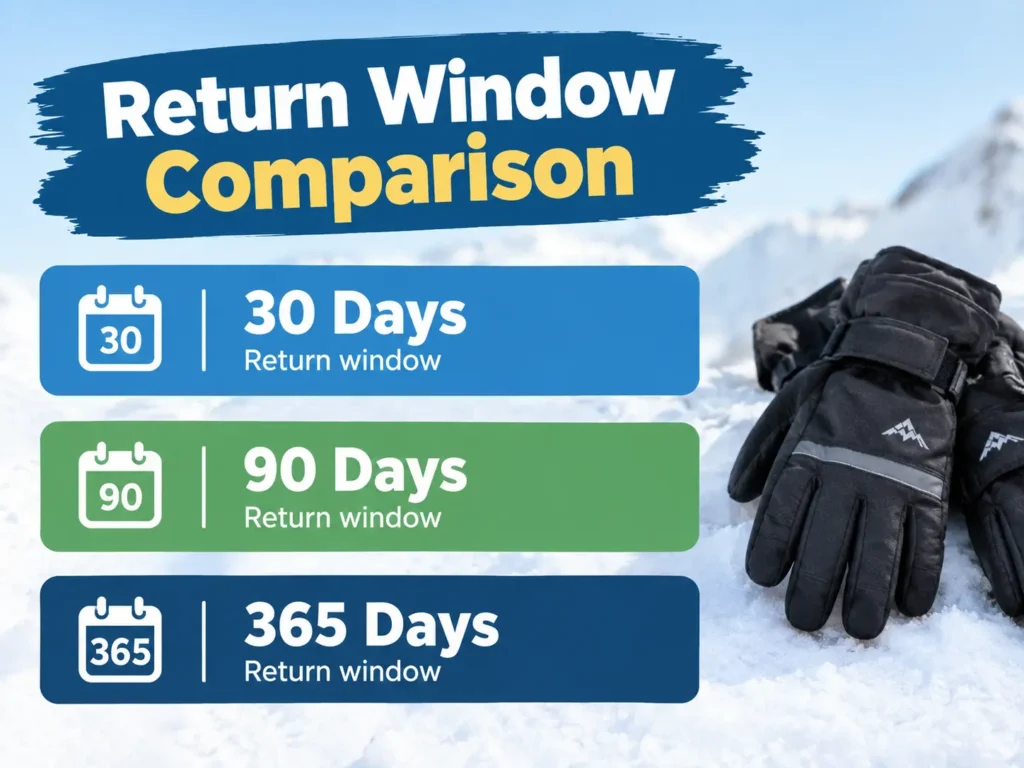
Return windows at big outdoor retailers vary more than most people expect, and they often split by whether the gear has been used. Backcountry’s policy page says unused gear can go back within 90 days of delivery for a full refund to the original payment method. Used, undamaged gear has to come back within 30 days, with proof of purchase, and it’s refunded only as store credit. That’s a real difference in what wearing a pair outside costs you, and it’s easy to miss at checkout.
The same page says the terms in effect on the day you return an item are the ones that apply, not the ones from the day you bought it. It also says a flat-rate return label costs $8.99, deducted from your refund, and that if the store decides an item isn’t eligible, it may not ship it back to you. That last point matters. Sending back a pair that’s dirty, damaged, or past the window can mean losing the pair and the refund together, so clean and inside the window is the safe combination.
REI runs on a different model. According to its published satisfaction guarantee as summarized in fall 2026, members get up to a year to return most items and non-members get 90 days. Outdoor electronics are limited to 90 days for everyone, and used gear is expected to come back clean. Mail returns can carry a shipping fee, while in-store returns are reported as free, so the in-store option is usually the cheaper one if a store is near you. Membership is a one-time fee, which is why the year-long window is often worth it if you buy several pieces of gear a season.
| Retailer | Unused gear | Worn but undamaged gear | Notes |
| Backcountry | 90 days from delivery, full refund to original payment | 30 days, store credit only | Return label fee is deducted; terms on the return date apply |
| REI (members) | Up to 365 days for most items | Accepted inside the window if clean | Outdoor electronics limited to 90 days |
| REI (non-members) | 90 days | Accepted inside the window if clean | Outdoor electronics limited to 90 days |
The REI figures come from its published policy as summarized in fall 2026, so confirm them on rei.com before you rely on them. The Backcountry figures come straight from its own policy page.
Two practical points follow from those numbers. First, Backcountry counts its window from delivery, not from the day you clicked buy, so a slow shipment doesn’t eat into your time. A gift bought in October, though, can run out of time before anyone opens it. Second, the gap between 90 days for cash and 30 days for credit means the single most expensive move at Backcountry is wearing a pair on snow before you’ve decided to keep it.
What a Brand Warranty Actually Promises
A brand warranty is narrower than the word suggests. Hestra states that it warrants its gloves against defects in materials and workmanship for their useful life, and its own warranty page adds a dry note that useful life is not the life of the wearer. Accidental damage and normal wear aren’t covered. Hestra decides whether a claim qualifies, and it repairs before it replaces; the page says most warranty cases are repairable.
Some of Hestra’s fine print surprises people. Warmth isn’t covered, because the company says every person and every day is different, so a glove that simply feels too cold is a return-window problem and not a claim. Natural markings in genuine leather aren’t defects. Buyers pay to ship gloves in for evaluation, though Hestra covers the trip back when a claim qualifies. Its heated styles carry a separate two-year warranty on the electronics, with a dated proof of purchase required.
Black Diamond’s published warranty follows a similar shape. Its apparel, which includes gloves, is warranted against defects in materials and construction for what it calls the practical lifetime of the product, and it says it doesn’t promise any particular lifespan. It lists fading, cuts, burns, abrasions, tears, stains, poor or incorrect fit, items bought used, and altered products as not covered. It repairs or replaces at its sole discretion, and a replacement doesn’t start a new warranty period. Proof of purchase is required, photos may be requested, and the buyer pays to ship a product in.
Notice what both companies actually promise. They’ll fix construction mistakes, but they don’t guarantee an experience. That’s normal, and it’s also what federal law allows a limited warranty to do, which comes up in a later section.
| Hestra | Black Diamond | |
| Covers | Defects in materials and workmanship | Defects in materials and construction |
| Length | Useful life of the glove | “Practical lifetime,” with no promised lifespan |
| The fix | Repair first; replacement only when a defect can’t be repaired | Repair or replace at the brand’s discretion |
| Not covered | Accidental damage, normal wear, warmth, natural leather markings | Wear, accidents, fading, cuts, burns, stains, poor fit, used or altered items |
| Shipping | Buyer sends in; brand pays the return trip | Buyer sends in; brand pays the return trip |
| Paperwork | Dated proof of purchase for heated electronics (two years) | Proof of purchase; photos may be requested |
Defect or Wear? How the Line Gets Drawn on Gloves
The hard part of any claim is deciding which side of the line your problem sits on, and gloves make that harder because they take more abuse per hour than almost any other piece of gear. As a rough guide, problems that show up early and don’t match how you used the glove tend to look like defects.
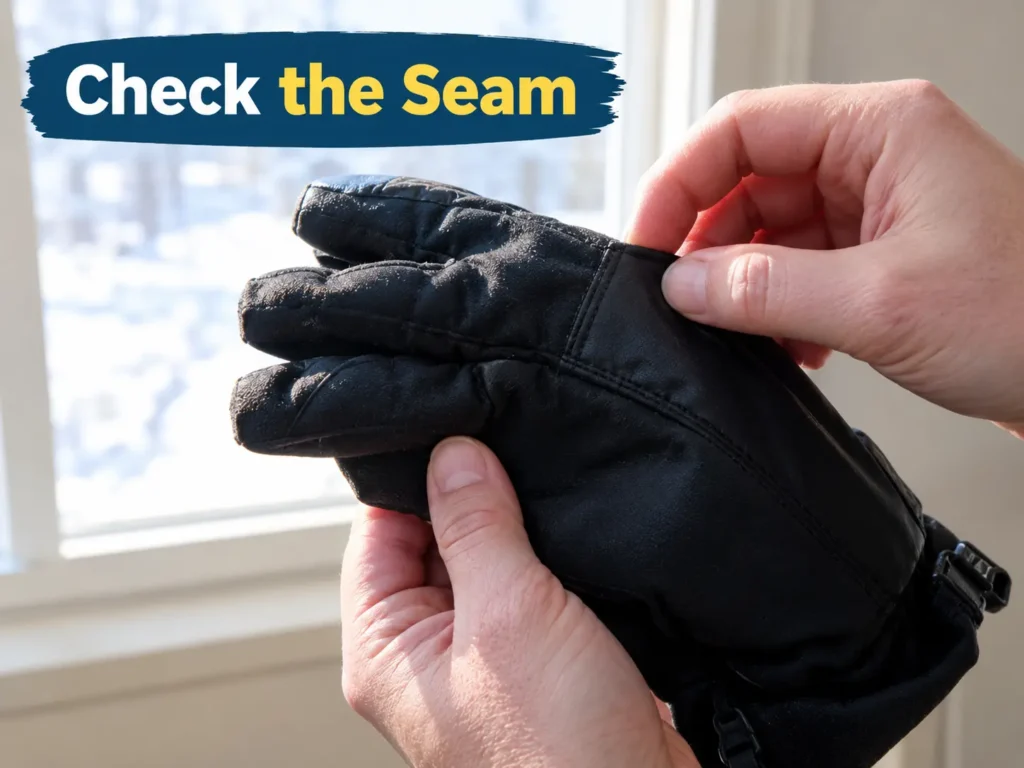
That includes a seam that splits in the first few outings, a lining that tears away from the shell, a waterproof layer that bubbles or separates, and a closure that fails the first time you use it. Problems that build up with use tend to look like wear: a palm gone smooth or thin, faded color, scuffs, or a cuff that has stretched out.
Gloves also pick up damage that no warranty touches. A slice from a ski edge, a burn from a heater or a drying rack set too hot, a stain from wax, a palm chewed up by a season of rope tows. Those are the kinds of damage brands listed by name as excluded. If you can point to a cause, it’s almost always an accident or wear problem and not a manufacturing one, and it’s worth checking whether a repair would cost less than the shipping on a claim.
Two details help your case. First, a claim is stronger when the glove has been washed and dried the way the label says, since Hestra lists incorrect washing, drying, or care among the things it doesn’t approve. Second, timing tells a story: a glove that fails in its first few outings looks very different from one that fails after two winters of weekly use, even if the failure is the same seam in the same spot.
| What you’re seeing | Likely category | Why |
| Seam splits within the first few outings | Possible defect | Early failure that doesn’t match normal use |
| Lining tears away from the shell early | Possible defect | Points to a construction problem |
| Waterproof layer bubbles or separates | Possible defect | Points to a material or bonding problem |
| Palm worn thin after a full season | Normal wear | Both brands exclude wear and tear |
| Faded color or logo | Normal wear | Black Diamond lists fading as not covered |
| Cut, burn, or tear from gear or heat | Accident or misuse | Named exclusions at both brands |
| Glove feels too cold | Not a warranty issue | Hestra says warmth isn’t covered |
| Fit feels off | Return-window issue | Black Diamond excludes poor fit |
Brands make the final call on every claim, so read “possible defect” as a reason to ask, not a promise of a fix.
The Federal Baseline Behind Every Written Warranty
No law forces a glove maker to offer a warranty at all. When a company does put one in writing, though, the Magnuson-Moss Warranty Act sets the ground rules, and the FTC explains them in plain language in its warranty guide. For consumer products costing more than $15, a written warranty has to be labeled clearly as either full or limited. A full warranty meets federal minimum standards, and a limited one doesn’t have to. Both Hestra and Black Diamond describe theirs as limited, which is why the exclusions above are allowed.
Another rule matters if you ever end up in a dispute. According to the FTC’s guidance for businesses, a company that offers a written warranty on a consumer product can’t disclaim the implied warranties on it. Implied warranties are the basic, unwritten promise that a product will work for its ordinary purpose. In practice that gives buyers a little extra footing when a glove fails in a way the written terms don’t spell out. It isn’t a shortcut to a free replacement, and brands still handle claims through their own process first.
State law can add rights too. Black Diamond’s own warranty text says the warranty gives you specific legal rights and that you may have others that vary from state to state. If a claim turns into a real dispute and the brand won’t budge, a state consumer protection office or an attorney is the right next step, not a longer email thread.
Where You Buy Changes What You Get
The same glove can come with different protection depending on the seller. Black Diamond says outright that it can’t control the quality of products sold by unauthorized sellers, and its published terms note that coverage can vary by where a product was bought and who sold it. Its warranty also extends only to the original end-user purchaser, so a pair bought used or handed down doesn’t carry it.
On big online marketplaces, check the “sold by” and “shipped by” lines before you order, not just the product name. A brand’s own store or an authorized retailer is the safest route to a warranty that will actually be honored. A third-party seller may well be offering a real, new pair, but if a claim comes up you could end up sorting out where the pair came from. If a price sits far below what every authorized shop charges, that gap deserves a second look.
Gifts follow the same rules with one extra wrinkle. Return windows count from the purchase or delivery date, not from the day someone opens the box, and stores generally want a receipt or gift receipt. If you’re buying gloves as a present, keep the order email and pass the gift receipt along with the box.
Building the Paper Trail Before You Need It

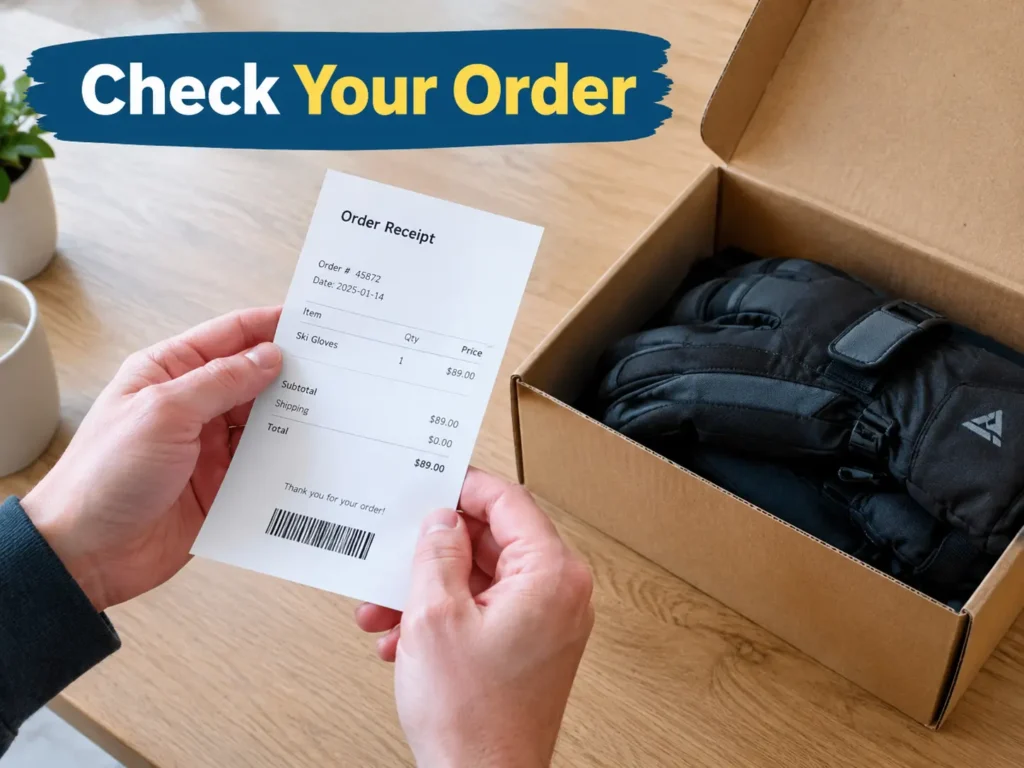
Almost every brand asks for proof of purchase, and some ask for photos. Take a screenshot of the order confirmation the day the gloves arrive and save it in a folder with the model name and size. Email receipts get buried and paper ones fade. Write the purchase date inside the box lid or in a note on your phone. Hestra requires a dated proof of purchase to establish coverage on its heated items, and Black Diamond requires proof of purchase for any claim.
If something fails, document it before you touch it. Take a close photo of the problem, a wider shot of the whole glove, and one of the size and care label. Don’t try a home repair first. Black Diamond excludes products that have been altered or modified by anyone other than the brand, and a quick fix can turn a valid claim into a denied one. A short note with the date you bought the pair, roughly how many days you’ve used them, and how you washed them saves a round of emails.
Then start in the right place. Backcountry’s own page says that if you spot a warranty issue within 30 days of purchase, you contact the store for a credit or exchange, and that later defects go through a separate warranty address. Most retailers follow a similar pattern, and the table below turns it into a quick decision.
| Where you are | Start with | Why |
| Still inside the store’s return window | The retailer | An exchange or refund is usually faster than a claim |
| Outside the window and it looks like a defect | The brand’s warranty team | Defect coverage runs on the brand’s terms |
| The problem is wear, fit, or warmth | The store, only if the window is still open | Warranties exclude all three |
| Bought from an unauthorized seller | The seller first, then ask the brand what it covers | Coverage can vary by seller |
Repairs Come First, and They Take Time
Warranty usually means repair. Hestra says it prioritizes repairing gloves whenever possible before it considers a replacement, and Black Diamond repairs or replaces at its own discretion and says a replacement doesn’t restart the warranty clock. Hestra’s claims page has also carried notices that processing slows down after the holidays. A claim filed in January can leave you without your gloves during some of the best snow weeks of the year.
If the pair is your only one, plan for that gap. A cheap backup pair to bridge a few weeks costs far less than a lost ski week, and it takes the pressure off you to accept whatever resolution is offered quickly. It also helps to file early in the season, when volumes are lower, than in the middle of a February rush.
Heated Gloves and Other Electronics Follow Their Own Rules
Anything with a battery sits on a separate clock. Hestra gives its heated styles a two-year warranty on the electronics, with dated proof of purchase, and says valid claims on heated styles are handled through replacement rather than repair. REI’s return window for outdoor electronics is 90 days for everyone, members included, according to recent summaries of its policy. Before you assume the longer window applies to a heated pair, check whether the retailer counts heated gear as electronics.
Test the heating on every setting the day the gloves arrive, not the night before a trip. A dead zone or a battery that won’t charge is a problem you want to find inside the return window, not after it. Charge, run, and check the warmth for an evening while you’re still free to exchange them.
Why Generous Windows Come With Strings
Retail Dive reported that REI stopped accepting returns from a small group of members with unusually heavy return habits. According to the company, that group averaged a 79 percent return rate and made up less than 0.02 percent of its 24 million members. Whatever you think of that decision, it shows that flexible windows are policed, and the people who use them as a rental service can lose the privilege.
Backcountry’s store-credit-only rule for worn gear is the other side of the same idea. Both policies are built around real fit and performance problems. If you use them that way, you’ll rarely run into trouble, and if you treat a return window as a free trial of the whole season, you eventually will.
Mistakes That Cost People Their Coverage
Waiting until the window is nearly closed is the most common mistake. A glove that seems fine on a mild December day can feel too cold on the first real January morning, and by then the 30 or 90 days may be gone. Test early, and try the pair in the kind of cold you actually ski in as soon as you can do it while still inside the window.
Wearing a pair outside “to really test them” before deciding is the most expensive one. At a retailer that splits unused and worn gear, it can move you from a 90-day cash refund to a 30-day store credit. If you can judge fit and feel indoors, do that first, and only take them out once you’re sure you’re keeping them.
Filing a warmth or fit complaint as a defect claim wastes weeks. Both brands covered here exclude those things by name, so the only place they can be fixed is the store’s return window, or by adjusting your setup with a different liner or another layer.
Fixing a problem yourself before contacting the brand, or washing the pair in a way the label forbids, gives the brand an easy reason to deny a valid claim. Leave the damage alone, photograph it, and ask first. The same goes for drying near a heater, which is one of the quickest ways to damage leather and glue.
Assuming a lifetime warranty means a lifetime pair is the last big one. Lifetime coverage on a glove means defects over its useful or practical life. It doesn’t cover the palm you wore through, and it doesn’t renew after a replacement.
Questions People Ask
Can I return ski gloves after wearing them?
Sometimes, the store makes the call. Backcountry takes used, undamaged gear back within 30 days as store credit. REI accepts used gear inside its window if it’s clean. Neither takes back gear that’s dirty or damaged, and both can refuse a return that doesn’t meet their rules.
Does a lifetime warranty cover a worn-out palm?
No. Hestra and Black Diamond both exclude normal wear and tear. A lifetime warranty on gloves means defects in materials or construction over the product’s useful or practical life, not a promise of a replacement whenever a pair wears out.
Do I have to pay shipping on a warranty claim?
For the two brands covered here, sending the gloves in is on you, and the brand pays for the return trip when the claim qualifies. Terms can differ elsewhere, so check the brand’s page before you ship anything.
Does a warranty carry over if I bought the gloves used or received them as a gift?
Black Diamond covers only the original end-user purchaser and excludes items bought and used. For a gift, the giver’s proof of purchase is the document that matters, so ask for the receipt or order email when you’re handed the box.
What if the gloves just aren’t warm enough?
That’s not a defect. Hestra says outright that warmth isn’t covered. If the return window is still open, send them back. If it isn’t, the fix is usually a different liner, another layer under the glove, or a warmer pair next season.
Are heated glove batteries covered for longer?
Hestra gives its heated styles a two-year warranty on the electronics, with dated proof of purchase. Other brands set their own terms, so check the listing or the brand’s warranty page before you buy.
Before You Order, and Before You Wear Them Outside
The steps that protect you are dull but they work. Measure your hand and check the brand’s own size chart. Buy from the brand or an authorized shop. Test the gloves indoors with the tags on and keep the order email somewhere you’ll find it. Know which window applies to your pair and mark the last day on a calendar. If something fails, photograph it before you touch it, then start with the store if the window is open and with the brand if it isn’t.
Return windows and warranty terms change, so treat the numbers in this article as a snapshot from fall 2026 and confirm them on the store’s or brand’s own page before you order.