
Quick answer: A ski glove that actually works for you comes down to five things: insulation weight matched to your coldest real conditions (not your average day), a fit that’s snug without compressing the insulation, a waterproof membrane rather than just a surface coating if you ski wet or heavy snow, a cuff style that matches how often you fall, and enough dexterity left over for the tasks you’ll actually do with gloves on. Get those five right and the brand name barely matters. If you’d rather skip the reading and get matched directly, the ski glove finder walks through these same factors and narrows it down based on your answers.
- What a Ski Glove Actually Needs to Do
- What Insulation Weight Numbers Actually Mean
- Insulation: Matching Weight to Real Conditions
- Fit Comes Before Everything Else
- Waterproofing: Membrane vs. Coating
- Cuff Style Depends on How You Fall
- Palm Construction and Grip
- Material Choices: Leather vs. Synthetic
- The Dexterity-vs-Warmth Trade-off
- What Extra Money Actually Buys
- Buying by Skier Type
- Common Buying Mistakes
- A Quick Decision Checklist
- Making the Decision
- FAQ
What a Ski Glove Actually Needs to Do
Before comparing features, it helps to be clear about the actual job. A ski glove has to keep your hands warm through a mix of active movement and stationary chairlift exposure, keep moisture out from both the outside (snow) and the inside (sweat), and still let you grip a pole and handle gear without fighting the glove itself. Most buying mistakes come from optimizing hard for one of those three jobs while ignoring the other two.
It also helps to separate the two environments a glove has to handle, since they’re almost opposite problems. Active skiing generates real body heat, so the glove mainly needs to manage that generated warmth without trapping too much of it. Standing still on a lift does the opposite — heat production drops fast, wind exposure often goes up, and the glove has to hold onto whatever warmth it already trapped instead of managing an excess. A glove built only around one of those two states tends to disappoint in the other.
What Insulation Weight Numbers Actually Mean
Most glove listings quote insulation in grams, and it helps to know roughly what those numbers mean before shopping by feel alone. Lighter fills in the 40-100g range suit mild, above-freezing conditions or high-output activity where you’re generating plenty of your own heat. Fills in the 100-200g range cover most standard resort skiing in typical winter cold. Above 200g moves into genuinely extreme-cold or low-activity territory, like lift operations or very cold, high-wind mountains. Anything toward the very top of that range is rarely necessary for active resort skiing and starts trading real dexterity for warmth you likely won’t use.
These numbers describe the insulation’s fill, not the glove’s real-world warmth on their own — fit, wind resistance, and how much time you spend stationary all shift how a given gram rating actually feels on the mountain. Treat the number as a starting filter, not a guarantee.
Insulation: Matching Weight to Real Conditions
The most common insulation mistake isn’t choosing a glove that’s too light — it’s choosing one rated for your average ski day instead of your coldest one. Chairlifts are colder than the slopes themselves, because sitting still generates almost no body heat compared to active skiing, so a glove that feels fine while moving can still leave you cold on every lift ride.
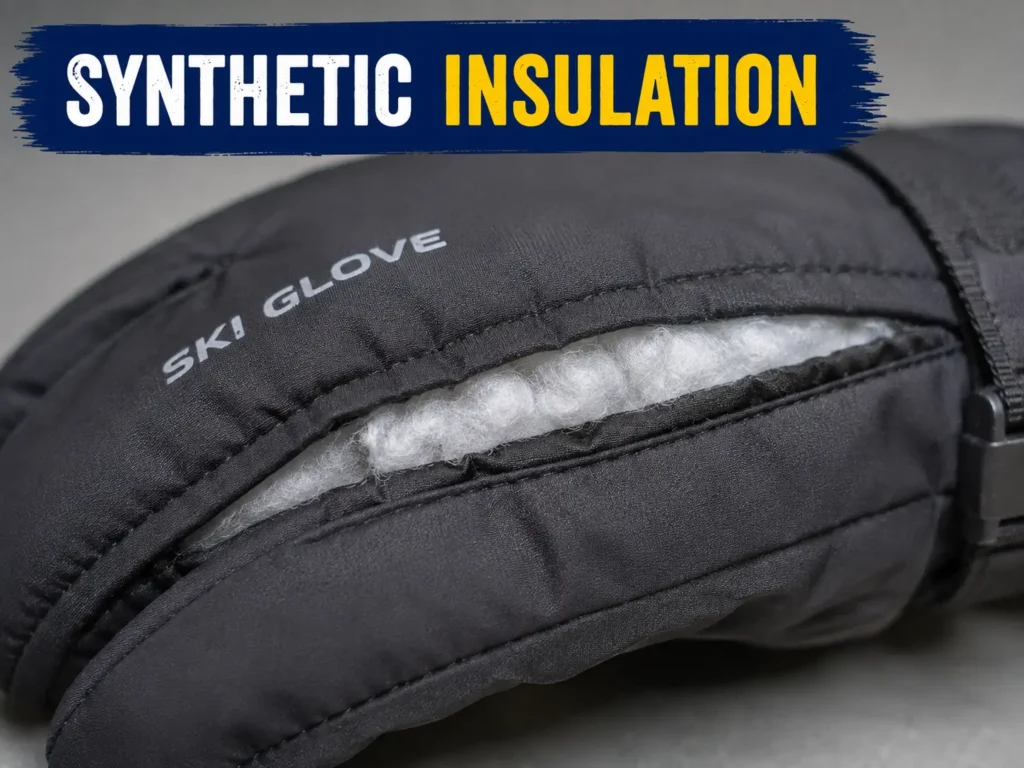
Insulation itself comes in two basic types, and the trade-off between them matters more than most buying guides admit. Down offers a better warmth-to-weight ratio but performs poorly once it’s wet, while synthetic insulation is heavier for the same warmth but keeps working when damp. A useful breakdown of this trade-off, including how each material actually traps warmth, is worth reading if you’re choosing between the two for the first time — most ski gloves lean synthetic specifically because snow exposure makes the wet-performance difference matter more than it would in a dry jacket.
Blended constructions exist too, pairing a down or down-synthetic fill core with a waterproof-treated outer layer specifically to close the wet-weather gap. These cost more than straightforward synthetic gloves, and for most resort skiers the added expense isn’t necessary — the wet-performance advantage of synthetic alone already covers typical ski conditions well.
Fit Comes Before Everything Else
A glove rated for genuinely cold temperatures can still leave you cold if the fit is wrong, because insulation only works by trapping still air, and a tight fit compresses that air right out. Too loose creates a different problem — dead air space that takes real time and body heat to warm up before you feel any benefit at all.
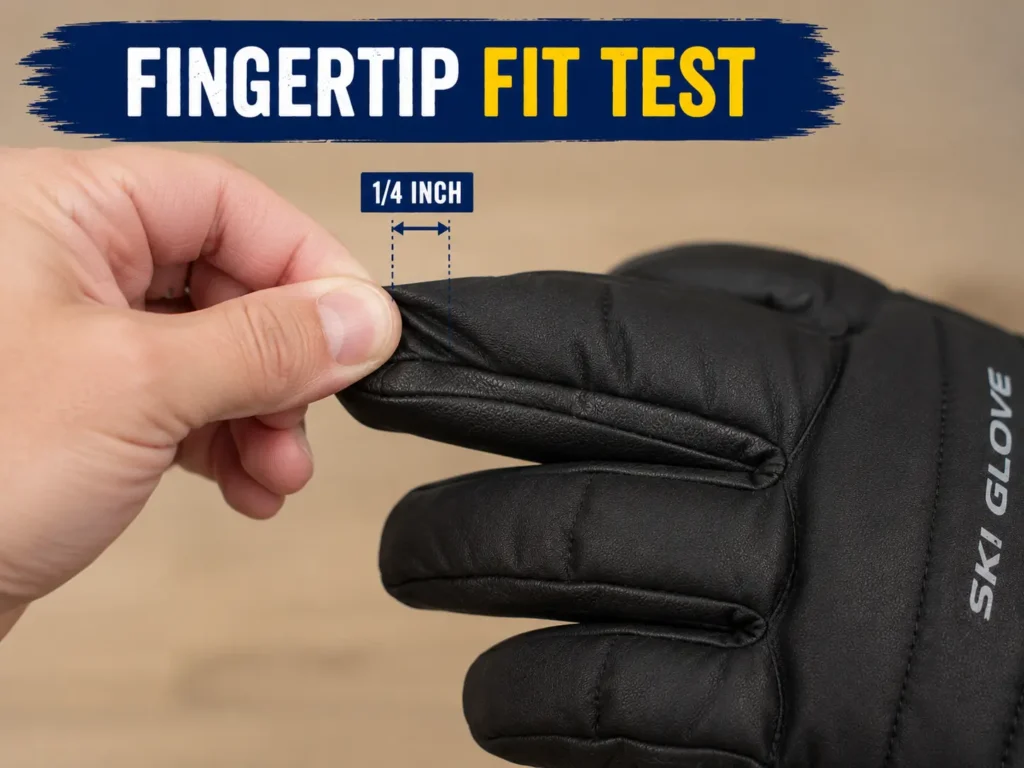
This is a big enough topic that it deserves its own full breakdown rather than a summary here — the fit guide covers the fingertip test, palm and knuckle fit, how much room a liner actually needs, and why cuff style changes what “correct size” even means. If you only read one linked page from this guide, that’s the one most likely to fix an existing cold-hands problem.
Waterproofing: Membrane vs. Coating
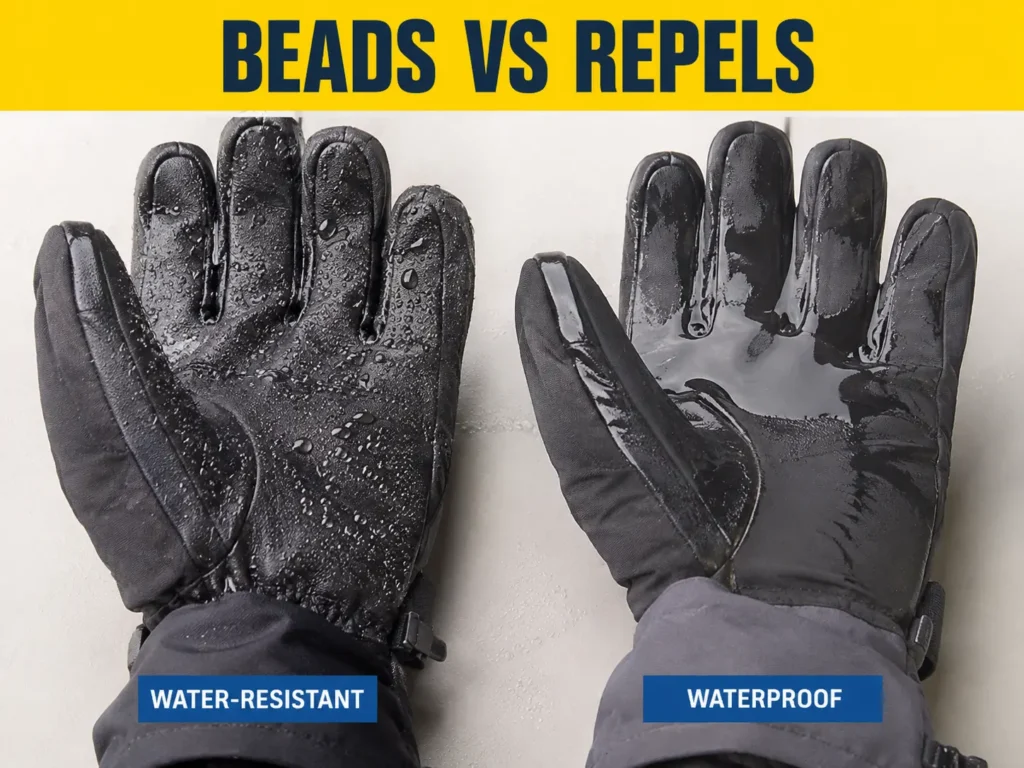
“Waterproof” on a glove tag can mean two very different things. A durable water-repellent (DWR) coating is a surface treatment that makes water bead off — it works well when new but wears off with use and washing. A waterproof membrane is a bonded layer inside the glove that keeps blocking water even after the surface coating has worn down.
The practical rule: if you ski mostly dry, cold powder, a DWR-only glove is usually fine, since the snow itself doesn’t melt on contact. If you ski wet snow, spring conditions, or fall often enough to grind snow into the surface repeatedly, a named membrane technology is worth paying for, since it keeps working long after the surface coating has given out.
There’s a breathability cost to consider alongside waterproofing, though. A membrane thick enough to fully block water can also slow how fast internal sweat escapes, which matters more on high-output days than most buyers expect. The better membrane constructions manage both at once, but it’s worth checking that a glove markets breathability specifically, not just waterproofing, if sweaty hands have been a problem for you before.
Cuff Style Depends on How You Fall
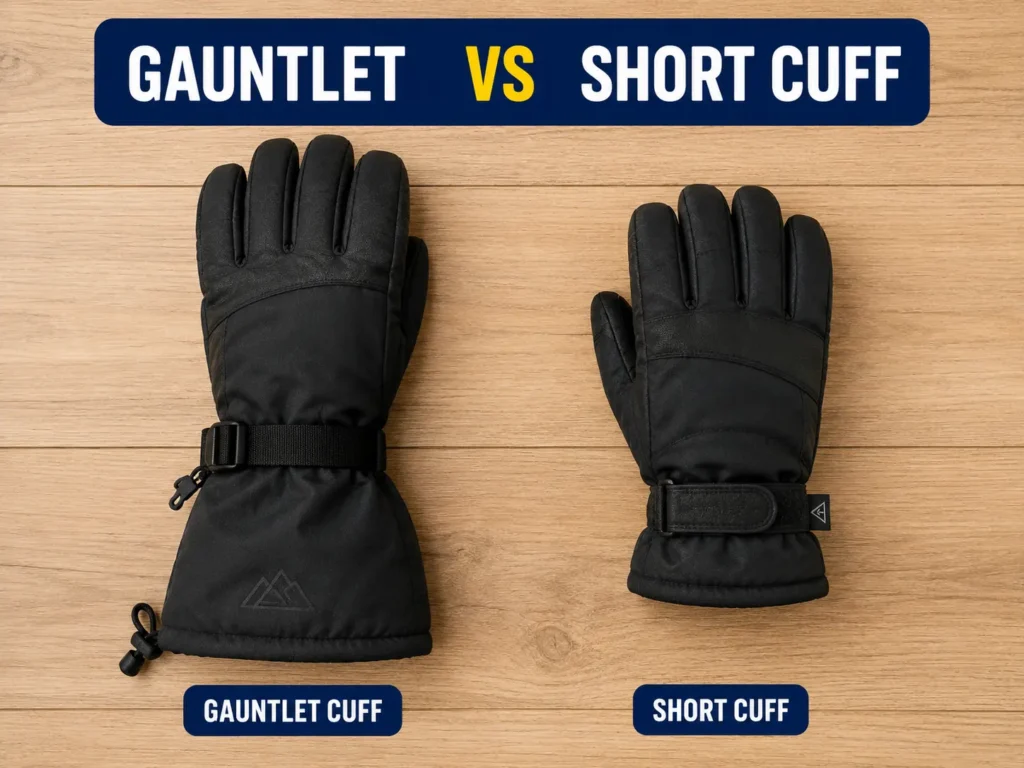
Gauntlet cuffs go over the jacket sleeve and seal the gap that would otherwise let snow reach the wrist during a fall. Short cuffs sit under the sleeve instead, trading that seal for less bulk and easier layering.
Which one matters more depends entirely on your actual fall pattern and terrain, which is exactly what the cuff comparison on this site breaks down in more depth — groomed-terrain skiers with infrequent falls can often get away with a short cuff, while anyone in powder or deep snow benefits from the gauntlet’s wrist seal on nearly every fall.
Palm Construction and Grip
Palm thickness is a direct trade-off between protection and feel, and it’s not just a comfort preference — it’s measurable. Ergonomics research on gloved grip strength has found that thicker glove material reduces both grip and feel compared to a bare hand, which is exactly why a heavily padded palm makes it harder to feel a pole handle precisely, even though it protects better in a fall.
For skiing specifically, where the hand’s main job is gripping a pole rather than absorbing repeated impacts, a thinner palm construction is usually the better trade. Palm padding heavy enough to matter for impact protection is more of a snowboarding priority than a skiing one.
Grip texture matters almost as much as thickness, and it’s easy to overlook when comparing gloves by spec sheet alone. A smooth synthetic palm can feel secure in a shop but slip more than expected on a wet pole grip, while a textured or lightly embossed palm surface holds grip through exactly the conditions — wet gloves, wet pole handles — where smooth material tends to fail first.
Material Choices: Leather vs. Synthetic
Full-grain leather palms grip well and age gracefully with proper conditioning, but they need that maintenance to stay supple — neglected leather cracks along the same flex lines every glove closes on. Synthetic (PU-coated) palms need no conditioning and resist water better when new, but they don’t self-heal the way leather does once a coating cracks or peels.
Neither material is objectively better; the honest trade-off is maintenance effort versus out-of-the-box water resistance. Someone willing to condition leather periodically gets a longer-lasting glove. Someone who wants zero upkeep is better served by a well-made synthetic palm.
A growing middle option worth knowing about is the hybrid palm — synthetic leather reinforced only at the highest-wear points, like the areas that contact a pole handle most directly, while the rest of the glove uses lighter, more breathable fabric. This isn’t better or worse than a full-leather or full-synthetic build, but it’s a reasonable middle ground for someone who wants some of leather’s grip without the maintenance commitment of a full leather palm.
The Dexterity-vs-Warmth Trade-off
Heavier insulation means less finger movement, and that’s a physical consequence of thicker material rather than a design flaw. The trade-off gets worse in genuinely cold conditions, since cold hands lose fine motor precision on their own, independent of how bulky the glove is — a real reason cold exposure guidance treats hand dexterity loss as a documented cold-stress effect, not just an inconvenience.
The practical fix for most skiers isn’t choosing less insulation — it’s a liner-plus-shell system instead of one maximally warm glove. That way the outer shell can stay closer to a dexterity-friendly weight while the liner adds warmth for the coldest stretches, and the liner can come off entirely for tasks that need real finger precision.
What Extra Money Actually Buys
Price differences between budget and premium ski gloves aren’t random, even though it can feel that way when two gloves look similar on a shelf. The jump usually buys three specific things: a named waterproof membrane instead of coating-only protection, better seam construction and reinforcement at high-wear points like the pole-contact palm zone, and more consistent sizing and cut quality across the size range.
That doesn’t mean the most expensive glove is automatically the right buy. A budget synthetic pair that matches your actual conditions will outperform an expensive pair mismatched to them — the money only pays off when it’s buying a feature you’ll actually use. Someone skiing five mild days a season doesn’t need the same glove as someone skiing forty cold, wet days, and paying for membrane waterproofing or heavy insulation that a mild, occasional ski schedule will never stress is money better spent elsewhere in a gear budget.

Buying by Skier Type
| Skier Type | Priority | What to Look For |
| Occasional resort skier, mild climate | Comfort and basic warmth | Mid-weight synthetic, DWR coating is usually enough |
| Regular skier, cold dry climate | Insulation matched to chairlift cold | Higher insulation weight, gauntlet cuff |
| Skier in wet or spring conditions | Waterproofing over warmth | Named membrane technology, breathable shell |
| Frequent faller, powder skier | Cuff protection | Gauntlet cuff, non-negotiable |
| Technical or icy-terrain skier | Dexterity and pole feel | Thinner palm, mid-weight insulation with liner option |
| Cold-sensitive hands | Warmth first | Heavier insulation or mittens over gloves |
| Kids learning to ski | Simple, durable, room to grow | Slightly loose fit, easy on/off, budget-friendly |
Common Buying Mistakes
Buying based on price alone, without checking whether the insulation and waterproofing actually match your conditions, is the single most common mistake — a cheap glove used exactly right can outperform an expensive one used in the wrong conditions.
Trying gloves on without the liner you actually plan to wear is a close second, since it’s the single easiest way to end up with a glove that fits perfectly in the shop and compresses uncomfortably on the mountain.
Choosing a cuff style purely on looks, without considering your actual terrain and fall frequency, is the third common mistake — the appearance trade-off is real, but it’s secondary to whether the wrist stays dry during a fall.
A fourth mistake worth naming separately: assuming a glove that worked perfectly at one resort will perform the same everywhere. Elevation, average humidity, and typical snow type vary enough between regions that a glove dialed in for dry Rocky Mountain cold can genuinely underperform in wetter coastal snow, even at a similar thermometer reading. If you split your season between very different climates, it’s worth weighting waterproofing higher than you would for a single-location skier.
A fifth mistake is ignoring how a glove performs specifically for the tasks around skiing rather than the skiing itself — working a phone at the lift line, handling a zipper with cold fingers, buckling a car seat before driving home. These moments add up over a season, and a glove that only performs well while actively holding a pole can still be the wrong daily choice.
A Quick Decision Checklist
- Know your coldest realistic condition, including chairlift wind, not your average day
- Try gloves on with the liner you’ll actually wear, not bare-handed
- Check for a named waterproof membrane if you ski wet or fall often
- Match cuff length to your actual terrain and fall frequency, not appearance
- Decide how much dexterity you need for tasks like bindings, zippers, and buckles before maximizing warmth
Making the Decision
None of these five factors work in isolation — a perfectly insulated glove with a bad fit performs worse than a lighter glove that fits correctly, and a great waterproof membrane doesn’t help if the cuff lets snow in from above it. Work through insulation, fit, waterproofing, cuff, and dexterity in that order, and most of the “which glove should I buy” confusion resolves itself without needing to compare dozens of specific models.
It’s also worth accepting upfront that no single glove maximizes all five factors at once — every real product on the market is a specific set of trade-offs, not a universal best answer. The goal isn’t finding the glove with the best score on every category; it’s finding the one whose particular trade-offs match how you actually ski, how cold your worst day gets, and what you’re doing with your hands beyond just holding a pole.
FAQ
Do more expensive ski gloves actually perform better?
Usually, but not automatically. Price tends to track membrane quality and construction, but it’s still worth checking the specific features above rather than assuming price alone guarantees the right glove for your conditions.
Should I buy gloves or mittens?
Mittens trade dexterity for warmth, since fingers sharing one compartment share heat more efficiently. If warmth is your priority over fine motor tasks, mittens are worth considering over gloves entirely.
How do I know if my current gloves are the real problem?
Run through the fit checks first — a surprising number of “bad glove” complaints are actually fit problems with an otherwise decent glove, especially once a liner is added.
Is it worth buying two pairs of ski gloves instead of one?
For frequent skiers dealing with genuinely variable conditions, yes. A lighter glove for mild or high-output days and a heavier one for genuinely cold days solves the insulation-matching problem better than any single glove can, since one pair optimized for the coldest day you’ll ever see will overheat on every mild day in between. It’s a real added cost, but for anyone skiing more than twenty days a season across a real temperature range, it usually pays for itself in comfort alone.