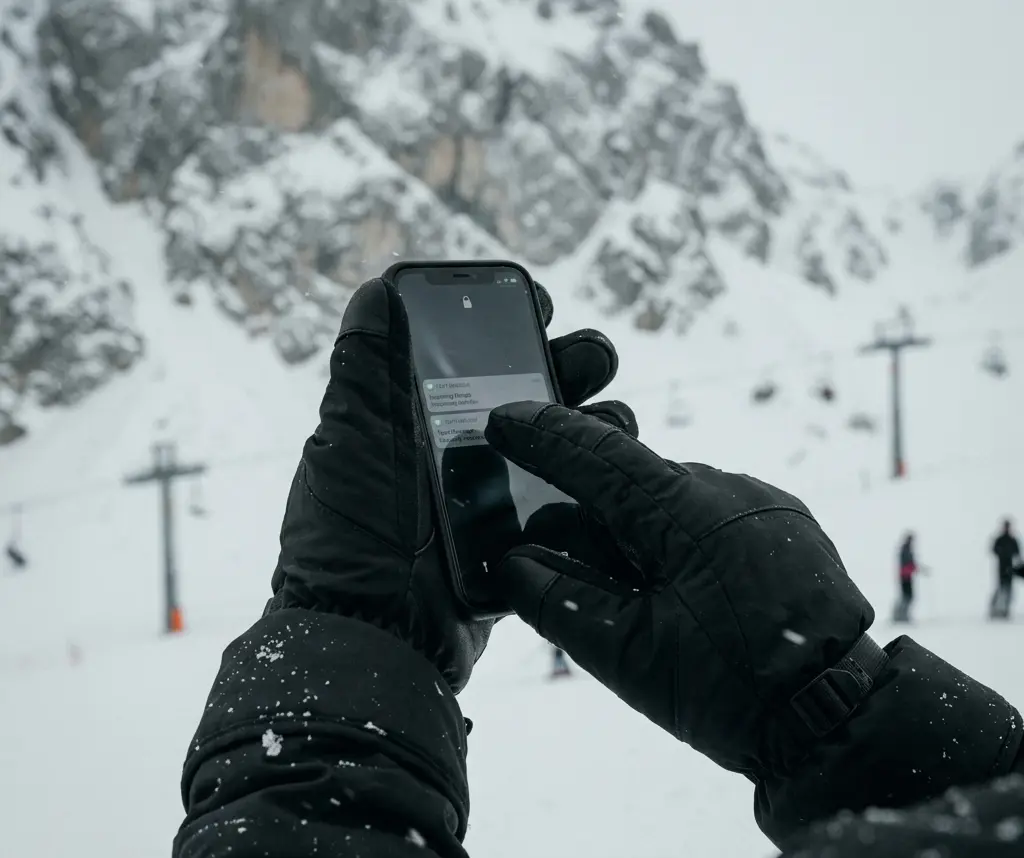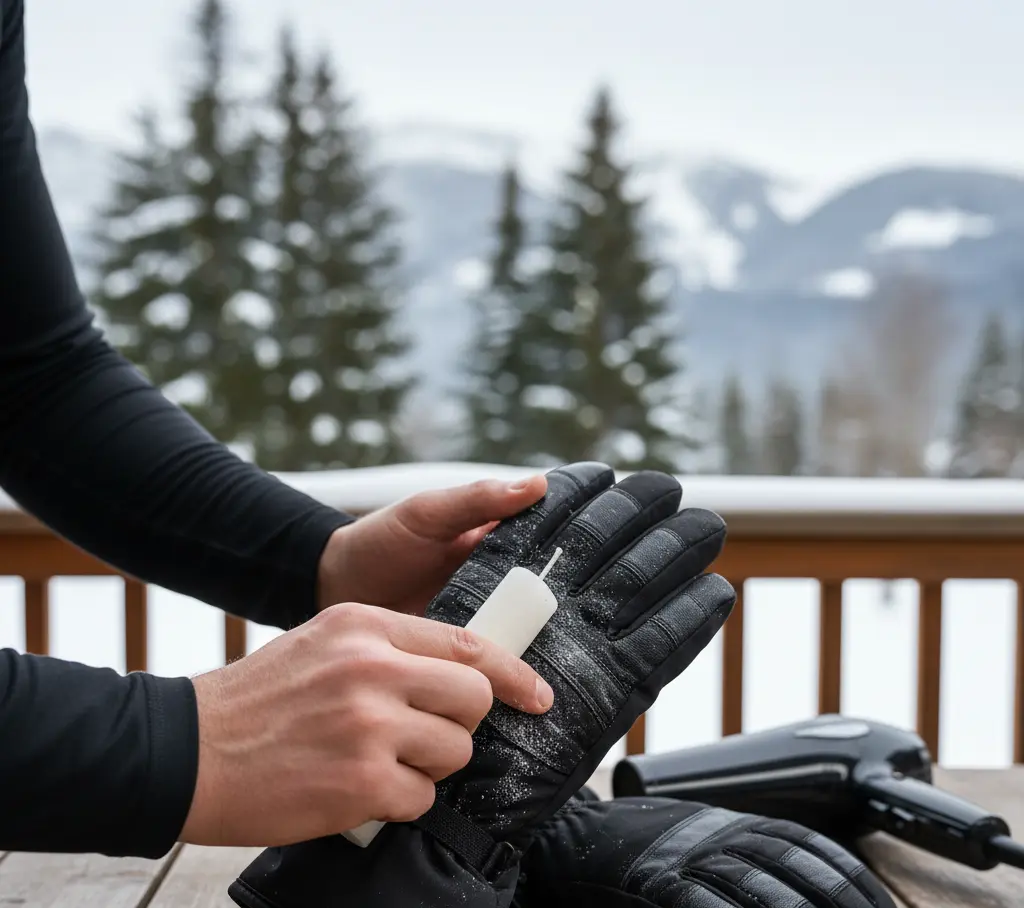
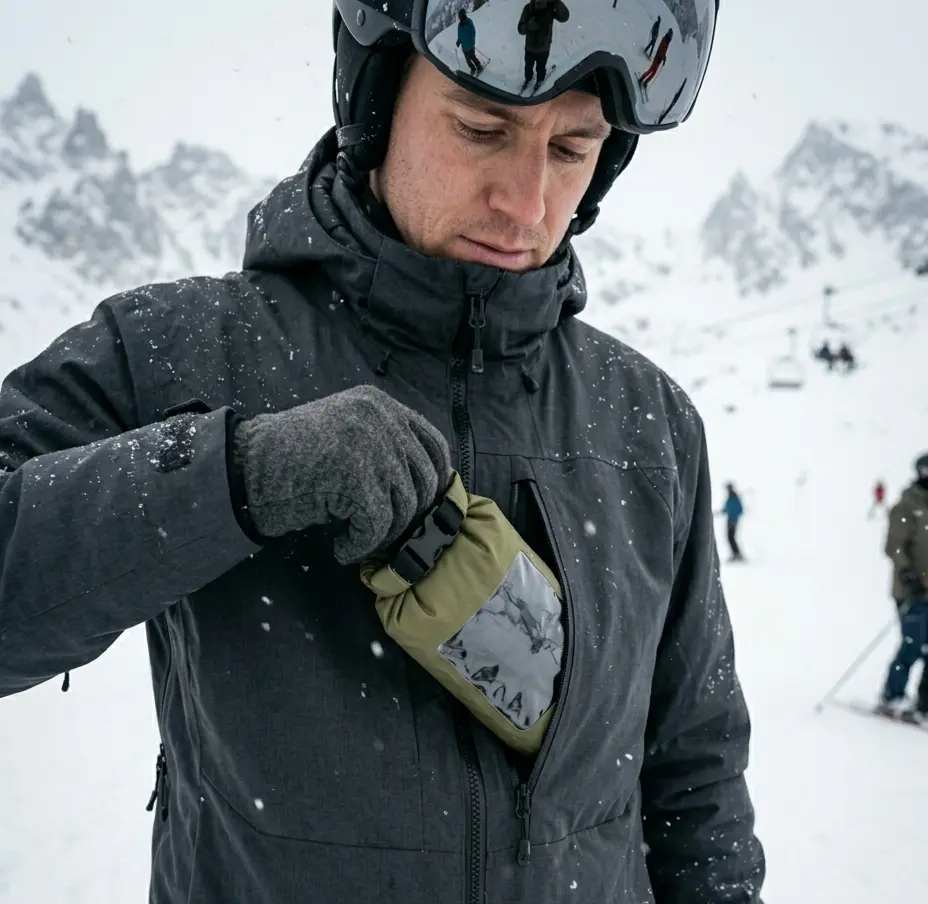
The best place to carry extra ski gloves on the mountain is your jacket’s interior chest pocket, with the spare pair compressed palm-to-palm and kept in a small dry bag or zip bag inside the pocket. This location keeps the spare gloves warm, dry, and accessible in under ten seconds without removing your pack or opening a zipper with cold hands. Knowing how to carry extra ski gloves correctly makes the difference between a quick swap that saves your ski day and a cold, wet search through your bag at the bottom of a run.
The two things most skiers get wrong about carrying extras are: they carry them somewhere they can’t reach easily with ski gloves on, or they carry them loose where they get wet from snow inside the pocket or bag. Both problems make the spare useless exactly when you need it. This guide covers every carrying location — jacket pocket, ski pack, cargo pants pocket, and lodge storage — with the specific technique for each one that keeps the spare dry and within reach.
What pair to carry and when to swap are separate decisions. This guide focuses specifically on how to carry the extra pair while you are skiing — where it goes on your body or bag, how to keep it dry in that location, and how to access it quickly when you need it.
Why a Spare Pair Changes Your Ski Day
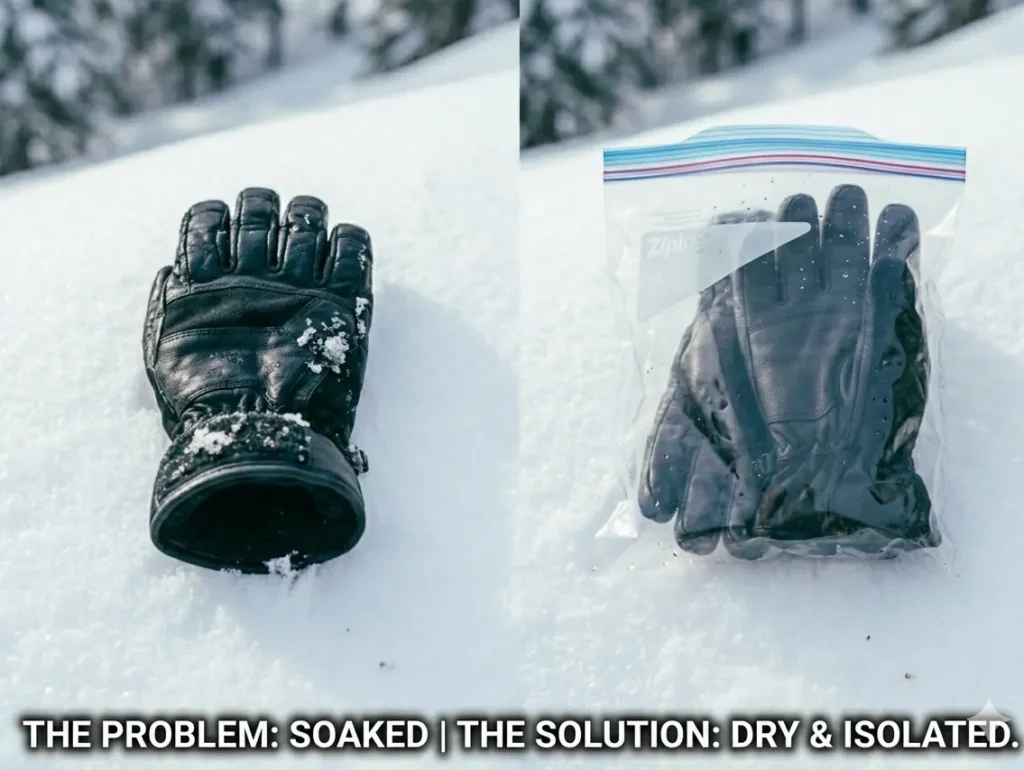
A glove that gets soaked through — from a wipeout in wet snow, from snow packed into the cuff, or from heavy moisture on a storm day — loses most of its insulation performance within thirty minutes of saturation. The insulation fibers, which work by trapping still air, cannot hold warmth once they are wet. At that point, you have two choices: ski with cold hands and end the day early, or put on a dry pair and continue.
Most ski days don’t end because of an injury — they end because your gloves get soaked too early. It is a soaked glove at 11am that makes the remaining four hours of the ski day uncomfortable enough to quit. A spare pair in the right location solves this completely. You swap at the chairlift, the wet pair goes in the pack to dry, and the day continues.
The reason carrying location matters: a spare pair stuffed into the bottom of a backpack, under a water bottle and a jacket, takes two to three minutes to retrieve in cold conditions with gloves on. By the time you have located it, unzipped the bag, moved items out of the way, and found the spare, your hands are cold from having both gloves off during the search. The right carrying location means the spare is out and on your hands in under fifteen seconds.
A spare pair is useless if you can’t grab it quickly with cold hands. If it takes more than 15 seconds to get to, your carrying location needs to change.
How to Carry Extra Ski Gloves — Every Method Explained
These are methods I’ve personally tested — what actually works, what doesn’t, and what most people get wrong.
Method 1 — Interior chest pocket of the ski jacket
This is the best location for most skiers. The chest pocket sits against your body, which keeps the spare pair at near body temperature — meaning you put on a warm dry glove rather than a cold dry glove. The location is also completely protected from falling snow and from snow that enters jacket pockets during falls.
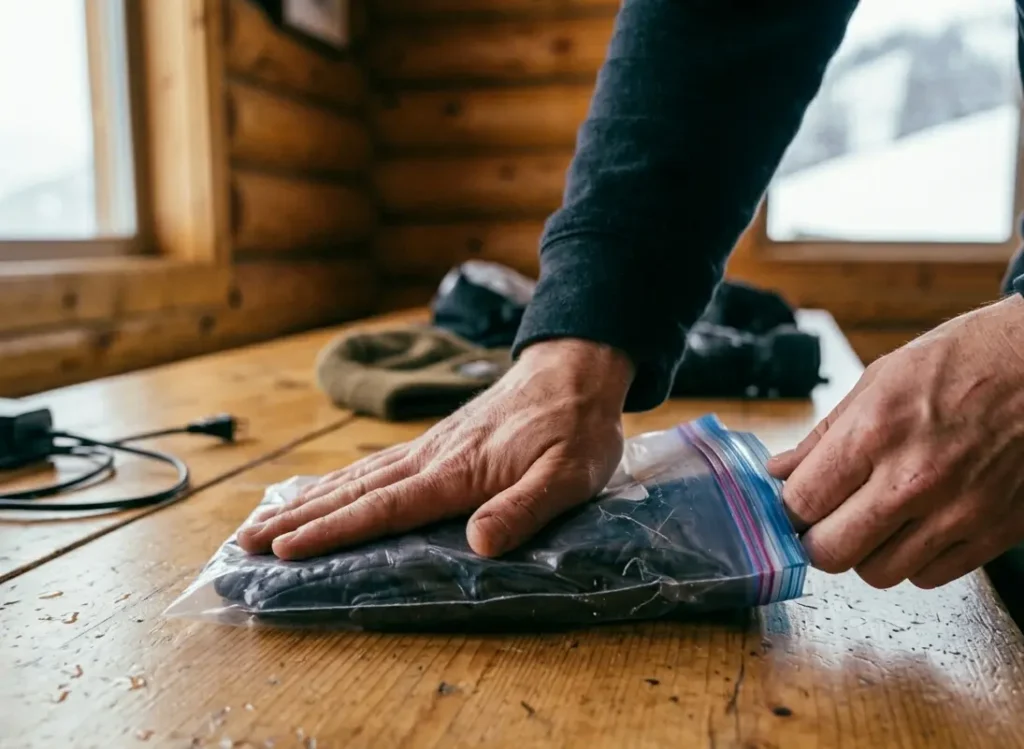
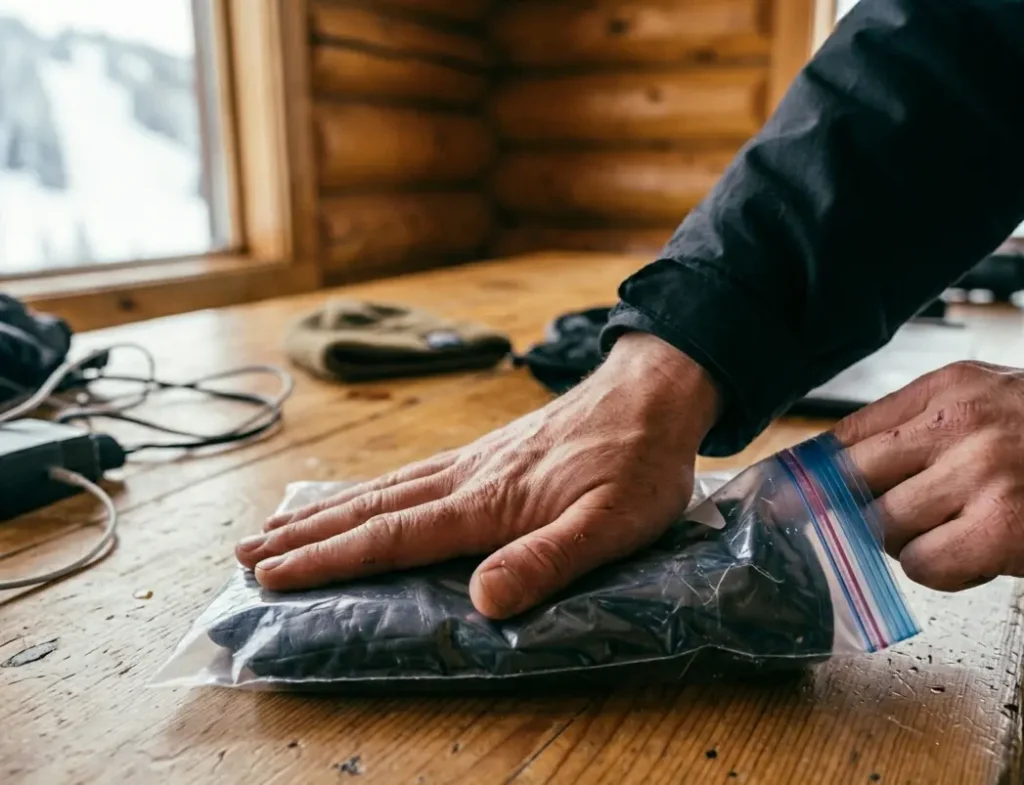
The technique for the chest pocket: press the two spare gloves palm-to-palm so the fingers of one glove align with the fingers of the other. This makes the gloves compact enough to fit easily into your pocket. Slide this unit into a small zip bag or dry bag first — this is important because chest pockets are not fully waterproof and body sweat can create some interior moisture over a long day. The zip bag ensures the spare stays dry regardless of what happens to the jacket. The flat palm-to-palm unit slides into most chest pockets without creating visible bulk.
The test for this method: put on your jacket fully zipped, reach across your body with your dominant hand to the chest pocket, and practice pulling the zip bag out with one gloved hand. If you cannot open the zip smoothly with a gloved hand, the zip bag is too small or the pocket zip is stiff. Practice at home before the ski day. On the mountain with cold hands, you want this to be automatic.
Method 2 — Inside pocket of the ski jacket (not chest pocket)
Many ski jackets have a secondary inside pocket lower on the torso, sometimes called a goggle or media pocket. This location is slightly harder to reach than the chest pocket but still protected from snow. For bulkier spare gloves — a full-size waterproof pair rather than a thin liner — this pocket sometimes provides more room than the chest pocket.
The limitation of the lower inside pocket: it sits further from body heat than the chest pocket, so the spare will be cooler when you put it on. In very cold conditions, a spare glove stored in a lower pocket for four hours will be cold to the touch when you need it. In moderate conditions this is fine. In extreme cold where your hands are already struggling, a cold spare adds discomfort before the warmth returns. For extreme colds, chest pocket is always better.
Method 3 — Ski pack side pocket or top lid
If you ski with a backpack — for backcountry, ivy gear, or hydration — the pack has multiple pockets that can hold a spare pair. The side pocket is the most accessible because it can be reached without removing the pack. The top lid pocket is the second most accessible for the same reason.
The problem with pack storage for spare gloves is that pack pockets are usually exposed to falling snow and are not body-warmed. A spare pair in a side pocket on a heavy snow day will be cold and possibly have snow packed around the zip bag by the time you need it. The solution is the same zip bag technique — the dry bag protects the spare from any moisture that enters the pack pocket. But the cold issue remains. Pack storage works well for moderate conditions and for skiers who ski with a pack regularly and know their pack layout.
The technique for pack storage: place the palm-to-palm compressed spare in a zip bag, then place the zip bag in the most accessible pack pocket. Before the ski day, practice reaching the pocket with both hands occupied by poles. The test: can you unclip the pack, open the pocket zip, and extract the zip bag in under twenty seconds? If not, the pocket is too difficult to access quickly in the field.
Method 4 — Thigh cargo pocket of ski pants
Some ski pants have large thigh cargo pockets with zip closures. These pockets are large enough for a compressed spare pair and are positioned where the thigh provides some warmth to the contents during skiing. The access test is the same — can you reach the zip and open the pocket with one gloved hand while standing on skis?
The limitation of thigh cargo pockets: during falls, the thigh takes impact and the pocket contents compress against the leg. A spare pair stored here can shift position or compress out of shape if falls are frequent. The pocket also sits further from the torso than jacket pockets, so the warmth benefit is lower. Thigh cargo pockets are a good secondary location — good for a thin liner pair or for conditions where falls are infrequent — but not the primary location for your main spare pair.
Method 5 — Lodge storage with rotation system
On heavy powder days with high fall frequency, some skiers use a rotation system: one pair on the hands, one pair hanging in the lodge to dry. At each lodge break — typically every ninety minutes to two hours — the pairs swap. The wet pair hangs on a hook or chair back near a heat source to dry, and the dry pair goes on for the next session.
This method requires that the lodge break is long enough for meaningful drying — at least twenty to thirty minutes. A five-minute snack stop does not produce a dry glove. The advantage is that the spare is always completely dry and warm when it goes on, because it has been drying in a heated space rather than sitting in a jacket pocket. The disadvantage is that the spare is not with you on the mountain — if you need it mid-run, you have to get to the lodge first.
Lodge rotation works best for skiers who already take regular lodge breaks and who are skiing in conditions wet enough to soak gloves within two hours. For casual groomed runs where gloves rarely get fully wet, lodge rotation is unnecessary. For heavy powder days with multiple falls, it is one of the most effective systems available.
Keeping the Spare Pair Dry — the Most Important Detail
A spare pair that is wet when you need it is not a spare pair. It is just another wet pair. The most common reason a spare carried all day is still wet when needed: it was not in a zip bag or dry bag, and jacket pocket moisture — from body sweat or snow that entered the pocket during a fall — got to it over the course of the day.
The zip bag system is simple and costs nothing if you have any zip-seal bag at home. This method works the same way as the drying techniques explained in our ski glove care guide. Put the compressed spare in the bag, squeeze out excess air, and seal it. The bag protects the spare completely from external moisture. It also keeps the spare compressed in its flat form so it does not expand and take up more pocket space than needed.
The dry bag alternative is better for skiers who regularly carry a pack and want a more durable solution. A small silnylon dry bag with a roll-top closure is fully waterproof, reusable across multiple seasons, and fits a compressed pair of gloves comfortably. Roll the top three times and clip it. This method is more secure than a zip bag in conditions where the pack gets submerged in snow during falls — which happens in deep powder.
One specific situation where the zip bag fails: if the spare gloves are put into the bag slightly damp — from the previous day’s use, or from being handled with wet hands — the bag seals moisture in rather than out. The spare arrives at your hands cold and damp because it has been sitting in a sealed environment with its own moisture all day. Always confirm the spare is completely dry before sealing it in the bag.
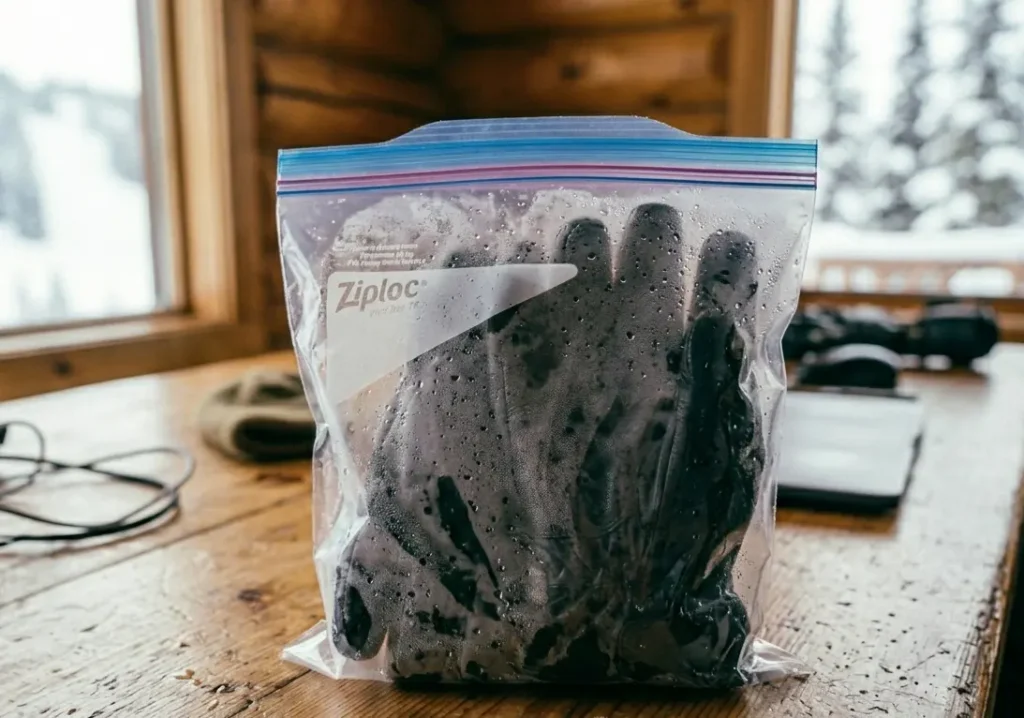
The zip bag protects the spare from external moisture getting in. It cannot protect against internal moisture from a spare that was damp when packed. Always start with a completely dry spare before sealing it.
What I Learned From Testing Every Carrying Method
I tested all five carrying locations across eight ski days in conditions ranging from cold dry groomed runs to heavy wet powder days. The test conditions for each location were identical: spare pair in a zip bag, checking dryness and temperature when accessed at the two-hour mark and at the end of the day.
The chest pocket was the clear winner on both temperature and dryness across all conditions. At the two-hour mark in cold conditions, the spare from the chest pocket was noticeably warmer than the spare from any other location. In wet conditions, the zip bag in the chest pocket kept the spare completely dry across a full day including two falls where the chest area made snow contact.
The pack side pocket was the most variable. On dry cold days it performed almost as well as the chest pocket for dryness. On wet days, snow that entered the pack pocket during falls made the zip bag wet on the outside — the spare inside stayed dry, but pulling the wet zip bag out and opening it with cold hands was noticeably slower than pulling a dry zip bag from the chest pocket.
The thigh cargo pocket was the worst performer for temperature. In cold conditions after two hours, the spare stored there was genuinely cold — not useful for pre-warming hands before a run in extreme cold. For moderate conditions it was fine. For any conditions where hand warmth was already a concern, the thigh pocket spare made the situation briefly worse before hands warmed up from the new pair.
The lodge rotation system, when executed properly with twenty-plus minute breaks, produced the warmest and driest spare of any method. But it requires committing to regular breaks, which not all skiers want. On days where I was trying to maximise ski time, the lodge rotation added friction that the chest pocket method did not.
One frustration from testing: the palm-to-palm compression technique I described above does not work equally well for all glove types. Heavily insulated gauntlet gloves do not compress as flat as mid-weight gloves, and fitting them palm-to-palm into a chest pocket requires more effort than fitting a lighter pair. For heavy gauntlet spares, the lower inside jacket pocket or pack top lid provides enough room without forcing the compression.
One thing surprised me during testing — I expected pack storage to perform much worse than it did on dry days. In a few sessions, it was almost as convenient as jacket storage. But the moment conditions turned wet, the difference became obvious.
Carrying Method Comparison
| Carrying Location | Best For / Limitation |
| Chest pocket — zip bag inside | Best overall — warmest, driest, fastest access; limited space for very bulky gauntlets |
| Lower inside jacket pocket — zip bag | Good for bulkier spares; slightly cooler than chest; still snow-protected |
| Pack side pocket — zip bag inside | Good for pack skiers; cooler than jacket; wet outside of zip bag in heavy snow |
| Pack top lid — zip bag inside | Accessible without removing pack; similar temperature and moisture to side pocket |
| Thigh cargo pocket — zip bag inside | Accessible; noticeably cooler spare in cold conditions; not ideal for extreme cold |
| Lodge rotation — dry at breaks | Warmest, driest spare available; requires committing to regular breaks; not available mid-run |
| Outer jacket pocket — no zip bag | Do not use — snow enters these pockets during falls; spare will be wet when needed |
How Pros Carry Spare Gloves (Real-World Insight)
Experienced skiers almost always carry spare gloves inside their jacket rather than in a backpack. The reason is simple — speed. When gloves get wet, the faster you can switch, the less time your hands stay exposed to cold air. Most advanced skiers prioritize access over storage space, which is why chest pockets are preferred over pack storage.
Mistakes That Make Your Spare Useless When You Need It
Carrying the spare in an outer jacket pocket without a zip bag. Outer jacket pockets are exposed to snow. During a fall, snow packs into the pocket opening and compresses against whatever is inside. Without a zip bag, the spare glove gets wet directly. With a zip bag, the spare stays dry inside the bag even if the bag itself gets snow on it. This single mistake accounts for most cases of ‘I had a spare but it was wet too.’
Carrying the spare at the bottom of a full backpack. A spare at the bottom of a full pack requires removing the pack, unzipping the main compartment, and moving items to reach it. In cold conditions with gloves on, this takes several minutes. By the time the spare is retrieved, hands have been cold long enough that the swap provides minimal immediate benefit. Always carry the spare in an accessible pocket, not buried in the main compartment.
Carrying the spare without compressing it first. An uncompressed spare pair of ski gloves takes up roughly the volume of two softballs placed side by side. Compressed palm-to-palm in a zip bag, the same pair takes up less than half that volume. The compressed spare fits in a chest pocket. The uncompressed spare often does not. Compression is the technique that makes jacket pocket carrying practical.
Starting the day without confirming the spare is dry. A spare that went into the zip bag slightly damp after the previous day’s skiing is damp throughout the day inside a sealed bag. It feels dry to the outside touch because the bag is dry. But when you open the bag and put the gloves on, the inside is damp. This is fully preventable — press the spare before sealing it in the bag. Any cool, dense feeling means it still holds moisture.
Carrying a spare that is the same weight as the primary pair. If your primary gloves are heavily insulated gauntlets, carrying an identical spare pair means double the bulk. A spare does not need to match the primary pair — it needs to keep your hands functional until you can get to the lodge. A lighter, thinner pair as the spare reduces carrying volume and still provides enough protection for the runs between the swap and the first lodge break. The spare is a bridge, not a permanent replacement.
Signs Your Carrying System Is Not Working
| Warning Sign | What It Means and What to Change |
| Spare is wet when you need it | No zip bag, or zip bag was sealed with a damp spare; fix both — dry the spare fully and always use a sealed bag |
| Spare is too cold to be comfortable immediately | Stored too far from body heat; move to chest pocket or use lodge rotation on cold days |
| Takes more than 15 seconds to access | Location requires too many steps; move to chest or inside jacket pocket |
| Cannot open the access zip with gloves on | Zip is too small or stiff; practice at home; try a different pocket with a larger zip pull |
| Spare has shifted out of compressed shape in pocket | Not in a zip bag; bag allows loose pair to expand and shift; always use a container |
| Spare takes up so much space it affects skiing | Wrong glove type for a spare — use a lighter liner or mid-weight as the spare rather than a full gauntlet |
What Your Conditions Require
Groomed runs, dry cold conditions
Fall frequency is low, gloves rarely get fully wet. A spare liner pair in the chest pocket is adequate. Full spare is not necessary for most groomed days unless temperatures are extreme enough that a wet glove from one fall would immediately become a cold hand problem.
Powder day with high fall frequency
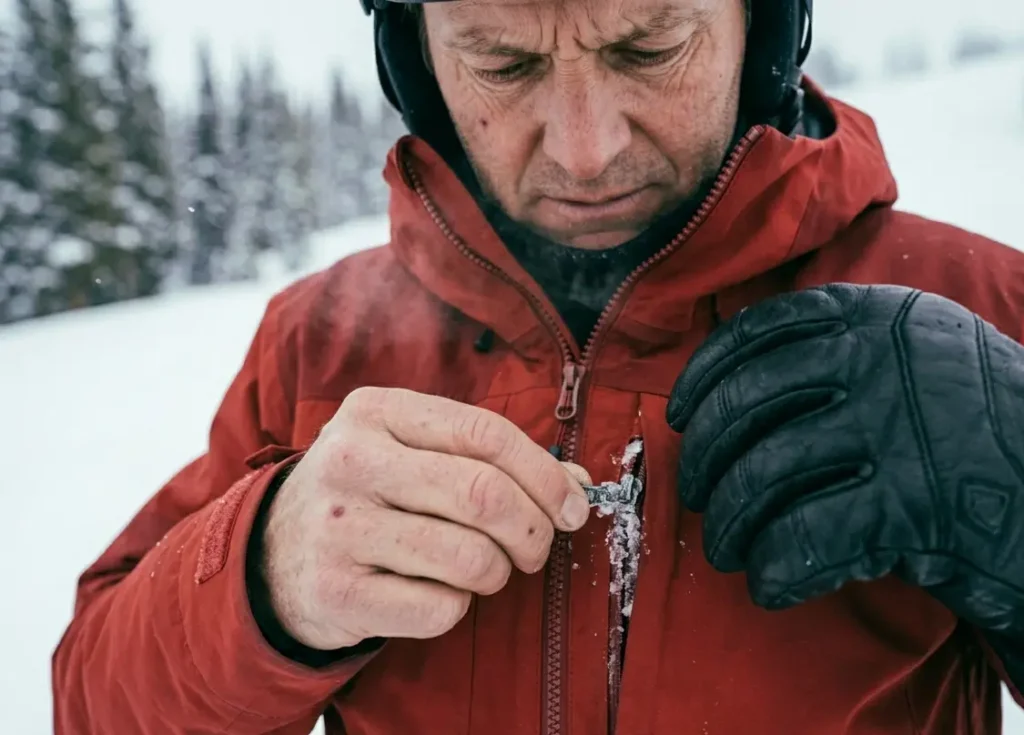
Each fall involves wrist and palm contact with snow. DWR coating saturates progressively through the morning. By midday, even a good waterproof glove may be letting moisture through if fall frequency has been high. Carry a full spare pair in the chest pocket. Consider the lodge rotation if breaks are regular.
Storm day with heavy snowfall
Snow enters pockets, builds up on jackets, and creates constant moisture exposure. This is the day when the zip bag inside the chest pocket matters most — external moisture is coming from everywhere. Chest pocket location is critical because outer pockets will have snow in them throughout the day. Lodge rotation is the best system for heavy storm days with regular breaks.
Spring skiing near zero degrees Celsius
Wet heavy spring snow saturates gloves faster than dry winter powder. Falls in spring slush produce more immediate moisture than falls in cold powder. A spare pair is more important on spring days than cold dry days, but a thinner pair works because temperatures are warmer and hand warmth is less of an immediate concern. Mid-weight spare in the chest pocket handles spring conditions well.
Half-day skiing
For two to three hour sessions, a spare is often unnecessary unless conditions are very wet or fall frequency is very high. Most gloves handle two to three hours of normal skiing without saturation. Skiers doing a half-day on moderate terrain in reasonable conditions can leave the spare in the lodge or car without meaningful risk.
Before You Leave the Lodge — Carrying Checklist
| Check This Before Skiing | Why It Matters |
| Spare pair is completely dry — press test confirms no residual moisture | A damp spare sealed in a bag stays damp all day; start dry or don’t bother carrying it |
| Spare is compressed palm-to-palm and sealed in a zip bag or dry bag | Compression makes it fit; the bag keeps it dry regardless of what enters the pocket |
| Carrying location confirmed — chest pocket, inside pocket, or pack pocket | Decide where it goes before you leave, not on the mountain when hands are cold |
| Access test done — spare retrieval practiced with gloves on | If you cannot get to it quickly with gloves on at home, you won’t be able to on the mountain |
| Zip or closure works smoothly with one gloved hand | Stiff zips become impossible with cold hands; address before going out |
| Spare is appropriate weight for conditions | Heavy gauntlet spare adds unnecessary bulk on dry groomed days; lighter spare is fine as a bridge pair |
Diagnosing Your Carrying Problem
I carried a spare but it was wet when I needed it. The spare was either stored without a zip bag, stored in a location where snow could reach it, or sealed in the bag while still holding moisture from the previous day. Solution: always use a zip bag or dry bag, always store in a snow-protected pocket, always confirm the spare is completely dry before sealing.
I could not get to the spare quickly enough. The carrying location requires too many steps. A spare in the main compartment of a pack behind other items, or in the bottom of a duffel, is not a spare you can access when you need it. Move to the chest pocket, inside jacket pocket, or pack top lid — locations that can be accessed with one hand in under fifteen seconds.
The spare was too cold and uncomfortable to put on in extreme cold. The carrying location is too far from body heat. The chest pocket against the torso is the warmest available location. If you are skiing in conditions cold enough that the spare temperature matters, the chest pocket is the only location that provides adequate warming. Lodge rotation is the alternative — warm spare available at every break.
The spare takes up too much space and affects movement. The spare pair is too bulky for jacket pocket carrying. Try a lighter spare — a thin liner or a mid-weight glove rather than a full gauntlet. Or switch the carrying location to a pack pocket where volume is less of a constraint. The spare does not need to match the primary glove in warmth or construction; it needs to be functional for the runs between the swap and the lodge.
When Carrying a Spare Is Not Necessary
Short groomed sessions of two hours or less in dry cold conditions rarely require a spare pair. Standard waterproof gloves handle this duration without saturation unless conditions are very wet or the skier falls frequently. For a two-hour morning lap on groomed terrain in dry cold, leaving the spare in the car or lodge is a reasonable choice.
Skiers who have a lodge available every thirty minutes on a small resort can leave spares in the lodge rather than on their body. The rotation system requires access to the lodge, but when the lodge is always close, it is simpler and more effective than carrying the spare on the mountain. The on-body carrying methods in this guide are for resorts where the lodge is not always within easy reach.
Skiers using very high-end heavily waterproofed gloves in dry powder conditions may find that the primary pair never approaches saturation across a full day. In this case, a spare adds weight and bulk with no practical benefit for those specific conditions. The carrying decision should be re-evaluated for each trip based on the actual conditions expected — not carried automatically regardless of what the day looks like.
For tips on what spare pair to choose — liner versus mid-weight versus full replacement — and how to store gloves in the lodge so they are warm and dry when you swap into them, those decisions are covered in Ski Glove Care Tips That Actually Work.
About the Author
Awais Rafaqat has spent over 15 years testing ski gear across North America — from the dry sub-zero conditions of the Rockies to the wet, heavy snow of the Pacific Northwest. His focus is real-world performance: what gear actually does in the conditions skiers encounter, not what the spec sheet says it should do.
© SkiGlovesUSA.com — Carrying methods tested across eight ski days in varied conditions. No sponsored product mentions. Last updated March 2026.