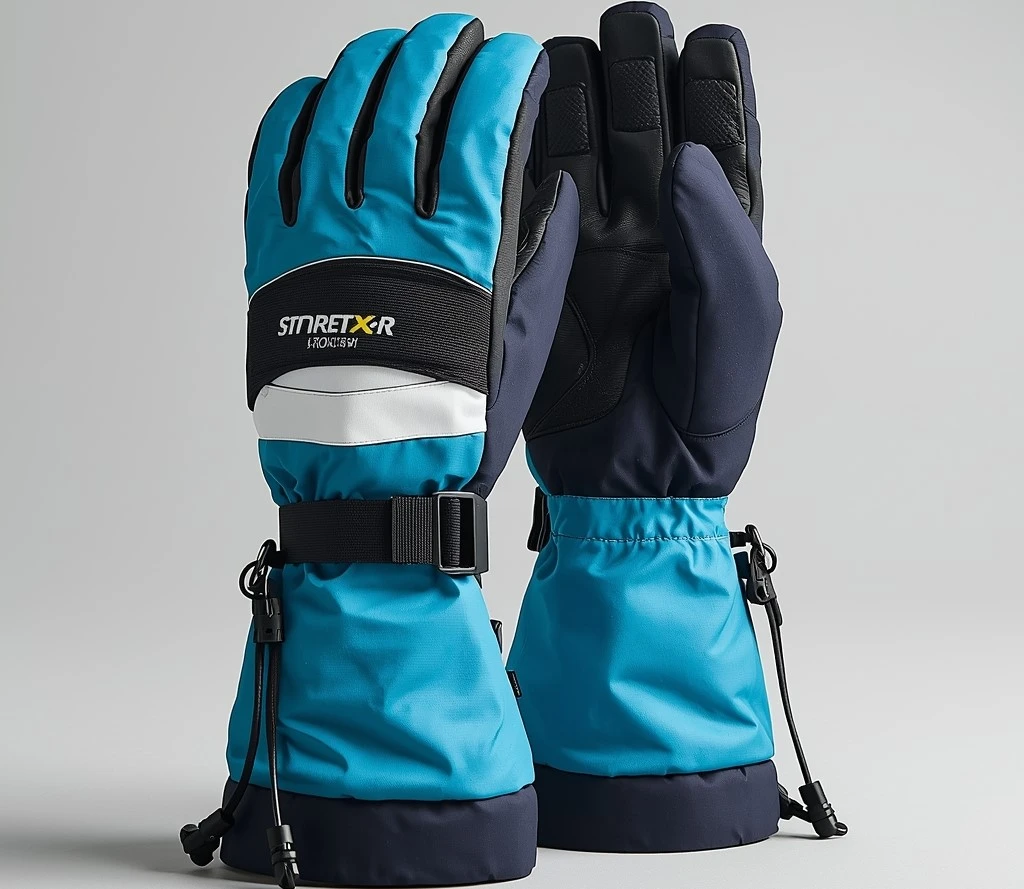
If your ski gloves get lost, damp, or crushed during travel, your entire first day on the mountain is compromised. Packing ski gloves sounds simple, but small mistakes — like where you place them or packing them slightly damp — can leave them smelling, flattened, or unusable when you arrive.
To understand how to pack ski gloves for travel, you have to get these three things right.: where in your luggage the gloves go, how they are positioned so the insulation does not get permanently compressed, and whether they are fully dry before they go in. Get any one of these wrong and you’ll notice it — either your gloves feel colder, or you end up spending money fixing the mistake at the destination.
This guide covers all three — the carry-on versus checked decision with the reasoning behind it, the physical positioning inside your bag, how to protect insulation from compression during long flights, and what to do in specific situations like one-bag travel, multi-day trips, and airline bag size restrictions. The focus here is packing specifically.
Quick Answer: How to Pack Ski Gloves for Travel
- Always pack your main gloves in your carry-on
- Make sure gloves are completely dry before packing
- Stuff gloves with soft items to maintain shape
- Place gloves at the top or side of your bag
- Avoid plastic bags unless gloves are fully dry
Carry-On or Checked Bag — How to Decide
Start with a simple question: if your checked bag did not arrive at the destination, could you ski the first day without those gloves? If the answer is no, the gloves go in your carry-on. If you have a backup pair or access to a replacement at the destination without significant cost or inconvenience, the checked bag is fine.
Airlines lose or delay checked bags on roughly one in every hundred flights according to DOT Air Travel Consumer reports. That sounds low until you picture standing at baggage claim in Innsbruck or Salt Lake City watching every other bag come out while yours does not. Ski resorts are often two hours from the nearest outdoor gear retailer. A delayed bag on the first day of a five-day trip means either skiing without your gloves or buying expensive lodge replacements.
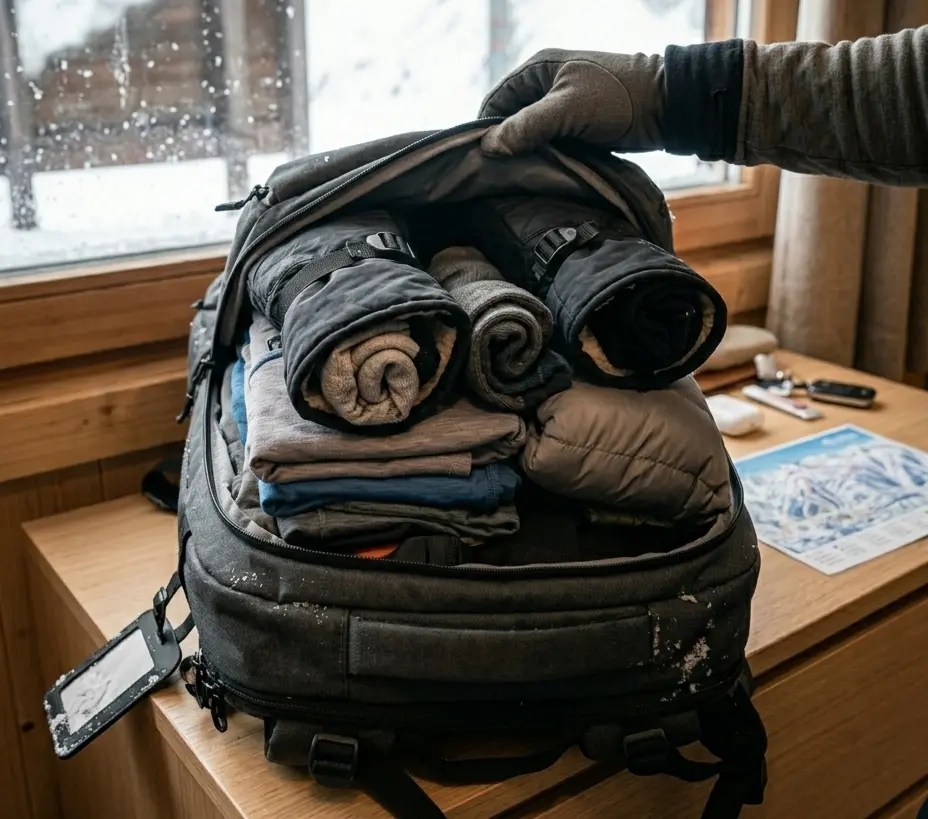
The carry-on concern most skiers have is space. A pair of ski gloves takes up roughly the same volume as two packed fists placed side by side. In a standard carry-on backpack or rolling bag, this is manageable. The trick is to use the empty space inside the gloves— rolled socks, a beanie, or a thin base layer stuffed inside the fingers and palm fills the interior without adding bulk, and allows the gloves to sit flat against the side of the bag rather than taking a full cubic foot of premium bag space.
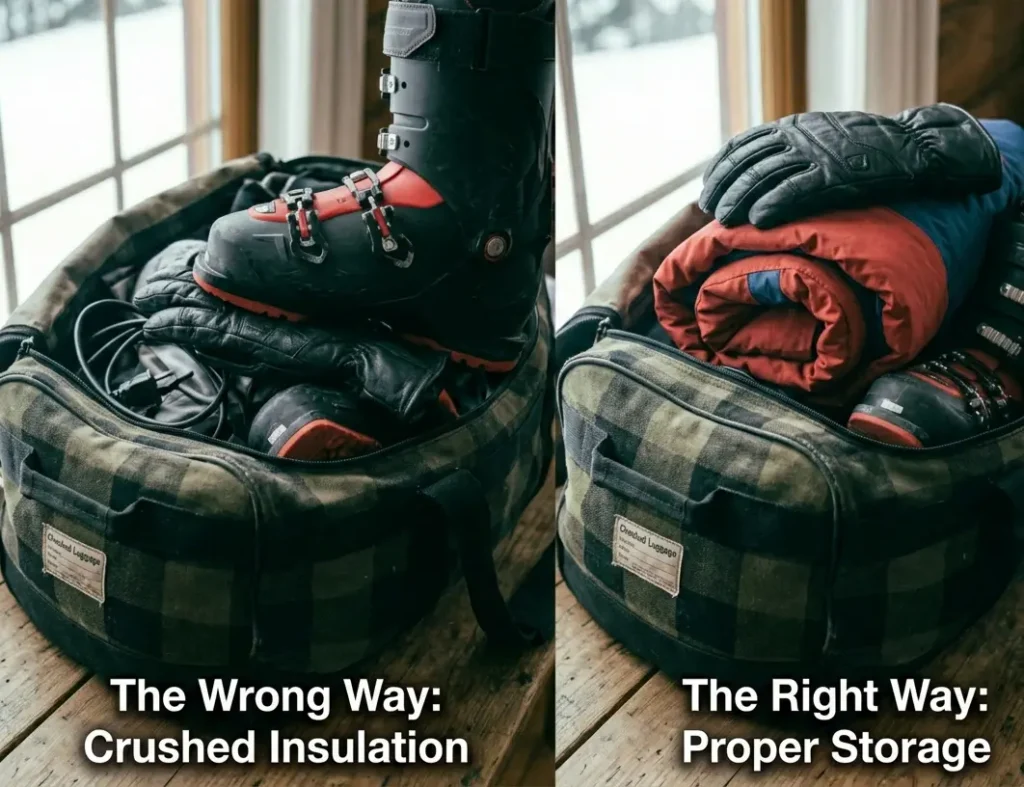
One pair that matters = carry-on. Backup pairs or budget spares = checked bag. This is the rule that experienced ski travelers follow. The carry-on pair is your insurance against a delayed or lost bag on day one.
How Packing Position Affects Insulation — What You’re Actually Protecting
Ski glove insulation works by trapping small pockets of still air between the fibers. When the insulation is compressed and held in that compressed state for a long time — like the eight to twelve hours of a long-haul flight — the fibers can take a set in the flattened position. This means the gloves come out of the bag feeling thinner and less warm than when they went in, and it takes several hours of use before the insulation fully rebounds. For a first-day powder run in cold conditions, this matters.
Think of it like a down jacket that has been sitting in a compression sack for a month. When you first shake it out, it looks flat and feels less warm than normal. Given time and air it rebounds, but it does not feel the same immediately after being packed. Ski glove insulation behaves the same way. The difference is that a down jacket compression sack is designed for that use. A suitcase corner where a boot has been sitting on top of your gloves for eight hours is not.
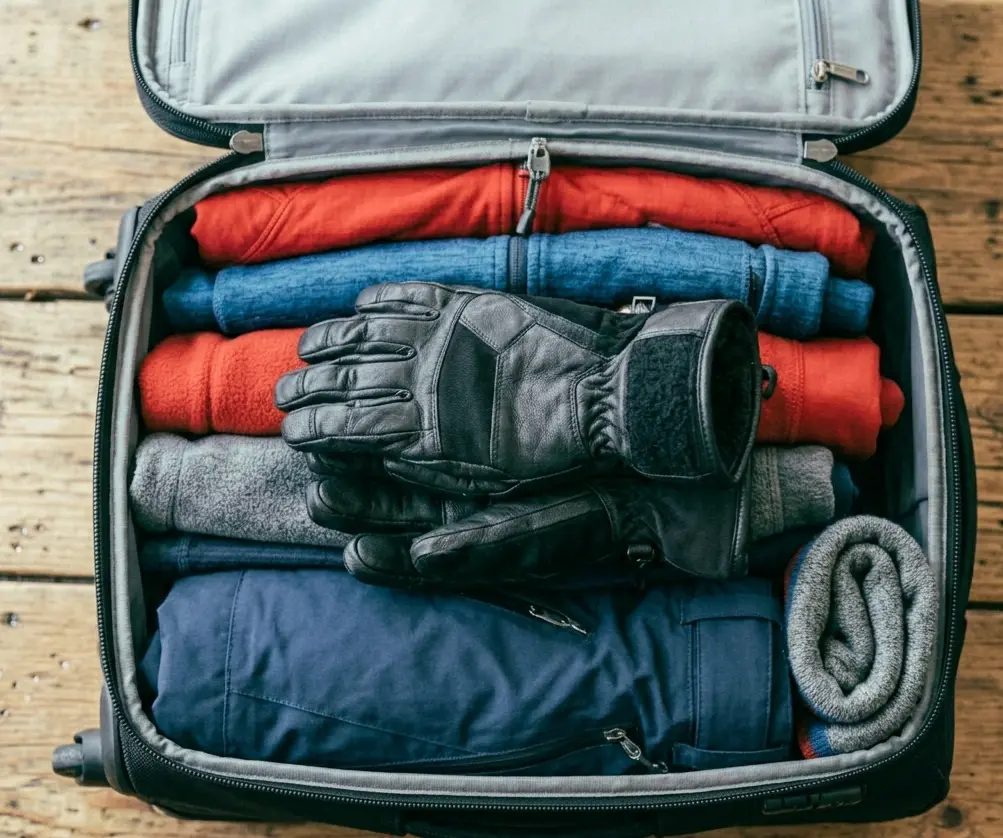
The position that protects insulation during packing is placing gloves at the top of the bag or along the sides — the zones that receive the least pressure from surrounding items. A glove placed at the very top of a packed bag, with clothing above it rather than boots or hard items, experiences almost no compression across a flight. If the gloves are placed at the bottom of a checked ski bag with boots, a helmet, and a jacket piled on top is under significant sustained pressure.
For carry-on bags, gloves can go at the top of the bag nearest the zip for the same reason — they get compression from clothing above but not from hard items. The specific placement that consistently produces the best results in testing: gloves at the top layer of a carry-on, palm-to-palm and fingers pointing toward the bag opening, with a soft item like a hat or base layer loosely placed over them. This position protects the finger tips — the zone with the least insulation volume and the most vulnerable to compression — from contact with any hard item.
How to Pack Ski Gloves for Travel — Step by Step
Step 1 — Confirm the gloves are completely dry
Do not skip this step. A glove packed while still holding any moisture — even just feeling slightly damp rather than wet — will develop odor in the sealed bag environment of checked luggage within eight hours. Leather gloves that go in damp can crack as they dry in the pressurized cargo hold environment. Pack only gloves that pass the press test: squeeze the back-of-hand zone firmly. If it feels cool or dense, it is still holding moisture.
Step 2 — Fill the interior of each glove with something soft
A rolled pair of socks, a lightweight beanie, or a folded thin base layer packed inside the fingers and palm achieves two things: it prevents the fingers from folding flat under compression, and it uses the interior dead space that would otherwise be wasted. The stuffed glove holds its shape better than an empty one. This is the same principle used by shoe retailers who stuff shoes with tissue paper for transport.
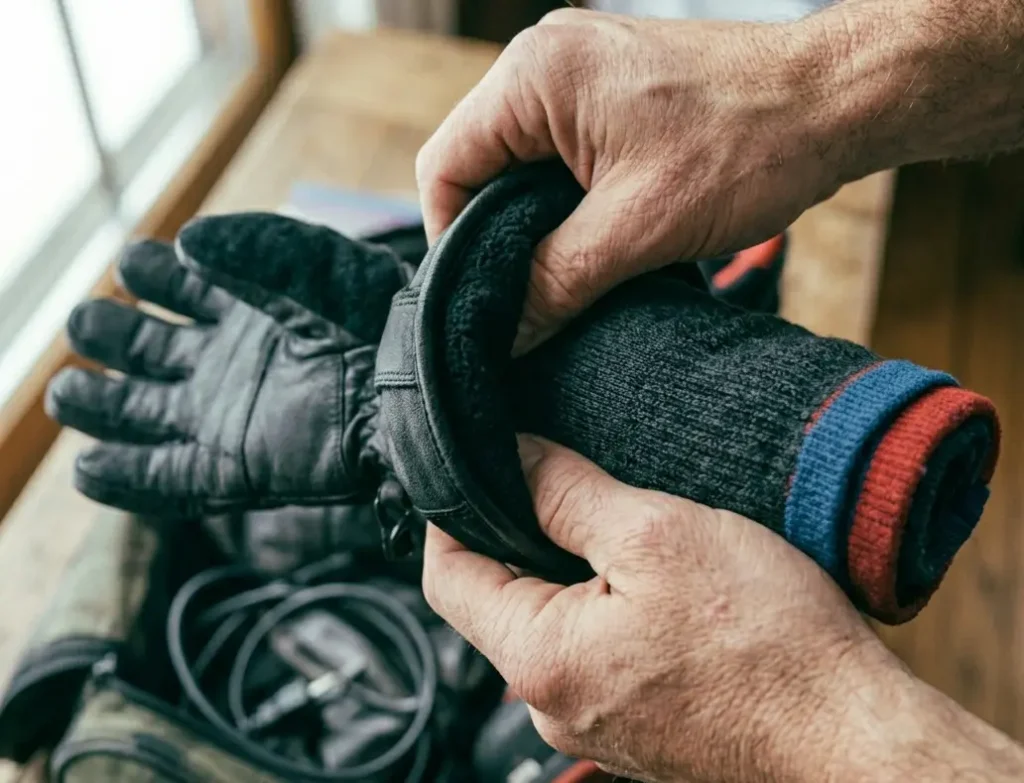
Step 3 — Place gloves palm-to-palm
Lay the two gloves with their palms facing each other and fingers aligned. This creates a single compact unit rather than two separate bulky items. The cuff zones can be folded slightly inward to reduce overall length. The palm-to-palm position distributes any external pressure across both palms simultaneously rather than concentrating it on one.
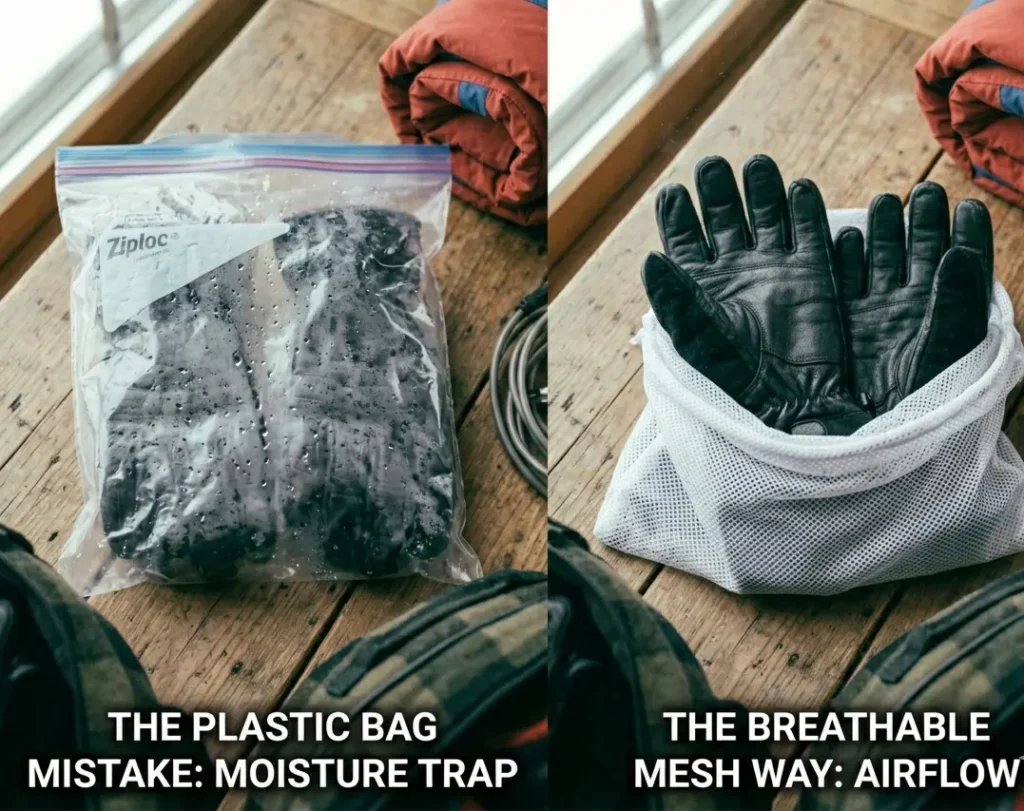
Step 4 — Choose a breathable container, not a plastic bag
A mesh bag, a pillowcase, or a fabric stuff sack is the right choice. A plastic zip bag is not, unless the gloves are already bone dry and you are protecting them from wet items in the same bag. Plastic prevents any remaining moisture from escaping and creates the sealed warm environment where bacteria grow fastest. Even a zip bag with a small gap left open at one corner is better than fully sealed.
Step 5 — Place the contained gloves at the top of the bag or against the side
Top of the bag means maximum distance from boots and hard items at the bottom. Against the side means the glove is supported by the bag structure rather than by compression from other items. For a checked ski bag or duffel, this means gloves go in last, after everything else is positioned. For a rolling suitcase, gloves go in the top layer of clothing rather than underneath it.
Step 6 — For carry-on, claim overhead space early if possible
The overhead bin above your seat is first-come, if you board late the bin may be full and your carry-on goes underneath the seat in front of you. A bag under the seat in front gets compressed between that seat and the floor, and anything soft in it gets that pressure. If you are checking your carry-on at the gate — which happens often on full flights — put the gloves in your personal item instead, the bag that goes under the seat in front where you control what is on top of them.
Step 7 — Keep leather gloves separated from synthetic items
Leather can transfer color to adjacent items in a bag, particularly if it gets warm in cargo hold conditions. A fabric stuff sack prevents this. It also prevents the DWR coating on synthetic gloves from picking up the natural oils from leather — this is a minor issue but one that shows up after multiple trips of packing leather and synthetic gloves in direct contact.
What Actually Happens When You Pack Gloves Wrong
Packed with moisture in a plastic bag — smell within eight hours. Here’s what actually happens in real use. A warm, moist, sealed environment is exactly what bacteria in the glove lining need to multiply rapidly. A glove that had no detectable odor at the end of the ski day can have a strong smell by the time the bag arrives at the destination.
Example: you ski your last run, come in, pack your gloves quickly because you have an early flight, and they go into a zip bag slightly damp from a wet day. You land twelve hours later and open the bag. The smell hits you immediately. This is not a function of glove quality — it is a function of packing a moist item in a sealed container.
Packed under boots in a ski duffel — reduced insulation loft. Example: you pack your ski bag with boots at the bottom, clothing in the middle, gloves somewhere in the middle under the jacket. For a twelve-hour checked flight, the boots — each weighing two to four kilograms — are sitting on the items above them, which includes your gloves.
The insulation in the gloves is compressed under this weight for the duration of the flight. You arrive, put the gloves on, and they feel thinner than normal. They are thinner than normal. The loft comes back partially over the first hour of use, but it does not fully rebound immediately.
Carry-on gate-checked at the last minute — gloves compressed under the seat. Example: you board late, every overhead bin is full, gate agent takes your carry-on as a checked bag. Your gloves, which were at the top of the carry-on specifically for protection, now go into cargo with the rest of the bags. Or, if your carry-on fits under the seat in front of you, the compression from that position is significant for a long flight. This is why gloves on important trips should be in your personal under-seat item — the bag you keep — rather than the overhead carry-on.
One pair in checked bag, bag delayed. Example: connecting flight through a hub, the connection is tight, your checked bag misses the transfer. You arrive at the ski resort for a three-day trip with no gloves. The resort ski shop sells a mid-range pair for significantly more than retail. You buy them, they are adequate but not what you chose for the trip. This is the scenario that makes experienced ski travelers carry their primary gloves every time without exception.
Carry-On vs Checked — Side-by-Side Comparison
| Factor | Carry-On vs Checked |
| Risk of loss or delay | Carry-on: essentially zero — you have the gloves with you. Checked: roughly 1 in 100 flights; higher on connections |
| Insulation compression risk | Carry-on: low if positioned at top of bag. Checked: higher — especially in full ski duffel with boots |
| Space cost | Carry-on: uses roughly the volume of two fists — manageable with interior stuffing technique. Checked: no space cost in carry-on |
| Moisture risk | Carry-on: cabin air is very dry — actually beneficial for any residual glove moisture. Checked: cargo hold varies; sealed bags in cargo can be warm |
| Convenience at destination | Carry-on: gloves available immediately on landing, no bag wait. Checked: available when bag arrives — may be hours if delayed |
| Cost if something goes wrong | Carry-on: essentially zero. Checked: replacement gloves at resort pricing if bag is delayed |
| Best for | Carry-on: any trip where the gloves are your primary or only pair. Checked: backup pairs, budget spares, trips with two pairs total |
Packing for Specific Trip Types
One-bag travel — carry-on only
Everything goes in one bag. The gloves have to be in the carry-on because there is no checked option. The technique that makes this work is maximum use of glove interior space. Stuff both gloves fully — not just the palm zone but all the way into every finger. This is where small items that would otherwise take their own bag space go: rolled thin socks, a beanie, a buff, individually wrapped energy bars. The gloves hold their shape and you gain the interior volume as usable packing space. Position them at the top of the bag and nothing hard goes above them.
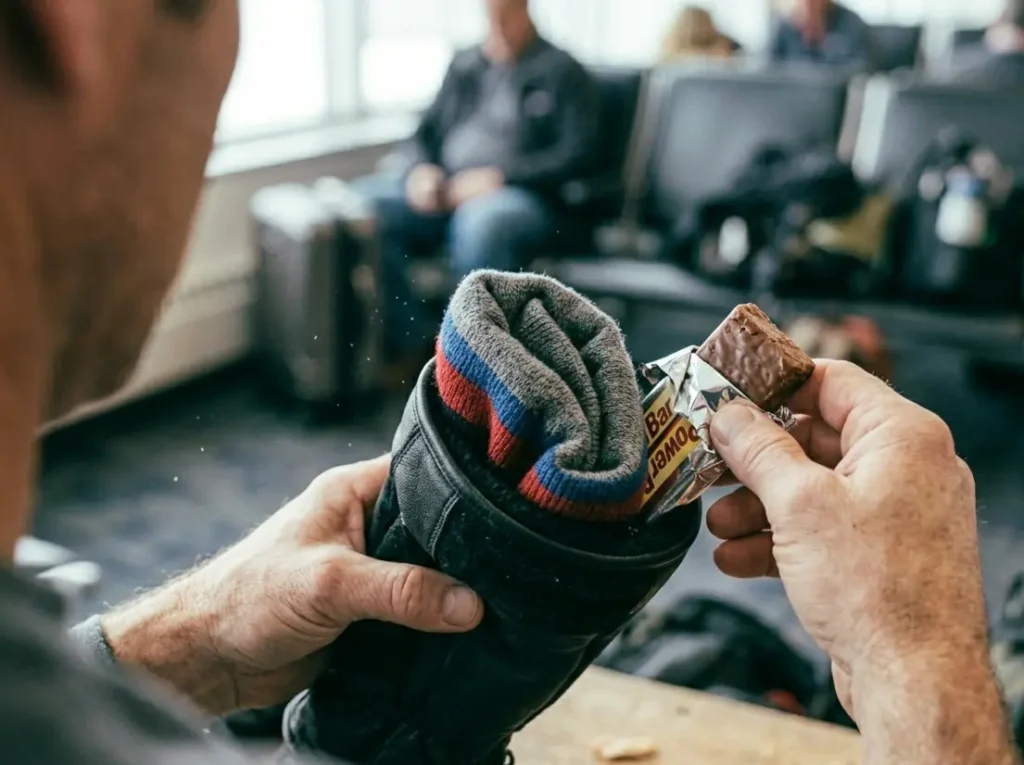
Multi-stop trip with connections
Connection flights are where bags get lost. The tighter the connection, the higher the risk. On a trip with a connection under sixty minutes, treat the gloves as if the checked bag will not arrive — because there is a real chance it will not. Put both pairs of gloves in your carry-on or wear one pair on the plane. Any connection under forty-five minutes at a major hub is a situation where experienced travelers carry everything critical on their person.
Long-haul international flights over ten hours
Two specific concerns: the cabin air is very dry at altitude, which is actually good for any residual glove moisture — carry-on gloves can lose moisture during a long flight. The second concern is compression. On a ten-plus hour flight, even overhead bin bags get shifted, compressed, and stacked by crew during the flight. A mesh bag with gloves positioned palm-to-palm at the top of the carry-on handles this well. For checked bags on long international flights, gloves should be at the very top of the duffel or suitcase with a clear barrier — a packed jacket — between them and the boots below.
Budget airline with strict size limits
Budget airlines in Europe and North America often enforce strict personal item and carry-on size limits. A ski glove pair has to compete for that limited space with every other item. The interior stuffing technique is most valuable here — every item that goes inside the gloves is an item that does not take its own bag space. A pair of well-stuffed gloves plus a beanie plus two pairs of socks takes the same space as a pair of gloves alone but carries four items.
If the carry-on is genuinely too full to fit the gloves, they go inside the ski boot as a last resort — the boot interior holds a surprising amount of soft gear and the boots usually go in the checked bag regardless.
Packing Mistakes That Cost You on Day One
Putting the gloves in last after everything else is packed. The items packed last in a bag are usually the ones that get crammed into whatever space remains. Gloves packed into the remaining space in a bag that is already full are getting compressed against hard items with no protection. Pack gloves first or second, choose their position deliberately, and pack everything else around them.
Using a plastic bag to contain the gloves in a checked bag. Plastic prevents any remaining moisture from escaping during the flight. Checked bag cargo holds are not cold enough to prevent bacterial growth. A moist glove in a sealed plastic bag in a warm cargo hold has all the conditions it needs to develop odor across a long flight. Use a mesh or fabric container instead.
Packing gloves touching metal ski edges or boot buckles. The shell fabric of ski gloves, particularly on the fingertips and palm, can snag on sharp metal edges. A ski bag where gloves share space directly with ski edges can produce small cuts or abrasion damage on the shell. A ski that shifts during transport can do this without any visible movement in the bag. Keep gloves in a separate container or at least wrapped in a clothing item when sharing space with skis.
Relying on airport retail if the checked bag is delayed. Airport ski shops at resort towns charge premium prices and carry limited selection. Assuming you can just buy replacement gloves if the bag is delayed is a reasonable plan only if you have both the time and the budget for it on the first day of the trip. Most people do not want to spend their first morning in a ski town shopping for gloves they should have packed in the carry-on.
Packing gloves flat and empty with no interior support. An empty glove folds and flattens under pressure. A stuffed glove holds its shape. The difference in insulation compression after a twelve-hour flight in a packed bag is measurable — the stuffed glove feels closer to its normal loft when unpacked. This takes thirty seconds to do and costs nothing.
Best Way to Pack Ski Gloves Without Taking Extra Space
If space is tight, the best method is to turn your gloves into storage. Fill each finger and the palm with small soft items like socks or a beanie. This prevents compression and turns unused space into functional packing volume. A fully packed glove takes no more space than an empty one — but carries multiple items inside it.
Signs Your Packing Method Is Not Working
| Warning Sign | What It Means and What to Do |
| Gloves smell immediately when the bag is opened at the destination | Packed with moisture in a sealed container; switch to mesh bag and confirm gloves are bone dry before packing on the return trip |
| Gloves feel noticeably thinner or less warm on arrival than departure | Insulation was compressed during transit; reposition in carry-on for return; rebound over first hour of use but starts the trip at reduced performance |
| Small cuts or snags on shell fabric that were not there before travel | Contact with metal edges or hard items in packed bag; use a fabric container and separate from skis and boot buckles |
| Leather gloves stiff and inflexible after travel | Either packed damp or compressed under weight; leather needs conditioning after any flight where it was compressed |
| Velcro cuff closure matted with fibers from clothing | Packed against clothing without Velcro closure folded back; fold Velcro closed before packing to prevent this |
| One glove missing at destination | Packed loose without container; easy to lose a single glove in a packed bag; always use a container that holds both together |
Pre-Travel Packing Checklist
| Check This Before You Pack | Why It Matters |
| Both gloves pass the press test — no residual moisture in insulation | Packed moisture = odor by destination; this is the most important pre-packing check |
| Interior of each glove stuffed with something soft | Prevents finger compression during transit; uses dead space efficiently |
| Gloves placed in a mesh or fabric container, not plastic | Allows any remaining moisture to continue escaping; prevents sealed-bag bacterial growth |
| Gloves positioned at top of bag or against side — not under boots | Protects insulation from sustained compression during flight |
| Primary or only pair confirmed in carry-on or personal item | Insurance against checked bag delay or loss on day one |
| Velcro closures folded back on themselves before packing | Prevents Velcro collecting fibers from adjacent clothing during transit |
| Leather gloves separated from synthetic items by a fabric layer | Prevents color transfer and DWR cross-contamination on long trips |
| Gloves not in contact with ski edges, boot buckles, or hard items | Prevents shell fabric snags and cuts during transit |
Diagnosing Your Packing Problem
Gloves smell at the destination. The cause is almost always moisture sealed in a non-breathable container. On the return trip: confirm gloves are completely dry using the press test, switch to a mesh or fabric container, and leave a gap if any zip bag is used. If the gloves developed the smell over the trip rather than arriving with it, the issue is overnight storage at the destination rather than packing — see the smell prevention guide.
Gloves feel less warm on arrival than they should. This is insulation compression from position in the packed bag. Check where the gloves were placed relative to heavy items. For the return, move them to the top layer of the bag with a soft barrier between them and anything heavy. If using a carry-on, consider placing the gloves in the personal under-seat item where compression is lower than in an overhead bin that may get shifted.
One glove makes it to the destination but not the other. This happens when gloves are packed loose rather than contained together. A single glove that shifts in a packed bag can fall behind a jacket lining, slide into a boot, or simply be impossible to find in a duffel at 5am before a departure. A container that holds both gloves together prevents this completely. Even a zip bag — despite its moisture limitations for regular storage — is fine for travel packing if it keeps both gloves in one locatable place.
Shell fabric has small cuts or abrasion marks after travel. Contact with ski edges or metal boot hardware. Gloves were sharing unprotected space in a ski bag. A fabric stuff sack around the gloves, or a clothing item wrapped around them, provides a buffer between the shell fabric and any metal items in the bag. This is particularly important in long ski duffels where skis, boots, and accessories all share the same interior.
When These Methods Don’t Apply
If you are driving to the ski destination rather than flying, the entire carry-on versus checked calculation does not apply. The relevant considerations become: keeping gloves away from car heater vents which dry leather too aggressively, not leaving gloves in a cold car overnight if temperatures drop significantly below freezing and you are concerned about insulation stiffness, and not leaving gloves in a hot car at the destination where heat can delaminate the waterproof membrane over time.
If you are renting gloves at the destination, there is nothing to pack. This is increasingly common for casual skiers who only ski once per year — rental gloves eliminate the packing problem entirely at the cost of using gear that was not fitted to you and has been used by multiple previous renters. The packing advice in this guide assumes you are bringing your own gloves that you have chosen and fitted for your use.
If the gloves are genuinely disposable — cheap backup mittens that cost less than the luggage fees — the insulation protection guidance is less critical. Cheap synthetic fill mittens are not worth protecting from compression with careful positioning. Put them wherever they fit. The carry-on versus checked guidance still applies if they are your only pair, but the physical packing technique matters less for gear you are not concerned about preserving.
If you pack your gloves correctly, you remove one of the most common points of failure in a ski trip. It takes less than a minute to do it right — and it can save your entire first day on the mountain.
Once the gloves arrive at the destination, the daily habits that keep them in good condition across a multi-day trip — specifically overnight drying to protect insulation and the prevention routine that stops odor from developing — are covered in How to Dry Ski Gloves Correctly and How to Prevent Ski Gloves from Smelling.
About the Author
Awais Rafaqat has spent over 15 years testing ski gear across North America — from the dry sub-zero conditions of the Rockies to the wet, heavy snow of the Pacific Northwest. His focus is real-world performance: what gear actually does in the conditions skiers encounter, not what the spec sheet says it should do.
© SkiGlovesUSA.com — Packing methods tested during trips across Colorado, Utah, and British Columbia in both dry and wet snow conditions. No sponsored product mentions. Last updated March 2026.