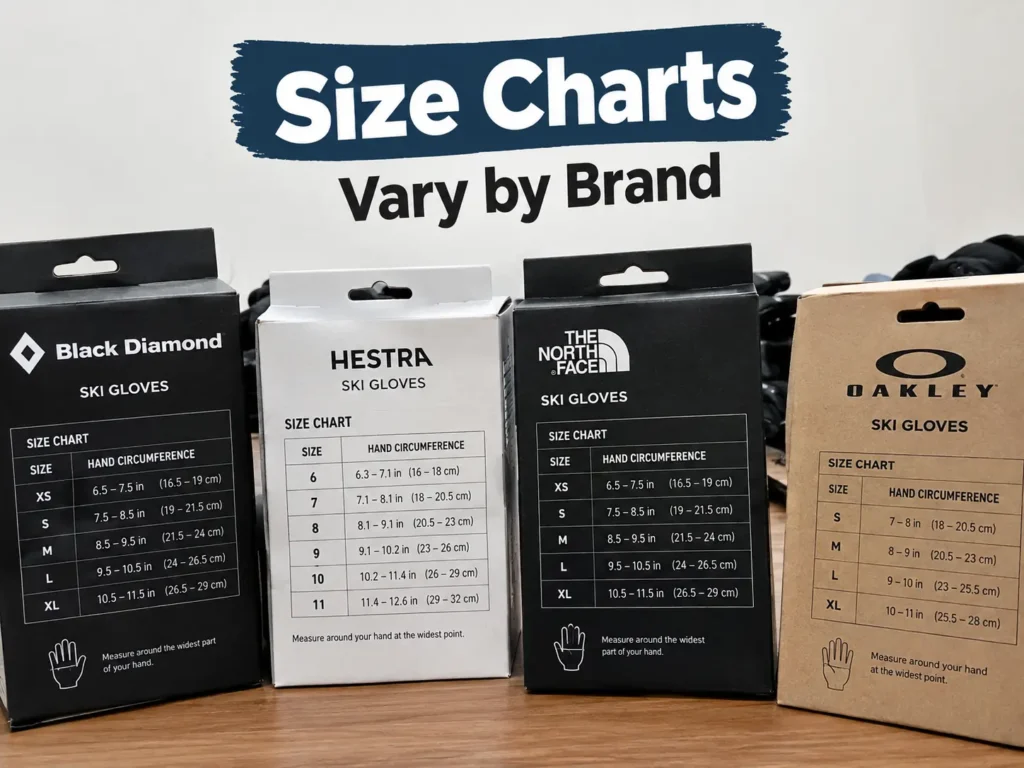
Quick answer: The same hand can land you a different letter size depending on which brand’s chart you’re reading, because brands don’t all measure the same way or use the same scale. Hestra uses a numeric system based on hand circumference in French inches. Black Diamond and Burton use letter sizes based on inch ranges, and Black Diamond has you take the larger of two separate measurements rather than just one. Knowing which system a brand uses, before you check their chart, saves you from assuming your “usual size” carries over automatically. If you’d rather skip cross-referencing charts yourself, ski glove finder can match you to a glove without needing to translate between systems.
- Why Brands Don't Size the Same Way
- How Hestra Sizes Gloves
- How Black Diamond Sizes Gloves
- How Burton and Dakine Size Gloves
- Why the Same Measurement Doesn't Guarantee the Same Fit
- Common Mistakes When Comparing Sizes Across Brands
- How to Actually Use This When Shopping Across Brands
- Real Scenarios Where Brand Differences Actually Trip People Up
- What to Do When You Can't Try Gloves On First
- Kids' Gloves Add Another Layer of Variation
- Why This Matters More for Winter Gloves Than Summer Ones
- Building Your Own Quick-Reference Sheet
- FAQ
Why Brands Don’t Size the Same Way
There’s no single industry-wide standard that every ski glove brand follows, which is the root cause of all the confusion. Some brands built their sizing around a centuries-old European measurement tradition. Others built theirs around a simpler inch-based letter system aimed at a snowboard-focused, more casual buyer. Neither approach is wrong — they’re just different systems solving the same basic problem in different ways.
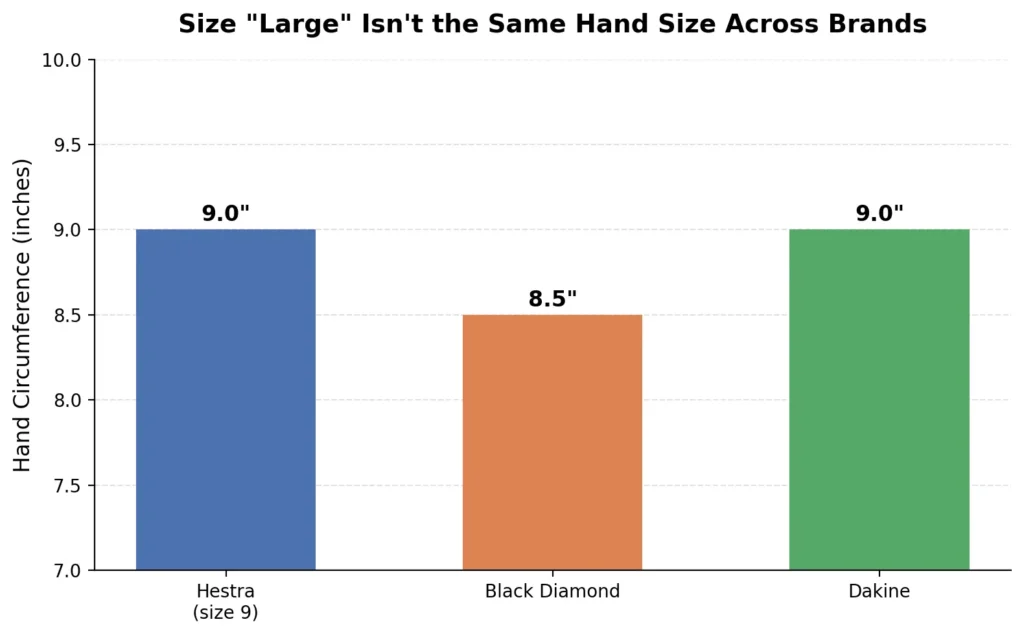
This matters practically because a size that fits perfectly in one brand doesn’t automatically tell you anything reliable about your size in a different brand. Two brands can both list a “Large,” and those two Larges can represent genuinely different actual hand circumferences.
How Hestra Sizes Gloves
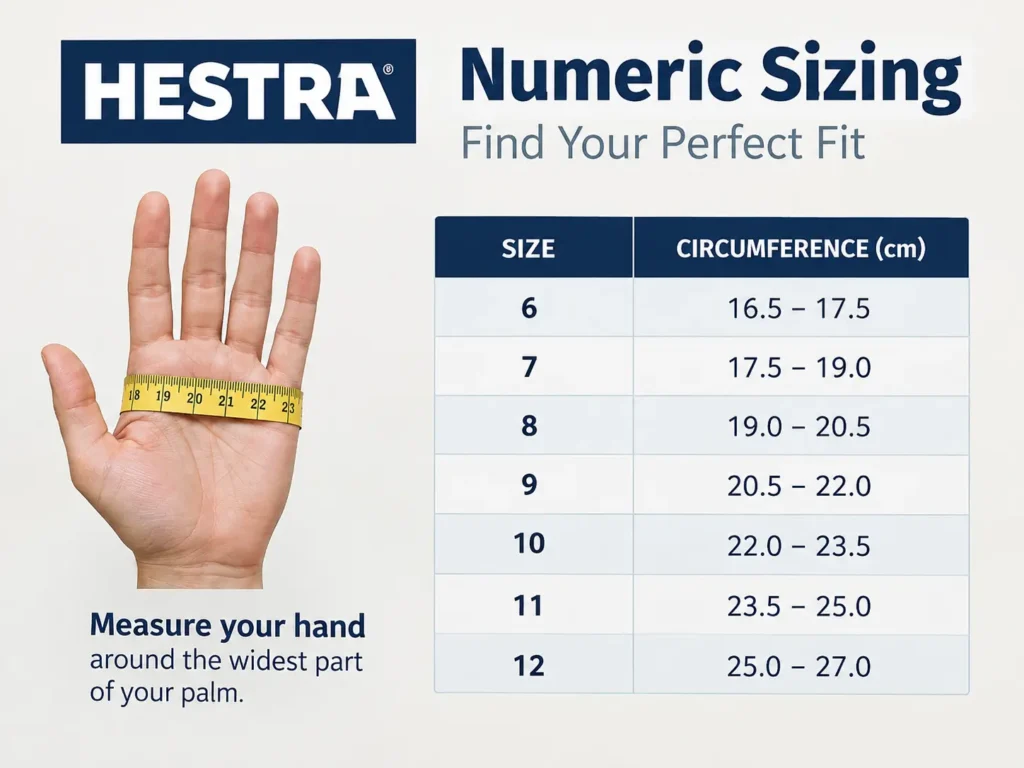
Hestra uses a numeric sizing system rather than letters, and it’s rooted in a French sizing tradition that measures hand circumference directly in inches — a size 8 corresponds to roughly an 8-inch hand circumference, a size 9 to roughly 9 inches, and so on up their full range.
What makes Hestra’s system worth understanding specifically is that fit also depends heavily on the glove’s style, not just the numeric size. According to Campman’s Hestra sizing guide, gauntlet-style Hestra gloves, the ones with a long cuff, tend to run large in both length and circumference, and the common recommendation is to size down from what your raw measurement suggests. Short-cuff styles run the opposite way — they tend to run small, so the standard advice is to size up from your measured number.
This style-dependent variation inside a single brand is something a lot of buyers don’t expect. It means “I’m a Hestra 9” isn’t a complete answer on its own — which specific glove style that size nine applies to actually matters.
How Black Diamond Sizes Gloves
Black Diamond uses letter sizes — XXS through XXL — built around inch ranges rather than a single numeric scale. According to evo’s Black Diamond sizing chart, their method also differs in a specific, practical way: you take two separate measurements, palm girth (circumference) and palm length, and your size is determined by whichever of the two numbers is larger, not an average of the two.
This two-measurement, take-the-larger approach means someone with a narrow but long hand and someone with a wide but short hand can land on the same Black Diamond size letter, even though their hands are shaped quite differently. It’s worth measuring both dimensions specifically for this brand rather than assuming circumference alone tells the whole story the way it might for a brand using a single measurement.
Some retailer sizing guides note Black Diamond gloves can run slightly small compared to the chart’s stated ranges, which is worth keeping in mind if your measurement lands right at the boundary between two sizes.
How Burton and Dakine Size Gloves
Burton, being snowboard-focused, sizes with letters tied to a numeric inch range similar in structure to Black Diamond’s system, but Burton’s chart includes a detail specific to snowboarding: according to Absolute-Snow’s Burton sizing guide, if you wear wrist guards underneath your gloves, their official guidance is to size up, while gloves with integrated wrist protection don’t need that adjustment. That’s a sizing consideration a ski-only shopper won’t find relevant, but it matters if you’re cross-shopping ski and snowboard gloves from the same brand.
Dakine’s system is simpler on paper — letter sizes tied to a circumference range only, without the palm-length component some other brands ask for. That makes Dakine’s chart faster to use if you’ve already got your circumference measurement handy, though it also means the chart alone gives less insight into how a longer or shorter-fingered hand might fit within that size.
| Brand | Sizing System | What Makes It Different |
| Hestra | Numeric (roughly matches inch circumference) | Fit also varies by glove style — gauntlet runs large, short-cuff runs small |
| Black Diamond | Letters (XXS–XXL), inch ranges | Uses two measurements, takes the larger of the two |
| Burton | Letters, inch ranges | Snowboard-specific wrist-guard sizing note |
| Dakine | Letters, inch ranges | Circumference only, no separate length measurement required |
Why the Same Measurement Doesn’t Guarantee the Same Fit
Even accounting for the different systems above, sizing charts describe hand circumference and sometimes length — they don’t describe how snug or loose a specific glove’s cut actually feels once you’re wearing it. A tightly tailored, performance-oriented glove and a roomier, more casual-cut glove can share the same size chart while feeling noticeably different once your hand is actually inside each one.
This is one reason it’s worth checking your fit against how a glove should actually perform once worn, not just against the chart number, especially for a glove style you haven’t tried from that brand before. It’s worth reviewing how ski gloves should genuinely fit in use alongside any brand’s chart, since chart accuracy and in-hand feel are related but not identical questions.
Material also plays a role charts don’t capture. A supple, well broken-in leather glove settles onto your hand differently than a stiff, brand-new synthetic shell at the same nominal size, even from the same brand across two different product lines.
Common Mistakes When Comparing Sizes Across Brands
Assuming your size in one brand transfers directly to another is the single most common mistake, and it’s exactly the assumption this whole comparison is meant to prevent. A Hestra 9 and a Black Diamond Large might happen to align closely for your specific hand, or they might not — checking both charts against your actual measurements is the only reliable way to know.
Ignoring a brand’s specific measurement method is a related mistake. If you only take a circumference measurement and then try to use it against Black Diamond’s two-measurement, take-the-larger system, you’re missing half of what that chart actually needs from you.
Trusting a general size chart aggregator instead of the specific brand’s own current chart risks working from outdated or slightly inaccurate numbers, since brands do occasionally revise their charts between product seasons. When in doubt, the brand’s own current listing is the more reliable source over a general reference site.
Forgetting to factor in glove style within a single brand, the way Hestra’s gauntlet-versus-short-cuff difference works, leads to buyers assuming one number applies uniformly across everything that brand sells, when it often doesn’t.
How to Actually Use This When Shopping Across Brands
Start with your own two measurements — hand circumference and hand length — taken once and written down somewhere you’ll actually find again, rather than re-measuring from memory every time you shop a new brand.
When you’re checking a new brand’s chart for the first time, look specifically for how they describe their measurement method before matching your numbers to a size. A brand using two measurements and taking the larger, like Black Diamond, needs a different approach from your numbers than a brand using circumference alone, like Dakine.
If you’re between two sizes on a specific brand’s chart and that brand doesn’t offer style-specific guidance the way Hestra does, sizing up is generally the safer default for winter gloves, since a slightly loose fit accommodates a liner or extra layer better than a slightly tight one restricts circulation.
Once you’ve found a good fit in one brand, it’s worth keeping a personal note of which brands run true to their chart for you and which don’t, since this is exactly the kind of pattern that saves guesswork on every future purchase from that same brand. If you’re still narrowing down your actual hand measurements before cross-checking any brand’s chart, it’s worth starting with how to measure your hand correctly rather than estimating.
Real Scenarios Where Brand Differences Actually Trip People Up
Picture someone who’s always worn a Burton Large for snowboarding and decides to buy a Hestra glove for a ski trip. Assuming “Large” translates means nothing here — Hestra doesn’t even use letter sizes for most of its line, so there’s no direct label to match against. The only reliable path is measuring and checking Hestra’s own numeric chart from scratch.
Now picture someone with a genuinely proportional hand — average circumference, average length — buying Black Diamond for the first time after years in Dakine. Dakine’s single-measurement system and Black Diamond’s two-measurement, take-the-larger system can actually agree closely for a proportional hand, which is part of why some buyers assume brand sizing barely differs at all — until they buy a brand meant for a hand shape less proportional than theirs and the systems diverge.
A parent buying a first pair of gauntlet-style Hestra gloves for an older kid, without knowing about the gauntlet-runs-large guidance covered earlier, is a common and avoidable mismatch. Sizing to the raw measured number instead of accounting for the style-specific adjustment leads directly to a glove that’s noticeably too roomy in exactly the way Hestra’s own sizing guidance warns against.
What to Do When You Can’t Try Gloves On First
Buying online without trying a specific brand’s glove in person first is now the norm rather than the exception, which makes accurate self-measurement more important than it used to be. Beyond checking a brand’s chart carefully, checking that brand’s return policy before you order gives you a real safety net if your first guess is off.
Ordering two adjacent sizes from a new brand, when the return process is easy and free, is a genuinely reasonable strategy for a first purchase from an unfamiliar sizing system — you keep the one that fits and return the other, rather than guessing once and hoping.
Reading recent buyer reviews that specifically mention fit, rather than general reviews about warmth or style, gives you real-world confirmation of whether a brand’s current chart matches actual buyer experience. Chart accuracy can drift slightly between product seasons even when the brand hasn’t formally updated the published numbers.
Kids’ Gloves Add Another Layer of Variation
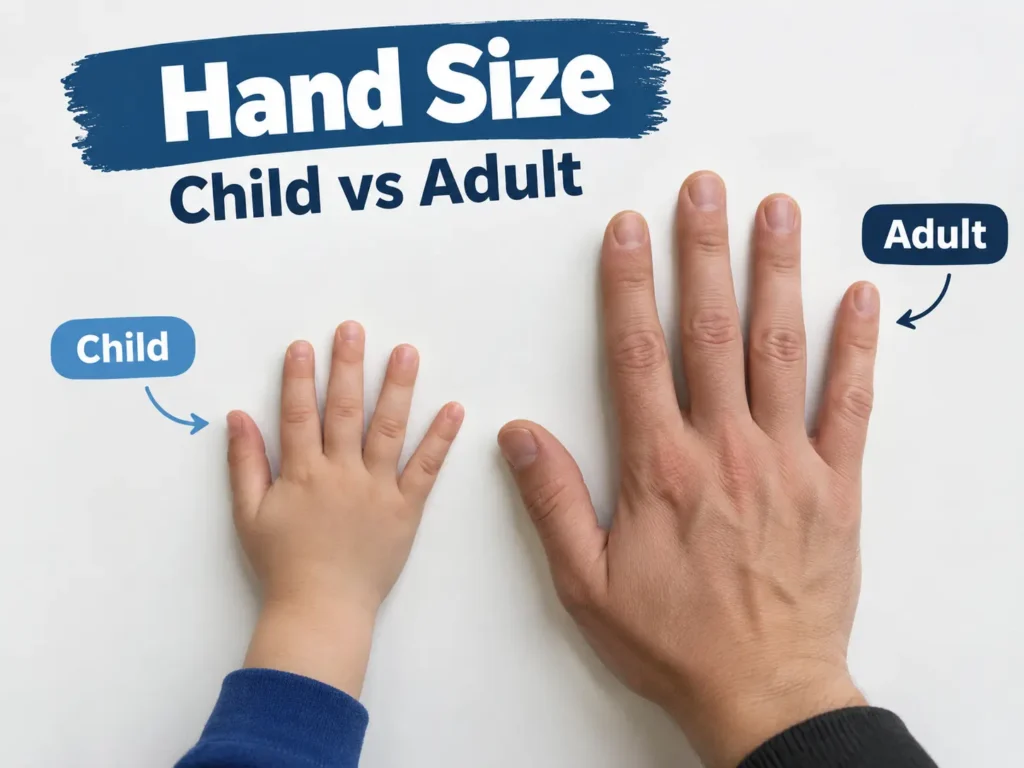
Kids’ sizing across brands is even less standardized than adult sizing, since several brands size children’s gloves by age range instead of measurement. Hestra’s own guidance notes that junior gloves are typically sized by age rather than hand circumference, on the reasoning that consistently and accurately measuring a young child’s hand is harder in practice than measuring an adult’s.
This creates a real disconnect when a parent tries to apply adult sizing logic to a kids’ purchase. A 6-year-old sized into a Burton “age 6-7” glove and a 6-year-old sized by hand circumference into a different brand’s kids’ chart can end up in genuinely different actual fits, since one brand is going by typical hand size for that age range and the other might have actually measured.
The practical fix is the same regardless of which system a specific brand uses: if the child will hold still long enough, a quick actual measurement beats an age-based guess every time, especially for a kid whose hand runs larger or smaller than typical for their age.
Why This Matters More for Winter Gloves Than Summer Ones
Sizing mistakes matter more here than they would for a lightweight glove used briefly, because winter gloves stay on for hours at a stretch in genuinely cold conditions. A glove that’s slightly off in a warm-weather context is a minor annoyance; the same sizing error in a cold, all-day ski context compounds into circulation problems, reduced dexterity, and faster heat loss, all covered from the sizing-accuracy angle in more general terms elsewhere on this site.
This is also why it’s worth the extra few minutes cross-referencing a specific brand’s chart carefully rather than defaulting to a size that “usually works” across your gear generally. A slightly loose winter glove and a slightly loose summer glove don’t have the same real-world consequences, even though the sizing mistake behind each one looks identical on paper.
Building Your Own Quick-Reference Sheet
Given how much variation exists between just the four brands covered here, it’s worth building a simple personal reference rather than re-researching from scratch every time you shop. Note your two core measurements once, then log the actual size that fit correctly for each brand and glove style you’ve tried.
Over a few purchases, this turns into a genuinely useful personal cheat sheet: “Hestra short-cuff, size up one from measurement; Black Diamond, true to chart; Burton, true to chart without wrist guards.” That kind of specific, brand-by-brand memory is more useful long-term than trying to remember a single “my size” number that, as this whole comparison shows, doesn’t actually exist across brands the way people assume it does.
FAQ
Is there an industry-standard glove sizing system all ski brands use?
No single system is used universally, which is the whole reason brand-by-brand comparison matters. Some manufacturers loosely reference broader hand-protection sizing conventions, but ski and snowboard glove brands largely maintain their own charts independently.
Should I always buy the same letter or number size across every brand?
No — treat each brand’s chart as its own reference point rather than assuming consistency. The safest approach is checking your actual measurements against that specific brand’s current chart every time, especially the first time you buy from a new brand.
Do kids’ glove sizes follow the same logic as adult sizing?
Generally the same measurement principles apply, but several brands size kids’ gloves by age range rather than hand measurement alone, since consistently measuring a young child’s hand accurately is harder in practice. Check whether a specific brand’s kids’ chart uses age or measurement before assuming one over the other.
Why do some brands ask for two measurements instead of one?
A single circumference measurement doesn’t capture finger length, and a brand using two measurements — like Black Diamond’s girth-and-length approach — is trying to account for hands that are proportionally wide-and-short or narrow-and-long, which a single number would size the same way despite being different hand shapes.