Quick answer: The right snowboard glove depends more on your riding style than your budget. Park and rail riders need reinforced palms above almost everything else. Powder riders need a sealed gauntlet cuff more than they need extra insulation. Beginners need wrist protection more than either, because falls happen constantly in the first few sessions. Figure out which category you actually fall into before comparing specific gloves, and ski glove finder can help narrow the search once you know your priority.
- Why Snowboarders Need a Different Buying Framework Than Skiers
- Cuff Style: The First Decision, Not the Last
- Palm Reinforcement for Park and Rail Riding
- Wrist Protection for Beginners
- Moisture Management: Powder vs. Spring Slush
- Who Needs Extra Consideration Beyond This Framework
- Buying by Riding Style
- Common Mistakes When Buying Snowboard Gloves
- What Extra Money Actually Buys
- A Quick Decision Checklist
- If Your Current Gloves Aren't Working
- Matching the Glove to How You Actually Ride
- FAQ
Why Snowboarders Need a Different Buying Framework Than Skiers
Snowboard-specific glove buying comes down to one core fact: snowboarders fall a lot more than skiers do, especially early on. A large field study interviewing over 1,400 skiers and snowboarders at Austrian resorts measured actual fall rates and found snowboarders fell roughly 5.6 times more often per hour than skiers, with poor skill level being the single strongest predictor.
That fall-rate gap isn’t just a beginner phenomenon that disappears with experience, either. The same research found soft, wet snow conditions increased fall risk for skiers specifically, while poor skill level remained the dominant factor for snowboarders across the board — meaning the fall-frequency gap between the two sports narrows with experience but never fully closes.
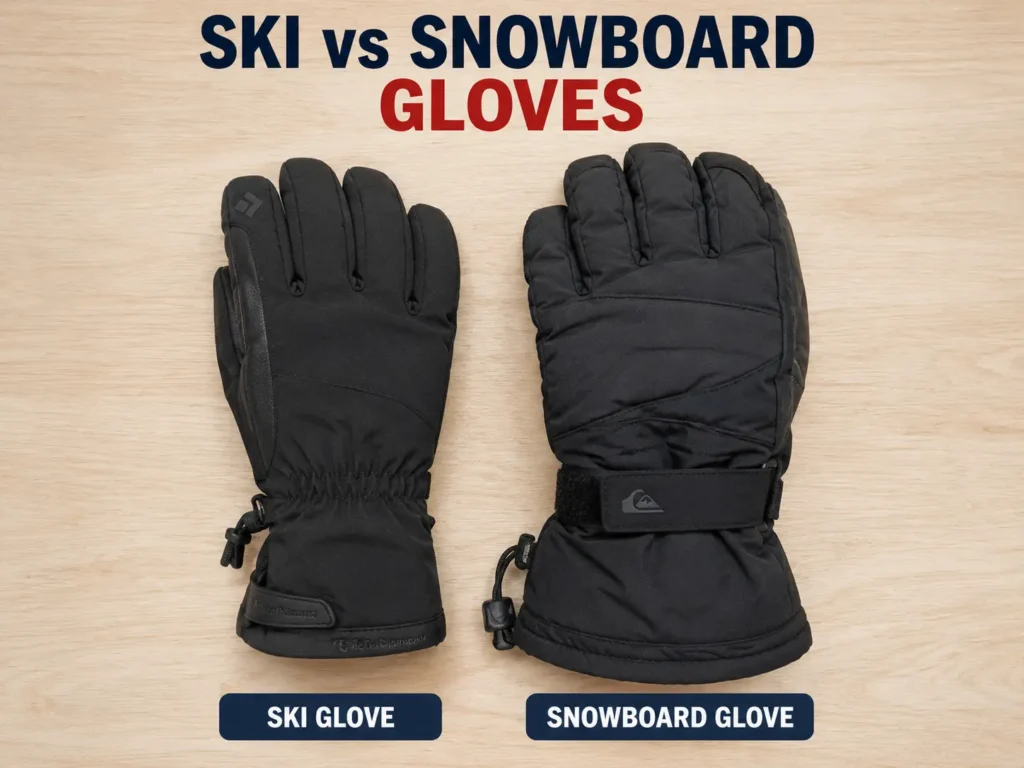
That single fact is why cuff seal and palm durability matter more for snowboard gloves than for ski gloves, and why a glove built around ski-specific priorities — thin palm, pole-grip feedback — performs badly for snowboarding. The full mechanical breakdown of why the two glove types are built differently is covered in more depth in the ski vs snowboard comparison on this site — worth reading if you’re deciding between the two rather than shopping specifically for snowboard gloves.
Cuff Style: The First Decision, Not the Last
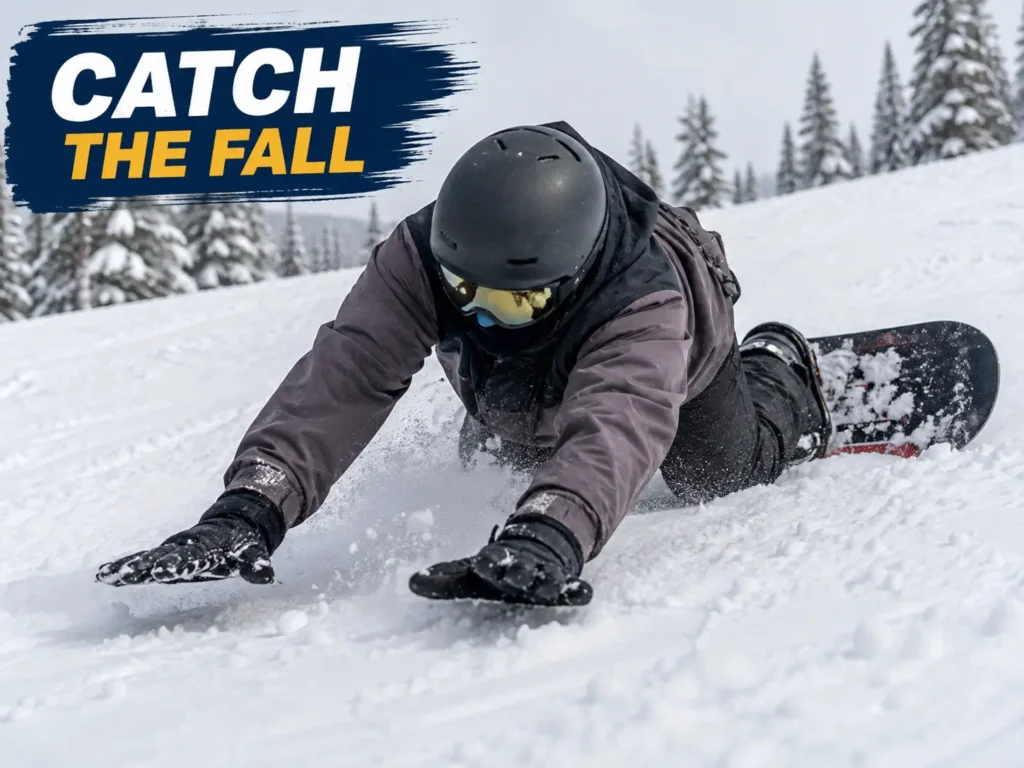
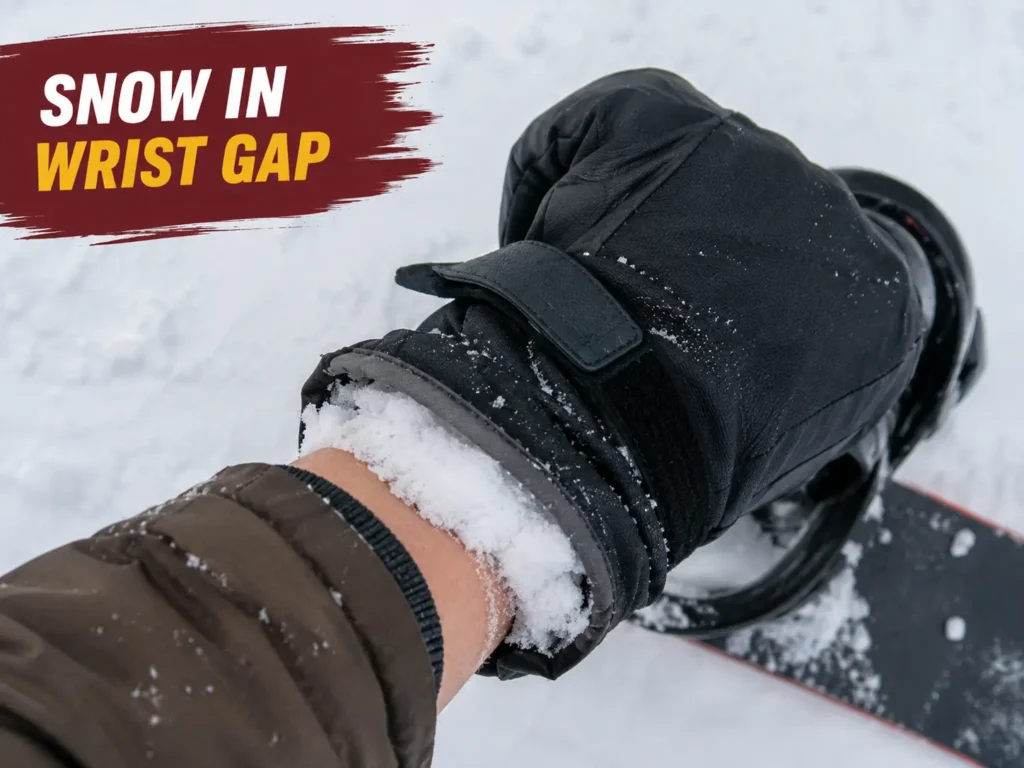
Most buying guides treat insulation as the headline decision and cuff style as an afterthought. For snowboarding specifically, that order should flip. Since falls happen often and tend to put hands and wrists in direct contact with snow, the cuff is what determines whether a fall means a damp inconvenience or a genuinely wet glove for the rest of the day.
A gauntlet cuff, sealed over the jacket sleeve with a drawcord, closes that gap directly. A short cuff, worn under the sleeve, depends on the jacket sleeve itself to close the gap — which only works if that sleeve actually fits snugly. The full comparison of when each style makes sense is worth reading in the cuff guide on this site, since the trade-offs go beyond just snow entry.
The practical way to think about this: gauntlet cuffs suit any riding style where falls are frequent or unpredictable — powder, backcountry, beginner terrain of any kind. Short cuffs make more sense for riders who fall rarely on predictable groomed terrain and value the reduced bulk and easier layering more than the extra wrist protection they’d otherwise be trading away.
Palm Reinforcement for Park and Rail Riding
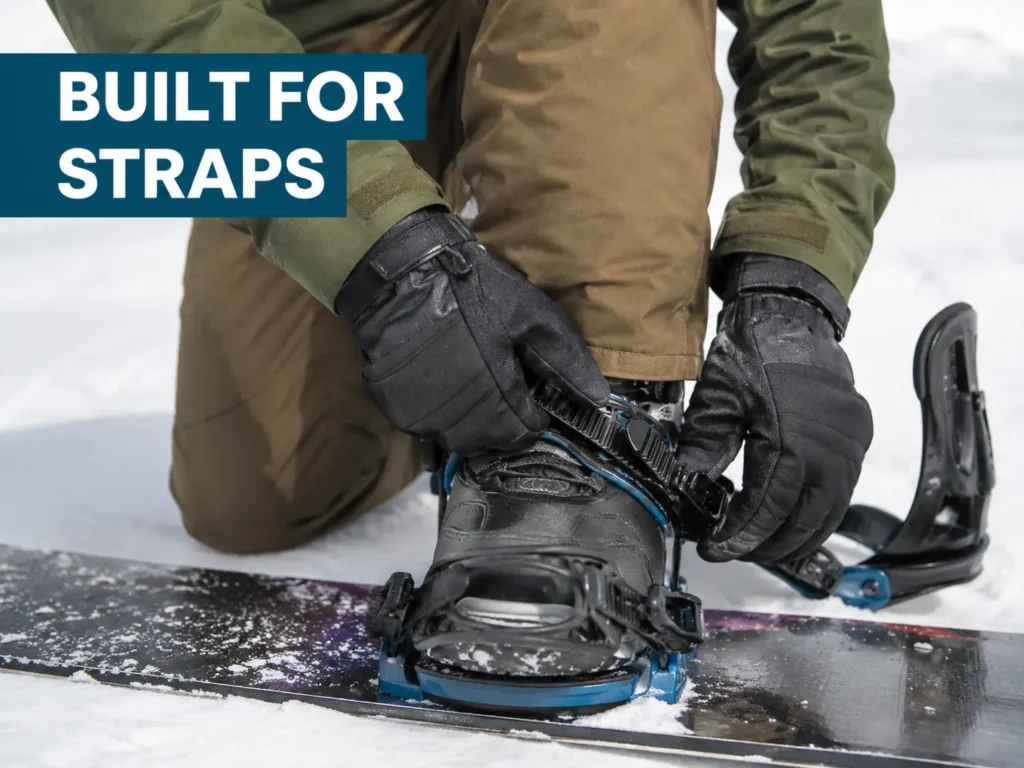
Snowboarding puts far more direct, repeated palm contact on a glove than skiing does — strapping and unstrapping bindings dozens of times a day, catching falls palm-first, and for park riders specifically, sliding a gloved hand across rails and boxes during grabs. An unreinforced palm wears through fast under that kind of repeated abrasive contact.
Reinforced palms typically use either a leather panel or a synthetic overlay at the heel of the hand and across the high-contact zone. This isn’t marketing language — abrasion-resistant synthetic fabrics like Cordura are specifically engineered around resisting exactly this kind of repeated surface friction, which is why you’ll see similar reinforced-panel construction anywhere a fabric takes concentrated, repeated contact rather than even overall wear.
If you ride in a park or spend a lot of time on rails and boxes, palm reinforcement should sit near the top of your priority list. If you mostly ride groomed terrain and rarely touch a rail, it matters less, and you can weigh other factors higher.
It’s also worth checking reinforcement placement specifically, not just whether a glove mentions it. The heel of the palm and the base of the thumb take the most repeated contact during binding adjustments and fall catches, while the fingers themselves see comparatively little direct abrasive contact. A glove reinforced only in a small central palm patch, away from where fall impacts and binding straps actually land, delivers less real durability than the spec sheet implies.
Wrist Protection for Beginners
Wrist guards matter disproportionately for beginners specifically, and the fall-rate research above explains exactly why: new riders fall far more often than experienced ones, and most of those falls involve an instinctive palm-down catch. A wrist guard doesn’t prevent the fall, but it changes what that fall costs your wrist.
This matters less as riding improves. An experienced rider falling occasionally on a mellow groomer doesn’t carry the same risk profile as someone learning to link turns for the first time. If you’re buying gloves for a first season or for a beginner, treat wrist protection as close to non-negotiable rather than a nice-to-have feature.
Wrist protection also interacts with fit in a way that’s easy to overlook. A guard that’s rigid enough to actually help in a fall needs enough room inside the glove to sit correctly against the wrist without bunching, which means beginner-oriented gloves with built-in guards often run slightly larger through the wrist than an equivalent glove without one. Trying the glove on with the same layers you’ll actually wear underneath is the only reliable way to check this fits correctly, since a guard that shifts or bunches during a fall doesn’t protect the way it’s designed to.
Moisture Management: Powder vs. Spring Slush
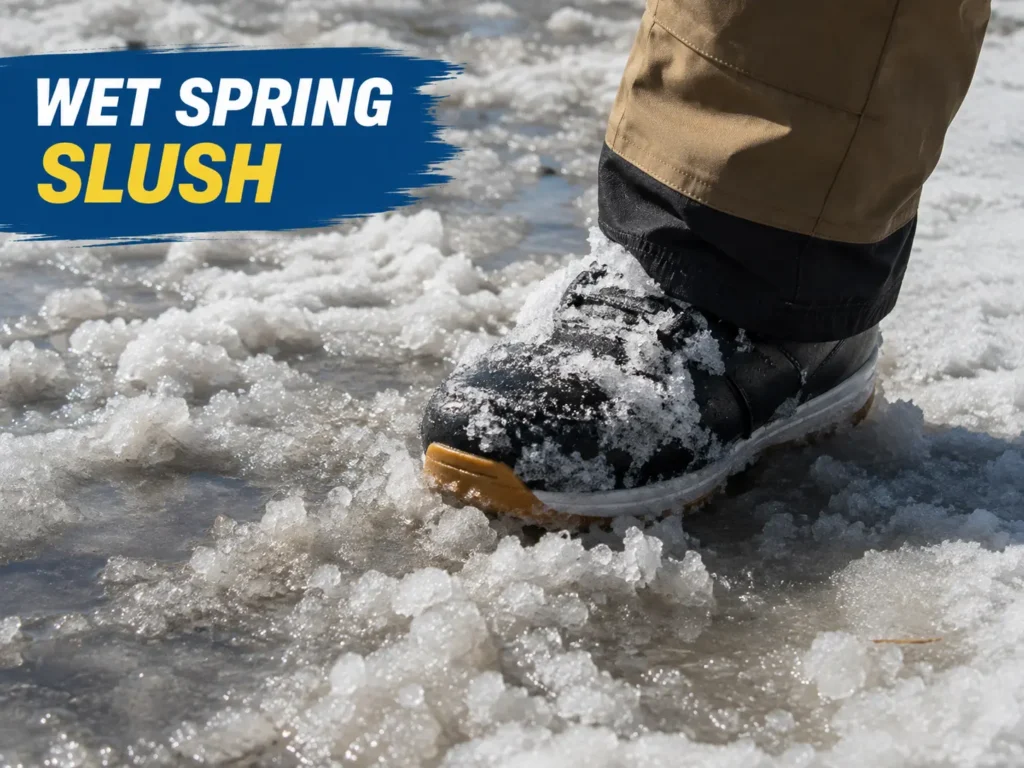
Insulation weight matters, but matching it to actual conditions matters more than the number on the label. Deep, dry powder days in genuinely cold temperatures reward more insulation, since the snow itself isn’t melting on contact and the main risk is straightforward cold exposure.
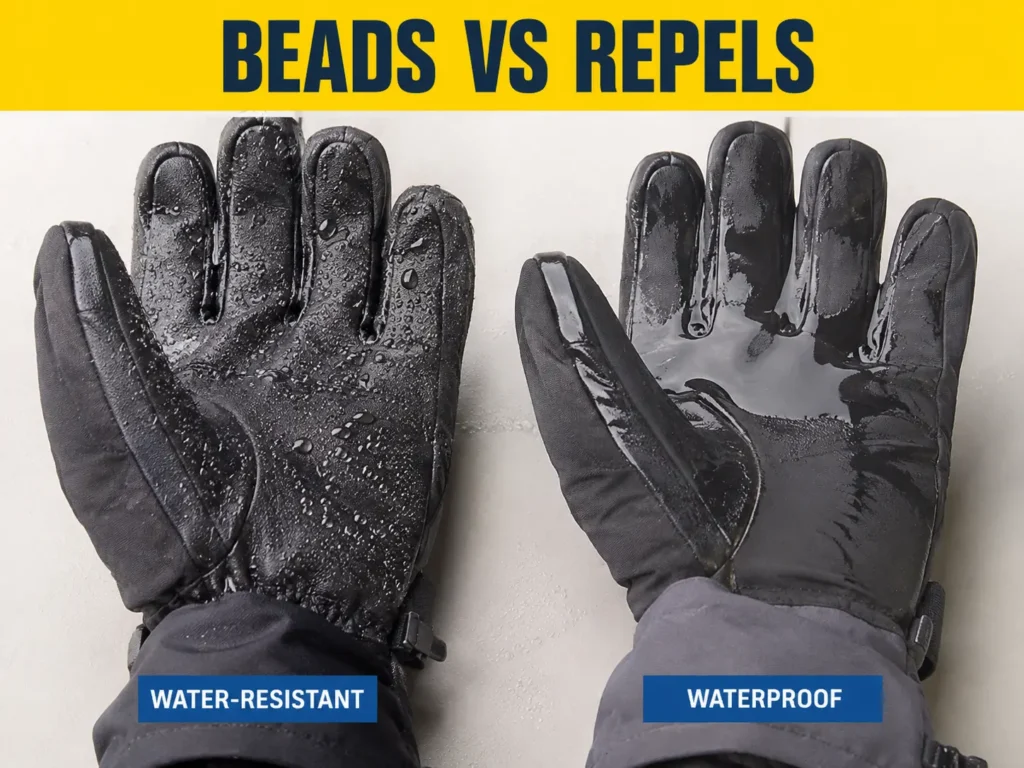
Spring conditions flip that equation. Wet, near-freezing slush means a glove is dealing with active moisture the entire day, and heavy insulation in those conditions traps sweat as much as it blocks cold, working against the waterproofing from the inside. This is exactly the problem breathable membrane technology is built to solve — a fabric like eVent uses a porous membrane structure that blocks incoming water while still letting internal moisture vapor escape, rather than trapping it against the skin.
Riding one glove across both extremes of a season is always a compromise. A lighter, more breathable glove for wet spring days and a heavier one for deep cold outperforms a single mid-weight glove trying to cover both.
There’s a practical middle path worth knowing about too: a liner-and-shell system, where a removable insulating liner sits inside a consistent waterproof shell. This lets one shell cover both ends of the season, swapping a heavier liner in for deep cold and a thinner one or none at all for spring slush, without buying two complete gloves. It costs more upfront than a single fixed-insulation glove, but less than owning two dedicated pairs.
Who Needs Extra Consideration Beyond This Framework
Riders transitioning from skiing to snowboarding often carry over ski-glove buying habits that don’t transfer well — prioritizing pole-grip dexterity and light weight over cuff seal and palm reinforcement. If you’re making that switch, treat this as a genuinely different purchase rather than “the snowboard version” of what you already know.
Instructors and anyone spending long stretches kneeling or sitting in snow while helping other riders face more cumulative ground contact than their actual riding time would suggest. Durability and reinforced construction matter more for this group than the riding-style table above implies on its own, since the wear pattern comes from teaching, not from riding.
Riders with cold-sensitive hands should weight insulation and moisture management higher than the riding-style table suggests by default, even if their riding style would otherwise point toward a lighter, more breathable build. Comfort with your actual circulation matters more than matching a generic recommendation.
Kids and younger riders lose heat faster than adults and have proportionally different grip needs, which means the fit and insulation guidance here applies directionally rather than exactly — a slightly roomier fit and a heavier insulation weight than an adult in the same conditions would choose is usually the safer default.
Buying by Riding Style
| Riding Style | Top Priority | What to Look For |
| Park and rails | Palm reinforcement | Reinforced palm overlay, moderate insulation, cuff length flexible |
| Deep powder | Cuff seal | Gauntlet cuff, non-negotiable, moderate to heavy insulation |
| All-mountain resort | Balanced build | Gauntlet cuff, mid-weight insulation, some palm reinforcement |
| Backcountry/touring | Adjustability | Liner-plus-shell system for variable exertion and temperature |
| Beginner (any style) | Wrist protection | Gauntlet with built-in wrist guard, non-negotiable |
| Spring/wet conditions | Moisture management | Lighter insulation, named breathable membrane |
| Instructors/frequent ground time | Durability | Reinforced palm, abrasion-resistant shell, replaceable liner |
Common Mistakes When Buying Snowboard Gloves
Assuming any glove labeled “snowboard glove” covers all riding styles equally is the most common mistake. A resort-groomer glove, a park glove, and a powder glove make different trade-offs between cuff length, palm reinforcement, and insulation, and none of the three is a universal best choice.
Testing fit with a flat, relaxed hand in the shop is a close second. Snowboarding rarely uses a flat hand — it’s a closed fist around a binding strap or grab, or an open palm during a fall. Testing with a closed fist instead gives a far more accurate sense of whether the glove will bind up or pull tight during actual riding.
Ignoring jacket-sleeve compatibility with a short-cuff glove is a mistake specific to this category. A short cuff depends entirely on the jacket sleeve to close the wrist gap — pairing one with a loose or unstructured sleeve leaves the exact opening a short cuff is supposed to avoid needing in the first place.
Buying on warmth rating alone, without checking cuff and palm construction, ranks close behind. A glove with an impressive gram rating printed on the tag can still leave you cold and wet if snow is getting in through the wrist or moisture is building up faster than it can escape — the insulation number describes potential warmth under controlled conditions, not what you’ll actually feel after a real fall in real snow.
Buying one pair to cover an entire season across wildly different conditions is a small but real mistake for anyone riding both deep winter and spring. The trade-offs described in the moisture-management section above don’t disappear just because replacing gear mid-season feels inconvenient.
What Extra Money Actually Buys
Price differences in snowboard gloves track a few specific things: genuine palm reinforcement rather than a thin decorative overlay, a named waterproof membrane instead of coating-only protection, and integrated wrist protection built into the glove’s structure rather than requiring a separate strap-on guard.
None of that means the most expensive option is automatically correct for you. A rider who mostly stays on groomed terrain and rarely falls doesn’t need the same investment as a beginner learning park tricks. Match the spending to your actual riding style table above, not to the assumption that more expensive always means more appropriate.
It’s also worth noting that some of what drives price has nothing to do with performance — brand recognition and marketing spend show up in retail price without necessarily showing up in construction quality. Checking the specific features covered in this guide (palm reinforcement placement, named membrane technology, actual wrist protection) tells you more than the price tag does on its own.
A Quick Decision Checklist
- Identify your dominant riding style before comparing specific gloves — park, powder, all-mountain, or backcountry
- Treat wrist protection as mandatory if you’re a beginner or buying for one
- Check reinforced palm construction specifically if you ride park or rails regularly
- Match insulation weight to your actual temperature range, not your coldest theoretical day
- Confirm your jacket sleeve actually seals if you’re considering a short-cuff glove
If Your Current Gloves Aren’t Working
If you already own snowboard gloves and they’re underperforming, the cause is usually one of a few specific things rather than a mystery.
| Problem | Likely Cause | What It Means |
| Cold hands right after a fall | Snow entered at the wrist | Cuff seal issue, not an insulation problem |
| Palm worn through in one season | No reinforcement, or reinforcement in the wrong spot | Look for palm and thumb-base reinforcement next purchase |
| Wet inside by midday, dry-looking outside | Membrane failed or coating worn off | Waterproofing issue, not a fit or insulation issue |
| Sweaty hands on mild days | Overinsulated for conditions | Match insulation to riding intensity, not worst-case cold |
| Sore wrist after a minor fall | No wrist protection | Consider a gauntlet with built-in guard |
Matching the Glove to How You Actually Ride
None of these factors matter equally for every rider — that’s the whole point of organizing this by riding style instead of by generic feature checklist. A park rider optimizing for palm durability and a powder rider optimizing for cuff seal are solving genuinely different problems, even though both are buying “snowboard gloves” from the same shelf. Identify your riding style first, then let that decide which trade-offs are worth paying for. The riding-style table above is a starting point, not a strict rule — someone who splits their season evenly between park and powder should treat it as a blend, weighting both palm reinforcement and cuff seal rather than picking one and ignoring the other.
FAQ
Do I need a different glove for park riding than for all-mountain riding?
Not strictly, but a dedicated park glove with reinforced palms will noticeably outlast a general all-mountain glove under regular rail and box contact.
Are wrist guards only necessary for beginners?
They matter most for beginners because fall frequency is highest early on, but any rider spending significant time in park or backcountry terrain with real fall risk benefits from the same protection.
Can I use the same snowboard gloves for powder and spring riding?
You can, but it’s a compromise in both directions — heavier insulation is unnecessary weight in spring slush, and a lighter spring glove will underperform in deep, cold powder.
Do reinforced palms make gloves noticeably less flexible?
Slightly, but well-placed reinforcement at the heel of the palm and thumb base costs little dexterity compared to the durability it adds, since those zones aren’t doing fine finger work anyway.