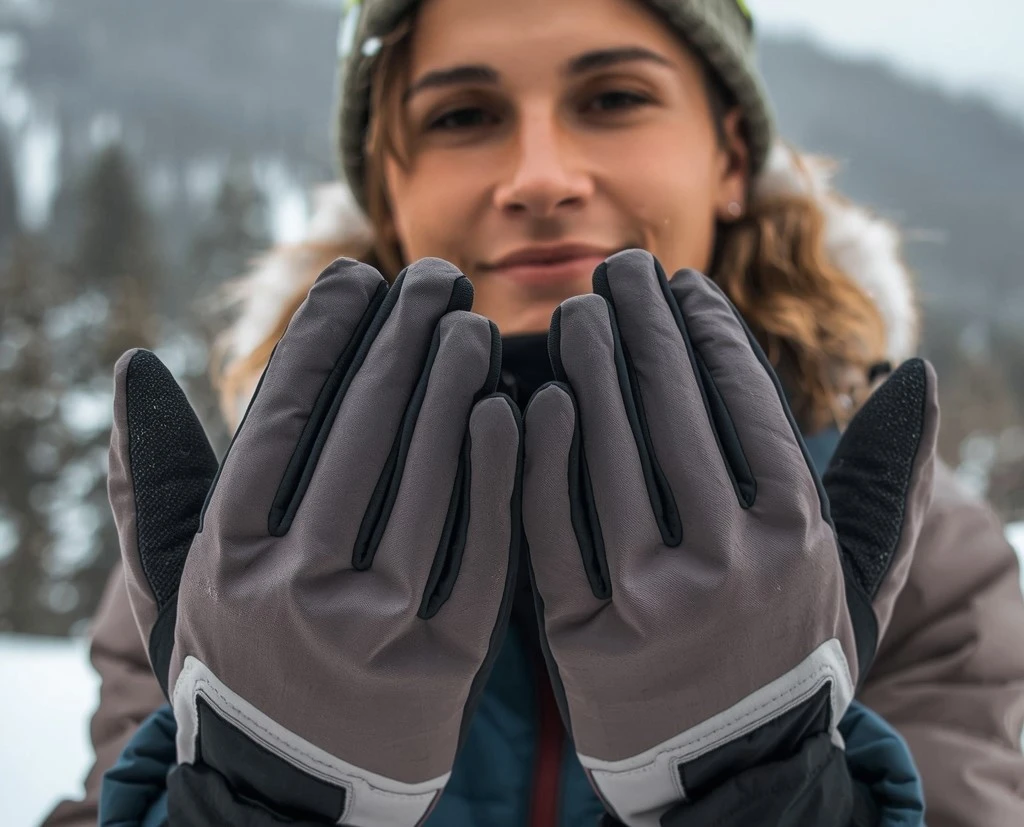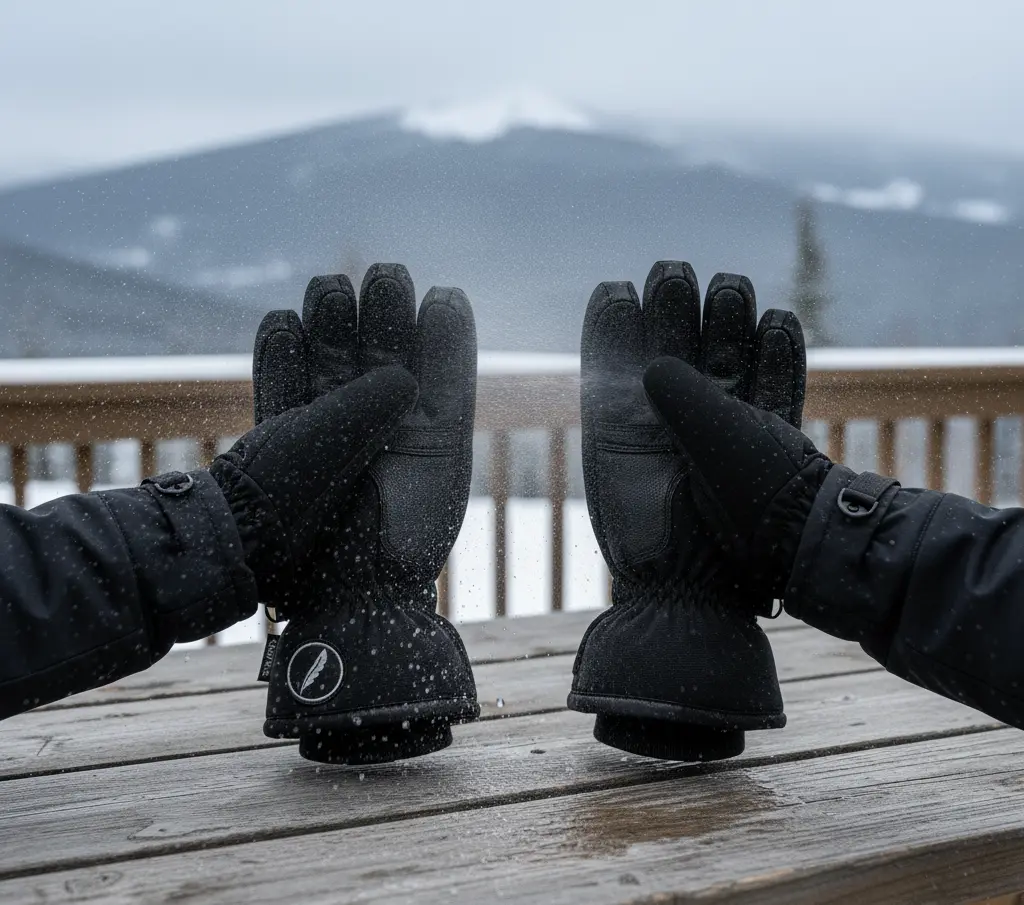
There is a specific kind of misery that only skiers know. It’s not the sore legs or the early mornings. It’s the feeling of sitting on a chairlift in 15-degree wind, unable to feel your thumbs, while your friends are laughing and planning the next run.
In my 15 years of skiing—from the ice-hard pack of the East Coast to the deep powder of the Rockies—I have seen more days ruined by bad gloves than by bad skis. I have seen grown men call it quits at 11:00 AM because their hands were in agony.
Most beginners treat gloves as an afterthought. They spend $800 on boots and then grab the fluffiest-looking mittens from the bargain bin. This is a mistake. Your hands are your primary interface with the mountain. If they are cold, you are miserable. If they are clumsy, you can’t zip your jacket or adjust your boots.
Knowing how to choose ski gloves correctly is about balancing three competing forces: warmth, dexterity, and waterproofing. Get it right, and you won’t even notice your hands all day. Get it wrong, and you’ll be fighting your gear instead of skiing the mountain.
How I Pick Ski Gloves (My Personal “3-Check” System)
Before we get into the technical details, I want to share the exact mental process I use when I’m standing in a ski shop. I don’t look at the brand name first. I don’t look at the colors. I use a “3-Check” system that has never failed me.
1. The “Zipper Test” (Dexterity)
When I try on a glove, I don’t just make a fist. I walk over to a jacket on the rack and try to zip it up and down.
- The Pass: If I can grab the zipper pull and move it without frustration, the glove has good articulation.
- The Fail: If I feel like I’m wearing boxing gloves and have to use two hands to clamp the zipper, I put them back. You need to be able to adjust your goggles or get a snack without exposing your bare skin to the cold.
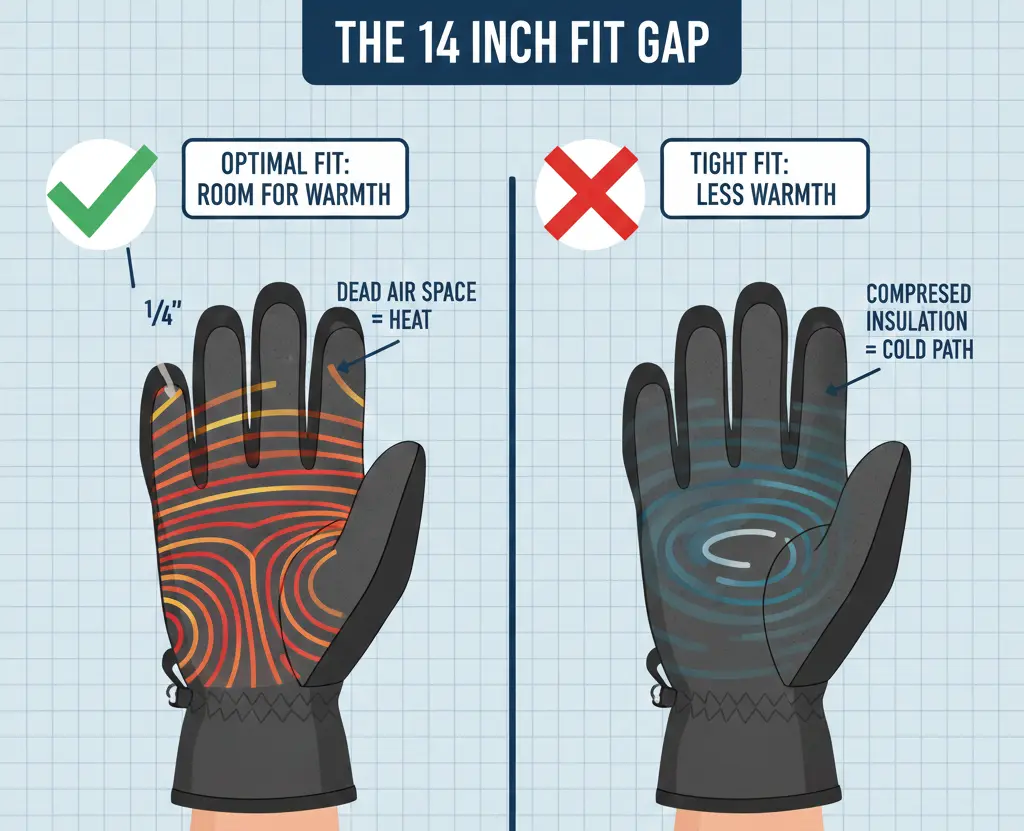
2. The “Pinch Test” (Fit)
I put the glove on and pinch the tip of the glove’s index finger with my other hand.
- The Goal: I want to feel about a quarter-inch (pinch width) of fabric before I hit my actual finger.
- Why? If my finger touches the very end of the glove, the insulation is compressed, creating a “cold bridge.” If there is too much room (an inch or more), the glove will flop around and my hand won’t be able to warm up the dead air space.
3. The “Breath” Test (Warmth/Breathability)
This sounds weird, but I put my mouth up to the back of the glove and blow hard.
- The Result: If I feel absolutely zero air moving through, it’s likely a PVC or cheap nylon shell that will trap sweat (bad). If I can feel the heat of my breath slowly dissipating but not rushing through, it’s a breathable membrane like Gore-Tex (good).
The Great Debate: Gloves vs. Mittens vs. “Lobsters”
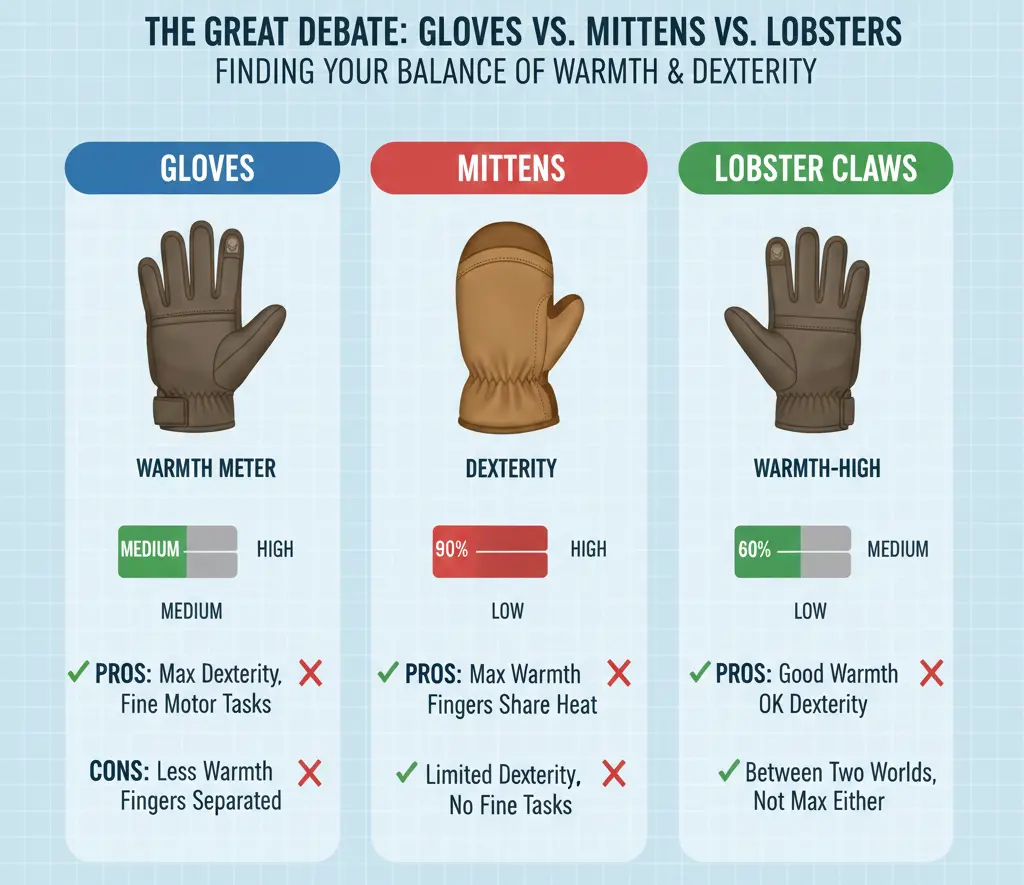
The first decision you make dictates how warm you will be. This isn’t about style; it’s about thermodynamics.
1. The Classic Glove (Five Fingers)
- Best For: Skiers who run warm, technical skiers who need to buckle boots often, and spring skiing.
- The Reality: Gloves separate your fingers. Since fingers generate heat by sharing it, isolating them makes them colder. However, the dexterity is unmatched.
- My Experience: I use five-finger gloves for 80% of my skiing. I value being able to grab my poles firmly and adjust my helmet buckle without taking them off.
2. The Mitten (The Oven)
- Best For: Skiers who suffer from cold hands (Raynaud’s syndrome), extreme cold days (-10°F or lower), and beginners who fall often.
- The Reality: Mittens keep your fingers together, sharing warmth in a single pocket of air. They are significantly warmer than gloves of the same thickness.
- The Trade-off: You have “paw hands.” You can’t point, you can’t zip pockets easily, and holding ski poles feels vague.
3. The “Lobster” Claw (The Hybrid)
- Best For: The undecided skier.
- The Reality: These group your index and middle finger together, and your ring and pinky finger together (or sometimes just a free index finger).
- My Experience: I bought a pair of Hestra “Lobster” claws for a trip to Japan. They were a revelation. I had 90% of the warmth of a mitten but could still use my index finger to pinch zippers. If you can get past the weird look, this is often the smartest choice.
Material Matters: Leather vs. Synthetic
When you look at the wall of gloves, you’ll see two main materials. Here is the honest breakdown of how they perform in the real world.
The Case for Leather (Goatskin/Cowhide)
I am a huge advocate for leather, specifically Goatskin.
- Why I choose it: Leather is naturally abrasion-resistant. Ski edges are sharp—they slice through cheap nylon like butter. Leather can take a beating. It also “breaks in.” After 10 days, a leather glove molds to the shape of your grip.
- The Maintenance: You must treat it. I apply a leather balm (like Sno-Seal) twice a season. If you don’t, leather absorbs water, freezes, and cracks.
- Real Test: My current pair of leather gloves is 6 years old. They look beat up, but they are warmer now than when I bought them because they fit my hand perfectly.
The Case for Synthetic (Nylon/Softshell)
- Why choose it: It’s usually lighter and completely waterproof right out of the box without maintenance.
- The Downside: Once you slice a synthetic glove on a ski edge, it’s usually game over. The fabric frays, and the waterproofing is compromised.
- Verdict: Synthetics are great for weekend warriors who don’t want to maintain their gear. Leather is for the dedicated skier who wants longevity.
Insulation: What’s Inside Counts
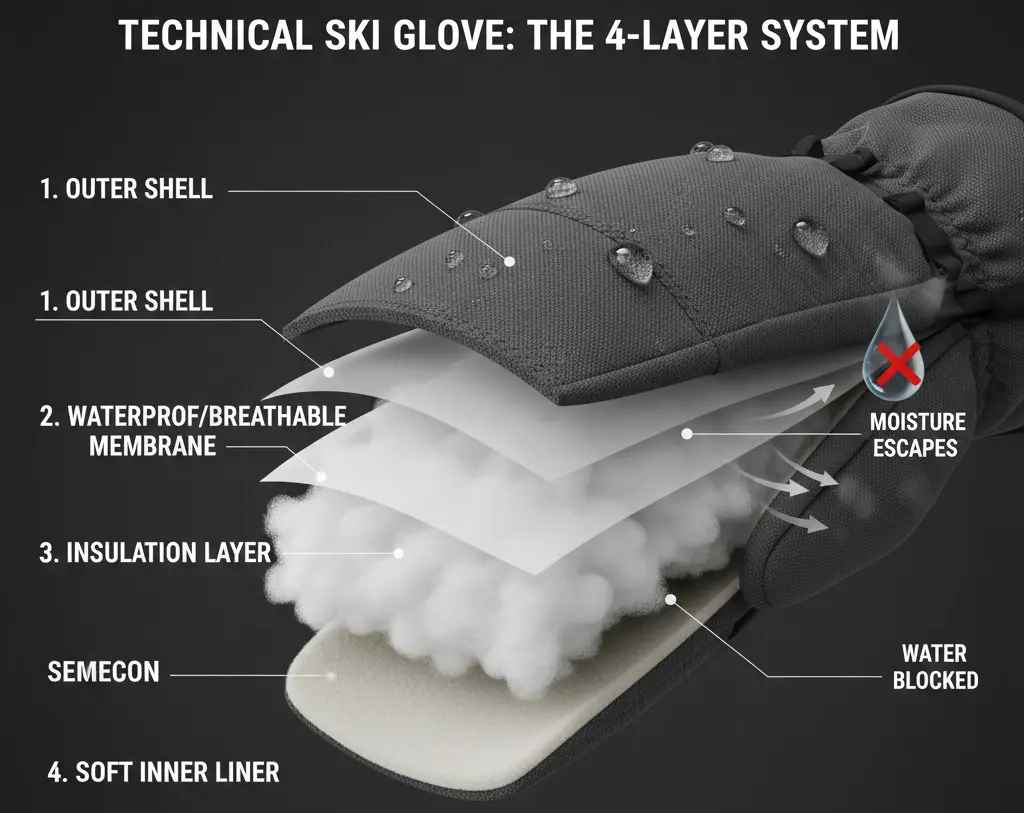
You can’t see it, but the fluff inside the glove is doing the heavy lifting.
Synthetic Insulation (Primaloft / Thinsulate)
- What it is: Plastic fibers spun to mimic down.
- The Advantage: It stays warm even if it gets wet. Since hands sweat, this is crucial.
- My Recommendation: For 95% of skiers, synthetic insulation is the right choice. It’s durable and handles moisture well.
Down Feathers
- What it is: The fluffy undercoating of geese/ducks.
- The Advantage: Unbeatable warmth-to-weight ratio. It feels like a cloud.
- The Risk: If down gets wet (from sweat or snow), it collapses and loses all insulating ability. It essentially becomes a wet rag.
- When I use it: Only on ultra-cold, dry days where I know I won’t be sweating much. I avoid going down for high-intensity skiing.
Waterproofing: The “Plastic Bag” Effect
Beginners think “100% Waterproof” is the goal. It’s not. You need Breathable Waterproofing.
If you wear a rubber glove (100% waterproof), your sweat has nowhere to go. Within 30 minutes, your hand is wet from the inside. Then, that sweat freezes.
- Look For: Gore-Tex, eVent, or high-end proprietary membranes (like Hestra’s C-Zone). These allow water vapor (sweat) to escape while stopping liquid water (snow) from entering.
- The “Cheap Glove” Trap: Cheap $20 gloves use a polyurethane insert that doesn’t breathe. I tried a cheap pair on a spring skiing day once; my hands were prunes by lunch, and freezing cold by 2 PM because they were soaked in my own sweat.
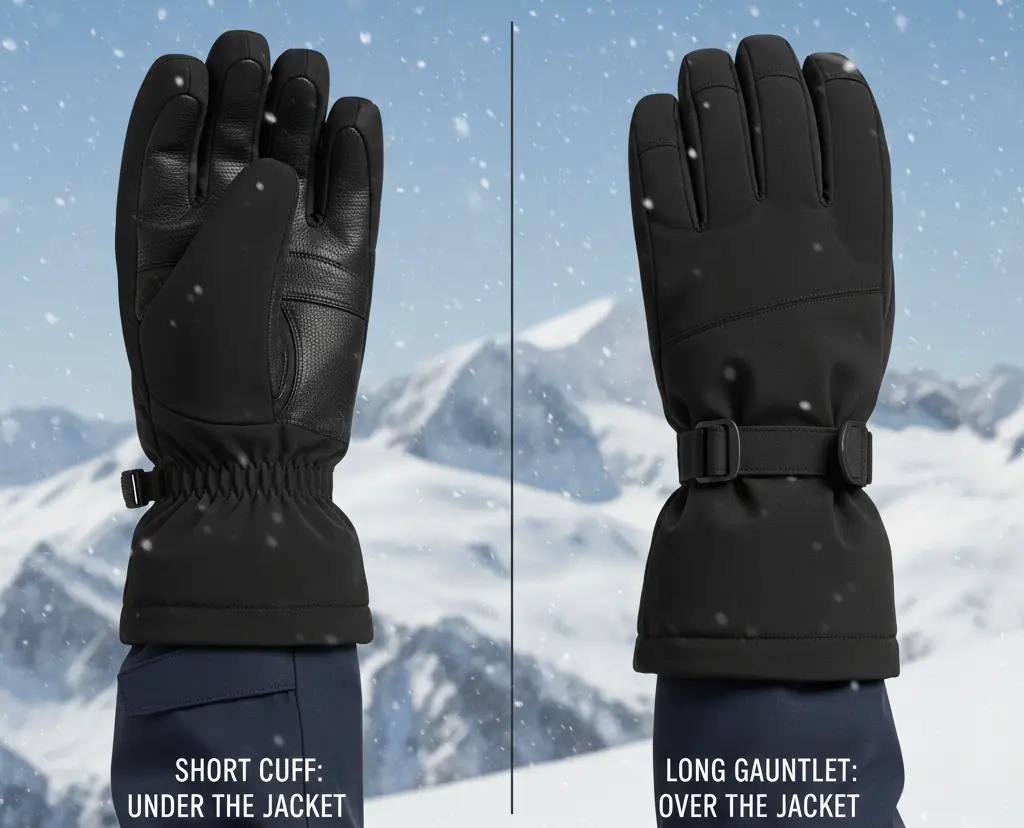
The Cuff Debate: Over or Under?
This seems minor until you get snow up your sleeve.
The “Under” Cuff (Short)
These have a neoprene or elastic cuff that slides inside your jacket sleeve.
- Pros: Looks sleek, feels less bulky, good for wrist mobility.
- Cons: Harder to take on and off quickly. If you fall in deep powder, snow will find its way into that gap.
- Who it’s for: Resort skiers who stay on groomed runs.
The “Gauntlet” Cuff (Long/Over)
These are big, flared cuffs that go over your jacket sleeve and cinch tight with a drawcord.
- Pros: Total weather seal. You can stick your arm in deep snow and nothing gets in. Easier to take off on the lift.
- Cons: Bulky. Can interfere with smartwatches.
- Who it’s for: Powder chasers, backcountry skiers, and beginners who fall often (it keeps the snow out).
- My Choice: I almost exclusively use Gauntlet cuffs. I prioritize staying dry over looking sleek.
Comparison Table: Quick Decision Guide
| Feature | Mittens | Gloves | Lobster/3-Finger |
| Warmth | 10/10 (Highest) | 7/10 (Moderate) | 9/10 (High) |
| Dexterity | 2/10 (Poor) | 10/10 (Excellent) | 6/10 (Good) |
| Best For | Beginners, Extreme Cold | Technical Skiing, Warm Days | All-Rounders |
| Zippers/Phone | Impossible | Easy | Doable |
| Pole Grip | Vague | Precise | Good |
Real-World Scenarios: If X, Choose Y
I’ve made the mistakes so you don’t have to. Here are specific recommendations based on conditions.
Scenario A: The “Spring Break” Skier
- Condition: 35°F to 50°F, sunny, slushy snow.
- Don’t Buy: Down mittens. You will sweat instantly.
- Choose: An uninsulated leather work glove (like a Kinco) or a thin “pipe glove.” You need abrasion resistance for slush, but minimal warmth.
Scenario B: The “Ice Coast” Skier (Vermont/Maine)
- Condition: 5°F, high humidity, biting wind.
- Don’t Buy: Cheap synthetic gloves. The wind cuts right through.
- Choose: A heavy-duty Gore-Tex mitten or high-loft glove. Windproofing is your #1 priority here.
Scenario C: The “Always Cold” Skier
- Condition: Your hands get cold even indoors.
- Choose: A heated glove (electronic) or a high-quality down mitten.
- My Tip: I bought my wife heated gloves three years ago. It changed our ski life. She went from skiing 2 hours a day to skiing 7 hours. It’s an investment, but cheaper than therapy.
Common Mistakes Beginners Make
1. Buying Tight Gloves
Beginners love a snug fit. Stop. Tight gloves cut off blood circulation. Blood flow is what keeps your fingers warm. If the glove is tight, your hand is cold. Period. Always size up if you are between sizes.
2. Ignoring the Wrist Leash
You think you won’t drop your glove off the lift. You are wrong. I watched a guy drop a $180 glove at Vail. He spent the rest of the day skiing with one hand in his pocket. Look for gloves with “idiot straps” (wrist leashes) so they dangle from your wrist when you take them off to check your phone.
3. Wearing Cotton Liners
Never, ever wear cotton gloves inside your ski gloves. Cotton absorbs sweat and holds it against your skin. It is the fabric of death in the mountains. If you need extra warmth, use Merino wool or silk liners.
Step-by-Step: How to Test a Glove Before Buying
Do this in the shop (or at home if you order online) before you remove the tags.
- The Shake: Put the glove on and shake your hand vigorously. Does it fly off? Too big. Does it stay put? Good.
- The Fist: Make a tight fist. Does the material fight you? Does it feel like it’s stretching tight across your knuckles? If yes, it’s too small or the leather is too stiff.
- The Liner Pull: Take the glove off by pulling the fingertips. Does the inner liner come out with your fingers? This is annoying and a sign of cheap construction. The liner should be sewn in (or easily removable, not half-stuck).
- The Pole Grip: Go grab a ski pole in the shop. Grip it. Does the glove bunch up in the palm? Too much material in the palm causes blisters. You want a smooth interface.
When This Is NOT The Right Choice
Sometimes, a standard ski glove isn’t the answer.
- If you are snowboarding: You need wrist guards. Many ski gloves don’t fit over wrist guards. Look for specific snowboard gloves with removable protection or wider cuffs.
- If you are backcountry touring (skinning up): Standard ski gloves are too hot for hiking uphill. You need a “two-glove system”—a thin liner for the hike up, and a warm shell for the ski down.
- If you work on the mountain (Liftie/Patrol): Don’t buy expensive retail gloves. Buy Kincos (pigskin work gloves) and waterproof them with Sno-Seal. They cost $30 and last forever. You don’t need dexterity; you need durability.
Decision Checklist: The Final Review
Before you head to the checkout, run through this mental list:
- [ ] Fit: Can I pinch a small amount of fabric at the fingertip? (Yes/No)
- [ ] Type: Does my choice match my circulation? (Cold hands = Mittens)
- [ ] Waterproof: Does the tag say Gore-Tex or list a waterproof membrane? (Yes/No)
- [ ] Cuff: Does it work with my specific ski jacket? (Test this!)
- [ ] Leash: Does it have wrist straps? (If not, can I buy aftermarket ones?)
Quick Problem-Diagnosis
- Problem:My fingertips are always cold, but my palms are sweaty.
- Diagnosis: Your gloves are too tight at the wrist or fingers, cutting off blood flow, or they aren’t breathing well.
- Fix: Size up or switch to a breathable Gore-Tex shell.
- Problem:My gloves are soaking wet inside after lunch.
- Diagnosis: You are overdressed. Your hands are sweating because your body core is too hot.
- Fix: Open your jacket vents or buy lighter gloves.
- Problem:My thumbs numb out first.
- Diagnosis: This is common. The thumb is isolated.
- Fix: Pull your thumb inside the main part of the glove (make a fist) while on the chairlift to warm it up.
Final Thoughts – How to Choose Ski Gloves
I remember my first “real” pair of ski gloves. They were black leather Hestras. I balked at the price tag—it was more than I spent on groceries that week. But that season, I skied through a blizzard in Vermont where the wind chill was -25°F. My face was freezing, my toes were numb, but my hands? My hands were totally fine.
That day taught me that gloves are not an accessory; they are equipment.
Don’t overcomplicate it. If you are a beginner, buy a mid-weight synthetic glove with a gauntlet cuff and a waterproof membrane. It is the “Swiss Army Knife” of gloves. As you get better, you can explore leather or lobsters. But for now, prioritize warmth and fit. The mountain is waiting, and it’s a lot more fun when you can feel your fingers.
Still Can’t Decide? The Ultimate Showdown
Even with the perfect fit and the right materials, many beginners still get stuck on the biggest question of all: “Do I sacrifice my dexterity for warmth, or do I risk cold fingers for grip?”
It is the classic skier’s dilemma. I have switched back and forth between the two styles for years depending on the month and the mountain. If you are standing in the shop holding a five-finger glove in one hand and a heavy mitten in the other, stop guessing. You need to understand thermodynamics before you spend your money.
Check out our head-to-head battle report on Mittens vs. Ski Gloves: What Should You Choose? to see the real-world trade-offs and find out which one matches your skiing style best.
About the Author
Awais Rafaqat has over 15 years of experience testing ski gear in some of the harshest conditions across North America, from the dry sub-zero peaks of the Rockies to the wet, freezing slopes of the Pacific Northwest. He specializes in real-world gear testing to help skiers find equipment that keeps them warm, dry, and performing at their best on every run.